
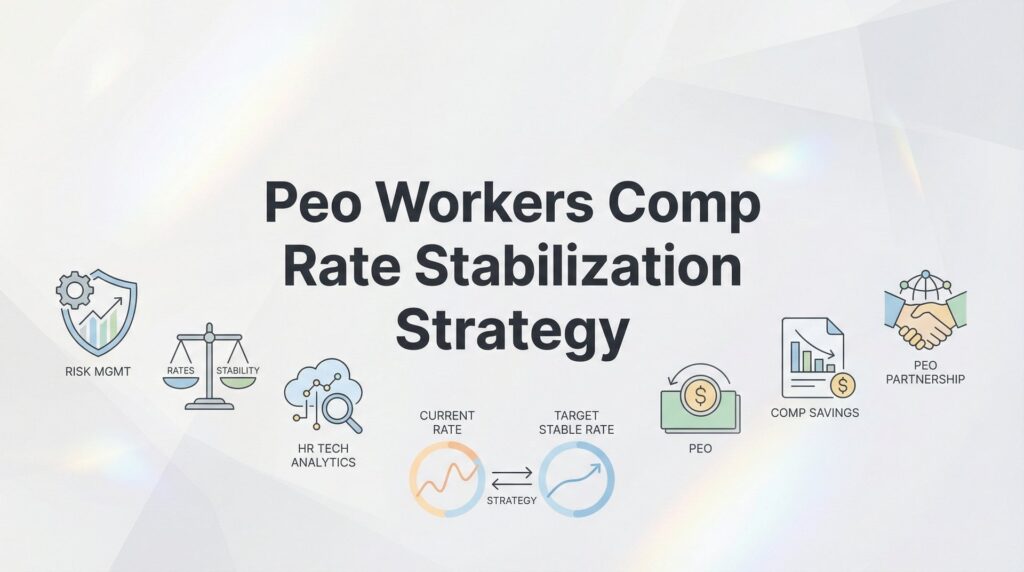
Workers’ comp is one of those line items that can swing wildly year over year—and if you’re using a PEO, you might assume rate stability is automatic. It’s not. Your PEO’s master policy spreads risk across hundreds of employers, which helps, but your individual experience modifier, claims history, and safety profile still matter. A lot. The difference between businesses that see steady, predictable workers’ comp costs and those who get blindsided by 20%+ increases often comes down to deliberate strategy versus passive hope.
Your PEO’s master policy spreads risk across hundreds of employers, which helps, but your individual experience modifier, claims history, and safety profile still matter. A lot.
The difference between businesses that see steady, predictable workers’ comp costs and those who get blindsided by 20%+ increases often comes down to deliberate strategy versus passive hope.
This guide breaks down seven specific approaches to stabilizing your workers’ comp rates through your PEO relationship—not theoretical concepts, but practical levers you can actually pull.
1. Negotiate Experience Modifier Protection Into Your PEO Contract
The Challenge It Solves
Most PEO contracts treat your Experience Modification Rate as a pass-through variable. When your EMR climbs—even modestly—your workers’ comp allocation can spike without warning. The problem is that EMR calculations look backward three years, meaning a bad claim from 2023 can still be hitting your 2026 rates.
Without contract protection, you’re exposed to compounding increases: the base rate adjustment plus your deteriorating modifier.
The Strategy Explained
Before you sign or renew, negotiate specific language that caps how much your rate can increase based solely on EMR movement. This isn’t about avoiding accountability—it’s about preventing disproportionate penalties when you’re actively improving safety but still carrying historical claims.
Some PEOs will agree to EMR-based rate caps (like limiting increases to 10% annually regardless of modifier changes) or graduated adjustment schedules that smooth spikes over multiple years instead of hitting you all at once.
The key is getting this in writing during the negotiation window, not after you’ve already signed a three-year commitment. Understanding how mod rate forecasting works can give you leverage in these discussions.
Implementation Steps
1. Request your current EMR calculation worksheet and identify which historical claims are driving your modifier—this gives you negotiating context.
2. Propose contract language that includes either a rate cap tied to EMR changes or a graduated adjustment formula that phases increases over 24 months.
3. If the PEO resists, ask for transparent EMR projection modeling at each renewal so you can at least anticipate changes instead of reacting to surprises.
Pro Tips
Push for quarterly EMR forecasting as part of your service agreement. If your PEO can’t or won’t model how open claims will affect future modifiers, that’s a transparency problem. Also, make sure any cap language specifies whether it applies to base rate changes, EMR adjustments, or both—vague contract terms always break in the PEO’s favor.
2. Front-Load Safety Program Investment in Year One
The Challenge It Solves
Workers’ comp rates are calculated using a three-year lookback window, but most businesses treat safety as a reactive expense rather than a strategic timing decision. If you implement strong safety protocols in year two or three of a PEO relationship, you’re still paying for year one’s incidents well into the future.
The actuarial lag means your investment doesn’t show up in rate calculations until it’s already been filtering through the system for months.
The Strategy Explained
Concentrate your safety program spending in the first 12 months of your PEO engagement. This means formal training, equipment upgrades, ergonomic assessments, and documented safety protocols—all implemented before claims accumulate.
The goal is to establish a clean baseline in year one that becomes part of your three-year average as quickly as possible. Businesses that delay safety investments end up paying elevated rates for years while waiting for old claims to age out of the calculation window.
Think of it as paying now to avoid paying later—but with compounding benefits because each claim you prevent in year one doesn’t haunt your rates through year four. A strong safety governance framework is essential to making this work.
Implementation Steps
1. Audit your current incident patterns and identify the top three claim drivers by frequency and severity—focus your safety investment there first.
2. Allocate budget for formal safety training, proper PPE, and any equipment modifications needed to address your high-risk exposures within the first six months.
3. Document everything: training records, equipment purchases, policy updates, and incident tracking—this creates the paper trail that supports lower EMR calculations down the road.
Pro Tips
If budget is tight, prioritize frequency over severity. Preventing three minor strains matters more to your EMR than preventing one potential major injury, because the formula weights frequency heavily for smaller employers. Also, ask your PEO if they offer safety grants or subsidized training—many do, but you have to ask.
3. Implement Aggressive Return-to-Work Protocols
The Challenge It Solves
The longer an employee stays off work after an injury, the higher your total incurred costs climb. Indemnity payments for lost wages add up fast, and extended absences increase the likelihood that temporary disability becomes permanent. Once a claim crosses certain duration thresholds, it gets weighted more heavily in your EMR calculation.
Businesses without structured return-to-work programs essentially let claim costs run unchecked, which directly translates to higher future rates.
The Strategy Explained
Build a formal light-duty program that gets injured employees back on-site as soon as medically cleared, even if they can’t perform their full job duties. This might mean modified tasks, reduced hours, or temporary reassignments—the point is keeping them engaged and limiting indemnity payments.
Return-to-work programs reduce total claim costs by cutting the duration of wage replacement and lowering the risk of permanent disability classifications. They also tend to improve claim outcomes because employees who stay connected to the workplace recover faster and return to full duty sooner.
This isn’t about pressuring injured workers—it’s about creating pathways that benefit both the employee and the business. Having a documented injury management protocol ensures consistency across all incidents.
Implementation Steps
1. Develop a written light-duty policy that outlines available modified work options, eligibility criteria, and duration limits—make it clear this is standard practice, not a special accommodation.
2. Train supervisors to identify suitable transitional tasks and communicate with injured employees within 48 hours of any injury to discuss return-to-work options.
3. Coordinate directly with your PEO’s claims adjuster and the treating physician to ensure medical restrictions are clearly documented and matched to available work.
Pro Tips
Track your return-to-work success rate as a KPI. If fewer than 70% of injured employees are back in some capacity within two weeks, your program needs work. Also, don’t wait until someone gets hurt to build the light-duty task list—have it ready now so you’re not scrambling when a claim happens.
4. Request Quarterly Loss Runs and Act on Them
The Challenge It Solves
Most businesses only see their workers’ comp performance once a year at renewal, when it’s too late to do anything about it. By then, reserves have been set, claims have developed, and your rates are locked in based on data you never had a chance to influence.
Waiting for annual renewal to understand your claims position is like checking your bank account once a year and wondering why you’re broke.
The Strategy Explained
Loss runs are detailed reports showing every open and closed claim, current reserve amounts, payments made, and claim status. Requesting them quarterly gives you real-time visibility into how your workers’ comp costs are trending before they calcify into rate increases.
The value isn’t just knowing the numbers—it’s spotting patterns early. If you see reserves climbing on claims you thought were minor, you can intervene. If you notice certain claim types repeating, you can address the root cause. If a claim stays open longer than expected, you can push for resolution.
Quarterly loss runs turn workers’ comp from a black box into a manageable business metric. Understanding reserve development patterns helps you interpret what you’re seeing.
Implementation Steps
1. Contact your PEO and request quarterly loss runs as a standard deliverable—specify you want claim-level detail, not just summary totals.
2. Review each report for three things: new claims since last quarter, reserve changes on existing claims, and claims approaching 90+ days open without closure.
3. Schedule a quarterly call with your PEO’s risk management team to discuss any claims with deteriorating reserves or unexpected development—don’t just accept the numbers passively.
Pro Tips
Pay special attention to reserve increases. If a claim initially reserved at $5,000 suddenly jumps to $25,000, find out why immediately. Sometimes it’s legitimate medical complexity, but sometimes it’s administrative sloppiness or adjuster overcaution. Either way, you need to know because those reserves directly affect your future rates.
5. Audit Your Class Code Assignments Annually
The Challenge It Solves
Workers’ comp premiums are calculated by multiplying your payroll by a rate assigned to your industry classification code. If your employees are assigned to the wrong class code—especially one with a higher risk rating—you’re overpaying on every dollar of payroll without realizing it.
Class code errors happen more often than you’d think, especially in businesses with multiple job functions or when employee roles evolve over time. A misclassified office worker in a high-risk code can cost you thousands annually.
The Strategy Explained
Conduct an annual audit of how your payroll is allocated across class codes. This means reviewing job descriptions, actual duties performed, and ensuring the codes assigned match the reality of what your employees do day-to-day.
PEOs typically assign codes based on initial onboarding information, but they rarely revisit those assignments unless you ask. If your business has shifted—maybe you’ve automated certain tasks or outsourced high-risk work—those changes should be reflected in your class code split.
Even small adjustments can yield meaningful savings when multiplied across your entire payroll base. A thorough understanding of payroll audit reconciliation helps you catch these issues before they compound.
Implementation Steps
1. Request a detailed breakdown of your current class code assignments from your PEO, including the rate per $100 of payroll for each code.
2. Compare those codes against the actual job duties your employees perform—look for mismatches where someone doing clerical work is coded as field labor or vice versa.
3. Submit a written request to your PEO for reclassification with supporting documentation (job descriptions, duty breakdowns, org charts) and ask for retroactive adjustment if the error has been ongoing.
Pro Tips
If you have employees who split time between office and field work, make sure their payroll is being allocated proportionally across the appropriate codes—don’t let the PEO default everything to the higher-risk classification for simplicity. Also, if your state uses NCCI codes, you can cross-reference your assignments yourself using the NCCI Scopes Manual to verify accuracy before challenging your PEO.
6. Leverage Multi-Year Rate Guarantees During Renewals
The Challenge It Solves
Annual renewals create uncertainty. Even if you’ve had a clean claims year, market conditions, carrier changes, or PEO portfolio adjustments can trigger rate increases that have nothing to do with your performance. That unpredictability makes budgeting difficult and leaves you vulnerable to mid-contract surprises.
Single-year agreements also give you less negotiating leverage because the PEO knows you’re back at the table in 12 months regardless.
The Strategy Explained
During renewal negotiations, push for multi-year rate guarantees that lock in your workers’ comp allocation for 24 or 36 months. This shifts rate risk to the PEO and gives you cost certainty, which is valuable even if you pay a slight premium for the guarantee.
The trade-off is real: you might not benefit if market rates drop, and PEOs often include performance triggers or escape clauses that let them adjust rates if your claims experience deteriorates beyond certain thresholds. But for businesses with stable operations and strong safety records, the certainty often outweighs the downside risk.
The key is understanding exactly what you’re locking in and what conditions allow the PEO to break the guarantee. Running a renewal risk analysis before negotiations gives you the data you need.
Implementation Steps
1. During renewal discussions, ask explicitly if multi-year rate guarantees are available and what performance conditions apply—don’t accept vague promises of “rate stability.”
2. Review the contract language carefully for escape clauses tied to EMR changes, claim frequency thresholds, or carrier policy adjustments that allow the PEO to modify rates mid-term.
3. If the PEO offers a guarantee with conditions, model the scenarios where they could invoke the escape clause—make sure the triggers are tied to metrics you can influence, not external market factors.
Pro Tips
If you’re in a low-risk industry with a clean claims history, you have more leverage to negotiate favorable guarantee terms. Use that. Also, watch for guarantees that lock your rate but allow the PEO to adjust your payroll allocation methodology—that’s a backdoor rate increase disguised as administrative cleanup.
7. Build a Claims Review Escalation Process
The Challenge It Solves
Claims adjusters make mistakes. Reserves get set too high. Denials happen based on incomplete information. Medical treatments get approved without scrutiny. And if you’re not reviewing these decisions systematically, you’re accepting claim costs that might not be justified.
The problem is that most businesses treat claims as something that happens to them rather than a process they can actively manage. That passivity is expensive.
The Strategy Explained
Establish a formal process for reviewing claim decisions, reserve changes, and settlement recommendations. This doesn’t mean second-guessing every adjuster call, but it does mean having a system to escalate questionable decisions and push back when something doesn’t add up.
Your PEO’s claims team works for you, even if it doesn’t always feel that way. If a claim is being handled in a way that seems inconsistent with the facts, you have the right—and the financial incentive—to challenge it. Understanding the audit dispute resolution process prepares you for these conversations.
Businesses that actively manage their claims see better outcomes because they catch errors early, prevent reserve creep, and ensure that settlements reflect actual liability rather than administrative convenience.
Implementation Steps
1. Designate one person internally as your claims liaison—someone who receives all claim notifications, reviews loss runs, and serves as the primary contact with the PEO’s claims team.
2. Create a simple escalation checklist: any claim with reserves above $10,000, any reserve increase over 50%, any claim open longer than 90 days, or any denial you believe is incorrect gets flagged for review.
3. When you escalate, document your concerns in writing and request a formal response from the claims manager—verbal assurances don’t create accountability.
Pro Tips
Don’t wait until renewal to discover that a claim was mishandled. If you see a reserve jump or a questionable settlement, address it immediately while the details are fresh and adjustments are still possible. Also, track your escalation outcomes—if your PEO consistently dismisses your concerns without explanation, that’s a relationship problem worth addressing before your next renewal.
Putting It All Together
Rate stabilization isn’t a single tactic—it’s a system. Start with the contract negotiation and class code audit (those are immediate wins), then build out your safety and return-to-work programs over the next quarter. The quarterly loss run reviews should become routine.
If your PEO pushes back on transparency around claims data or reserve calculations, that’s a signal worth paying attention to. The businesses that maintain flat or declining workers’ comp costs over 3-5 years aren’t lucky—they’re deliberate.
They negotiate protections upfront. They invest in prevention early. They monitor their numbers quarterly instead of annually. They challenge decisions that don’t make sense. And they treat workers’ comp as a manageable business metric rather than an uncontrollable expense.
Before you sign that PEO renewal, make sure you’re not leaving money on the table.
Many businesses unknowingly overpay because of bundled fees, hidden administrative markups, and contracts designed to limit flexibility. We give you a clear, side-by-side breakdown of pricing, services, and contract terms—so you can see exactly what you’re paying for and choose the option that truly fits your business.
