
Most PEO sales pitches include a savings claim somewhere in the first ten minutes. “Companies like yours typically save 20 to 30 percent on HR costs.” It sounds compelling. It might even be true for someone. But without a framework to verify it against your specific situation, that number is essentially meaningless.
The problem isn’t that PEOs don’t generate real savings — many do. The problem is that the savings model most providers present is built to close deals, not to help you make a grounded decision. It highlights the favorable comparisons and glosses over the costs, constraints, and scenarios where the math doesn’t work in your favor.
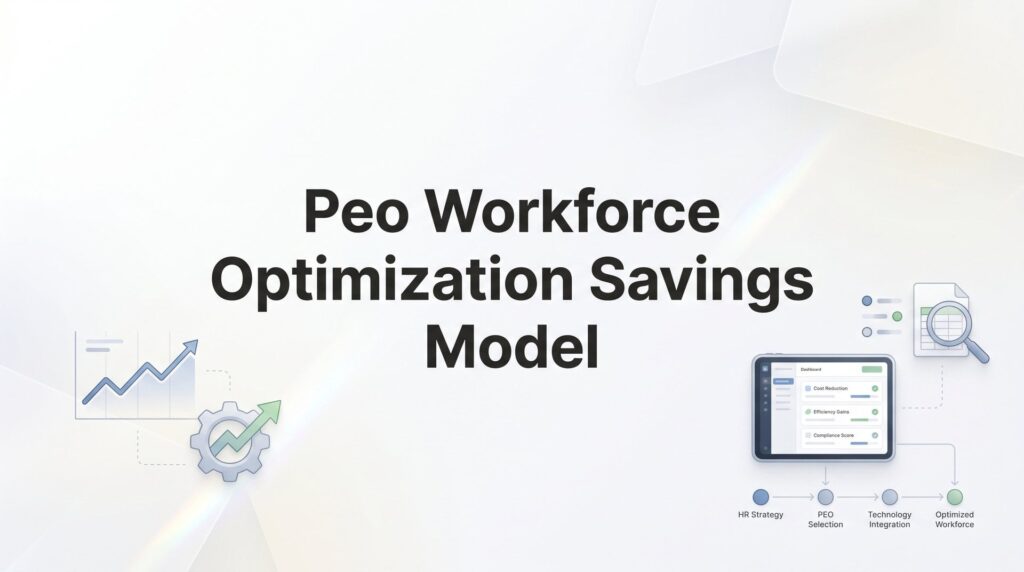
This article walks through a practical workforce optimization savings model you can build yourself. Not just a line-item cost comparison, but a fuller picture that accounts for compliance risk reduction, workforce performance, and opportunity cost recovery. The goal is to give you enough structure to pressure-test any PEO’s claims against your own numbers — before you sign anything.
Why PEO Savings Estimates Often Don’t Survive Contact with Reality
There’s a meaningful difference between headline savings and net savings. Headline savings are what a PEO quotes you: lower workers’ comp premiums, reduced benefits administration costs, HR software you no longer need to license separately. Net savings are what you actually keep after accounting for all the fees, the flexibility you give up, and the internal coordination work that doesn’t actually disappear.
Most PEO proposals are built around headline savings. That’s not necessarily dishonest — it’s just incomplete.
A few common blind spots worth knowing before you evaluate any proposal:
Per-employee fees scale with your headcount. A flat PEPM (per-employee-per-month) structure that looks reasonable at 40 employees can become expensive by the time you’re at 80. If your growth trajectory isn’t factored into the model, you may be comparing today’s cost against a structure that gets more expensive as you succeed. Understanding how to build a PEO HR scalability financial model can help you project these costs accurately.
Benefits lock-in limits future leverage. When a PEO manages your benefits through their master policy, you lose the ability to independently negotiate rates or switch carriers. For companies that already have strong broker relationships or favorable claims histories, this can erode savings over time rather than protect them.
Transition and exit costs are rarely modeled. Moving employees onto a PEO’s platform takes time and internal resources. Moving them back off — if you outgrow the relationship or find a better option — can be operationally disruptive. Having a clear understanding of PEO cancellation and exit processes is essential before you commit.
The workforce optimization lens matters here because it forces a broader question: does this arrangement make your workforce more effective, or just cheaper to administer? A PEO that reduces your HR line item while increasing turnover, slowing your hiring process, or creating compliance friction in a key state isn’t actually saving you money. It’s just moving costs around.
The goal of a real savings model isn’t to prove a PEO is good or bad. It’s to surface the full economic picture so you can make a decision you’ll still feel good about two years from now.
The Four Layers of a Workforce Optimization Savings Model
A complete savings model has four distinct layers. Most PEO proposals only cover the first one. Understanding all four changes how you evaluate any provider’s claims.
Layer 1: Direct cost displacement. This is the most straightforward layer and the one PEOs are most comfortable discussing. It includes payroll processing fees, benefits administration costs, HR software licenses, workers’ comp premiums, and any internal HR headcount that could be reduced or redeployed. These numbers are relatively easy to pull from your current vendor invoices and payroll records. This layer is where most proposals stop — and where most savings comparisons are made. A solid PEO financial modeling template can help you organize these line items systematically.
Layer 2: Risk cost avoidance. This layer covers compliance penalties you haven’t incurred yet but are exposed to, employment litigation costs, and unemployment claims management. It’s harder to quantify because it involves estimating the cost of things that haven’t happened. But for businesses operating across multiple states, or in industries with complex wage and hour rules, this layer can represent substantial value. A single misclassification penalty or a missed state-specific leave law can cost more than a year of PEO fees. The challenge is that PEO proposals often present this layer as a vague “compliance peace of mind” benefit rather than a modeled risk reduction with real dollar estimates.
Layer 3: Workforce performance gains. This is where the “workforce optimization” part of the model earns its name. Better benefits access can improve your ability to attract and retain talent, particularly for sub-50 employee companies that can’t independently negotiate competitive health plans. Faster, more consistent onboarding processes reduce time-to-productivity for new hires. Reduced administrative friction for managers means more time on actual work. These gains are real but difficult to attribute directly to a PEO. The honest approach is to estimate them conservatively and treat them as supporting evidence rather than primary justification.
Layer 4: Opportunity cost recovery. How many hours per week does your leadership team currently spend on HR-related issues? Payroll questions, benefits enrollment problems, compliance research, employee relations issues that escalate because there’s no HR infrastructure to catch them early? Multiply that time by a realistic hourly value for those people. For founders and senior operators at growing companies, this number can be surprisingly large. A PEO doesn’t eliminate all of that time, but it can materially reduce it. This layer is often the most personally motivating for business owners — and also the most prone to overestimation.
A complete savings model adds all four layers together, then subtracts the full cost of the PEO arrangement, including fees that scale with headcount growth. What’s left is your projected net benefit.
Running the Numbers: A Framework You Can Actually Use
Start with your fully-loaded current HR cost. This means everything: internal HR staff compensation and benefits, payroll processing fees, HR software subscriptions, benefits broker fees, employment law counsel costs, compliance training, and any time your non-HR leaders spend managing HR issues. Most businesses underestimate this number because the costs are spread across multiple budget lines and some of them — like leadership time — aren’t tracked at all.
Once you have that baseline, map each cost against what a PEO would absorb versus what remains your responsibility. This is where proposals get fuzzy. A PEO doesn’t eliminate your need for internal HR judgment — it absorbs the administrative execution. If you have a 3-person HR team, a PEO might reduce that to 1 or 2, but rarely to zero. Detailed PEO vs internal HR cost modeling can help you map these distinctions accurately.
Next, calculate your break-even headcount. This is the employee count at which a PEO’s per-employee fees would equal or exceed the cost of building equivalent internal HR capacity. This number varies considerably by industry, state complexity, and your current HR maturity. A professional services firm in a single state with straightforward compensation structures will hit break-even at a much higher headcount than a multi-state employer in construction or healthcare. There’s no universal answer, but knowing your specific number changes the conversation significantly.
A few red flags to watch for when reviewing a PEO’s savings model:
They’re comparing against industry averages, not your actual costs. If the proposal uses benchmark data rather than your real numbers, the savings projection is generic. Push for a model built on your invoices and payroll data.
They’re not accounting for your claims history. If your workers’ comp or health insurance claims history is favorable, you may already have better rates than a PEO’s pooled pricing can offer. A PEO proposal that ignores your current rates is incomplete.
The compliance savings are presented as a fixed dollar amount. Compliance risk reduction is real, but it’s probabilistic. A credible model presents it as a range tied to your specific exposure — not a precise number that happens to make the math work.
The goal of running this framework isn’t to prove the PEO wrong. It’s to arrive at a number you trust — one built on your assumptions, your data, and your realistic expectations about what will and won’t change.
Where the Savings Are Real and Where They’re Exaggerated
Some areas of PEO savings hold up well under scrutiny. Others don’t survive honest analysis.
Genuinely strong savings scenarios:
Workers’ comp pooling for high-risk industries. If you’re in construction, manufacturing, staffing, or another industry with elevated workers’ comp rates, access to a PEO’s pooled coverage can produce meaningful premium reductions. Understanding how PEO workers’ comp cost allocation actually works helps you evaluate whether pooling benefits your specific situation.
Benefits access for smaller employers. Companies under 50 employees often can’t independently negotiate competitive health insurance rates. A PEO’s master policy gives those employees access to plan quality that would otherwise be out of reach. This is real and it matters for retention.
Multi-state compliance infrastructure. If you have employees in three or more states, the compliance burden — different leave laws, tax registration requirements, wage and hour rules — is genuinely complex. A PEO with strong multi-state infrastructure can absorb that complexity in a way that’s hard to replicate internally at reasonable cost.
Commonly overstated savings scenarios:
HR headcount elimination. Most businesses still need internal HR coordination even with a PEO in place. Someone has to manage the PEO relationship, handle employee relations issues that require judgment, and serve as the internal point of contact. Learning how to effectively use a PEO alongside your internal HR department gives you a more realistic picture of what stays on your plate.
Benefits cost reduction for companies with strong broker relationships. If you’ve been with a good broker for several years and have a favorable claims history, a PEO’s pooled pricing may not beat your current rates. Sometimes it’s worse. This is worth modeling specifically before assuming savings exist.
Productivity gains attributed to the PEO. Any savings model that projects specific productivity improvements as a direct result of PEO services is making an attribution claim that’s nearly impossible to verify. Treat these as qualitative benefits, not quantified savings.
And sometimes the model shows negative ROI. That’s a valid outcome. A larger company with a mature HR function, strong benefits broker relationships, and primarily single-state operations may find that a PEO’s fees exceed any realistic savings. That’s useful information — and a good savings model should surface it rather than paper over it.
Why Two PEOs at Similar Prices Can Produce Very Different Outcomes
Two PEOs quoting similar per-employee fees can produce dramatically different net savings — and dramatically different workforce outcomes. The fee structure is only one variable.
Benefits plan quality varies significantly across PEOs. A lower PEPM fee paired with a weaker health plan may cost you more in total compensation expense than a slightly higher-fee provider with better coverage. Employees compare benefits. If your PEO’s plan is noticeably worse than what competitors offer, you’ll pay for it in turnover.
Claims management approach matters for workers’ comp and unemployment. PEOs that actively manage claims — with dedicated adjusters, return-to-work programs, and proactive case management — produce better outcomes than those that simply pool coverage and let claims run. The difference shows up in your experience modifier over time, which is why understanding PEO insurance pooling savings before signing is so important.
Service model affects how quickly problems get resolved. A dedicated service team that knows your account is a different experience than a shared call center. When an employee has a payroll issue or a benefits question, the resolution speed matters to their experience. This is hard to quantify but it’s real.
What to demand from any PEO during evaluation: a transparent, itemized fee breakdown (not a bundled rate), actual client retention data rather than projected satisfaction scores, and a willingness to build their savings model against your specific numbers. A thorough comparison of top PEO providers can help you benchmark what good transparency looks like across the market.
Build Your Baseline Before You Talk to Anyone
The single most useful thing you can do before evaluating any PEO is build your own savings model independently. Not a rough estimate. An actual model with your real numbers as inputs.
The advantage is straightforward: when you control the assumptions, you can pressure-test every claim a PEO makes against your own analysis. You’re not dependent on their math. You’re evaluating their proposal against yours. A detailed guide on how to build a PEO savings projection model can walk you through this process step by step.
Key inputs to gather before you start:
Current per-employee HR cost. Divide your fully-loaded HR spend — all staff, software, broker fees, legal, and compliance costs — by your total headcount. This is your baseline cost per employee that any PEO needs to beat.
Benefits renewal trends over the past three years. If your premiums have been increasing significantly, a PEO’s pooled pricing may offer meaningful relief. If they’ve been stable, the savings case is weaker.
Turnover rate and cost-per-hire. Even a rough estimate of your annual turnover cost gives you a basis for evaluating workforce performance claims. If a PEO can credibly reduce turnover by improving benefits access, that’s a real number worth modeling.
Compliance incidents or near-misses. Any penalties, audits, or close calls in the past few years are evidence of risk exposure that a PEO’s compliance infrastructure could reduce.
Leadership time on HR administration. A rough weekly estimate, multiplied by a realistic hourly rate, gives you an opportunity cost baseline for Layer 4 of the model.
Once you have this baseline, use it as a negotiation tool. Any PEO that can’t demonstrate clear value against your specific numbers — not industry averages, not hypothetical benchmarks — probably isn’t the right fit. The ones worth working with will welcome the specificity.
The Bottom Line on PEO Savings Models
A workforce optimization savings model isn’t just about finding the cheapest PEO. It’s about understanding the full economic picture of outsourcing HR operations versus building or maintaining internal capacity. Those are genuinely different decisions with different implications depending on your size, industry, state footprint, and growth trajectory.
The businesses that make good PEO decisions are the ones that run honest numbers first. They know their baseline. They understand which layers of savings are real for their situation and which are marketing. They’ve thought through the break-even headcount and the exit costs alongside the upfront savings.
The businesses that regret PEO decisions are usually the ones that trusted a sales deck over their own analysis.
Build your model before you start talking to providers. Then use comparison data to validate whatever proposals you receive against your real baseline. That’s the sequence that produces decisions you’ll still feel good about when the contract is up for renewal.
Before you sign that PEO renewal, make sure you’re not leaving money on the table. Many businesses unknowingly overpay because of bundled fees, hidden administrative markups, and contracts designed to limit flexibility. PEO Metrics gives you a clear, side-by-side breakdown of pricing, services, and contract terms so you can see exactly what you’re paying for and choose the option that actually fits your business. Don’t auto-renew. Make an informed, confident decision.
