
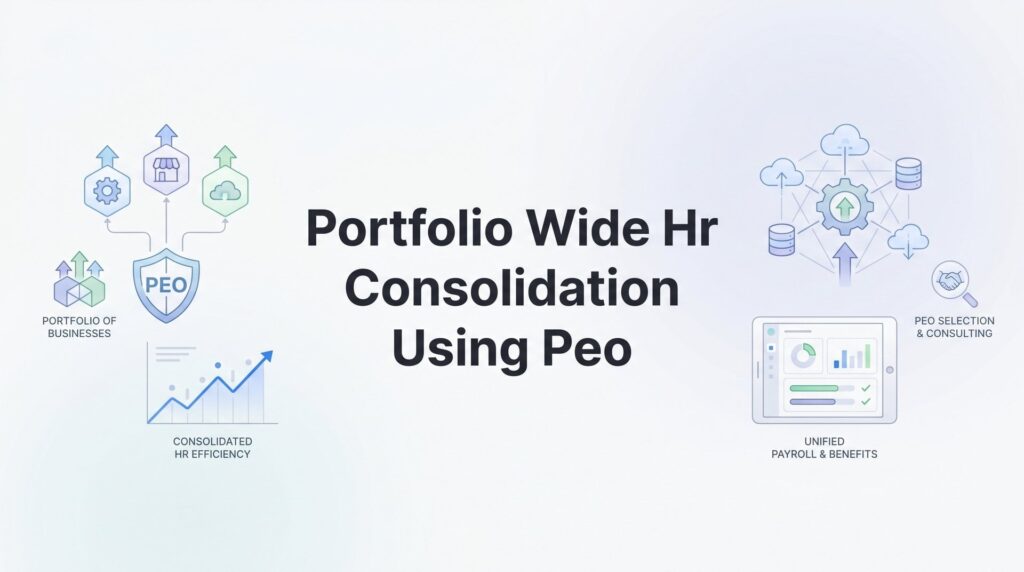
If you’re running a portfolio of companies and each one is handling HR on its own, you already know the problem. Different payroll systems, different benefits brokers, different workers’ comp carriers, different compliance practices. Multiply that by five or ten entities and you’re looking at a significant pile of duplicated cost and operational risk that doesn’t show up cleanly on any single P&L.
Portfolio-wide HR consolidation using a PEO is one of the more practical ways to fix this without building out a full internal shared-services function. Done right, it gives you aggregated purchasing power on benefits, centralized compliance oversight, and a single operational layer managing HR across every entity. Done wrong, it creates payroll disruptions, benefits lapses, and a vendor relationship that’s harder to manage than what you started with.
The challenge is that most PEO guidance is written for single-company buyers. The multi-entity context is fundamentally different. You’re dealing with multiple EINs, potentially multiple states and industries, varying employee counts per entity, and existing vendor contracts with different expiration dates. The consolidation decision isn’t one decision — it’s a series of decisions that have to be made in the right order.
This guide walks through that sequence. Each step reflects the actual decisions you’ll face: what to audit, which entities to include, how to structure the consolidation model, how to run the PEO comparison at portfolio scale, how to sequence the rollout without creating chaos, and how to build the governance layer that makes the whole thing actually deliver value over time.
No theory here. Just the practical framework for getting this done.
Step 1: Audit Every Entity’s Current HR Setup and Costs
Before you can make any consolidation decisions, you need a clear picture of what you’re actually consolidating. Most holding companies and PE firms don’t have this. Each portfolio company manages HR independently, which means the cost data lives in different systems, reported differently, with different line items. Your first job is to build a single view.
Map the vendor landscape for every entity. For each portfolio company, document: whether there’s an in-house HR team and at what cost, which payroll provider they use and what they pay for it, whether they have an existing PEO relationship (and if so, what the contract terms are), who their benefits broker is and what the broker fee or commission structure looks like, how workers’ comp is structured and what their current rates are, and whether they’re using any outside compliance or employment law consultants.
Then document the hard costs. Pull actual numbers: payroll processing fees, benefits premiums (both employer and employee contributions), workers’ comp premiums, HR admin headcount fully loaded, broker fees, and any compliance or legal spend tied to employment matters. The goal is a per-entity cost stack that shows total HR spend in a comparable format across every company in the portfolio. Using structured cost accounting methods to compare internal HR vs PEO expenses can help standardize this analysis across entities.
Don’t skip the soft costs. These are harder to quantify but they matter. How much time does each entity’s leadership spend on HR issues that should be handled operationally? Are there compliance gaps — I-9 practices, leave policy inconsistencies, state-specific classification issues — that represent liability exposure? Is onboarding quality inconsistent across entities in ways that affect retention? These don’t show up in the vendor invoices but they’re real costs.
Pay specific attention to entities that already have PEO contracts. Pull the actual agreements and note the renewal dates, auto-renewal clauses, and any early termination penalties. A poorly timed consolidation that triggers early exit fees can wipe out the first year of savings before you’ve even started. Understanding how much a PEO actually costs at the line-item level will help you build accurate comparisons.
The output of this step is a single spreadsheet: every entity in one view, with their current HR vendor stack, total annual HR spend, and any contract constraints that affect timing. This document becomes the foundation for every decision that follows. Without it, you’re making consolidation decisions based on assumptions rather than data.
Step 2: Determine Which Entities Are Actually PEO-Compatible
Not every business in your portfolio belongs on a PEO. This is one of the most common mistakes in portfolio consolidation — assuming that because the concept makes sense at the portfolio level, it makes sense for every individual entity. It doesn’t always.
Start with headcount. PEOs generally deliver the most value for companies in the 5-to-150 employee range. Below 5 employees, the administrative overhead of a PEO relationship often outweighs the benefits purchasing advantage. Above 150, many companies find they can self-fund benefits more cost-effectively, and some large entities are better served by a more customized HR outsourcing arrangement rather than a co-employment model. A thorough review of the pros and cons of using a PEO at the entity level will help you make these calls with confidence.
Industry matters significantly. High-risk industries — construction, transportation, manufacturing, staffing — have workers’ comp profiles that many standard PEOs aren’t equipped to handle well. A general-purpose PEO that’s strong on white-collar office workers may be a poor fit for a portfolio company running field crews. If you have entities in high-risk industries, you need to specifically evaluate whether your PEO candidates have demonstrated capability in those sectors, not just general coverage.
State-by-state regulatory complexity is another filter. Some states have specific PEO registration requirements or co-employment statutes that affect how the relationship works. If a portfolio company operates primarily in a state with unusual PEO regulatory requirements, that needs to be assessed before assuming consolidation is straightforward. Multi-state entities add another layer — a company operating in eight states needs a PEO with demonstrated compliance infrastructure across all of them, not just the home state.
Co-employment itself is worth flagging for certain entity types. If a portfolio company has a highly specialized workforce, union employees, or business relationships where co-employment status could create complications with client contracts, those are real considerations. If you need a foundational overview of how a PEO works and the co-employment model before going further, that context is worth reviewing separately.
The output of this step is a tiered list: entities that are clear PEO candidates, entities that need more evaluation, and entities that should stay on independent solutions. This segmentation drives your consolidation model in the next step.
Step 3: Define Your Consolidation Model
Once you know which entities are PEO-compatible, you need to decide how to structure the consolidation. There are three basic models, and the right one depends on your portfolio composition.
Single-PEO model: Every eligible entity goes to one provider. This is the simplest to manage and gives you maximum leverage on benefits pricing — the more aggregate headcount you bring, the stronger your negotiating position. The tradeoff is concentration risk. If that provider has service quality problems, financial instability, or technology failures, every entity is affected simultaneously. For a portfolio where most entities are similar in size, geography, and industry, this model often makes the most sense.
Tiered model: Group entities by risk profile, geography, or industry and use two or three PEOs. You sacrifice some pricing leverage but can better match specialized providers to specialized needs. A portfolio with both white-collar professional services companies and a manufacturing operation might use one PEO for the office-heavy entities and a different, industry-specialized PEO for manufacturing for the high-risk operation. You gain fit, but you take on more vendor management complexity.
Hybrid model: Consolidate most entities onto one PEO but carve out specific entities for standalone solutions. This is often the most practical outcome for portfolios with a wide mix of entity types. The majority of entities get the consolidation benefits; the outliers — whether they’re too large, too high-risk, or too specialized — get handled separately without forcing them into a structure that doesn’t fit.
Portfolio size affects this decision significantly. A three-company portfolio is a different situation than a fifteen-company portfolio. With three entities, the management overhead of running two different PEO relationships may not be worth the optimization. With fifteen entities across multiple industries and states, some tiering often makes more operational sense.
One thing worth flagging: the single-PEO model sounds cleanest on paper, but it only works if you’ve found a provider that genuinely has multi-state, multi-industry capability — not one that says they do but operationally functions as a regional, single-industry shop. That evaluation happens in the next step.
Step 4: Run a Structured PEO Comparison at Portfolio Scale
Standard PEO selection criteria still apply here — pricing structure, service model, technology platform, benefits quality, compliance support. But portfolio consolidation adds a layer of requirements that most single-company buyers never need to evaluate. If you’re comparing PEOs using a framework built for a single entity, you’re missing the criteria that matter most for your situation.
The portfolio-specific requirements to evaluate:
Multi-EIN support: Can the provider handle multiple employer identification numbers under a coordinated account structure? Not all PEOs are set up to manage multi-entity clients with clean separation between entities and consolidated portfolio-level visibility. Ask specifically how they handle this operationally, not just whether they can do it.
Master billing and consolidated reporting: You need the ability to see HR costs, headcount, benefits utilization, and compliance status across all entities in one view. If the PEO’s reporting structure treats each entity as a completely separate account with no portfolio-level rollup, you’ve just moved fragmentation from multiple vendors to one vendor with multiple silos.
Dedicated portfolio account management: Entity-level service reps are fine for day-to-day issues, but you need a single point of contact at the strategic level who understands the full portfolio relationship and has authority to resolve cross-entity issues. Ask how this is structured and who specifically would own the relationship.
Multi-state compliance capability: If your portfolio operates across ten states, the PEO needs to demonstrate actual, operational compliance infrastructure in all of them — not just general claims of national coverage. Understanding how providers handle multi-state workers’ comp consolidation is a useful litmus test for their cross-jurisdictional capabilities.
Negotiate at portfolio scale from the start. Aggregate headcount across all eligible entities and use that number as your negotiating baseline. Portfolio-level deals typically unlock better per-employee pricing, richer benefits tiers, and more dedicated service resources. Don’t let PEO sales teams evaluate each entity separately and then add up the individual quotes — that’s not a portfolio deal.
Financial stability deserves more scrutiny in a portfolio context than it gets in a single-entity evaluation. If your PEO provider has financial problems, every entity is affected simultaneously. Evaluating whether a provider holds CPEO vs standard PEO certification is one concrete way to assess financial accountability and tax liability protections across your portfolio.
Request references specifically from multi-entity clients. The operational complexity of managing a portfolio relationship is fundamentally different from managing a single company. A PEO that’s excellent for a 50-person company may not have the infrastructure to handle 12 entities across 8 states. Talk to clients who’ve actually run portfolio consolidations through them.
If you want to run a structured side-by-side comparison across these criteria, PEO Metrics is built specifically for this kind of evaluation — giving you actual data on providers rather than relying on sales presentations.
Step 5: Sequence the Rollout
This is where most consolidations go wrong. The instinct is to move fast — you’ve done the analysis, you’ve selected the provider, you want to start capturing savings. Rushing the rollout is how you end up with payroll gaps, benefits lapses, and compliance exposure that turns a cost-saving initiative into a crisis management situation.
Start with your lowest-risk entity. Pick the portfolio company that has the cleanest existing HR setup, the most straightforward employee population, and the fewest contract complications. Migrate that entity first, get it stable, and prove the model before touching anything else. A detailed PEO transition guide can help you structure the migration steps for each entity so nothing falls through the cracks.
Align migration timing with existing contract cycles. The audit you did in Step 1 should have flagged every entity’s current contract expiration dates and open enrollment windows. Build your migration calendar around those dates. Migrating an entity mid-benefits-year or before an existing PEO contract expires is expensive and disruptive. Patience here saves real money.
Stagger the rollout over three to six months. A portfolio of eight entities doesn’t need to migrate in eight separate months, but it also shouldn’t migrate simultaneously. Group entities into waves based on complexity and timing alignment. The PEO’s onboarding team has capacity constraints — trying to onboard everything at once strains their resources and yours.
Assign a portfolio-level project lead. This should be someone at the holding company level, not a person at each individual entity. The consolidation timeline needs a single owner who can coordinate across entities, manage the relationship with the PEO’s onboarding team, and make judgment calls when timing conflicts arise. Entity-level HR managers will naturally prioritize their own operations — someone needs to hold the portfolio view.
The success indicator for this step is simple: the first entity is fully migrated, payroll is running cleanly, benefits are in force, and employees aren’t experiencing service disruptions. That’s your green light to start the second migration. Not the calendar date — the operational stability of the first entity.
Step 6: Build Portfolio-Level Governance and Reporting
Consolidation delivers value on day one through cost savings. But the ongoing value — the compounding benefit of running HR through a centralized model — only materializes if you build a governance structure that maintains visibility and leverage over time.
Without this, a common pattern emerges: the consolidation goes well, costs drop in year one, and then over the next two or three years each entity starts managing its PEO relationship independently again. Renewal negotiations happen at the entity level. Benefits changes get approved without portfolio-level review. The leverage you built by consolidating slowly erodes because no one is maintaining the centralized view. Understanding how to align HR operations across acquired entities is critical for maintaining that centralized discipline.
Define what portfolio-level reporting looks like and require it from your PEO. At minimum, you want consolidated headcount across all entities, total benefits spend broken down by entity, workers’ comp claims data across the portfolio, compliance status by state and entity, and admin fee totals. This shouldn’t require you to manually aggregate entity-level reports — it should be a standard deliverable from the PEO.
Set a governance cadence. A quarterly review with your PEO account team covering performance metrics, cost trends, and service quality across all entities is a reasonable starting point. These aren’t just status calls — they’re the mechanism for catching cost creep before it compounds and for holding the provider accountable to the service commitments they made during the sales process.
Clarify escalation paths upfront. Entity-level HR issues should have a clear path to entity-level support. Portfolio-level issues — pricing disputes, service quality concerns, contract terms — should escalate to a dedicated portfolio account manager, not the same queue as individual employee questions. If this isn’t clearly defined in the contract, define it operationally before you finish onboarding.
Watch for cost creep at renewal. PEO renewals, benefits repricing, and admin fee adjustments should be reviewed at the portfolio level. When each entity renews independently, you lose the aggregated leverage that justified the consolidation in the first place. Centralize the renewal process and negotiate the full book of business together.
If the arrangement isn’t working, recognize it early. Signs that it’s time to renegotiate or restructure: service quality is consistently poor across multiple entities, costs have crept back to pre-consolidation levels, the PEO can’t produce portfolio-level reporting, or you’re spending more time managing the vendor relationship than you saved in HR admin. Consolidation isn’t a permanent commitment — it’s a structure that should continue to deliver value or be replaced. If you reach that point, having a clear understanding of the PEO exit and cancellation process ensures you can transition out cleanly without operational disruption.
Putting It All Together
Portfolio-wide HR consolidation using a PEO is a real operational lever. The value is genuine: aggregated purchasing power on benefits, centralized compliance oversight, eliminated redundant admin costs, and a single vendor relationship instead of a fragmented vendor landscape across every entity.
But the value only materializes if you treat it as a structured project. The steps matter and so does the sequence. Skipping the audit means you’re negotiating blind. Skipping the compatibility assessment means you’ll try to force entities onto a structure that doesn’t fit. Rushing the rollout means you’ll create the kind of disruptions that make entity-level operators distrust the whole initiative.
Quick checklist before you start:
1. Full HR cost audit across all entities — completed, in a single document
2. Compatibility assessment per entity — which ones consolidate, which ones don’t
3. Consolidation model chosen — single PEO, tiered, or hybrid
4. Portfolio-level PEO comparison completed — using portfolio-specific criteria, not single-entity criteria
5. Phased rollout calendar built — aligned with contract expirations and open enrollment
6. Governance and reporting structure defined — before you finish onboarding, not after
If you’re at the comparison stage and want to evaluate PEO providers using actual data rather than sales decks, this is where having the right tool matters. Don’t auto-renew. Make an informed, confident decision. A structured side-by-side evaluation across the criteria that matter for multi-entity consolidation will surface the differences that a standard RFP process often misses.
