

If you run quick service restaurants, you already know the pressure points: high turnover, hourly and tipped staff, shifting schedules, and margins that leave little room for a bad vendor decision. The real question is whether a payroll company covers enough or whether a PEO’s co-employment model is worth the tradeoff.
These options were chosen on restaurant fit (tips, shift scheduling, multi-state hourly workforces), how clearly each provider separates payroll from PEO services, pricing transparency, and how well each handles workers’ comp, benefits and compliance support. Some are PEOs, some are payroll-only, and some are neither. That mix is deliberate.
Quick Comparison of the Options
- PEO Metrics: operators deciding between a PEO and payroll who want a side-by-side comparison first; pricing on request via the website; compares multiple providers on the same terms before you sign.
- ADP TotalSource: multi-location franchisees wanting an established, large PEO; quote-based; a large-scale PEO from a long-established payroll brand.
- Insperity: operators wanting a consultative HR partner; quote-based; a hands-on HR advisory model.
- TriNet: growing chains where benefits spend drives the decision; quote-based; industry-tailored benefits packaging.
- Justworks: small franchise groups without an HR department; see website for pricing; a software-first PEO experience.
- Paychex (PEO and Payroll): operators unsure which model they need; quote-based; both payroll-only and PEO paths under one vendor.
- Toast Payroll: Toast-based QSRs with in-house HR; see website for pricing; payroll tied directly to POS hours and tips.
- Gusto: single-location owners who want payroll without co-employment; see website for pricing; low-friction setup with no co-employment.
- 7shifts: operators whose main pain is scheduling and overtime; see website for pricing; restaurant-built scheduling that feeds hours into payroll.
Payroll, PEO, CPEO, ASO and EOR: The Terms That Decide Your Shortlist
Most of the confusion in this category comes from vendors using adjacent words for different arrangements. Here is how they differ.
- Payroll-only: software or a service that calculates pay, withholds and files taxes. You remain the sole employer and keep responsibility for benefits, workers’ comp and compliance.
- PEO: a professional employer organization enters a co-employment relationship with you. It typically runs payroll, offers benefits through its plans, and provides workers’ comp and HR support, while you still direct daily work.
- CPEO: a PEO certified by the IRS. If this matters to you, check the IRS’s published CPEO list rather than relying on a vendor’s marketing.
- ASO: an administrative services organization handles HR tasks for a fee, but without co-employment or pooled plans.
- EOR: an employer of record is the legal employer of workers, most often used for hiring in places where you have no entity. It is a different tool from a PEO.
Three misconceptions are worth clearing up. A PEO is not just payroll. A payroll vendor does not share your employer liability. And a PEO does not always save money, so compare total cost, not just the headline fee.
The better framing is what risk you want to hand off (workers’ comp, benefits administration, HR compliance) versus what you want to keep. Tip credit and minimum wage rules also vary by state and locality, so confirm how any provider handles each state where you operate. For a deeper look at the model comparison, see our [LINK CHECK: PEO vs payroll guide] and [LINK CHECK: restaurant PEO guide].
1. PEO Metrics
PEO Metrics is our own service, so read this entry with that in mind. It is an independent comparison service, not a PEO and not a payroll provider. It helps you compare PEO providers side by side, using provider metrics and pricing analysis, before you commit to one.
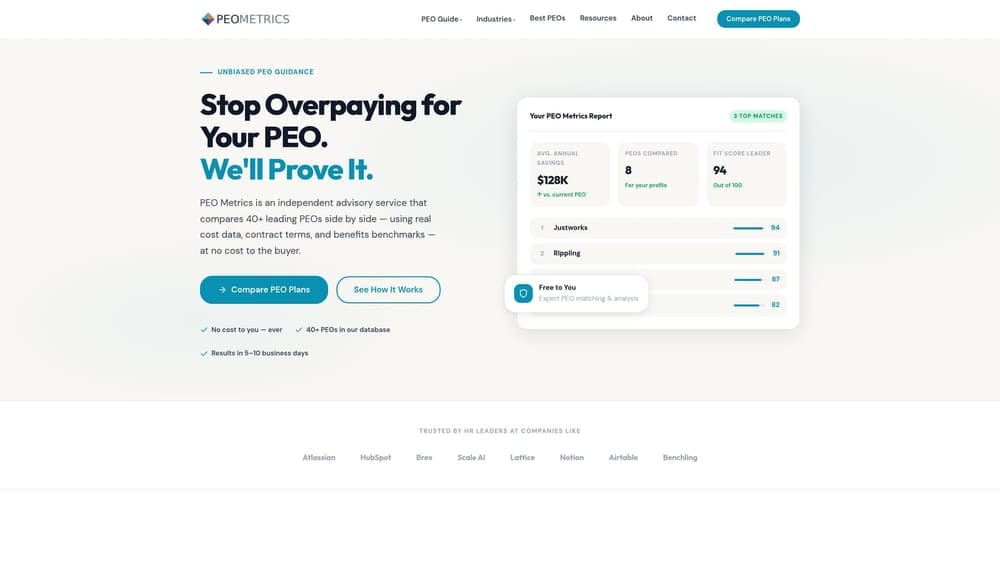
Where it differs from everything else on this list is that it puts multiple providers on the same terms. Every other entry here is a vendor describing its own offering. For a QSR operator, that matters because PEO quotes arrive in different structures, with fees bundled differently, and the cheapest-looking one is not always the cheapest once administrative charges and contract terms are counted.
- Side-by-side PEO comparisons so you can weigh providers against the same criteria.
- Pricing analysis that shows what sits inside a quote, helping you spot bundled or administrative charges.
- Provider metrics that give you more data to work with than a sales deck.
- Guidance on PEO versus alternatives, so you can decide whether a PEO is even the right model before you shop.
It is an advisory service, so there is nothing to integrate and no software to implement. A decision-maker, usually the owner or HR lead, uses it during the evaluation phase.
Limitations: PEO Metrics does not run payroll, scheduling or benefits, so it solves the selection problem only. You will still need a vendor afterward. PEO Metrics may also receive vendor placement fees, which you should factor into how you weigh any recommendation. Pricing details are on the website.
Best for: Operators deciding between PEO and payroll who want a neutral-style comparison first.
2. ADP TotalSource
ADP TotalSource is ADP’s PEO offering, combining payroll, benefits access, workers’ comp coverage and HR compliance support. Its main draw is scale and brand: it is a large-scale PEO from an established payroll company, which tends to appeal to franchisees running several units who want a provider with deep infrastructure.
For restaurant operators, the practical value is having payroll, benefits and workers’ comp under one co-employment arrangement rather than managing separate vendors for each. That can reduce administrative load when you have a lot of hourly staff cycling through.
- PEO payroll that runs inside the co-employment arrangement, so tax filing sits with the PEO.
- Access to benefits plans that a single small operator might not get on its own.
- Workers’ comp coverage handled through the PEO rather than a separate policy you manage.
- HR compliance support for the employment questions that come with large hourly teams.
Integrations are with ADP’s time and payroll tools; verify exactly which time-tracking and POS connections are supported for your setup before relying on them. Setup is typically a guided implementation, and day-to-day administration usually falls to an HR lead or operations manager.
Limitations: Pricing is quote-based, and eligibility minimums should be verified directly with ADP, since smaller operators may not qualify. As with any PEO, you accept co-employment. A single-unit owner with in-house HR may be paying for more than needed.
Pricing is quote-based. What moves it is typically headcount, benefits selections and the risk profile of your workforce, so ask for a full fee breakdown.
Best for: Multi-location franchisees wanting an established, large PEO.
3. Insperity
Insperity is a full-service PEO known for assigned HR support. Its distinctive pitch compared with the rest of this list is a hands-on HR advisory model: you work with people rather than only a portal, which can matter when a manager is dealing with a termination, a wage dispute or a leave request at an awkward hour.
That consultative approach suits an operator who does not have an HR team and wants one to lean on. It is less obviously suited to an owner who wants self-service software and minimal contact.
- Payroll processing included in the PEO arrangement, so you are not running a separate system.
- Benefits access through the PEO’s plans, which matters when you want to offer coverage to retain key staff.
- HR advisory support from a dedicated resource for employee-relations questions.
- Risk and compliance support covering the rules that apply to your workforce.
Time and attendance tool compatibility should be verified, particularly if you rely on a restaurant POS for hours and tips. Implementation involves onboarding your employees into the PEO, and day-to-day work typically sits with an owner or HR lead working with the assigned contact.
Limitations: Pricing is quote-based. Fit for high-turnover hourly staffing needs requires verification, since the model may be built more around salaried or mid-size teams than a rotating crew. Ask how onboarding and offboarding of large volumes of hourly workers is handled and priced.
Pricing is quote-based. Expect it to depend on headcount, benefits choices and your workers’ comp risk class.
Best for: Operators wanting a consultative HR partner.
4. TriNet
TriNet is a PEO offering HR, payroll, benefits and compliance services, with industry-focused packages. Its differentiator on this list is industry-tailored benefits packaging, which makes it worth a look if the main reason you are considering a PEO is the cost and quality of the benefits you can offer.
Whether it has a restaurant-specific offering is something to confirm directly with TriNet rather than assume. Ask what it actually provides for food service, and get that in writing as part of the proposal.
- Payroll services run within the PEO relationship.
- Benefits plans, which may give a growing chain more options than it could buy alone.
- Compliance support for employment rules across the states you operate in.
- Industry-specific offerings, which need to be verified for quick service restaurants.
Integrations should be checked on the vendor’s site, particularly for time tracking and POS data. Setup follows the usual PEO onboarding path, with administration generally owned by an HR lead or finance manager.
Limitations: Pricing is quote-based, and minimums and restaurant fit need verification. If your workforce is mostly part-time and high-turnover, press on how benefits eligibility and administration work for that group, since benefits value depends on who actually enrolls.
Pricing is quote-based. Benefits selections, headcount and enrollment typically move it most.
Best for: Growing chains where benefits spend drives the decision.
5. Justworks
Justworks is a PEO with a self-service platform aimed at small and midsize businesses. What sets it apart here is that it is software-first: employees and managers handle much of their own administration through the platform, which suits small teams that do not want a heavy service relationship.
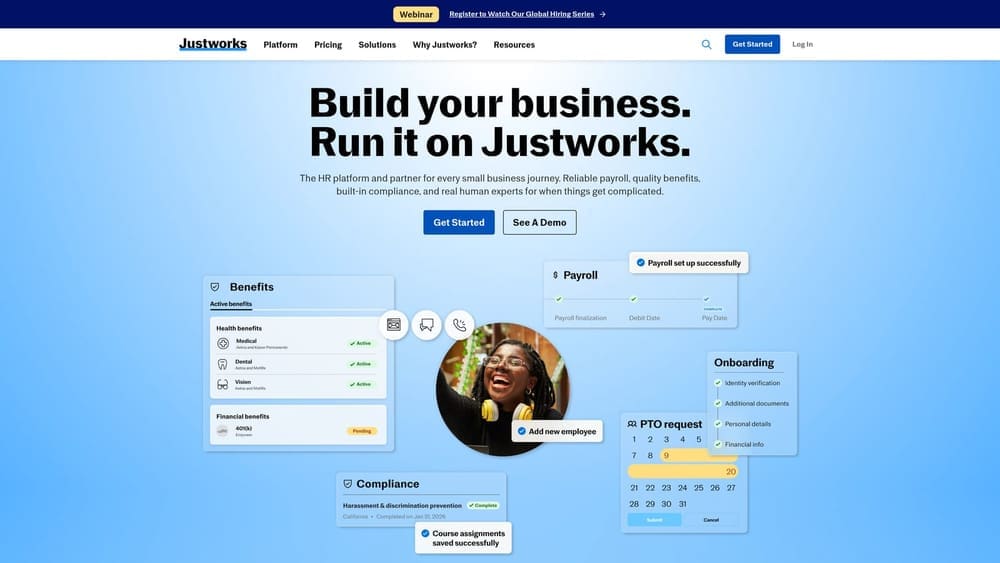
For a small franchise group with no HR department, that simplicity is the appeal. You get PEO-style coverage without a large vendor process around it.
- Payroll built into the platform, so pay and tax filing run in one place.
- Benefits access that employees can enroll in themselves.
- Workers’ comp handled as part of the PEO arrangement.
- Employee self-service that cuts the number of routine requests reaching an owner or manager.
Check which time-tracking and accounting integrations are supported, since restaurant operators usually need hours, and often tips, to flow in from other systems. A small team can generally run it day to day, often an owner or office manager.
Limitations: Fit for large hourly teams and tip handling needs verification. If you have dozens of locations and heavy turnover, ask exactly how tips, tip credits and multi-state wage rules are processed before you commit.
See the website for current pricing. Costs generally depend on headcount and the plans selected.
Best for: Small franchise groups without an HR department.
6. Paychex (PEO and Payroll)
Paychex offers both payroll products and a PEO. That is its main distinction here: one vendor with payroll-only and PEO paths, which is useful if you are still deciding which model fits.
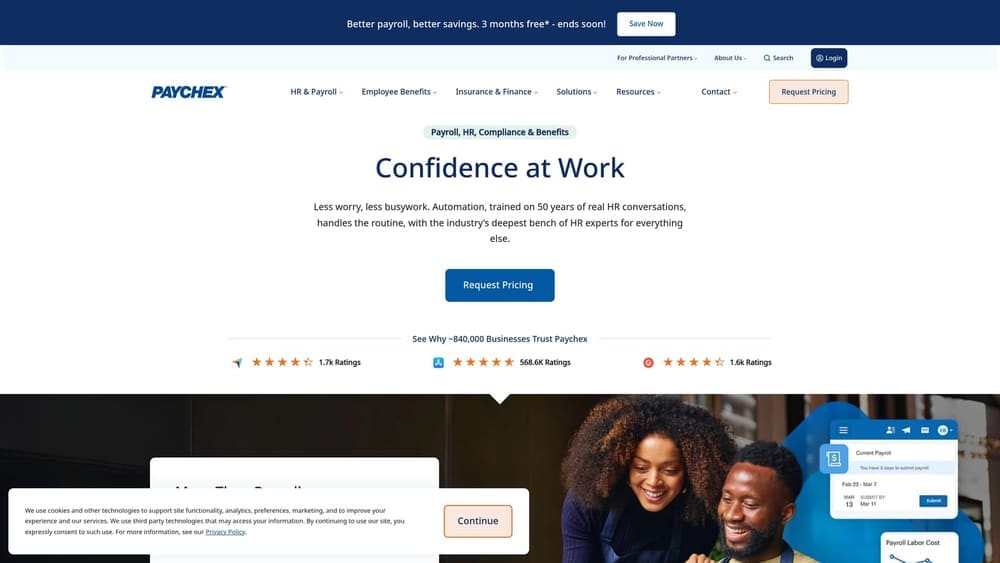
Starting with payroll and moving to a PEO later (or the reverse) within the same vendor relationship can be simpler than switching providers. Confirm what the migration actually involves and whether any fees apply.
- Payroll services for operators who want to keep employer responsibilities.
- PEO services for those who want co-employment and shared administration.
- Benefits options that differ depending on the path you choose.
- HR support, whose depth varies by plan, so ask what is included at each tier.
Paychex time tools are the likely integration route; verify compatibility with your POS and scheduling software. Setup varies by product, and day-to-day ownership usually falls to an owner, controller or HR lead.
Limitations: Pricing is quote-based, and plan fit by size must be verified. A payroll-only path leaves you responsible for workers’ comp, benefits and compliance, so be clear about which product you are actually buying.
Pricing is quote-based. Employee count, services selected and the payroll versus PEO path are the main drivers.
Best for: Operators unsure which model they need.
7. Toast Payroll
Toast Payroll is a restaurant-focused payroll product connected to Toast POS data. It is not a PEO. Its strength is that hours and tips can come from the point-of-sale system rather than being re-entered, which cuts a common source of errors in tipped roles.
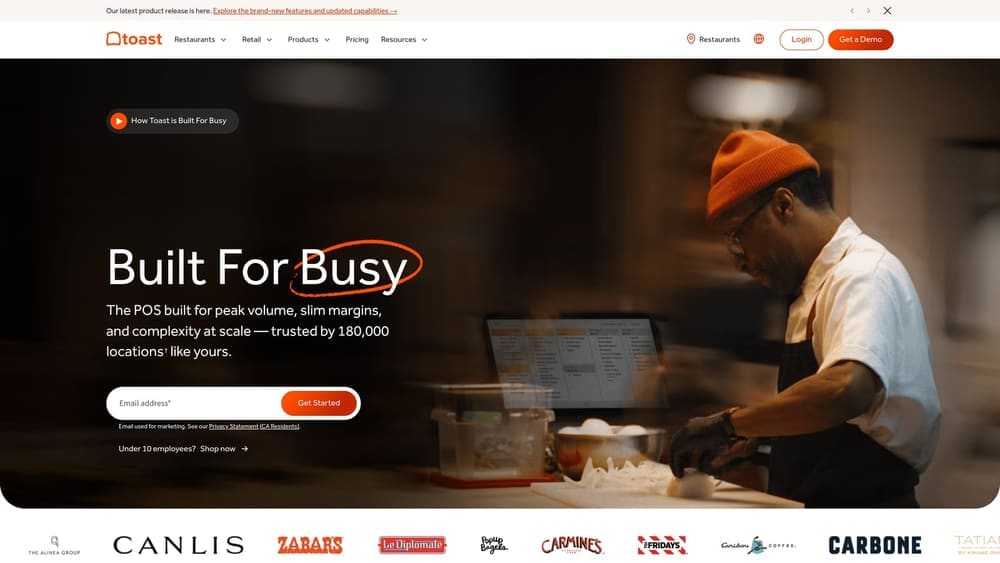
For a restaurant already running Toast, it avoids a separate data pipeline between sales, labor and pay.
- Payroll that draws on tip and hours data from the POS, reducing manual entry.
- Tax filing so payroll taxes are handled within the product.
- Team management tools for day-to-day workforce administration.
- Restaurant-specific design, with workflows built around hourly and tipped roles.
Its integration is with Toast POS, so it makes the most sense if that is already your system. Setup is lighter than a PEO onboarding, and a manager or owner can usually run it with in-house HR support.
Limitations: It is not a PEO, so there is no pooled benefits or workers’ comp arrangement. It is best for Toast POS users. You keep employer responsibility for compliance, benefits and workers’ comp.
See the website for current pricing. Cost typically depends on headcount and the Toast products you use.
Best for: Toast-based QSRs with in-house HR.
8. Gusto
Gusto is a payroll and HR platform for small businesses, and it is not a PEO. Its distinction on this list is low-friction setup without co-employment: you stay the sole employer and get a clean, approachable system.
That makes it a reasonable choice for a single-location owner who wants payroll running properly but has no interest in sharing employer status.
- Payroll with tax filing so deposits and filings are handled in the product.
- Benefits administration that helps you manage plans you arrange yourself.
- Onboarding tools that speed up the paperwork on each new hire, useful with turnover.
- Tax filing support that lowers the chance of missed deadlines.
It connects with QuickBooks, and time-tracking tool compatibility should be verified against what you use. A single owner or manager can usually administer it without dedicated HR staff.
Limitations: You keep full responsibility for compliance, workers’ comp and benefits. There is no pooled buying power. Multi-state restaurants with complex tip rules should check how well it handles their specific requirements.
See the website for current pricing. Costs generally depend on the plan tier and number of employees.
Best for: Single-location owners who want payroll without co-employment.
9. 7shifts
7shifts is restaurant scheduling and labor management software. It is neither payroll nor a PEO, and it belongs here because scheduling and overtime are often the actual cost problem, not the choice of payroll vendor.
It stands apart as restaurant-built scheduling that feeds hours into payroll, so it can sit alongside nearly any option above.
- Scheduling that helps managers build shifts around availability and demand.
- Team communication so shift changes do not run through personal texts.
- Labor cost tracking that shows how scheduling affects spend before overtime hits.
- Tip pooling tools, which need to be verified for your state’s rules.
It connects to POS and payroll systems; verify the current integration list against your stack. Shift managers use it daily, with an owner or operations lead overseeing labor costs.
Limitations: It does not file taxes, offer benefits or provide workers’ comp, so you still need a payroll provider or PEO. It does not reduce employer liability.
See the website for current pricing. Costs typically depend on locations and the features selected.
Best for: Operators whose main pain is scheduling and overtime.
Matching the Option to Your Situation
If you run a single unit with in-house HR, payroll-only is usually the sensible starting point. Toast Payroll fits if you are on Toast, and Gusto fits if you want a general-purpose option. Add 7shifts if scheduling and overtime are what actually hurt.
If benefits, workers’ comp and compliance support are the pain, a PEO is worth pricing seriously. ADP TotalSource, Insperity, TriNet and Justworks each lean differently: scale, advisory support, benefits packaging and simplicity. Paychex makes sense if you want both paths under one vendor while you decide.
Before choosing, verify current pricing, minimums, state availability and co-employment terms directly with each provider, since all of these change. PEO Metrics may receive vendor placement fees, and this article is informational, not legal, tax or benefits advice.
Before you sign that PEO renewal, make sure you’re not leaving money on the table.
Many businesses unknowingly overpay because of bundled fees, hidden administrative markups, and contracts designed to limit flexibility. We give you a clear, side-by-side breakdown of pricing, services, and contract terms, so you can see exactly what you’re paying for and choose the option that truly fits your business.
