
Retail is one of the trickier industries to evaluate a PEO for. You’re dealing with seasonal hiring spikes, high turnover, part-time and variable-hour workers, multi-location complexity, and wage-and-hour compliance risks that most generic PEO pitches gloss right over.
A PEO can genuinely solve some of these headaches. But it can also add cost and friction if it’s not the right fit for how your stores actually operate.
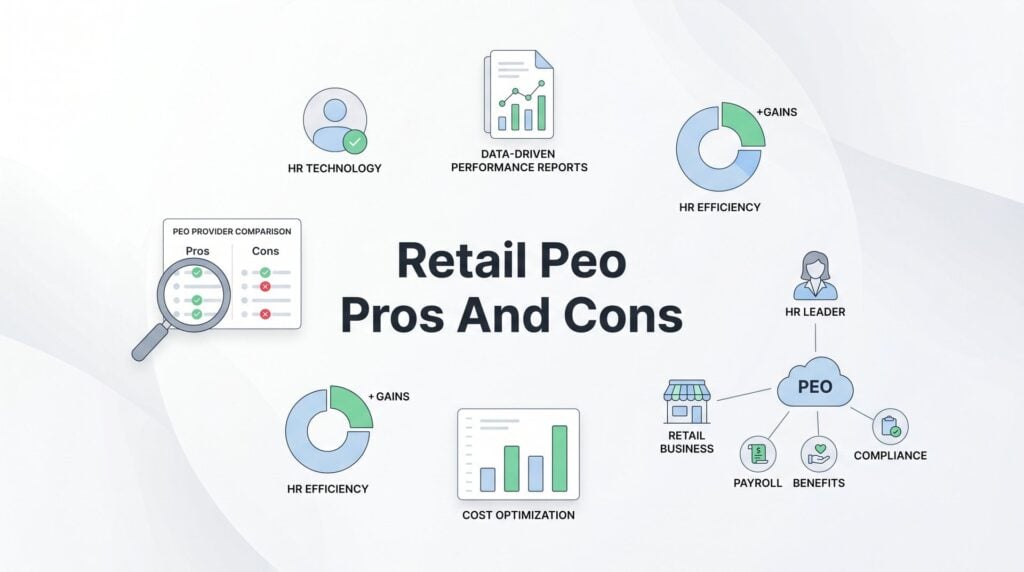
This article breaks down the real pros and cons of using a PEO in retail: not the brochure version, but the operational reality. Whether you’re running a single boutique, a regional chain, or a franchise group, the goal is to help you make a clear-eyed decision before signing a multi-year agreement.
If you’re already familiar with what a PEO is and how co-employment works, this guide is designed to go deeper into the retail-specific tradeoffs rather than rehash the basics. We’ll cover where PEOs tend to deliver strong ROI for retail businesses, where they fall short, and what to watch out for during the evaluation process.
1. The Seasonal Staffing Problem: Where PEOs Help and Where They Don’t
The Challenge It Solves
Retail headcount doesn’t stay flat. You hire aggressively before the holidays, scale back in January, ramp up again for back-to-school, and then do it all over again. That volatility creates a structural tension with how most PEOs price their services — and it’s a tension that rarely gets discussed during the sales process.
The Strategy Explained
Most PEOs charge either a per-employee-per-month (PEPM) fee or a percentage of payroll. Both models can work against you during peak hiring seasons. When you’re adding 30 temporary workers for the holidays, your PEO costs spike in parallel. When those workers leave in January, the costs drop — but the administrative overhead of onboarding and offboarding them doesn’t disappear.
Where a PEO does help with seasonal staffing: onboarding automation, standardized new hire paperwork, and consistent I-9 and background check workflows. If you’re hiring 40 people in three weeks, having a system behind that process has real value. The question is whether you’re paying for that value at a rate that makes sense given how short those employment relationships actually are.
Some PEOs also offer seasonal or temporary worker pricing tiers. These are worth asking about specifically — don’t assume they’ll surface them on their own. Understanding the full pros and cons of using a PEO before entering a contract will help you ask the right questions from the start.
Implementation Steps
1. Map your headcount by month for the past two years. Know your peak-to-trough ratio before any PEO conversation.
2. Ask each PEO vendor directly how seasonal workers are priced and whether short-tenure employees affect your rate.
3. Calculate what your monthly PEO cost looks like during your peak month versus your slowest month — and make sure both numbers work for your margins.
Pro Tips
Watch out for minimum headcount clauses buried in PEO contracts. Some agreements require you to maintain a minimum employee count regardless of your actual staffing levels. In a slow January, that clause can cost you real money for coverage you’re not using.
2. Workers’ Comp Coverage in Retail: A Genuine Advantage Worth Pricing Out
The Challenge It Solves
Retail isn’t a desk job. Slip-and-fall incidents, repetitive motion injuries from stocking and scanning, and loading dock hazards in larger format stores create real workers’ comp exposure. For smaller retailers without the scale to negotiate competitive standalone rates, this is one area where a PEO can deliver tangible cost savings.
The Strategy Explained
PEOs pool their clients’ employees into a single workers’ comp program, which means smaller employers get access to rates typically reserved for much larger organizations. If your current standalone workers’ comp premium is high because of your industry classification or claims history, a PEO’s pooled rate may come in meaningfully lower.
That said, this advantage isn’t universal. If you’re a mid-size retailer with a clean claims history and enough payroll volume to negotiate your own rates, you may already be getting competitive pricing. The PEO’s pooled rate won’t automatically beat what you can get on your own.
The other variable is claims management. A good PEO handles the administrative side of workers’ comp claims, which reduces the burden on your store managers. A mediocre one creates friction and slow response times — understanding common PEO claims handling conflicts before you sign can save you significant headaches down the road.
Implementation Steps
1. Pull your current workers’ comp premium and your experience modification rate (EMR) before starting PEO conversations.
2. Ask each PEO to provide their workers’ comp rate for your specific retail classification code — don’t accept a range, ask for the actual number.
3. Compare the PEO’s all-in workers’ comp cost against your current premium, factoring in the administrative management component as a line item.
Pro Tips
If you’ve had significant claims in the past two years, a PEO may actually be reluctant to take you on, or may price your workers’ comp higher than their standard rate. Ask about underwriting criteria early so you don’t spend time in a sales process that goes nowhere.
3. Benefits Pooling: Real Value for Small Retailers, Diminishing Returns at Scale
The Challenge It Solves
Small retailers typically can’t offer competitive health benefits because they lack the employee count to access group rates. A PEO solves this by pooling employees across multiple client companies, giving small employers access to large-group benefit plans. In theory, this is one of the strongest arguments for a PEO. In practice, retail’s workforce structure limits how much of that value actually reaches your employees.
The Strategy Explained
The benefits pooling advantage is real — but only for employees who are actually benefits-eligible. In retail, a significant portion of the workforce is part-time, and part-time workers are generally not eligible for employer-sponsored health benefits unless they hit ACA variable-hour thresholds through a measurement period analysis.
If most of your workforce is part-time or variable-hour, the benefits access argument for a PEO applies to a much smaller slice of your actual employee population than the sales pitch implies. You may be paying PEO fees across your entire headcount for benefits infrastructure that only a fraction of your employees can use.
For retailers with a meaningful full-time workforce — store managers, assistant managers, full-time floor staff — the benefits access argument holds up better. When evaluating your options, comparing a PEO vs in-house HR department can clarify whether the benefits infrastructure cost is justified for your specific workforce mix.
Implementation Steps
1. Segment your workforce: full-time benefits-eligible, ACA variable-hour, and clearly part-time. Know your actual eligible population before evaluating benefits value.
2. Ask the PEO specifically how they handle ACA variable-hour tracking for retail workers who fluctuate between part-time and full-time hours across measurement periods.
3. Compare the PEO’s benefits cost per eligible employee against what you’d pay for a standalone small-group plan — the gap may be smaller than the sales presentation suggests.
Pro Tips
A PEO with retail industry experience will understand ACA measurement period administration for variable-hour employees. A generalist PEO may not. Ask for specific examples of how they’ve handled this for other retail clients — it’s a good test of whether they actually know your business.
4. Wage-and-Hour Compliance: Retail’s Biggest Legal Exposure
The Challenge It Solves
Retail is a high-audit industry for Department of Labor wage-and-hour enforcement. Overtime miscalculations, tip credit errors, missed meal break premiums, and predictive scheduling violations can generate significant liability. If you operate in multiple states or cities, the complexity compounds quickly — and the rules are not static.
The Strategy Explained
Predictive scheduling laws have expanded meaningfully across major markets. Seattle, Chicago, New York City, and Oregon statewide all have predictive scheduling requirements as of 2025-2026, with additional cities and states considering similar legislation. These laws require advance notice of schedules, premium pay for last-minute changes, and good-faith estimates of hours at hire. Managing compliance across multiple jurisdictions without dedicated HR infrastructure is genuinely difficult.
A PEO with retail compliance depth can help here — but the operative phrase is “with retail compliance depth.” Not every PEO tracks local predictive scheduling ordinances or has the payroll system configuration to handle schedule change premiums automatically. This is a specific capability to evaluate, not a general assumption. Knowing how to choose a PEO with the right compliance infrastructure for your operating locations is one of the most important steps in the evaluation process.
Multi-state minimum wage variation is the other major exposure. Minimum wage rates vary significantly by state and locality, and some jurisdictions have different rates for tipped employees, small employers, or workers under specific age thresholds. A PEO’s payroll system needs to handle these distinctions correctly across every location where you operate.
Implementation Steps
1. List every state and city where you have employees, then identify which have predictive scheduling laws, local minimum wage rates, or specific overtime rules that differ from federal standards.
2. Ask each PEO to walk you through how their system handles multi-jurisdiction wage-and-hour compliance — not in general terms, but for your specific operating locations.
3. Ask whether they provide proactive compliance alerts when local wage laws change, or whether you’re responsible for monitoring that yourself.
Pro Tips
Co-employment doesn’t automatically transfer your wage-and-hour liability to the PEO. Read the contract carefully to understand what compliance responsibilities remain yours. Some PEOs are explicit about this; others are not. If a PEO is vague about liability allocation, that’s a red flag.
5. The Real Cost of a Retail PEO (And How to Avoid Overpaying)
The Challenge It Solves
High turnover and variable headcount make retail one of the hardest industries to accurately project PEO costs. The headline rate a PEO quotes you in month one may look very different from your actual monthly invoices once seasonal hiring, turnover-related fees, and administrative charges are factored in. This is where retail operators most commonly get burned.
The Strategy Explained
PEO pricing in retail is complicated by a few factors that don’t affect more stable industries. First, turnover. Every time an employee leaves and is replaced, there are potential administrative fees — offboarding, unemployment claim management, and re-onboarding a replacement. If your annual turnover rate is high, as it commonly is in retail, these events happen constantly. A per-transaction fee structure can make your actual cost significantly higher than your quoted rate.
Second, headcount volatility affects percentage-of-payroll models differently than PEPM models. If your payroll spikes during the holidays because you’re paying overtime and adding temporary workers, a percentage-of-payroll fee spikes with it — even if the administrative work per employee doesn’t increase proportionally.
Third, bundled pricing can obscure what you’re actually paying for. Many PEOs bundle HR software, compliance support, benefits administration, and workers’ comp into a single rate. That’s convenient, but it makes it hard to know whether you’re paying a fair price for each component or subsidizing services you don’t use. Retailers managing labor costs across multiple retail locations need to be especially rigorous about breaking down these bundled fees before committing.
Implementation Steps
1. Build a true total-cost comparison: current payroll processing costs, HR staff time, benefits administration, workers’ comp premiums, and compliance overhead on one side; the all-in PEO cost on the other.
2. Ask each PEO to provide a fee schedule that itemizes every potential charge — not just the base rate. Look specifically for per-hire fees, termination fees, and unemployment claim handling charges.
3. Run your cost projection using your peak headcount, not your average headcount. The difference matters more in retail than in almost any other industry.
Pro Tips
Get pricing from at least three PEOs before making a decision. Retail-focused PEOs often price differently than generalist providers, and the spread between quotes can be substantial. A side-by-side comparison with real numbers is the only way to know if you’re being quoted a competitive rate.
6. High Turnover and the Hidden Operational Cost of Co-Employment in Retail
The Challenge It Solves
Retail turnover isn’t just a cost on the income statement — it creates a continuous stream of administrative events that a PEO relationship doesn’t automatically simplify. In some cases, co-employment adds friction to processes that would be faster and cheaper to handle internally or through a basic payroll provider.
The Strategy Explained
Every new hire in a PEO relationship requires onboarding through the PEO’s system: new hire paperwork, benefits enrollment decisions, payroll setup. Every departure triggers offboarding: final pay processing, benefits termination, potential unemployment claim management. In a stable workforce, this overhead is manageable. In retail, where turnover can cycle through a significant portion of your workforce annually, this overhead is constant.
Unemployment claims are worth specific attention. Retail generates a disproportionate number of unemployment claims relative to other industries — both because of involuntary terminations and because seasonal workers naturally file when their positions end. A PEO typically handles unemployment claim responses on your behalf, which sounds like a benefit. But if the PEO’s response process is slow or generic, you can end up with approved claims that you could have successfully contested on your own.
The other friction point is manager training. Co-employment means your store managers need to understand what they can and can’t do independently versus what requires routing through the PEO. That’s a real training burden, and in a retail environment with high manager turnover, you’re retraining constantly. Before committing, it’s worth reviewing what a PEO service agreement actually requires of your management team on an ongoing basis.
Implementation Steps
1. Estimate your annual hire and termination volume. Multiply that by the time required per transaction in the PEO’s system to understand your actual administrative burden.
2. Ask the PEO specifically about their unemployment claims process: response time, contestation rate, and how they handle high-volume claim periods after seasonal layoffs.
3. Ask for a demo of the onboarding workflow for a new hourly employee — the actual click-by-click experience. If it’s cumbersome, your store managers will route around it.
Pro Tips
The best PEOs for high-turnover retail environments have streamlined, mobile-friendly onboarding that employees can complete on their own before day one. If the onboarding experience requires significant manager involvement for each new hire, that’s a hidden labor cost that adds up fast across dozens of annual hires per location.
7. When a PEO Is Not the Right Fit for Your Retail Business
The Challenge It Solves
Not every retail business benefits from a PEO. The challenge is that the PEO sales process is designed to make the fit seem obvious regardless of your actual situation. Knowing the scenarios where a PEO genuinely doesn’t make sense saves you from signing a contract that costs more than it delivers.
The Strategy Explained
Single-location retailers with fewer than 20 employees are often better served by a payroll provider and a part-time HR consultant than by a full PEO. The cost of co-employment — both the fees and the administrative complexity — typically exceeds the value when your operation is small and your HR needs are straightforward. Benefits access is less compelling at this scale because you may qualify for small-group insurance directly, and the workers’ comp pooling advantage may not be large enough to justify the full PEO cost.
Franchise operators face a specific complication worth understanding. Many franchise agreements include HR requirements, approved vendor lists, or operational standards that interact with co-employment in ways that can create conflict. Some franchisors are comfortable with PEO arrangements; others are not. If you’re a franchisee, verify with your franchisor before entering a PEO agreement — and understand the joint-employer liability implications, which can be more complex in a co-employment structure.
Retailers whose primary need is payroll processing often don’t need a PEO at all. A modern PEO vs payroll company comparison can clarify exactly which solution fits your actual needs — if benefits access and workers’ comp pooling aren’t meaningful advantages for your workforce, you may be paying for infrastructure you don’t need.
Implementation Steps
1. Be honest about what problem you’re actually trying to solve. Payroll complexity, benefits access, workers’ comp cost, and compliance risk are four different problems with potentially different solutions.
2. If you’re a franchisee, review your franchise agreement and consult with your franchisor before starting a PEO evaluation.
3. If your primary workforce is part-time and benefits-ineligible, model the cost of a PEO against a payroll-only solution plus standalone workers’ comp — the comparison may be eye-opening.
Pro Tips
A PEO that won’t tell you honestly whether you’re a good fit for their service isn’t a PEO you want to work with. The best providers will tell you when a simpler solution makes more sense. If every vendor you talk to insists you’re a perfect fit, that’s a signal to slow down and do the math yourself.
Putting It All Together
Retail PEOs can deliver real value — but only when the fit is right and the pricing is transparent. The businesses that get the most out of a PEO are typically mid-size retailers, roughly 25 to 150 employees, with genuine benefits eligibility needs, meaningful workers’ comp exposure, and multi-state or multi-location complexity that makes DIY HR genuinely painful.
If that’s your situation, a well-matched PEO can reduce risk, improve benefits access, and free up management time. If you’re a small single-location retailer with low benefits eligibility and high turnover, the math often doesn’t work in your favor.
Before committing to any PEO, run a side-by-side cost comparison that includes your current HR spend, benefits costs, workers’ comp premiums, and compliance overhead. Then compare that against the all-in PEO cost — not just the headline rate. Many businesses unknowingly overpay because of bundled fees, hidden administrative markups, and contracts designed to limit flexibility.
The right comparison gives you a clear picture of what you’re actually paying for and whether it’s worth it for your specific operation. Don’t auto-renew. Make an informed, confident decision.
Before you sign that PEO renewal, make sure you’re not leaving money on the table.
Many businesses unknowingly overpay because of bundled fees, hidden administrative markups, and contracts designed to limit flexibility. We give you a clear, side-by-side breakdown of pricing, services, and contract terms—so you can see exactly what you’re paying for and choose the option that truly fits your business.
