
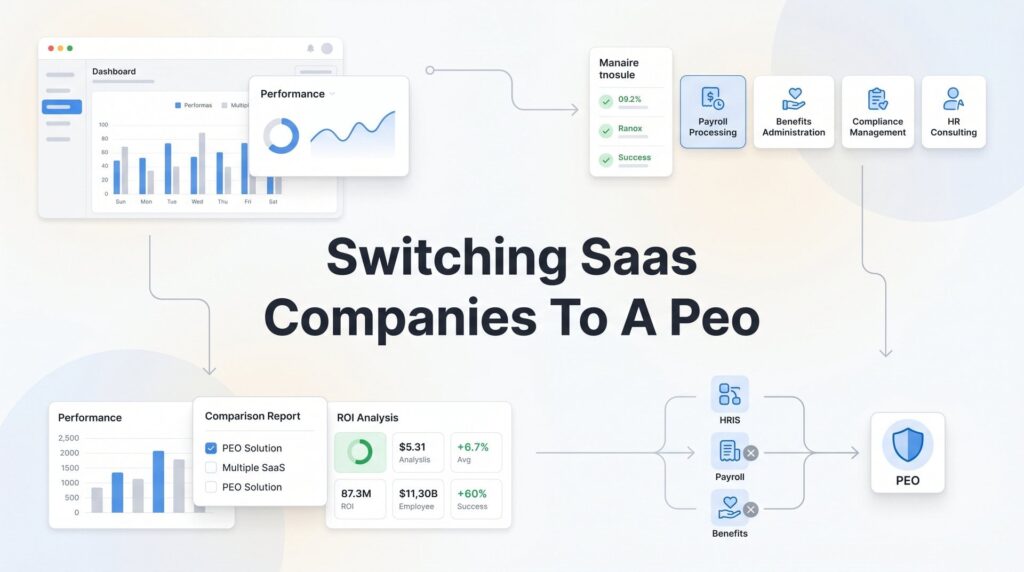
SaaS companies scale fast. The HR setup that worked fine at 15 people starts showing cracks at 40 — suddenly you’re juggling benefits renewals, multi-state payroll compliance, equity comp questions, and a recruiting pipeline, usually with a lean HR team that wasn’t designed for that volume. That’s the moment a lot of SaaS founders and HR leads start seriously looking at PEOs.
But switching to a PEO isn’t just signing a contract and handing over payroll. There’s a real transition process, and if you skip steps or pick the wrong provider for your growth stage, you’ll feel it. The companies that struggle usually didn’t audit their existing setup, evaluated providers on price alone, or underestimated what it takes to communicate the change to employees without creating unnecessary anxiety.
This guide walks through the actual process of moving a SaaS company onto a PEO: what to audit before you start, how to evaluate providers against criteria that actually matter for tech companies, what the contract and onboarding process looks like, and how to manage the employee communication piece cleanly. If you’re already sold on the concept and need to know how to execute, this is where to start.
Step 1: Audit Your Current HR Setup Before You Talk to Anyone
Before you take a single sales call from a PEO, you need a clear picture of what you’re currently running. This step is easy to skip because it feels like homework before the interesting part. Skip it anyway and you’ll pay for it mid-transition.
Start by mapping every vendor and contract touching your HR function: your payroll processor, benefits broker, workers’ comp carrier, and HRIS platform. For each one, note the contract term, renewal date, and any cancellation provisions. You need to know what you’re replacing, what you might keep, and what exit costs exist.
Renewal dates matter more than most people realize. If your benefits plan renews on January 1st and you’re trying to go live with a PEO in October, you’re either rushing a complicated transition or you’re paying for overlapping coverage. Aligning your PEO go-live with your benefits renewal date is one of the most practical ways to reduce cost and disruption. It’s worth building your entire timeline around this date if possible.
Document your headcount by state. This is especially important for SaaS companies because distributed, remote-first teams are common in this space, and multi-state footprint is one of the biggest drivers of PEO value. A company with employees in eight states has a fundamentally different compliance burden than one with everyone in a single office. Know your exact footprint before you start evaluating providers.
Flag edge cases upfront. PEOs handle W-2 domestic employees. They don’t cover 1099 contractors, international workers, or equity plan administration. SaaS companies often have a mix of all three. If you have contractors who are functionally working like employees, that misclassification issue needs to be resolved before transition — not discovered during onboarding. If you have international team members, you’ll want to understand the distinction between a PEO and an Employer of Record before assuming one solution covers everything.
The audit output should be a simple document: vendor list, contract terms, renewal dates, headcount by state, and a flag list of anything non-standard. It takes a few hours to build and it prevents a lot of expensive surprises later.
Step 2: Define What You Actually Need From a PEO
Once you know what you have, you need to get specific about what you need. This step determines whether you evaluate providers correctly or get distracted by the wrong criteria.
SaaS companies have different priorities than construction firms or retail businesses. For most tech companies, benefits competitiveness isn’t just a cost issue — it’s a recruiting and retention lever. The quality of your health plan, the 401(k) match structure, and the availability of ancillary benefits like mental health coverage or fertility benefits directly affect your ability to hire engineers and product talent. A PEO that offers mediocre benefits at a low price isn’t necessarily a good deal if it weakens your compensation package.
Think through your actual pain points. Is it multi-state compliance complexity? HR admin time that’s pulling your team away from higher-value work? Benefits cost? All three? Ranking these helps you weight your evaluation criteria rather than treating every feature as equally important.
Consider your growth trajectory honestly. A SaaS company planning to double headcount in the next 12 months needs a PEO with scalable onboarding workflows, a solid HRIS, and the ability to handle rapid state expansion. A company that’s stable at 35 people has different needs. Don’t evaluate providers as if your current situation is permanent if it isn’t.
Identify your non-negotiables before you start talking to vendors. Common ones for SaaS companies include: strong 401(k) plan options, integration with your existing ATS or performance management tools, robust self-service for employees, and responsive multi-state compliance support. If you’re remote-first with employees in California, New York, or Washington, compliance support needs to be near the top of that list — those states have some of the most complex employment law environments in the country.
The goal of this step is to walk into provider conversations with a clear scorecard, not a vague sense of what you’re looking for. Price alone is a trap. A lower quote from a provider whose platform doesn’t integrate with your tools, whose benefits are mediocre, and whose compliance support is slow will cost you more than a slightly higher fee from the right fit.
Step 3: Compare PEO Providers Against SaaS-Specific Criteria
Not all PEOs serve tech companies well. Some were built for industries with physical worksites, hourly workforces, and simpler compliance profiles. Their HR technology reflects that. When you’re evaluating providers, you need to look past the sales pitch and assess whether the platform actually fits how a modern SaaS company operates.
Start with the HRIS. Can employees self-serve benefits enrollment, PTO requests, and document management without going through HR? Does the platform offer API integrations with common tools — your ATS, your performance management system, your Slack or communication stack? For engineering and product teams who live in modern software, a dated HR portal creates friction and low adoption. That friction lands back on your HR team as support tickets. Understanding what a PEO HR technology platform actually does before you evaluate vendors will sharpen your questions considerably.
Multi-state compliance support: Ask providers directly how they handle state-by-state payroll tax, leave laws, and new hire reporting when you expand into a new state. What’s the process? How long does state registration take? Who owns that work? Some PEOs have strong infrastructure for this; others treat it as an add-on or handle it inconsistently. For a SaaS company with a distributed team, this isn’t a nice-to-have. The best PEOs for multi-state companies have built their compliance workflows specifically around this challenge.
Benefits plan quality: Request the actual plan options, not just the summary. Look at network coverage, plan design, and what the employee contribution structure looks like. If you’re hiring in competitive tech markets, your benefits package is part of your offer letter. Understand what you’re actually putting in front of candidates.
Pricing transparency: PEO fees are typically structured as either a per-employee-per-month flat fee or a percentage of payroll. Both models can work, but you need to understand exactly what’s included and what triggers add-on costs. Ask for a full fee breakdown in writing, not just a headline number. Ask specifically: what happens to pricing if you add a new state? What happens if headcount grows significantly?
References from similar companies: Ask for references from SaaS or tech companies of similar size. A PEO’s overall client count doesn’t tell you much. Their track record with 40-person software companies does. Ask those references specifically about multi-state compliance handling, HRIS usability, and responsiveness when issues come up.
Side-by-side comparison tools can help you cut through the noise here. Rather than relying solely on sales calls, structured comparisons across providers on the criteria that matter to your situation give you a cleaner decision framework. The goal is to be able to articulate clearly why Provider A fits your situation better than Provider B — not just that one came in with a lower quote.
Step 4: Review the Service Agreement Before You Commit
The PEO service agreement — sometimes called a client service agreement or CSA — is the legal foundation of the co-employment relationship. It deserves more attention than it usually gets. Most companies spend more time reviewing the sales deck than the actual contract.
A few clauses deserve particular scrutiny. First, liability allocation: understand what the PEO is responsible for and what remains your liability. In a co-employment arrangement, the PEO typically assumes employer-of-record status for payroll taxes and benefits administration, but you retain control over hiring, firing, job duties, performance management, and culture. Make sure the agreement reflects that clearly and that liability for employment claims is allocated in a way that makes sense.
Termination provisions matter more than people expect. What’s the notice period required to exit? What happens to employee benefits coverage if you terminate mid-year? Some agreements have provisions that create coverage gaps or require you to secure replacement coverage quickly. Know this before you sign, not after you decide to leave. A detailed PEO termination clause risk analysis is worth reviewing before you sit down with the document.
Watch for auto-renewal clauses and fee escalation language. Some agreements allow rate increases with limited notice, or automatically renew for another full term unless you cancel within a specific window. These clauses are easy to miss and can significantly affect your cost structure over time.
If you have equity compensation plans — stock options, RSUs, or anything similar — confirm explicitly in writing that the PEO agreement doesn’t affect those plans. PEOs handle W-2 payroll and benefits; they don’t administer equity. But you want that boundary clearly documented, particularly if you’re a VC-backed company where equity is a significant part of total compensation.
Have your legal counsel or an experienced HR advisor review the agreement before you sign, especially if you operate in heavily regulated states or have non-standard compensation structures. For deeper coverage of what to look for in PEO contract terms, reviewing a detailed breakdown of PEO service agreements is worth the time before you sit down with the document.
Step 5: Plan the Transition Timeline and Coordinate Vendors
Most PEO transitions take 30 to 90 days depending on complexity. Rushing it creates payroll errors and benefits gaps that damage employee trust in ways that are hard to recover from. Build in more time than you think you need, especially if you have employees in multiple states.
Start by establishing a go-live date with the PEO that aligns with a payroll cycle start. Mid-cycle transitions create reconciliation headaches that your payroll team will be untangling for weeks. A clean cycle start makes everything easier to verify and audit.
For SaaS companies with remote employees across multiple states, the PEO will need to register as an employer in each state where you have employees. This process takes time and varies by state. It needs to start early in the transition, not in the final weeks before go-live. Ask your PEO specifically which states require registration, how long each takes, and who owns the process.
Coordinate vendor terminations carefully. Give proper notice to your current payroll provider — check your contract for the required notice period. Notify your benefits broker. Confirm the timing of workers’ comp policy cancellation so there’s no coverage gap and no overlap you’re paying for unnecessarily. These conversations are easy to delay, but getting them wrong creates real problems.
Build a transition checklist that covers the operational pieces your team owns:
1. Employee data migration: confirm that all employee records, compensation data, and tax information transfer accurately to the PEO’s system.
2. Benefits elections: employees will likely need to re-enroll in benefits through the PEO’s platform. Build in enough time for this process and plan for stragglers.
3. Payroll setup verification: run a parallel check before go-live to confirm that pay rates, deductions, and direct deposit information are correct.
4. Direct deposit re-authorization: employees may need to re-authorize direct deposit through the new system. Don’t assume it transfers automatically.
5. Manager training: your managers need to know how to use the new HRIS for basic functions — approving PTO, accessing employee data, submitting HR requests. Don’t skip this. A practical walkthrough on integrating your PEO with an existing HRIS platform can help your team prepare for this step.
One thing to be clear about: the PEO handles a lot, but you still own the accuracy of the data you hand over and the communication to your team. Assuming the PEO handles everything is the most common transition mistake.
Step 6: Communicate the Change to Your Employees Clearly
This step gets underestimated more than any other. How you communicate the PEO transition to your team directly affects how smoothly the operational side lands.
Employees hearing “co-employment” for the first time often assume something is wrong — that the company is in trouble, that their status is changing, or that they’re being transferred to a staffing agency. At VC-backed SaaS companies especially, where employees are often equity holders and culturally invested in the company, this language can create unnecessary anxiety. Your communication needs to get ahead of that reaction before it spreads on Slack.
Frame the change around what improves for employees, not the operational reasons you made the switch. Better benefits options, more self-service HR tools, faster payroll support, a cleaner onboarding experience for new hires — these are the things that matter to your team. Lead with those. Companies that have gone through this process and later regretted it often trace the problem back to avoidable communication and selection mistakes that created distrust early on.
Address the most common questions directly and proactively:
Will my pay change? No. Your compensation is set by the company and doesn’t change as a result of this transition.
Will I lose my current benefits? Explain clearly what’s happening — whether benefits are transferring, improving, or requiring re-enrollment, and what the timeline is.
Do I need to do anything? Yes, and be specific about what, when, and where. Don’t leave this vague.
Is my job changing? No. The company still employs you, manages your work, and makes all decisions about your role.
For engineering and product teams, equity compensation questions will come up. Be ready with a clear, accurate answer: PEOs handle payroll and benefits administration for W-2 employees. They don’t touch equity plans. Your stock options or RSUs are not affected by this change.
Send a clear timeline: when employees will receive onboarding materials from the PEO, when benefits elections are due, who to contact with questions, and what happens if they miss a deadline. The goal is zero surprises on go-live day. If employees complete their paperwork on time and HR doesn’t get flooded with panic questions when the system goes live, the communication worked.
What to Watch in the First 90 Days
The transition isn’t over when the system goes live. The first 90 days are your quality control window, and how you use that window determines whether the PEO delivers the value you projected or becomes a source of ongoing friction.
The first two or three payroll cycles are critical. Verify that tax withholdings are correct, that direct deposits land on time, and that state filings are accurate for every state where you have employees. Errors in this window are normal to some degree — what matters is catching them quickly and getting them corrected before they compound.
Schedule a 30-day check-in with your PEO account manager. Don’t wait for problems to surface on their own. A good PEO will proactively flag discrepancies, but you want a structured conversation early to surface anything that hasn’t been escalated yet. This is also a good time to assess whether the account management relationship is working — responsiveness and proactive communication from your rep will matter a lot over the life of the contract.
Monitor employee adoption of the new HRIS platform. Low adoption usually signals a training gap, not a platform problem. If employees aren’t logging in, submitting requests through the system, or enrolling in benefits properly, identify where the friction is and address it with targeted training rather than assuming the platform is the issue.
Track whether the operational benefits you expected are actually materializing. Is HR admin time decreasing? Are benefits questions getting resolved faster through the PEO’s support team? Are state compliance filings happening without your team having to manage them? If the answer is no, document the specific gaps and raise them with your account manager before assuming the relationship isn’t working. Running a PEO ROI analysis for your technology company at this stage gives you a structured framework for measuring whether the investment is delivering.
If something isn’t working — a specific state compliance issue, a benefits enrollment error, a platform integration problem — escalate it early. PEOs have implementation teams for exactly this reason. Early escalation gets problems fixed; delayed escalation lets them compound and erode trust with your employees.
At the 90-day mark, revisit your original decision criteria. Are you getting the value you projected? If not, be specific about what’s missing and have a direct conversation with your account manager before drawing conclusions. Most early-stage issues are fixable. The ones that aren’t fixable are the ones worth paying attention to.
Putting It All Together
Switching a SaaS company to a PEO is one of those decisions that looks simple from the outside and gets complicated fast once you’re in it. But the process is manageable if you follow the steps: audit your current setup first, define your actual needs before evaluating providers, compare on the right criteria, read the contract carefully, plan the transition with enough lead time, and communicate clearly to your team.
The companies that struggle with PEO transitions almost always skipped one of the early steps. They didn’t audit their existing vendor relationships. They evaluated providers on price alone. They underestimated the communication piece and ended up with anxious employees and a chaotic go-live day. Use this guide as your operational checklist and you’ll avoid the most common mistakes.
If you’re still in the evaluation phase and want to compare providers side by side before committing, PEO Metrics offers unbiased, data-driven comparisons built specifically for companies at your stage. Don’t auto-renew. Make an informed, confident decision.
Before you sign that PEO renewal, make sure you’re not leaving money on the table.
Many businesses unknowingly overpay because of bundled fees, hidden administrative markups, and contracts designed to limit flexibility. We give you a clear, side-by-side breakdown of pricing, services, and contract terms—so you can see exactly what you’re paying for and choose the option that truly fits your business.
