

Manufacturing and industrial businesses don’t fit neatly into the standard PEO sales pitch. Your HR challenges look different from a software company’s: shift differentials, workers’ compensation classifications tied to NCCI codes, OSHA recordkeeping, and payroll that may span multiple facilities in multiple states. The wrong PEO can add complexity rather than reduce it.
The providers in this guide are worth evaluating if you run a manufacturing, machining, or industrial operation. Each brings a different mix of strengths, and what works well for a 30-person fabrication shop may not suit a 200-person assembly operation spread across three states.
We start with PEO Metrics, a comparison resource designed to help you evaluate any provider on your shortlist before you commit. The remaining entries cover established PEO providers, what they tend to do well, and what you should verify directly before signing anything. Pricing figures are not included because verified, current manufacturing-specific rates are not available from primary sources. Contact each provider for a quote based on your actual headcount, states, and risk profile.
This content is informational and not individualized legal, tax, or benefits advice. PEO Metrics may receive vendor placement fees.
1. PEO Metrics
Best for: Manufacturing businesses that want to compare multiple PEO providers before committing to one.
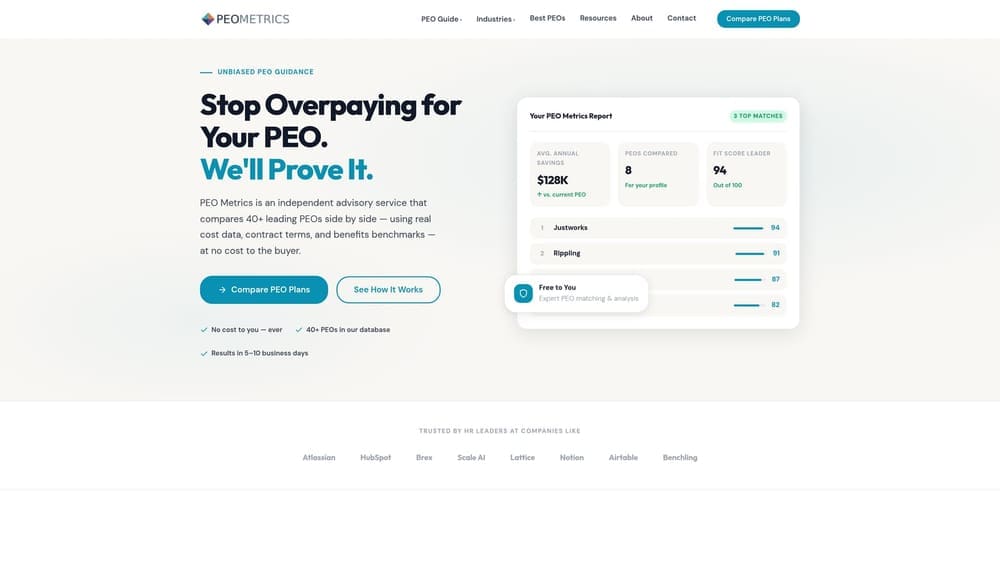
PEO Metrics is a PEO comparison service that helps businesses evaluate providers using side-by-side data, pricing analysis, and structured guidance rather than a single vendor’s sales pitch.
Where This Tool Shines
For manufacturing buyers, the challenge isn’t finding a PEO. It’s knowing whether the one you’re talking to actually understands workers’ compensation classifications for machine operators, whether their compliance team has handled OSHA-related situations, and whether their pricing is competitive for your risk profile. PEO Metrics gives you a framework to ask those questions systematically rather than relying on each vendor’s marketing materials.
The side-by-side comparison format is particularly useful when you’re narrowing a shortlist. Rather than running separate sales conversations and trying to reconcile incompatible quotes, you can see where providers differ on the metrics that matter most to an industrial operation.
Key Features
Side-by-Side Provider Comparisons: Structured comparisons across multiple PEO providers using detailed metrics, so you’re not evaluating apples against oranges.
Pricing Analysis: Helps identify whether you’re being quoted a competitive rate or paying a premium for services that don’t match your needs.
Unbiased Multi-Provider Guidance: Covers a range of PEO options rather than steering you toward a single provider.
Evaluation Framework for Complex Industries: The structured approach is well-suited to manufacturing environments where workers’ compensation, multi-state payroll, and compliance requirements make provider selection more consequential.
Best For
Manufacturing and industrial businesses that are selecting a PEO for the first time, switching providers, or approaching a renewal and want to verify they’re not overpaying. Also useful for HR leaders who need to present a defensible vendor recommendation to ownership or a CFO.
Pricing
Contact PEO Metrics directly for details. Note that PEO Metrics may receive vendor placement fees from providers in its network.
2. ADP TotalSource
Best for: Larger manufacturing operations that need national coverage, established payroll infrastructure, and access to a broad benefits purchasing pool.
ADP TotalSource is the full-service PEO offering from ADP, one of the largest payroll and HR companies in the United States, serving a wide range of industries including manufacturing.
Where This Tool Shines
ADP’s scale is its most tangible advantage. A large co-employment pool can translate to more competitive benefits pricing, which matters when you’re trying to offer health coverage that competes with larger employers for skilled trades and machine operators. The compliance and payroll infrastructure is well-established, which reduces the risk of processing errors across multiple states or pay periods.
For manufacturers with facilities in several states, ADP TotalSource’s multi-state capabilities are worth evaluating. Managing wage laws, tax filings, and workers’ compensation across jurisdictions is exactly the kind of administrative complexity a capable PEO should absorb. Verify current state availability and minimum employee requirements directly with ADP before drawing any conclusions.
Key Features
Benefits Purchasing Pool: Access to group benefits rates that may be difficult to obtain independently, particularly relevant for smaller manufacturers competing for skilled workers.
Payroll and Compliance Infrastructure: Built on ADP’s established systems, with multi-state tax filing and compliance support.
Multi-State Capabilities: Designed to support businesses operating across state lines, which is common in manufacturing and distribution.
HR Technology Platform: Access to ADP’s broader HR technology suite for administration, reporting, and employee self-service.
Best For
Mid-size to larger manufacturing businesses that prioritize platform stability, national coverage, and benefits access. Companies already using ADP payroll may find the transition to TotalSource more straightforward than switching to an unfamiliar system.
Pricing
Pricing is not confirmed from a current primary source. Contact ADP TotalSource directly for a quote based on your headcount, states, and industry classification. Do not rely on third-party pricing estimates.
3. Insperity
Best for: Businesses that want a dedicated HR specialist assigned to their account alongside full-service PEO support.
Insperity is a publicly traded PEO (NYSE: NSP) known for pairing clients with dedicated HR specialists, offering a more hands-on service model than some larger competitors.

Where This Tool Shines
The dedicated HR specialist model is the clearest differentiator here. Rather than routing every question through a general support queue, Insperity clients typically work with an assigned specialist who develops familiarity with their business. For a manufacturing operation dealing with a workers’ compensation claim, an OSHA recordkeeping question, or a termination in a state with specific notice requirements, that continuity has practical value.
Insperity also covers risk management and workers’ compensation support as part of its service model, which is directly relevant to manufacturing environments where injury risk is higher than in office-based industries. Verify current service scope, minimums, and state availability directly with Insperity before drawing conclusions about fit.
Key Features
Dedicated HR Specialist: Assigned specialists who learn your business rather than general support staff rotating through tickets.
Full-Service HR Administration: Covers payroll, benefits, compliance, and HR administration in a bundled model.
Risk Management and Workers’ Compensation Support: Relevant to manufacturing environments where claims management and classification accuracy affect cost.
HR Technology Platform: Administrative tools for HR management, reporting, and employee access.
Best For
Manufacturing businesses that want a relationship-driven PEO model with consistent point-of-contact support. Particularly useful for operations where HR questions arise frequently and require someone familiar with the company’s specific workforce and risk profile.
Pricing
Pricing is not confirmed from a current primary source. Contact Insperity directly for a quote. Verify current employee minimums before outreach, as these can affect eligibility.
4. TriNet
Best for: Smaller manufacturing or industrial businesses that need compliance depth and industry-tailored HR packages without a large administrative overhead.
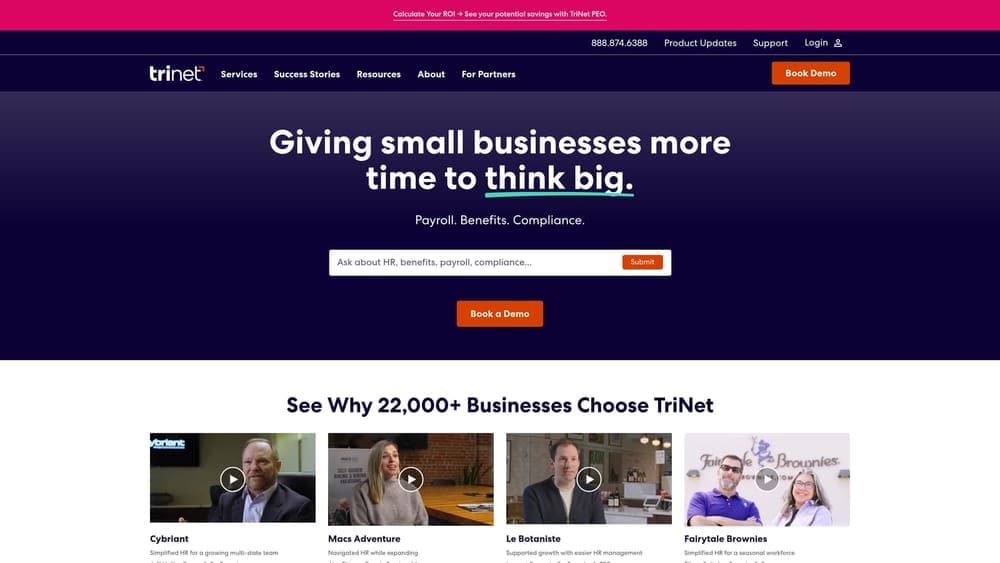
TriNet is a publicly traded PEO (NYSE: TNET) that markets industry-specific HR and benefits packages, with a historical focus on smaller businesses across a range of sectors.
Where This Tool Shines
TriNet’s industry-specific packaging is designed to give clients access to HR and benefits structures that reflect their sector rather than a generic bundle. For manufacturing buyers, the relevant question is how well their current industrial or trades-oriented package aligns with your workforce composition and compliance requirements. Verify current product lines directly with TriNet, as offerings and minimums can change.
The compliance support, including employment law guidance, is a meaningful feature for smaller manufacturers that don’t have in-house legal or HR expertise. Managing multi-state employment law, wage and hour requirements, and FLSA overtime rules across shifts is exactly where that guidance adds value.
Key Features
Industry-Tailored Packages: HR and benefits offerings structured around specific industries rather than a single generic bundle.
Employment Law Compliance Support: Guidance on employment law requirements, which is relevant for manufacturers navigating multi-state and multi-shift complexity.
Pooled Benefits Access: Benefits purchasing through a co-employment model that may offer more competitive rates than individual employer purchasing.
Employee Self-Service Technology: HR platform with employee-facing tools for benefits enrollment, payroll visibility, and HR administration.
Best For
Smaller manufacturing businesses that want structured, compliance-focused HR support without building an internal HR department. Also worth evaluating for operations where employment law exposure is a primary concern.
Pricing
Pricing is not confirmed from a current primary source. Contact TriNet directly for a quote. Verify current product offerings and any minimum employee thresholds before making any assumptions.
5. Paychex PEO
Best for: Manufacturing businesses already using Paychex payroll that want to add co-employment services without switching platforms.
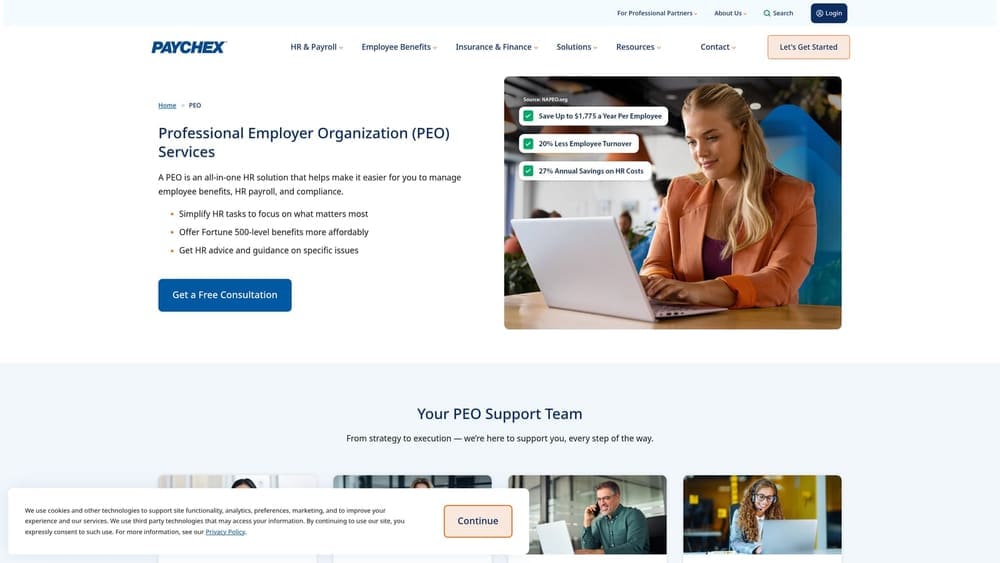
Paychex PEO is the co-employment service line from Paychex, Inc. (NASDAQ: PAYX), a major payroll and HR services company with a broad client base across industries including manufacturing.
Where This Tool Shines
The most practical case for Paychex PEO is continuity. If your operation already runs payroll through Paychex, moving to their PEO service adds co-employment benefits without the disruption of migrating to a new platform. For manufacturers where payroll accuracy on shift differentials, overtime, and multi-rate pay is operationally critical, avoiding a platform transition has real value.
Workers’ compensation administration and multi-state tax filing are part of the PEO service scope, both of which matter in manufacturing environments. Verify the current PEO product structure and scope directly with Paychex, as the PEO offering is distinct from their standard payroll service and the details can differ.
Key Features
Payroll Infrastructure Integration: Deep connection to Paychex’s existing payroll systems, reducing transition friction for current Paychex clients.
Multi-State Tax Filing and Compliance: Support for manufacturers operating across state lines with varying tax and wage requirements.
Workers’ Compensation Administration: Handles workers’ compensation program management within the co-employment structure.
HR Support Layered onto Existing Relationships: Adds co-employment services to an established payroll relationship rather than starting from scratch.
Best For
Manufacturing businesses with an existing Paychex relationship that want to expand into co-employment services. Also worth evaluating for operations where payroll continuity is a top priority during any HR vendor transition.
Pricing
Pricing is not confirmed from a current primary source. Contact Paychex directly for a PEO-specific quote, as pricing differs from standard payroll service arrangements.
6. Oasis (a Paychex Company)
Best for: Businesses that prefer a more modular PEO structure rather than a fully bundled service model.
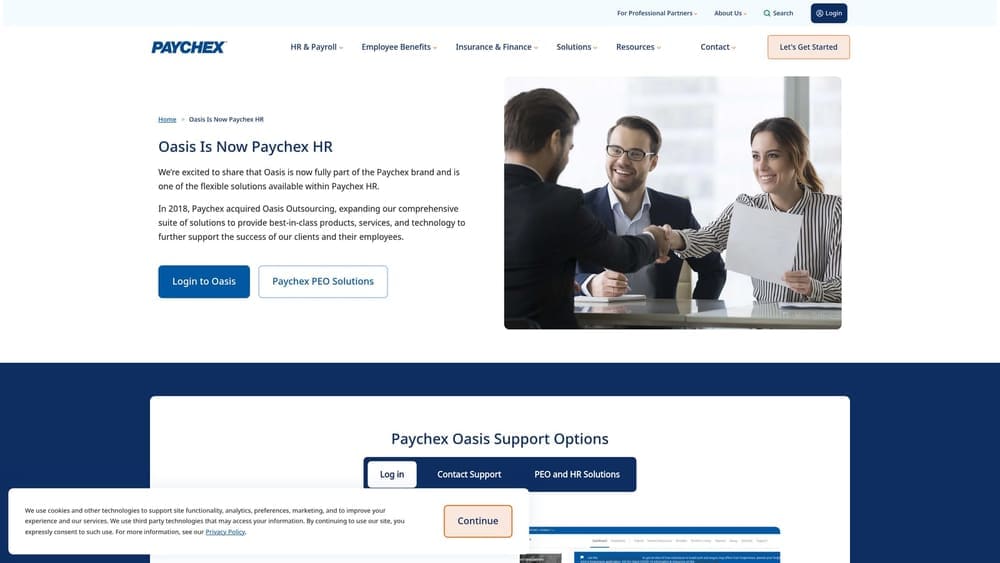
Oasis is a PEO brand acquired by Paychex that has historically offered flexible, modular service options. Verify current brand status and product structure directly with Paychex before relying on this listing, as the service model may have evolved post-acquisition.
Where This Tool Shines
Oasis has historically positioned itself around flexibility: the ability to select specific PEO services rather than accepting a fully bundled package. For manufacturing businesses that already have certain HR functions handled internally and don’t want to pay for redundant services, a modular approach can reduce cost and complexity. That said, the current product structure should be verified directly with Paychex, as acquisitions often result in brand and service consolidation over time.
The Paychex backing provides infrastructure stability, which is a practical consideration when evaluating a smaller or acquired brand. The key question is whether Oasis still operates as a distinct product with its own service model, or whether it has been absorbed into the broader Paychex PEO offering.
Key Features
Historically Modular Service Tiers: Flexibility to select specific PEO services rather than a single bundled model, though current structure should be verified.
HR Administration, Payroll, and Benefits Support: Core PEO functions covering the standard administrative scope.
Paychex Infrastructure Backing: Post-acquisition support from one of the larger payroll and HR companies in the country.
Selective Service Potential: May suit businesses that want targeted co-employment services without a fully bundled arrangement.
Best For
Manufacturing businesses that want flexibility in how they structure PEO services, or those that already have some HR functions covered and don’t need a full-service bundle. Verify current availability and product structure with Paychex before drawing conclusions.
Pricing
Pricing is not confirmed from a current primary source. Verify whether Oasis operates as a distinct brand and contact Paychex directly for a current quote.
7. Engage PEO
Best for: Smaller manufacturing businesses that need employment law compliance guidance integrated directly into their PEO service.
Engage PEO is a privately held PEO that markets an attorney-led compliance model, with a focus on smaller businesses that need employment law expertise alongside standard HR and payroll services.
Where This Tool Shines
The attorney-led compliance model is the defining characteristic here. Rather than routing compliance questions to HR generalists, Engage PEO integrates employment law attorneys into the service delivery. For a small manufacturer dealing with a complex termination, a wage and hour dispute, or an OSHA inquiry, having legal expertise embedded in the PEO relationship is a meaningful differentiator from standard service models.
This approach tends to suit smaller operations that can’t justify in-house legal or senior HR staff but face the same compliance exposure as larger employers. Verify current state availability directly with Engage PEO before assuming they operate in your jurisdiction.
Key Features
Attorney-Led HR Compliance Team: Employment law attorneys integrated into the service model rather than generalist compliance staff.
Employment Law Guidance: Direct access to legal expertise on employment matters, particularly valuable for businesses without in-house counsel.
Payroll, Benefits, and Risk Management: Standard PEO services covering core HR administration alongside the compliance focus.
Small Business Orientation: Service model designed around the needs and budget realities of smaller employers.
Best For
Smaller manufacturing businesses where compliance risk is a primary concern and in-house legal or HR expertise is limited. Worth evaluating for operations that have experienced employment law exposure or operate in states with complex wage and hour requirements.
Pricing
Pricing is not confirmed from a current primary source. Contact Engage PEO directly for a quote. Verify current state availability before outreach.
8. CoAdvantage
Best for: Manufacturing and industrial businesses concentrated in the Southeast or Sun Belt states that want a regionally focused PEO with workers’ compensation program depth.
CoAdvantage is a privately held PEO that has historically concentrated its operations in the Southeast and Sun Belt markets, with workers’ compensation program management frequently cited as a service emphasis.
Where This Tool Shines
Regional concentration can work in a PEO’s favor when it translates to deeper familiarity with state-specific compliance requirements, local workers’ compensation markets, and regional labor law nuances. For a manufacturing business with all or most of its facilities in the Southeast, a regionally focused provider may offer more relevant expertise than a national PEO that treats every state as equivalent.
Workers’ compensation program management is a particularly relevant capability for manufacturing clients, where classification accuracy and claims handling directly affect cost. Verify CoAdvantage’s current geographic coverage before assuming they operate in your specific states, as regional focus means they may not be the right fit for operations outside their core markets.
Key Features
Regional Depth in Southeast and Sun Belt Markets: Concentrated expertise in specific regional markets rather than a broad national footprint.
Workers’ Compensation Program Management: A cited area of emphasis that is directly relevant to manufacturing operations with elevated injury risk and complex classification needs.
Payroll and HR Administration: Core PEO services for small to mid-size businesses, including payroll processing and HR support.
Pooled Benefits Access: Group benefits purchasing through the co-employment model.
Best For
Small to mid-size manufacturing businesses operating primarily in the Southeast or Sun Belt that want a regionally experienced PEO with a clear emphasis on workers’ compensation management. Verify current geographic coverage directly with CoAdvantage before recommending to clients outside their established markets.
Pricing
Pricing is not confirmed from a current primary source. Contact CoAdvantage directly for a quote. Confirm current geographic coverage and service scope before proceeding.
Choosing the Right PEO for Your Operation
Selecting a PEO for a manufacturing or machine-intensive business is a more consequential decision than it might appear at the outset. Workers’ compensation classification accuracy, OSHA compliance support, multi-state payroll handling, and benefits costs all vary considerably from one provider to the next. A mismatch on any of those dimensions can cost you more than you’d save by switching to a PEO in the first place.
The providers on this list each bring different strengths. ADP TotalSource and Insperity are worth evaluating for larger operations that need national reach and dedicated HR support. TriNet and Engage PEO tend to fit smaller businesses that need compliance depth without a large administrative footprint. Paychex PEO and Oasis make sense if payroll continuity is a top concern. CoAdvantage is worth considering for regionally concentrated operations in the Southeast and Sun Belt.
None of those generalizations replace a proper evaluation. Before you contact any provider, it’s worth understanding how workers’ compensation classification works under a co-employment arrangement. The impact of workers’ comp class code restructuring under a PEO is one area where manufacturing buyers frequently find unexpected cost differences between providers. Similarly, reviewing what to know before selecting a PEO can help you structure better questions before you enter a sales conversation.
If you’re running a manufacturing operation and want to understand how compliance strategy intersects with PEO selection, the workforce compliance strategy guide for manufacturing firms covers that ground in more detail.
The most common mistake in PEO selection is letting the sales process drive the evaluation rather than your own criteria. Build your comparison around your actual headcount, states, risk classifications, and benefit priorities before you start collecting quotes. That groundwork helps you ask sharper questions and identify where providers are padding margins rather than delivering value.
Before you sign that PEO renewal, make sure you’re not leaving money on the table. Many businesses unknowingly overpay because of bundled fees, hidden administrative markups, and contracts designed to limit flexibility. PEO Metrics gives you a clear, side-by-side breakdown of pricing, services, and contract terms so you can see exactly what you’re paying for and choose the option that fits your operation. Don’t auto-renew. Make an informed, confident decision.
