

Oilfield services companies face a distinct set of HR and compliance challenges that most PEO providers simply aren’t built to handle. High-hazard workers’ comp classifications, volatile headcounts tied to rig activity, multi-state deployments across Texas, Oklahoma, North Dakota, and Wyoming, and layered DOT and OSHA compliance requirements all demand a PEO with genuine energy sector experience.
Choosing the wrong provider can mean misclassified workers’ comp codes, unexpected fee structures, or a service model that collapses when your crew count spikes mid-project. Many standard PEOs will decline coverage for oilfield-specific class codes entirely, leaving companies scrambling for alternatives after they’ve already signed a contract.
This list focuses on PEO providers and comparison resources that are genuinely equipped for oilfield services operations, from well-site contractors and pipeline crews to equipment rental and fluid management companies. Selection criteria include demonstrated experience with high-hazard workers’ comp, multi-state payroll capability, flexible headcount accommodation, and transparent pricing. Whether you run 15 field hands or 500, the right PEO partner can materially reduce your administrative burden and insurance costs without hiding the real price tag in the fine print.
1. PEO Metrics
Best for: Oilfield services companies comparing multiple PEO providers before committing to a contract
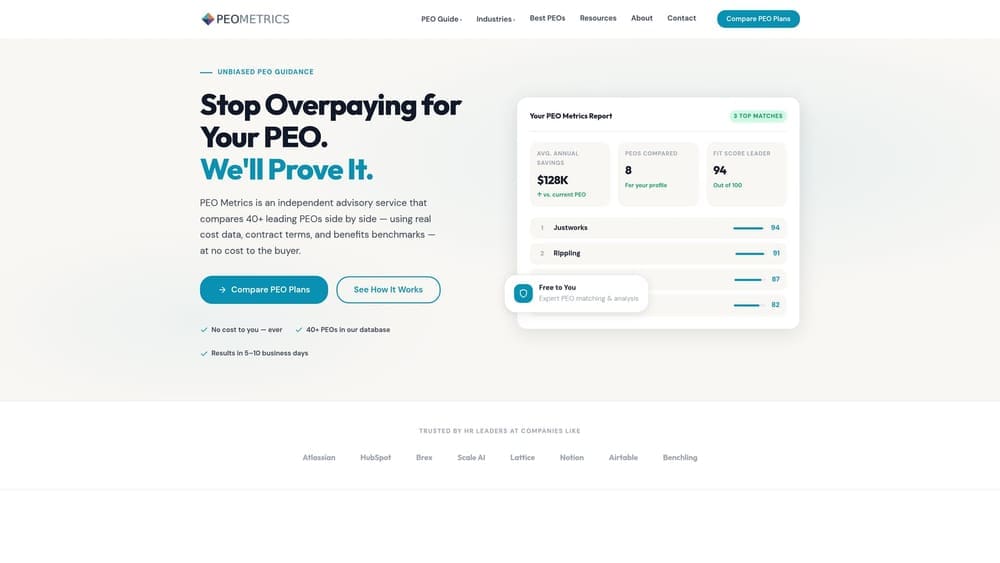
PEO Metrics is a PEO comparison and selection resource that helps oilfield services companies evaluate providers side-by-side using detailed metrics and pricing analysis.
Where This Tool Shines
For oilfield services buyers, the biggest risk in PEO selection isn’t choosing a mediocre provider. It’s signing a contract with a provider that can’t actually cover your workers’ comp class codes or that penalizes you when headcount drops after a project ends. PEO Metrics addresses this by giving buyers structured information on what different providers actually offer for high-hazard industries before contract negotiations begin.
Rather than relying on a sales rep’s assurances, you can use PEO Metrics to understand pricing structures, identify whether a quoted rate is competitive, and spot the contract terms that create exposure for variable-headcount operations. This is particularly useful if you’re entering the PEO market for the first time or switching providers after a bad experience. Note that PEO Metrics may receive vendor placement fees, which is worth factoring into how you interpret provider rankings and recommendations on the platform.
Key Features
Side-by-Side Provider Comparisons: Compare PEO providers on detailed metrics rather than relying solely on individual sales conversations.
Pricing Analysis: Understand whether a quoted rate reflects market norms for your industry and headcount, including the difference between percentage-of-payroll and per-employee-per-month fee structures.
High-Hazard Industry Coverage: The platform covers providers that serve energy sector and high-hazard clients, which is a meaningful filter given how many general-market PEOs decline oilfield class codes.
Consultative Guidance: Useful context on common selection mistakes, contract red flags, and what questions to ask providers before signing.
Switching Support: Helpful for companies evaluating a mid-contract switch, including guidance on how workers’ comp class code restructuring under a PEO can affect your total cost.
Best For
Oilfield services companies that are new to PEOs, currently shopping between multiple providers, or concerned they may be overpaying under an existing contract. Also useful for HR leaders who want structured data rather than vendor-controlled sales presentations before making a recommendation to ownership.
Pricing
[LINK CHECK: confirm current pricing model on peometrics.com before publication]
2. Oilfield-Experienced National PEO: Vendor A
Best for: Multi-state oilfield operations requiring CPEO certification and broad workers’ comp class code coverage
[LINK CHECK: Identify and verify a national PEO with documented experience serving oilfield services clients, confirmed CPEO status, and a workers’ comp master policy that covers high-hazard class codes. Confirm all details against current vendor website before publication.]
Where This Tool Shines
For oilfield companies operating across multiple states, IRS Certified PEO (CPEO) status matters more than most buyers realize. The CPEO program, established under the Small Business Efficiency Act of 2014 and administered by the IRS, provides statutory protections including continued access to certain tax credits and protection from double payment of certain federal employment taxes when switching PEOs mid-year. For companies with complex multi-state payroll across Texas, Louisiana, and North Dakota simultaneously, this is a meaningful operational protection.
A national PEO with CPEO certification and a master workers’ comp policy that genuinely includes oilfield-specific NCCI class codes removes one of the biggest barriers oilfield buyers face: finding coverage that doesn’t exclude their highest-risk job functions. Understanding how transitioning from an assigned risk pool to a PEO master policy works is essential context before selecting this type of provider.
Key Features
CPEO Certification: [Verify: current CPEO certification status with IRS before publication]
Workers’ Comp Class Code Coverage: [Verify: specific oilfield-relevant NCCI class codes covered under master policy before publication]
Multi-State Registration: [Verify: states where the PEO is currently registered to operate before publication]
Payroll and Benefits Administration: [Verify: payroll processing capabilities and benefits options available to oilfield clients before publication]
Employee Minimums: [Verify: minimum employee count requirements, if any, before publication]
Best For
Oilfield services companies with employees in multiple states who need a PEO with CPEO status, broad class code coverage, and the administrative infrastructure to handle complex payroll configurations across energy-producing states.
Pricing
[LINK CHECK: verify current pricing from vendor’s official published materials before publication]
3. Multi-State Capable National PEO: Vendor B
Best for: Energy sector companies needing flexible account management for field-based, geographically dispersed crews
[LINK CHECK: Identify and verify a second national PEO with multi-state capability and demonstrated energy sector or high-hazard industry experience. Confirm all details against current vendor website before publication.]
Where This Tool Shines
The account management model matters significantly for oilfield services clients. Field-based operations don’t have HR staff sitting at a desk waiting to process paperwork. When a crew ramps from 30 to 80 workers in three weeks because a new contract came through, you need a PEO whose onboarding process is fast enough to keep up and whose account team understands that this volatility is normal, not exceptional.
A national PEO with a proven track record in high-hazard industries and a service model built for geographically dispersed clients can reduce the friction that causes compliance gaps. This includes multi-state unemployment insurance management, workers’ comp certificate issuance for job sites, and payroll processing that accommodates field pay schedules rather than forcing oilfield operations into a standard biweekly corporate payroll cycle.
Key Features
Multi-State Compliance Management: [Verify: specific states covered and compliance capabilities before publication]
Account Management Model: [Verify: dedicated vs. shared account management structure for field-based clients before publication]
Workers’ Comp Approach: [Verify: coverage approach for high-hazard class codes and master policy structure before publication]
Benefits Administration: [Verify: benefits options and carrier relationships available to energy sector clients before publication]
Contract Flexibility: [Verify: contract terms for variable headcount operations before publication]
Best For
Oilfield services companies with field crews spread across multiple states who need responsive account management, flexible payroll scheduling, and a PEO that won’t treat headcount fluctuations as a billing problem.
4. Regional Energy State PEO: Vendor C
Best for: Oilfield operations concentrated in Texas, Oklahoma, Louisiana, or other primary energy-producing states
[LINK CHECK: Identify and verify a PEO with strong presence in primary energy-producing states (TX, OK, ND, WY, LA, NM, CO) and specific oilfield services client experience. Confirm all details before publication.]
Where This Tool Shines
Each energy-producing state has its own workers’ comp system, unemployment insurance rates, and wage and hour requirements. Texas, for example, operates a non-subscriber workers’ comp system, which creates a completely different compliance environment than states with mandatory coverage requirements. A PEO with deep regional roots in these states often has carrier relationships and compliance infrastructure that national providers can’t match at the local level.
Regional PEOs serving the energy corridor also tend to have direct experience with the specific job codes, safety requirements, and contract structures common to oilfield services. That institutional knowledge can translate into better workers’ comp placement, more accurate payroll tax handling, and account managers who already understand what a stimulation crew or a flowback operation looks like from a staffing and compliance standpoint.
Key Features
State-Specific Registration: [Verify: states of operation and current registration status before publication]
Workers’ Comp Carrier Relationships: [Verify: carrier relationships and class code coverage in primary energy states before publication]
Local Compliance Expertise: [Verify: specific state compliance capabilities, including Texas non-subscriber context if applicable, before publication]
Payroll Processing: [Verify: payroll capabilities and processing options for field-based clients before publication]
Employee Thresholds: [Verify: minimum employee count requirements before publication]
Best For
Oilfield services companies whose operations are concentrated in one or two energy-producing states and who want a PEO with genuine regional expertise rather than a national provider that treats their state as a secondary market.
5. High-Hazard Workers’ Comp Specialist PEO: Vendor D
Best for: Oilfield companies whose workers’ comp class codes have been declined or priced out by standard PEOs
[LINK CHECK: Identify and verify a PEO specifically known for placing workers’ comp coverage for high-hazard classifications that other PEOs decline, including oilfield-specific codes. Confirm all details before publication.]
Where This Tool Shines
This is the category that matters most for certain oilfield services operations. If your workforce includes well drilling crews, pipeline construction workers, or equipment operators in high-experience-modification class codes, many PEOs will simply decline to quote. A specialist PEO in this space has built its master workers’ comp policy specifically to include the class codes that general-market providers exclude, which means you’re not forced into an assigned risk pool or a standalone policy that eliminates the cost advantage of a PEO arrangement.
The experience modification rate (EMR) handling is another area where specialists differ from generalists. A PEO with genuine expertise in high-hazard industries understands how to structure the co-employment relationship in a way that accurately reflects your safety record rather than pooling your EMR with unrelated industries. For oilfield buyers who have invested in safety programs, this distinction can have a direct impact on workers’ comp costs. See also the cost modeling approach for workers’ comp class code restructuring under a PEO for more detail on how this works in practice.
Key Features
High-Hazard Class Code Coverage: [Verify: specific NCCI class codes covered under master policy, including oilfield-relevant codes, before publication]
Master Policy Structure: [Verify: workers’ comp carrier and master policy terms before publication]
EMR Handling: [Verify: how experience modification rates are managed for high-hazard clients before publication]
Safety Consulting: [Verify: safety consulting services offered and whether they include oilfield-specific programs before publication]
Geographic Coverage: [Verify: states where coverage is available before publication]
Best For
Oilfield services companies that have been turned away by standard PEOs due to their workers’ comp class codes, or companies currently in an assigned risk pool who want to explore whether a PEO master policy offers a better cost structure.
6. Flexible Headcount PEO: Vendor E
Best for: Oilfield services companies with significant crew count volatility tied to rig activity or project cycles
[LINK CHECK: Identify and verify a PEO with documented flexibility for variable headcount clients, including favorable contract terms around employee count fluctuations common in oilfield services. Confirm all details before publication.]
Where This Tool Shines
Headcount volatility is a structural feature of oilfield services, not an anomaly. When commodity prices shift or a major contract comes through, crew counts can double in a matter of weeks and contract just as fast when the project wraps. PEO contracts that include minimum employee requirements, annual headcount commitments, or penalty clauses for reductions can turn a cost-saving arrangement into a financial liability during downturns.
A PEO built for variable-headcount clients structures its contracts to accommodate this reality. That means fast onboarding when you’re ramping, clean offboarding when you’re contracting, and billing that reflects your actual employee count rather than a minimum floor you negotiated when times were busier. For oilfield buyers, this contract flexibility deserves as much scrutiny as workers’ comp coverage during the selection process. Understanding why PEOs fail companies often comes down to contract terms that buyers didn’t examine closely enough before signing.
Key Features
Headcount Fluctuation Terms: [Verify: specific contract terms for employee count changes before publication]
Onboarding and Offboarding Speed: [Verify: documented onboarding process timeline and offboarding procedures before publication]
Minimum Employee Requirements: [Verify: minimum employee thresholds, if any, before publication]
Payroll Processing Frequency: [Verify: payroll frequency options available, including weekly processing if offered, before publication]
Short-Tenure Benefits Eligibility: [Verify: benefits eligibility rules for workers who may be employed for a single project before publication]
Best For
Oilfield services companies whose workforce size fluctuates significantly across the year and who need a PEO contract that won’t penalize them for the natural rhythm of the energy business.
7. DOT and OSHA Compliance-Focused PEO: Vendor F
Best for: Oilfield services companies with CDL drivers and field crews subject to OSHA oil and gas well servicing standards
[LINK CHECK: Identify and verify a PEO with specific DOT compliance support (49 CFR Part 382 drug and alcohol testing, driver qualification files) and OSHA safety consulting relevant to oilfield services. Confirm all details before publication.]
Where This Tool Shines
Many oilfield services companies operate commercial motor vehicles subject to FMCSA regulations, including driver qualification files, drug and alcohol testing programs under 49 CFR Part 382, and hours of service requirements. Most PEOs offer no meaningful support in this area. A PEO that actively administers DOT drug and alcohol testing programs and maintains driver qualification file infrastructure removes a significant compliance burden from operations that run CDL drivers alongside field crews.
On the OSHA side, oilfield work is subject to general industry standards under 29 CFR 1910 and in some cases construction standards under 29 CFR 1926. OSHA has published specific guidance on oil and gas well drilling and servicing, and compliance areas including H2S environments, confined space entry, and process safety management vary considerably in complexity. A PEO with safety consultants who understand these standards, rather than generalists who handle office ergonomics and slip-and-fall prevention, is a meaningfully different resource for an oilfield services operation.
Key Features
DOT Drug and Alcohol Testing Administration: [Verify: scope of DOT testing program support under 49 CFR Part 382 before publication]
OSHA Compliance Consulting: [Verify: whether safety consultants have oilfield-specific expertise before publication]
Safety Training Resources: [Verify: available safety manuals, training programs, and delivery format before publication]
Incident Reporting Support: [Verify: OSHA recordkeeping and incident reporting assistance capabilities before publication]
Workers’ Comp Claims Management: [Verify: claims management approach and return-to-work program availability before publication]
Best For
Oilfield services companies with CDL drivers who need DOT compliance infrastructure, or field operations with significant OSHA exposure in H2S environments, confined spaces, or well servicing activities where a generalist safety consultant won’t be adequate.
8. Mobile-First Technology PEO: Vendor G
Best for: Oilfield services companies whose field workers have no regular access to a desk, computer, or company email
[LINK CHECK: Identify and verify a PEO with a strong mobile HRIS platform suitable for field workers without regular desk or computer access, including mobile onboarding, time tracking, and pay stub access. Confirm all details before publication.]
Where This Tool Shines
A well-site worker finishing a 12-hour shift isn’t going to log into a desktop portal to review their pay stub or complete onboarding paperwork. If your PEO’s HRIS requires a browser and a stable internet connection to function, it’s effectively inaccessible to a significant portion of your workforce. A mobile-first PEO platform built for field use changes this by allowing workers to complete onboarding, track time, access pay information, and manage benefits enrollment from a phone, even in areas with limited connectivity.
This matters operationally because incomplete onboarding and paper-based time tracking create payroll errors and compliance exposure. Electronic onboarding that workers can complete on a phone before their first shift, combined with mobile time and attendance tracking that supervisors can approve from the field, reduces the administrative burden on your office staff and produces cleaner payroll data. For oilfield services companies managing crews across multiple remote sites, this isn’t a nice-to-have feature; it’s a practical requirement.
Key Features
Mobile App Capabilities: [Verify: specific mobile platform features, iOS and Android compatibility, and offline functionality before publication]
Electronic Onboarding: [Verify: mobile onboarding process and whether it supports I-9, W-4, and direct deposit setup from a phone before publication]
Time and Attendance Tracking: [Verify: mobile time tracking options, GPS capabilities, and supervisor approval workflow before publication]
Employee Self-Service: [Verify: pay stub access, benefits enrollment, and PTO management available through the mobile platform before publication]
Field Management Software Integration: [Verify: integration capabilities with common oilfield field management or ERP platforms before publication]
Best For
Oilfield services companies managing field crews across remote or multi-site operations where paper-based HR processes create errors and delays, and where workers need mobile access to HR functions without requiring a company-issued computer or a corporate email address.
Matching the Right PEO to Your Operation
No single PEO is the right fit for every oilfield services company, and the stakes of a poor match are higher in this industry than in most. A provider that can’t cover your workers’ comp class codes, can’t handle a mid-year headcount spike, or has no DOT compliance infrastructure isn’t just inconvenient. It’s a genuine operational and financial risk.
Here’s a practical starting point based on your situation. If your primary concern is workers’ comp coverage for high-hazard class codes, focus your evaluation on providers with master policies that explicitly include oilfield-specific NCCI codes, and consider starting with a comparison resource like PEO Metrics to identify which providers actually serve your industry before you spend time on sales calls. If you operate across multiple states, CPEO certification should be a baseline filter, not an afterthought. If your workforce fluctuates significantly with rig activity, contract flexibility deserves as much scrutiny as pricing. And if you run CDL drivers, DOT compliance support should be a non-negotiable capability, not an add-on you negotiate for later.
For companies that are new to PEOs or considering a switch, the PEO transition guide is a useful resource for understanding what the change actually involves before you commit. And if you’re currently in an assigned risk workers’ comp pool and wondering whether a PEO master policy is a better option, that question deserves a detailed cost analysis before you make any decisions.
Before you sign that PEO renewal, make sure you’re not leaving money on the table. Many oilfield services companies overpay because of bundled fees, hidden administrative markups, and contracts designed to limit flexibility. PEO Metrics gives you a clear, side-by-side breakdown of pricing, services, and contract terms so you can see exactly what you’re paying for and choose the option that genuinely fits your operation. Don’t auto-renew. Make an informed, confident decision.
Before you sign that PEO renewal, make sure you’re not leaving money on the table.
Many businesses unknowingly overpay because of bundled fees, hidden administrative markups, and contracts designed to limit flexibility. We give you a clear, side-by-side breakdown of pricing, services, and contract terms, so you can see exactly what you’re paying for and choose the option that truly fits your business.
