

Benefits are often the single largest driver behind a company’s decision to hire a PEO. When a co-employment arrangement works well, the PEO’s purchasing power gives small and mid-sized businesses access to health, dental, vision, life, and retirement plans that would otherwise be out of reach or prohibitively expensive to administer on their own.
When it doesn’t work well, you end up locked into a benefits package that doesn’t fit your workforce, paying more than you should, with limited visibility into why.
This guide covers eight PEO services worth evaluating if benefits optimization is your primary goal. Each entry covers what the provider does well, who it fits, and what to watch for. Before committing to any provider, compare their actual plan options, carrier relationships, and total cost structure side by side. A few questions worth asking upfront: Does the PEO use a master health plan, or can you retain your existing carrier? What are the renewal rate protections? Are benefits costs bundled into the admin fee or billed separately?
Those details matter far more than any headline feature.
1. PEO Metrics
Best for: Businesses evaluating PEO options before committing to a contract
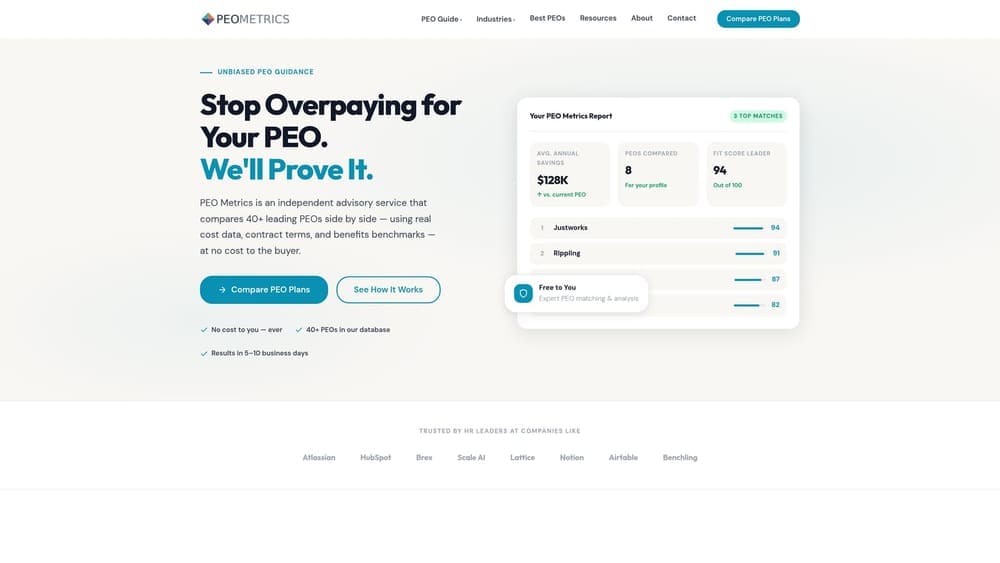
PEO Metrics is a PEO comparison and consulting service that helps HR teams and business owners evaluate providers side by side, with detailed data on benefits options, pricing structures, and provider metrics.
Where This Tool Shines
PEO Metrics sits at the beginning of the selection process, which is exactly where most companies need the most help. Choosing a PEO based on a sales presentation alone means you’re working with incomplete information. PEO Metrics gives you a structured way to compare what providers actually offer on benefits, what their pricing structures look like, and how they stack up on the criteria that matter to your workforce.
If benefits optimization is your goal, starting here before you talk to any individual PEO sales team puts you in a much stronger negotiating position. You’ll know what questions to ask and what answers to push back on.
Key Features
Side-by-side provider comparisons: Compare multiple PEOs on benefits plan data, carrier relationships, and plan structures in one place rather than piecing it together from separate sales calls.
Pricing analysis: Helps identify whether your current or proposed PEO arrangement is competitively priced, which is particularly useful if you suspect bundled fees are obscuring the true cost of benefits.
Unbiased provider guidance: Recommendations are based on your specific workforce profile, industry, and priorities rather than a generic ranking. Note that PEO Metrics may receive vendor placement fees.
Detailed metrics across providers: Consolidates data that would otherwise require multiple vendor conversations to gather, saving time during the evaluation phase.
Best For
HR leaders and business owners who are evaluating PEOs for the first time, considering switching providers, or approaching a renewal and want to verify they’re not overpaying. Also useful for companies that want to understand how their current PEO’s benefits offerings compare to alternatives before auto-renewing.
Pricing
Contact PEO Metrics directly for details. PEO Metrics may receive vendor placement fees from providers featured on the platform.
2. Justworks
Best for: Small and mid-sized businesses that want transparent, predictable benefits pricing
Justworks is a CPEO-certified PEO known for publishing its pricing tiers publicly, which is relatively uncommon in an industry where most providers require a custom quote before sharing any cost information.
Where This Tool Shines
Justworks makes it easier to understand what you’re paying for benefits administration before you ever get on a sales call. That transparency is genuinely useful for smaller companies that don’t have the time or leverage to negotiate opaque pricing structures. The ability to see per-employee-per-month tiers upfront changes the dynamic of the evaluation process.
On the benefits side, Justworks provides access to large-group medical, dental, vision, and mental health plans that small employers typically can’t access independently. The ancillary benefits catalog is reasonably broad, covering life, disability, and commuter options alongside core health coverage.
Key Features
Published pricing tiers: Per-employee-per-month pricing is listed publicly on their website, though you should verify current rates at justworks.com before making any decisions.
Large-group health access: Medical, dental, vision, and mental health plans available through co-employment, giving smaller employers access to plan types typically reserved for larger organizations.
CPEO certification: IRS-certified status, which affects how federal employment tax liability is treated. Verify current certification status via the IRS CPEO public registry before relying on this.
Ancillary benefits: Life, disability, and commuter benefit options available alongside core health coverage.
Best For
Small businesses and early-stage companies that want straightforward benefits access without navigating a complex custom quoting process. Particularly useful for companies that value pricing transparency as part of vendor selection.
Pricing
Published per-employee-per-month tiers are available at justworks.com. Verify current rates directly, as pricing can change and this article does not hardcode specific figures.
3. TriNet
Best for: Companies in specialized industries that need benefits tailored to their workforce profile
TriNet is a CPEO-certified PEO that structures its benefits offerings around specific industry verticals, including technology, life sciences, financial services, and professional services.
Where This Tool Shines
Most PEOs offer a generalist benefits catalog. TriNet takes a different approach by building carrier relationships and plan structures around the specific workforce profiles common in their target industries. A life sciences company competing for research talent has different benefits priorities than a professional services firm, and TriNet’s vertical model reflects that.
For companies in tech or life sciences especially, this means the benefits package is more likely to align with what their employees expect and what competing employers are offering, rather than a one-size-fits-all plan that may not hold up in recruiting conversations.
Key Features
Industry-specific benefits packages: Plan structures and carrier relationships built around workforce profiles in technology, life sciences, financial services, and professional services.
Tailored carrier relationships: Carrier access aligned with the specific health and ancillary benefit priorities common in each vertical.
CPEO certification: Verify current certification status at the IRS CPEO public registry before publication.
HR and compliance tools: Benefits administration comes alongside HR support and compliance assistance relevant to each industry.
Best For
Mid-sized companies in technology, life sciences, or professional services that are competing for specialized talent and need a benefits package that reflects industry norms rather than a generic catalog.
Pricing
Custom quotes based on industry, headcount, and benefits selections. Contact TriNet directly for current pricing.
4. Rippling
Best for: Companies that want benefits administration connected to payroll, HR, and IT in one platform
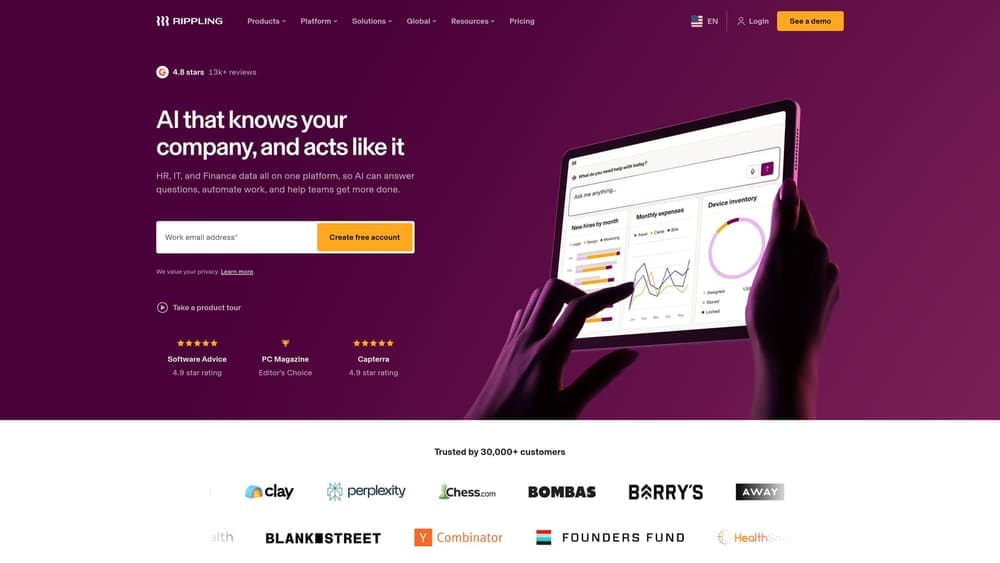
Rippling is a modular HR and IT platform that includes a PEO option, with benefits administration integrated across payroll, HR, and device management in a single connected system.
Where This Tool Shines
Rippling’s core advantage is integration. Benefits enrollment connects directly to payroll, so deductions update automatically. Onboarding triggers benefits eligibility. Offboarding triggers termination of coverage. For companies that have historically managed these steps manually across disconnected systems, that kind of automation reduces administrative burden significantly.
It’s worth being precise about what Rippling is: primarily a software platform with a PEO module, not a traditional PEO-first provider. If your priority is deep benefits strategy or dedicated HR specialist support, that distinction matters. If your priority is operational efficiency and platform integration, Rippling is worth a close look.
Key Features
Integrated benefits and payroll: Benefits deductions and enrollment connect directly to payroll and HR records, reducing manual reconciliation.
Modular structure: Companies can add or remove product modules as their needs change, rather than committing to a fixed service bundle.
Automated enrollment workflows: Benefits enrollment and administration workflows can be automated across the employee lifecycle.
PEO co-employment benefits access: Health, dental, vision, and ancillary benefits available through the PEO module.
Best For
Technology-forward companies that want a unified platform for HR, payroll, benefits, and IT management. Particularly useful for businesses that are already managing multiple disconnected systems and want to consolidate.
Pricing
Custom quotes based on modules selected. Contact Rippling directly for current pricing.
5. Insperity
Best for: Mid-sized businesses that want national carrier access and dedicated HR support
Insperity is one of the largest PEOs in the United States by employee count served, offering access to benefits through relationships with major national health carriers alongside dedicated HR specialists assigned to client accounts.
Where This Tool Shines
Insperity’s scale gives it carrier relationships that smaller PEOs can’t easily replicate. For mid-sized businesses that want access to recognizable national health plans rather than regional or smaller carrier options, that breadth matters. The dedicated HR specialist model also differentiates Insperity from more platform-centric providers, giving clients a named point of contact for benefits questions and HR issues rather than a support queue.
That said, Insperity has minimum employee count requirements, which means it’s not the right fit for very small businesses. Verify current minimums directly at insperity.com before evaluating.
Key Features
National carrier access: Benefits available through relationships with major national health carriers, including medical, dental, vision, and ancillary coverage.
Dedicated HR specialists: Named HR specialists assigned to client accounts rather than a generalized support model.
Broad ancillary benefits: Dental, vision, life, disability, and employee assistance program (EAP) options available alongside core health coverage.
CPEO certification: Verify current certification status at the IRS CPEO public registry before relying on this designation.
Best For
Mid-market companies with enough headcount to meet Insperity’s minimums that want a full-service PEO with national carrier relationships and dedicated human support rather than a self-service platform.
Pricing
Custom quotes; minimum employee requirements apply. Verify current minimums and pricing directly at insperity.com.
6. ADP TotalSource
Best for: Businesses that want a large, established PEO with broad geographic reach
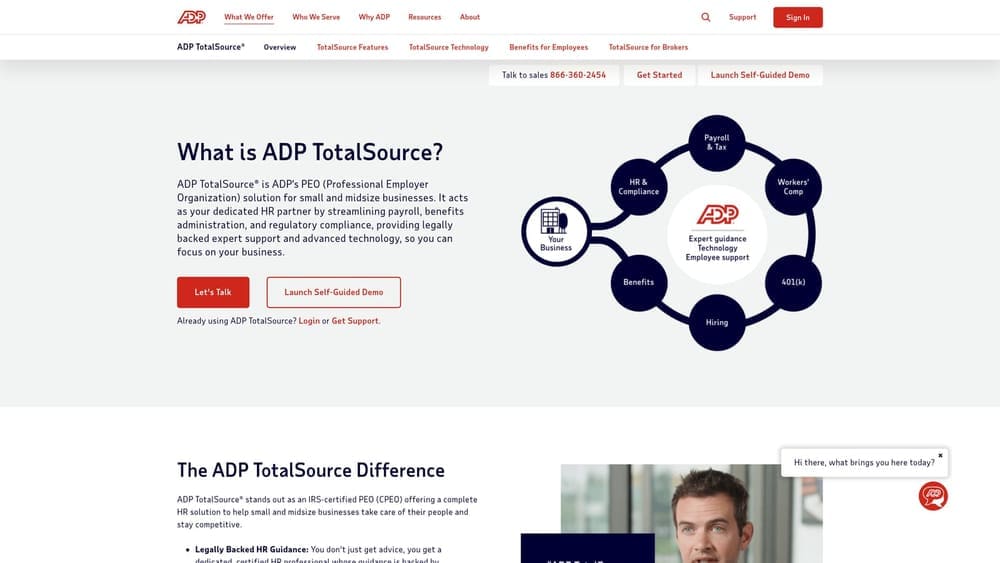
ADP TotalSource is ADP’s CPEO-certified PEO division, offering health and ancillary benefits backed by ADP’s carrier relationships and payroll infrastructure across a wide range of business sizes and locations.
Where This Tool Shines
ADP’s scale and infrastructure are the main draw here. For companies that operate across multiple states or have geographically distributed workforces, ADP TotalSource’s national footprint and established carrier relationships provide consistent coverage options that smaller regional PEOs may struggle to match.
Existing ADP payroll customers may find the transition to TotalSource smoother than switching to an entirely new provider, since the underlying payroll infrastructure is familiar. That familiarity can reduce implementation friction when moving to a co-employment model.
Comprehensive benefits catalog: Health, dental, vision, life, and retirement benefits available through co-employment.
ADP payroll infrastructure: Benefits administration backed by ADP’s established payroll platform and systems.
Broad geographic coverage: Serves businesses across the United States, including those with multi-state workforces.
Best For
Mid-to-large businesses with multi-state operations that want a well-established PEO provider, as well as current ADP payroll customers considering a move to co-employment.
Pricing
Custom quotes based on company size and benefits selections. Contact ADP TotalSource directly for current pricing.
7. Oasis (a Paychex Company)
Best for: Small-to-mid-market businesses already using Paychex payroll
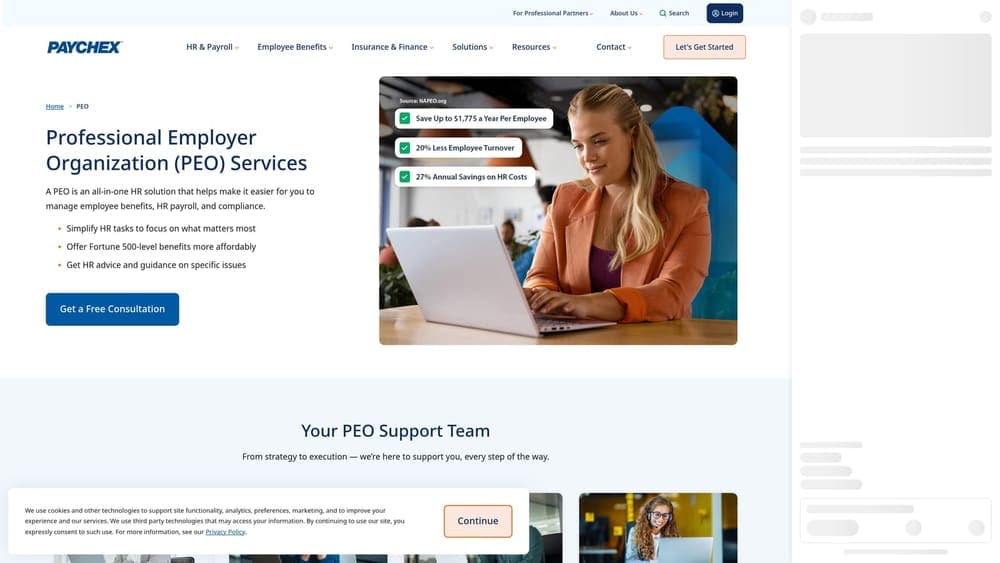
Oasis, now operating as Paychex’s PEO offering, integrates benefits administration with Paychex’s payroll systems and provides access to health and ancillary benefits through co-employment.
Where This Tool Shines
The clearest case for Oasis is for businesses already running payroll through Paychex. The integration between Paychex payroll and the PEO benefits layer reduces the complexity of switching providers, since the underlying payroll infrastructure stays in place. That continuity can simplify benefits administration for HR teams that don’t want to manage a platform migration alongside a co-employment transition.
For companies not already in the Paychex ecosystem, the value proposition is more similar to other established mid-market PEOs. It’s worth comparing Oasis against other options on benefits depth and carrier access before defaulting to it based on the Paychex name alone.
Key Features
Paychex payroll integration: Benefits administration connects with existing Paychex payroll systems, which is particularly useful for current Paychex customers.
Core and ancillary benefits access: Medical, dental, vision, life, and retirement benefits available through PEO co-employment.
HR and compliance support: HR assistance and compliance guidance available alongside benefits administration.
Small-to-mid-market focus: Service model oriented toward smaller and mid-sized businesses rather than enterprise accounts.
Best For
Small and mid-sized businesses already using Paychex for payroll that want to add co-employment benefits without switching their payroll provider. Also worth evaluating for companies in the small-to-mid-market range comparing established PEO options.
Pricing
Custom quotes; contact Paychex directly for current pricing on PEO services.
8. Sequoia One
Best for: Venture-backed startups competing for technical talent through premium benefits
Sequoia One is a PEO built specifically for venture-backed startups and high-growth companies, with benefits strategy centered on talent acquisition and access to premium carriers. Note that Sequoia One is a distinct product from Sequoia Capital, the venture firm.
Where This Tool Shines
Sequoia One’s differentiation is focus. Most PEOs serve a broad range of business types. Sequoia One is designed around the specific pressures of startup culture: competing for technical talent, managing equity compensation alongside traditional benefits, and scaling headcount quickly without sacrificing benefits quality. For a venture-backed company trying to match the benefits packages offered by larger tech employers, that specialization is meaningful.
The equity compensation support alongside traditional health and ancillary benefits is a feature set that most generalist PEOs don’t offer at the same depth, making it relevant for startups where equity is a core part of total compensation.
Key Features
Startup-focused benefits packages: Benefits designed around startup culture and talent competition rather than a generalist catalog.
Equity compensation support: Support for equity compensation alongside traditional health and ancillary benefits, relevant for companies where stock options are part of total comp.
Premium carrier access: Health carrier relationships suited to companies competing for technical and specialized talent.
High-growth HR support: HR services tailored to the pace and complexity of rapidly scaling organizations.
Best For
Venture-backed startups and high-growth technology companies that need premium benefits to compete for talent and want a PEO that understands the startup context, including equity, rapid headcount changes, and investor-driven timelines.
Pricing
Custom quotes; contact Sequoia One directly for current pricing.
Which Provider Fits Your Situation
No single PEO is the right benefits partner for every business. The right fit depends on your industry, headcount, carrier preferences, budget, and how much flexibility you want at renewal.
Justworks and Sequoia One tend to serve smaller or startup-stage companies well, with Justworks offering pricing transparency and Sequoia One offering startup-specific depth. Insperity and TriNet are worth evaluating for mid-market companies or those in specialized industries where a generalist benefits catalog won’t hold up in recruiting. ADP TotalSource and Oasis suit businesses that want a large, established provider with national infrastructure. Rippling fits companies that prioritize platform integration as much as benefits access.
Before signing with any provider, ask specifically about their master health plan structure, which carriers they work with, how renewal rates have trended over the past few years, and whether benefits costs are bundled into the admin fee or billed separately. Those details reveal more about the true cost and flexibility of a PEO relationship than any feature list.
If you’re not sure how your current or proposed PEO stacks up on those criteria, PEO Metrics helps HR teams and business owners compare providers side by side on benefits options, pricing structures, and plan details. It’s a useful starting point before you commit to any contract or auto-renew with your current provider.
Many businesses unknowingly overpay because of bundled fees, hidden administrative markups, and contracts designed to limit flexibility. Getting a clear, side-by-side breakdown of what you’re actually paying for, and what alternatives exist, is a straightforward way to make a more confident decision.
Don’t auto-renew. Make an informed, confident decision.
Before you sign that PEO renewal, make sure you’re not leaving money on the table.
Many businesses unknowingly overpay because of bundled fees, hidden administrative markups, and contracts designed to limit flexibility. We give you a clear, side-by-side breakdown of pricing, services, and contract terms, so you can see exactly what you’re paying for and choose the option that truly fits your business.
