

Real estate brokerages have a workforce structure that trips up a lot of PEO shopping. You’ve got licensed agents working as independent contractors alongside W-2 transaction coordinators, marketing staff, and office managers, and those two groups don’t get administered the same way. A PEO enters a co-employment arrangement for your W-2 employees, handling payroll, benefits, and compliance for that group under a shared employment model. It has no role with your 1099 agents, who remain independent contractors regardless of which PEO you choose. This list covers established PEOs with the multi-state infrastructure that brokerages with branch offices or growing back-office teams tend to need, based on publicly available vendor information as of September 2026.
Quick Comparison
- TriNet: best for brokerages wanting one vendor across benefits, payroll, and compliance; pricing is quote-based; its benefits marketplace aims to give smaller employer groups access to larger-group-style plans.
- Insperity: best for multi-office brokerages wanting a named HR contact; pricing is quote-based; assigns a dedicated HR business partner rather than a support queue.
- ADP TotalSource: best for brokerages with offices in several states; pricing is quote-based; leans on ADP’s payroll infrastructure for multi-state tax filing.
- Justworks: best for smaller or newer brokerages wanting predictable costs; published flat monthly per-employee pricing tiers on its site; the only PEO here with transparent published pricing rather than a full custom quote.
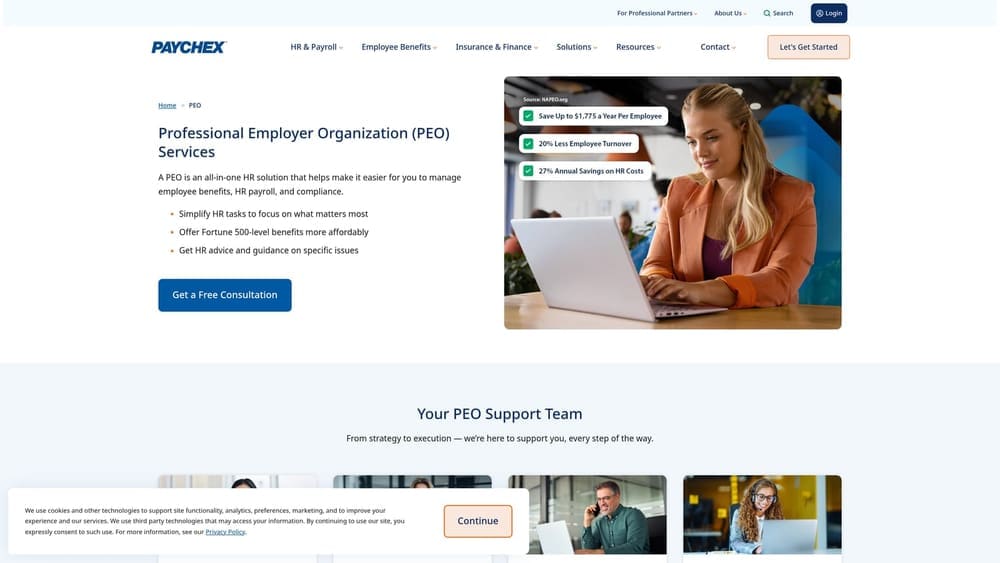
- Paychex PEO: best for brokerages already running Paychex payroll; pricing is quote-based; offers tiered plans so you can pick service depth.
- G&A Partners: best for brokerages concentrated in Texas or the Southwest; pricing is quote-based; built around a concentrated regional account team.
- Engage PEO: best for mid-sized brokerages consolidating vendors; pricing is quote-based; bundles payroll, benefits, and risk management under a single contract.
- Extensis HR: best for brokerages wanting ongoing HR advisory support; pricing is quote-based; layers HR consulting onto the PEO relationship rather than staying purely self-service.
1. TriNet
TriNet is a national PEO providing payroll, benefits administration, and HR compliance support, with platform options tailored by industry for businesses managing distributed teams. For a brokerage with branch offices spread across a metro area or multiple states, that combination matters more than it does for a single-location retail shop.
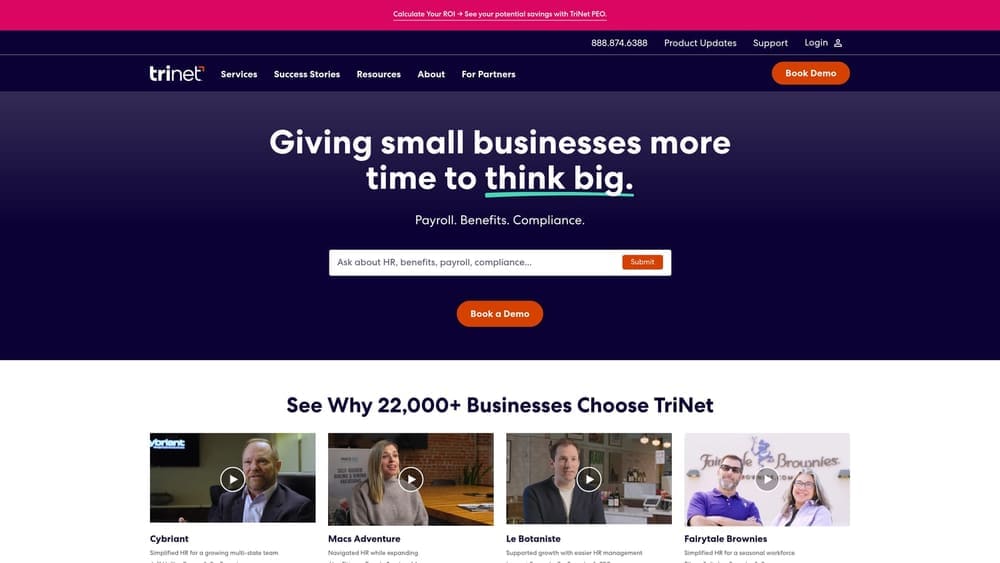
What sets TriNet apart on this list is the reach of its benefits marketplace. It’s built to give smaller employer groups access to national carrier plans that would typically require larger headcounts to negotiate directly, which can help a brokerage compete for administrative talent without a huge W-2 staff count.
- Benefits marketplace access to national carriers, aimed at giving smaller groups larger-group-style plan options
- Dedicated HR support contacts for day-to-day questions
- Payroll and tax administration handled through the platform
- HR compliance resources covering wage-hour and classification topics
TriNet integrates with common accounting and applicant tracking tools, per the vendor’s site, and is typically run day to day by an office manager or HR generalist rather than a dedicated HR department. Setup involves onboarding your existing W-2 census and benefit elections, a process TriNet’s team walks clients through.
The limitation to watch for: TriNet markets its platform toward specific industry verticals, and brokerages should confirm directly with a sales rep whether real estate or professional services fits the intended vertical setup, rather than assuming general applicability. Pricing is quote-based and not published on the vendor site, so get a line-item proposal before comparing.
Best for: Brokerages that want one vendor handling benefits, payroll, and compliance across multiple branch offices.
2. Insperity
Insperity is a long-established PEO built around full-service HR outsourcing, with a model that assigns a dedicated HR specialist to each client account rather than routing questions through a general support line.
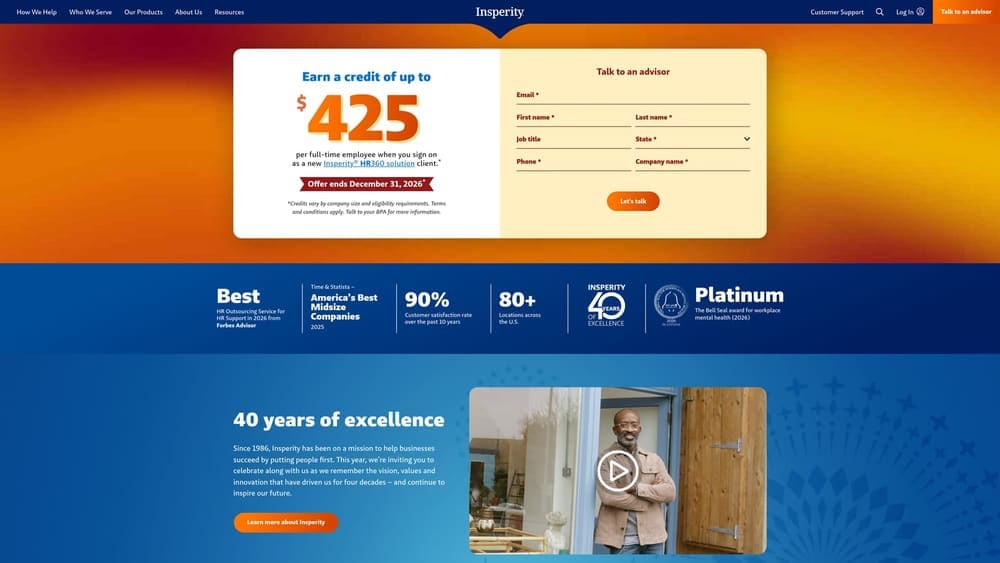
That named-contact structure is the main differentiator here. For a growing brokerage adding branch offices or scaling its transaction coordination team, having one person who already knows your account history can cut down on the back-and-forth that comes with rotating support reps.
- A dedicated HR business partner assigned per account for continuity
- Performance management tools for tracking staff reviews and goals
- Workers compensation program options built into the service
- Benefits administration covering enrollment and plan management
Insperity connects with common payroll and time tracking systems per its vendor site. It’s typically managed by whoever holds HR or office administration duties at the brokerage, with Insperity’s assigned specialist handling the heavier compliance lifting.
Insperity has historically positioned itself toward established, growing companies, which can translate into a higher service tier and cost structure than a single-office brokerage with a handful of W-2 staff actually needs. If your back office is lean, it’s worth asking directly whether the service model scales down, or whether you’d be paying for infrastructure built for larger accounts. Pricing is quote-based and not published publicly.
Best for: Growing multi-office brokerages that want consistent, named HR contacts rather than self-service tools.
3. ADP TotalSource
ADP TotalSource is ADP’s PEO offering, built on the same payroll infrastructure the company runs for its non-PEO payroll clients. The pitch is scale and compliance depth rather than a boutique feel.
For brokerages, the standout advantage is multi-state tax handling. If your firm has offices on both sides of a state line, a common situation in metro areas that straddle borders, ADP’s payroll backbone is built to file and reconcile taxes across jurisdictions without manual patchwork.
- Multi-state payroll processing designed for employers with offices in several jurisdictions
- A compliance library and reporting tools for tracking obligations
- Benefits administration integrated with the payroll platform
- Access to ADP’s broader HR technology suite beyond core PEO services
Integrations run through ADP’s own payroll and workforce management ecosystem, which is an advantage if you’re already in that ecosystem and a wash if you’re not. Day-to-day administration typically falls to an office manager, with ADP’s account team handling escalations.
The tradeoff for that scale is service personalization. Some clients moving from smaller PEOs report less individualized attention compared to regional providers, simply because ADP’s account volume is so much larger. Pricing is quote-based and not published on the site.
Best for: Brokerages with offices in several states that need consistent multi-state payroll tax handling.
4. Justworks
Justworks is a PEO built around transparent flat-rate pricing and a self-service technology platform, aimed at smaller and newer employers who want to avoid a drawn-out sales quote process.
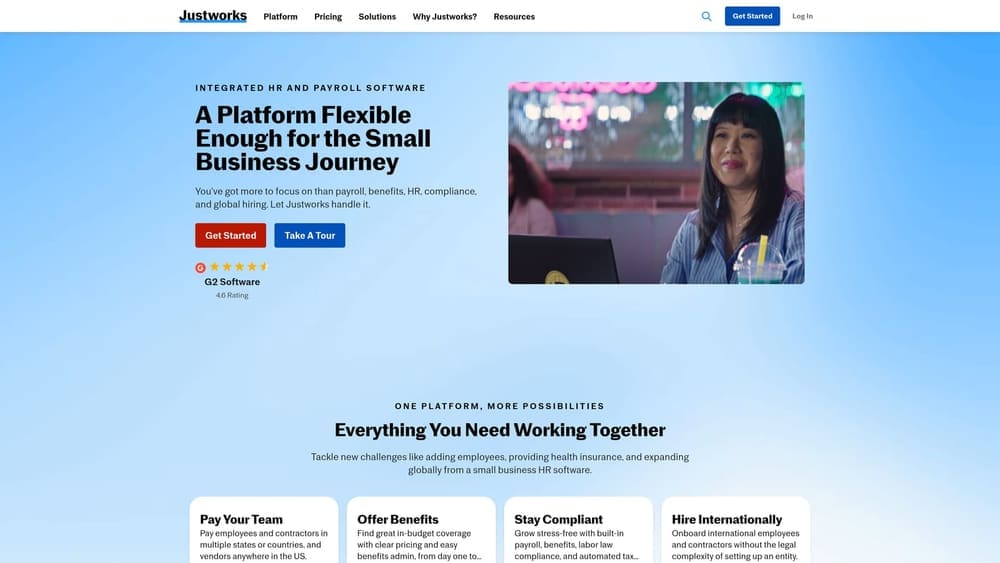
Pricing transparency is the differentiator here, and it’s a meaningful one on this list. Justworks publishes flat monthly per-employee pricing tiers on its site, rather than requiring a sales call before you know roughly what you’ll pay. For a brokerage owner trying to build a first-pass budget comparison, that’s a real time saver.
- Flat per-employee monthly pricing tiers published on the vendor site
- A self-service HR and benefits platform for managing enrollment and records
- Payroll processing and compliance support bundled into the plan
- Health insurance and 401(k) plan options available through the platform
Justworks integrates with common accounting and expense tools per its site, and it’s designed to be run by a single office administrator without a dedicated HR hire. Setup is generally faster than the enterprise-oriented PEOs on this list, since the platform is built for self-onboarding.
The limitation is scope. Justworks’ platform is built more for straightforward W-2 headcounts than for brokerages managing complex multi-office HR structures, layered compensation plans for staff, or heavy state-by-state compliance variation. If your back office is small and centralized, that’s a non-issue. If you’re running several branch offices with different state requirements, verify the platform handles that complexity before committing. Confirm current published pricing tiers directly on the Justworks site, since flat-rate structures are updated periodically.
Best for: Smaller or newer brokerages with a lean back office that want predictable monthly costs.
5. Paychex PEO
Paychex PEO is offered alongside Paychex’s core payroll software business, with multiple plan tiers letting employers choose different levels of service depth.
Fit for existing Paychex clients
The clearest reason to consider Paychex PEO is if your brokerage already runs payroll through Paychex. Adding the PEO tier means you’re not migrating to a new payroll system, just layering additional HR and compliance services onto a platform your office staff already knows.
- Multiple PEO plan tiers so you can match service level to your needs
- Payroll integration with the existing Paychex platform
- Benefits administration for W-2 enrollment and management
- HR compliance support across the plan tiers
What to check before signing
Paychex’s tiered structure means full plan details and pricing require a sales consultation, which makes early-stage, apples-to-apples comparison harder than with a vendor like Justworks that publishes tiers upfront. Ask your rep for a written breakdown of what’s included at each tier, and get it in writing before assuming a lower tier covers what you need.
Day-to-day administration is typically handled by an office manager, with Paychex’s team managing plan-level compliance questions. Pricing is quote-based and not published by the vendor.
Best for: Brokerages already using Paychex payroll that want to add PEO services without switching systems.
6. G&A Partners
G&A Partners is a regional PEO with a concentrated presence in Texas and the broader Southwest, built around a more personalized account team model than the national providers on this list.
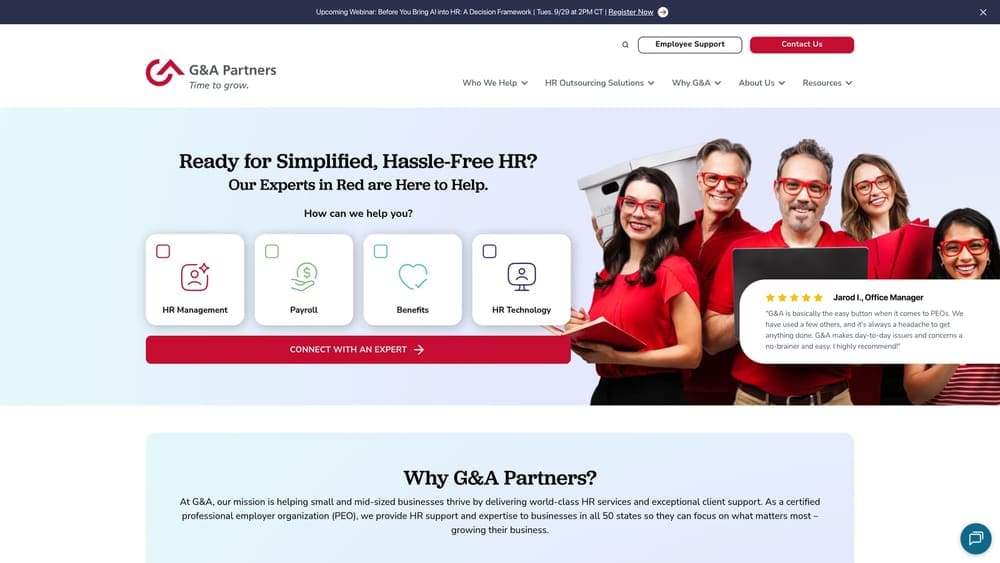
The regional concentration is the real differentiator. Brokerages operating in Texas or nearby Southwest markets get an account team that’s likely more familiar with local wage-hour rules and licensing norms than a national provider spreading attention across every state.
- Dedicated regional account teams assigned to client relationships
- Payroll and benefits administration for W-2 staff
- HR compliance support tailored to regional requirements
- Risk management services covering workplace safety and claims
G&A Partners uses standard payroll and accounting integrations per its site, and is generally run day to day by an office administrator with support from the assigned regional account team. Onboarding follows a similar census and benefits-election process as other PEOs on this list.
The obvious limitation is footprint. G&A Partners has less national reach than TriNet, ADP, or Insperity, so a brokerage expanding into new states outside the Southwest should confirm coverage and service quality in those markets before signing, rather than assuming the same regional depth applies everywhere. Pricing is quote-based and not published.
Best for: Brokerages concentrated in Texas or the Southwest that value a locally focused account team.
7. Engage PEO
Engage PEO is a mid-market PEO combining payroll, benefits, and risk management under a single contract, with configurable industry program options.
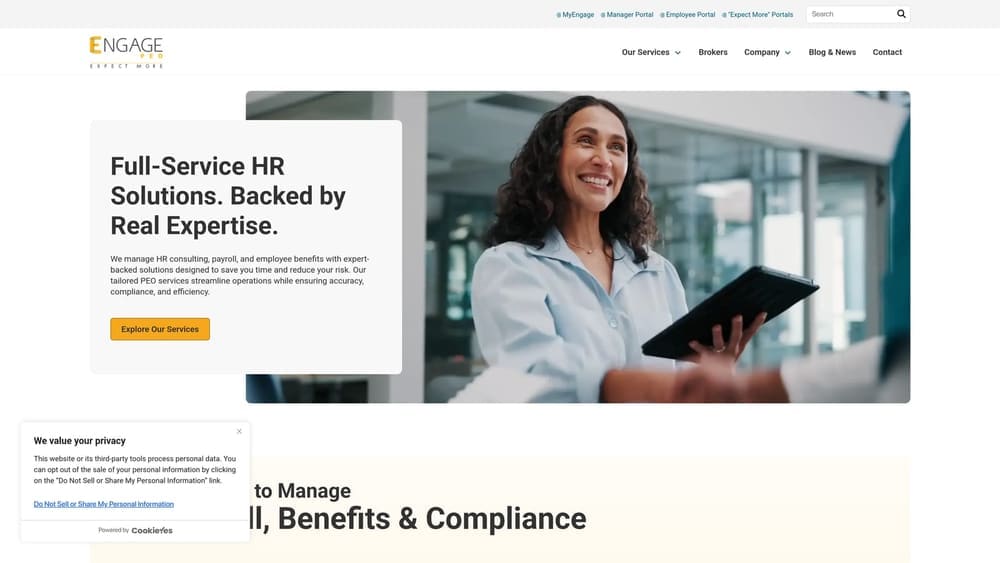
Consolidation is the pitch. Instead of running separate vendors for payroll, benefits brokering, and workers’ comp risk management, Engage bundles all three under one agreement, which can simplify vendor management for a brokerage that’s outgrown ad hoc arrangements but doesn’t want enterprise-level complexity.
- Payroll and tax administration for W-2 employees
- Benefits administration covering enrollment and carrier management
- Risk management and workers compensation support under the same contract
- Configurable industry program options for different business types
Engage works with standard payroll and HR tools per its site. It’s typically administered by an HR generalist or office manager, with Engage’s account team handling risk management and compliance escalations.
The mid-market focus means Engage may be more service than a very small, single-office brokerage with only a few W-2 staff actually requires. If your administrative headcount is under five, ask whether the risk management bundling still makes financial sense compared to a leaner option. Pricing is quote-based and not published on the vendor site.
Best for: Mid-sized brokerages that have outgrown a basic payroll provider but are not yet enterprise scale.
8. Extensis HR
Extensis HR pairs standard payroll and benefits services with additional HR consulting, aimed at professional services clients working through more nuanced compliance questions.
That advisory layer is what separates Extensis from the more platform-driven options on this list. Real estate brokerages regularly face questions about where the line falls between 1099 agents and W-2 support staff, especially as roles evolve or job duties blur. Extensis positions its consulting arm to help document and think through those distinctions, rather than leaving it entirely to a self-service portal.
- HR consulting layered onto the core PEO services
- Payroll and benefits administration for W-2 employees
- Compliance support specifically addressing employee classification questions
- Risk and safety program support for workplace claims management
Extensis integrates with standard payroll and HR tools per its vendor site, and is generally run by an office manager or HR lead who works directly with Extensis consultants on classification and compliance questions as they come up.
The more advisory-heavy model can cost more than a brokerage needs if all you actually want is basic payroll and benefits administration without ongoing consulting. If your classification questions are already settled and documented, weigh whether you’re paying for a service layer you won’t use much. Pricing is quote-based and not published by the vendor.
Best for: Brokerages that want ongoing HR advisory help documenting the line between 1099 agents and W-2 staff.
Matching the Right Provider to Your Office Structure
A single-office brokerage with a lean back office, say a handful of W-2 support staff and no plans to open a second location soon, is generally better served by a provider with published, predictable pricing like Justworks, or a provider already integrated with payroll you’re running, like Paychex PEO. You don’t need enterprise risk management or a dedicated HR business partner for three or four employees.
A multi-office or multi-state brokerage has different priorities. TriNet, Insperity, and ADP TotalSource are built for that complexity, with TriNet’s benefits marketplace helping smaller staff counts compete for talent, Insperity’s named HR partner model suiting brokerages that want continuity across locations, and ADP’s payroll infrastructure handling the tax filing headaches that come with employees in more than one state. G&A Partners fits a narrower case: brokerages rooted specifically in Texas or the Southwest that want a regionally focused account team over a national one.
Brokerages sitting in the middle, growing past a basic payroll setup but not yet running a large administrative staff, tend to fit Engage PEO’s bundled model or Extensis HR’s consulting-forward approach, particularly if agent classification questions come up often enough to want an advisor on call.
Because agent commission structures and license compliance requirements vary by state, no vendor comparison here should substitute for a line-item quote. Request detailed proposals from your finalists and compare them side by side, including how each handles benefits eligibility waiting periods against seasonal hiring patterns tied to housing market cycles. A service like PEO Metrics can help you put those quotes next to each other so you’re comparing actual terms rather than marketing copy.
Don’t auto-renew. Make an informed, confident decision.
Before you sign that PEO renewal, make sure you’re not leaving money on the table.
Many businesses unknowingly overpay because of bundled fees, hidden administrative markups, and contracts designed to limit flexibility. We give you a clear, side-by-side breakdown of pricing, services, and contract terms, so you can see exactly what you’re paying for and choose the option that truly fits your business.
