
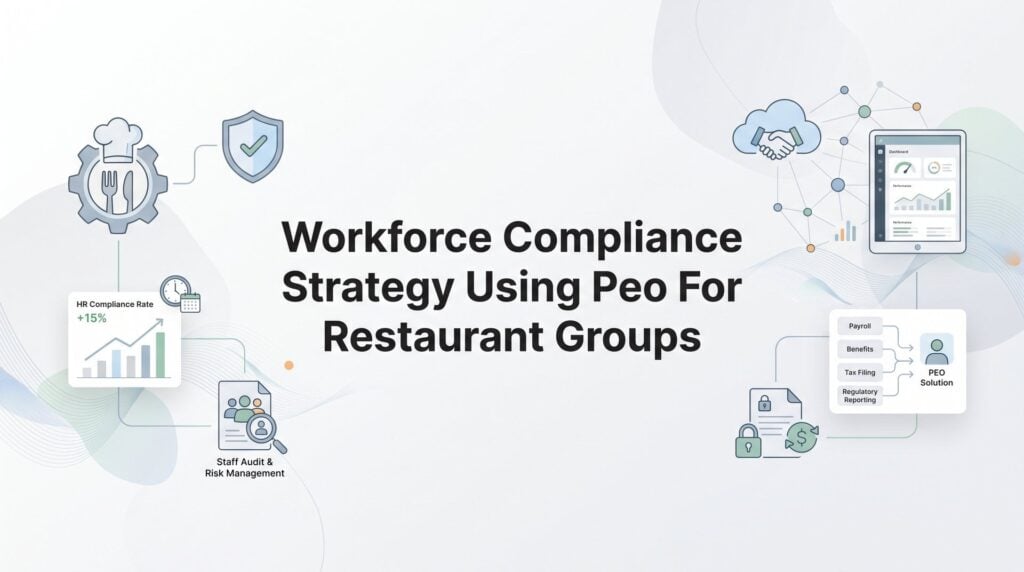
Restaurant groups operate in one of the most compliance-dense environments in American business. You’ve got tip credit rules that vary by state, predictive scheduling ordinances spreading city by city, minor labor laws that differ by municipality, and OSHA requirements specific to food service — all of it layered on top of standard federal employment law. When you’re running multiple locations, possibly across state lines, staying on top of all of it internally is genuinely unsustainable.
A PEO can absorb a significant portion of that compliance burden through co-employment. But “can” is doing a lot of work in that sentence. The arrangement only delivers real protection if you’ve set it up correctly, chosen a provider who actually understands food service, and built the kind of ongoing oversight that prevents things from slipping through the cracks.
This guide is for restaurant group owners and operators who are ready to get specific. Not a generic overview of what PEOs do — you can find that elsewhere. This is the actual process of building a compliance strategy around a PEO given the realities of running restaurants: high turnover, tipped employees, multi-location complexity, and a regulatory environment that keeps getting harder to navigate.
If you’re new to PEOs entirely and need the foundational context before diving in, start with a general PEO services overview first. If you already understand how co-employment works and you’re ready to build something practical, let’s get into it.
Step 1: Map Your Compliance Exposure Across Every Location
Before you talk to a single PEO, you need a clear picture of what you’re actually dealing with. Most restaurant groups underestimate their compliance exposure because they’re managing it reactively — handling problems as they surface rather than tracking the full landscape proactively.
Start with a location-by-location matrix. For each location, document the following:
Tip credit thresholds: The federal minimum for tipped employees is $2.13/hour in direct wages, but that number is functionally irrelevant in many states. California eliminates the tip credit entirely. Minnesota, Oregon, Washington, and others have their own structures. If your payroll system defaults to federal rules and you’re operating in a state that doesn’t recognize the tip credit, you have a wage and hour problem waiting to happen.
Minimum wage variations: State minimums vary, but so do city and county minimums. A restaurant group operating in Seattle, Chicago, or New York City is dealing with local minimum wages that exceed state floors — and those local rates can change on different schedules than state rates. Understanding multi-state payroll governance becomes critical when you’re navigating these variations across locations.
Predictive scheduling mandates: Cities including Seattle, San Francisco, New York City, Chicago, Philadelphia, and Los Angeles have enacted fair workweek ordinances. These require advance schedule posting (often 14 days), premium pay for last-minute changes, and right-to-rest provisions between shifts. If you have a location in any of these cities and you’re not documenting schedule changes and premiums correctly, you’re exposed.
Minor labor restrictions: States and municipalities vary significantly on what hours minors can work, what equipment they can operate in food service, and how many hours they can work during school weeks. This is an area where restaurant groups frequently get caught off guard, especially in kitchens where equipment use by minors is tightly regulated.
Break and meal period rules: Federal law doesn’t require meal breaks. Many states do, with specific rules about timing and pay. California’s break rules are particularly strict and carry significant penalty exposure for violations.
Beyond building the matrix, identify where you’ve already had near-misses or actual problems. Wage and hour complaints, DOL inquiries, failed audits — these are your highest-priority items when evaluating whether a PEO can actually address your real exposure. A PEO that hasn’t handled tip credit disputes in a California restaurant environment isn’t going to solve your most pressing problem. Understanding your litigation risk mitigation framework helps you prioritize which exposures need the most attention.
Finally, document your headcount tiers per location. ACA reporting obligations, FMLA eligibility, and various state-level thresholds kick in at different employee counts. A PEO needs this data to scope their support accurately. A location with 12 employees has a different compliance profile than one with 60, even if they’re both running the same menu in the same state.
Step 2: Define What the PEO Owns and What Stays With You
This is where most restaurant groups get into trouble. They sign with a PEO assuming the compliance burden has been transferred, and then discover six months later that a significant portion of their actual exposure was never on the PEO’s plate to begin with.
PEOs handle payroll tax compliance, benefits administration, workers’ compensation, and many HR regulatory functions. That’s genuinely valuable. But they don’t handle food safety compliance, health department requirements, liquor licensing, or operational permits. If your biggest compliance anxiety is a health inspection or a liquor license renewal, a PEO isn’t solving your problem.
The co-employment structure means the PEO becomes the employer of record for tax and benefits purposes. You retain control over day-to-day operations, hiring and firing decisions, and scheduling. That boundary matters for restaurant-specific issues. Tip pooling policies, for instance, are an operational decision that stays with you — but the payroll mechanics of how those tips are reported and taxed fall to the PEO. If you’re not clear on where that line sits, you’ll end up with a gap. For a deeper look at how PEOs handle the employment side for restaurant operations, review a comprehensive PEO benefits and cost containment strategy for restaurants.
The gray zones that cause the most problems in restaurant PEO relationships tend to be:
Harassment training compliance: Some states (California, New York, Illinois, among others) have mandatory harassment training requirements with specific timing and content standards. Does the PEO provide this training and track completion? Or does that stay with you? Get a clear answer before you sign anything.
I-9 verification: Restaurant groups with high turnover are processing a lot of new hires. I-9 compliance is time-sensitive and error-prone at volume. Clarify whether the PEO’s system manages I-9 collection and retention, or whether that workflow still sits with your managers.
Predictive scheduling documentation: If you’re in a fair workweek city, someone needs to be documenting schedule changes, tracking premium pay obligations, and maintaining records. Is that the PEO’s system, your scheduling software, or your GMs keeping a spreadsheet? This needs to be explicit.
Build a responsibility matrix before you start evaluating providers. A simple RACI format works — who is Responsible, Accountable, Consulted, and Informed for each compliance area. This document becomes your evaluation framework. When you’re talking to a PEO, you’re not asking “do you handle compliance?” You’re asking “can you handle these specific items in this matrix?”
Step 3: Vet PEOs on Restaurant-Specific Criteria
Most PEOs serve general business clients. Accounting firms, staffing agencies, small professional services companies. A PEO that’s excellent at handling benefits administration for a 30-person marketing agency may be completely unprepared for the operational realities of a restaurant group with 200 employees across eight locations, half of whom are tipped and a third of whom turn over every six months.
You need a PEO with demonstrated experience in food service or hospitality. Not “we’ve worked with restaurants before” — actual operational depth. The way to test this is through specific questions, not general claims.
Tip reporting and FICA tip credit calculations: Ask how their system handles tip credit compliance across multiple states with different rules. Ask how they configure payroll for a location in a state that doesn’t recognize the tip credit alongside a location in a state that does. If the answer is vague or they need to “check with their team,” that’s a signal.
Multiple pay schedules: Restaurant groups often run different pay schedules across locations — weekly for hourly staff, bi-weekly for salaried managers. Can their platform handle that without creating payroll errors?
Tipped vs. non-tipped classifications: Within a single entity, you may have servers (tipped), cooks (non-tipped), and shift supervisors (potentially both depending on duties). Can their system handle those classifications correctly within the same payroll run?
Workers’ compensation rates: Restaurant work carries higher risk classifications due to burns, slips, and cuts. NCCI codes for food service operations typically land in higher rate tiers. A PEO with a large food-service-heavy client pool may be able to offer better rates through their master workers’ comp policy than you’d get on your own — but this depends heavily on the composition of their client base. Ask specifically about their restaurant and hospitality client mix, and ask to see how their rates compare to your current policy. For a detailed breakdown of how PEOs can reduce these costs, explore strategies for insurance cost control for restaurant groups.
Multi-state payroll and tax filings: If your group crosses state lines, this is where cost and complexity differences between PEOs become significant. Some PEOs are genuinely strong at multi-state compliance; others treat it as an add-on with additional fees and slower response times. Ask for specifics on which states they’re registered in, how they handle mid-year state registrations when you open a new location, and what their process is when a new state minimum wage or scheduling law takes effect.
Evaluate providers side by side rather than in isolation. It’s difficult to assess whether a PEO’s pricing is reasonable or their capabilities are sufficient when you’re looking at each one independently. A structured comparison — same questions, same criteria, same compliance matrix from Step 1 — gives you a real basis for decision-making. Using a PEO workforce savings calculator can help you quantify the financial differences between providers.
Step 4: Structure Onboarding to Catch the Gaps Before They Become Problems
The transition period is when compliance risk is highest. Employee classifications get transferred incorrectly. Tip reporting configurations get set up for the wrong state rules. State registrations lag behind the go-live date. These aren’t hypothetical risks — they’re the most common failure points in restaurant PEO implementations.
The single most important thing you can do is run a parallel payroll cycle before fully cutting over. Process at least one full pay period through both your existing system and the PEO simultaneously. Compare the outputs line by line. You’re specifically looking for discrepancies in tip credit calculations, overtime computations, and tax withholdings. If the numbers don’t match, you need to know why before you’ve decommissioned your old system.
Prioritize I-9 compliance during the transition. Restaurant groups with high turnover often have incomplete or expired I-9s that surface when everything gets transferred to a new system. This is actually an opportunity — use the PEO transition as a forcing function to audit your I-9 files across every location. Maintaining workforce compliance during rapid hiring is especially important for restaurant groups that onboard dozens of employees at a time.
Set up location-specific compliance profiles in the PEO’s system from day one. Don’t let the PEO default every location to the same state rules because it’s easier to configure. A location in Chicago needs a different profile than a location in suburban Ohio. Predictive scheduling requirements, tip credit configurations, minimum wage settings, and break rules all need to be location-specific. This setup work is tedious, but it’s the difference between a PEO that actually protects you and one that gives you a false sense of security.
Assign a point person on your side who owns the onboarding process and is responsible for verifying that each location’s profile is configured correctly. Don’t assume the PEO’s implementation team will catch every restaurant-specific nuance. They may not know your Chicago location is subject to the One Fair Wage ordinance unless you tell them.
Step 5: Make Compliance Monitoring Part of How You Operate
A PEO relationship is not a one-time fix. The restaurant industry’s regulatory environment changes constantly — new cities pass scheduling ordinances, states adjust tip credit rules, minimum wages increase on different schedules, and enforcement priorities shift. A compliance strategy that worked when you signed your PEO agreement may have gaps within 18 months if you’re not actively maintaining it.
Schedule quarterly compliance reviews with your PEO account manager. Not general check-ins — structured reviews that specifically address restaurant-industry regulatory changes. What new scheduling laws have taken effect in your markets? Have any state tip credit rules changed? Are there new harassment training mandates in any of your states? Your PEO should be tracking this, but you should be asking about it explicitly rather than assuming they’ll proactively flag everything relevant to your specific locations.
Assign an internal compliance point person. This doesn’t need to be a dedicated compliance role — in many restaurant groups, it’s a GM or an operations manager wearing another hat. What matters is that someone on your side is responsible for flagging real-world issues before they become violations. A new city ordinance, a complaint from an employee about scheduling premiums, a manager who’s been handling I-9s incorrectly — these issues surface at the ground level before they ever reach the PEO. You need someone whose job it is to catch them and escalate. For restaurant groups managing growth through acquisitions, a solid M&A workforce integration strategy ensures compliance doesn’t fall apart during transitions.
Use the PEO’s reporting tools actively. Run regular audits on overtime patterns, tip credit compliance, and benefits eligibility across locations. Don’t wait for the PEO to flag issues proactively. Their systems can surface anomalies, but they’re not watching your data the way you would if you knew what to look for. A location that’s consistently showing overtime spikes may have a scheduling problem. A location where tip credit calculations look off may have a payroll configuration error. These are things you can catch early with regular reporting reviews.
Re-evaluate the PEO relationship annually against your compliance matrix from Step 1. Your exposure changes as you open new locations, enter new states, or cross headcount thresholds. A PEO that was the right fit when you had three locations in one state may not be the right fit when you have eight locations across three states. Reviewing how multi-location businesses handle workforce integration can provide useful benchmarks for your own annual evaluation. Annual re-evaluation isn’t about being disloyal to a provider — it’s about making sure the relationship is still serving your actual compliance needs.
When a PEO Isn’t the Right Answer for Your Restaurant Group
Not every restaurant group needs a PEO. It’s worth being honest about when the arrangement doesn’t make sense, because signing with a PEO that’s a poor fit for your situation creates its own compliance problems.
If your group operates in a single state with fewer than 15 to 20 employees, the compliance burden may not justify the per-employee PEO cost. A payroll provider with solid compliance features and a good HR advisory service might be sufficient. The cost-benefit math on PEO co-employment typically improves as headcount and multi-state complexity increase.
Restaurant groups with union locations face additional complications. PEO co-employment can conflict with collective bargaining agreements, and some unions have specific provisions about employer-of-record arrangements. If any of your locations are unionized, review your CBA carefully before pursuing a PEO arrangement and involve your labor counsel in the evaluation.
If your primary compliance pain points are food safety, health codes, or liquor licensing rather than employment law and payroll taxes, a PEO won’t address your actual problems. A PEO is an employment compliance tool. It doesn’t interact with your health department relationship or your liquor license renewals. If those are your biggest vulnerabilities, you need different solutions.
Franchise agreements sometimes restrict or complicate PEO arrangements. Franchisors may have specific requirements about payroll systems, benefits structures, or employer-of-record arrangements that conflict with PEO co-employment. Check your franchise disclosure documents and your franchise agreement before committing to a PEO. This is a step many franchisee operators skip, and it can create significant complications after the fact.
Your Compliance Checklist Before You Move Forward
Here’s the practical summary of what you need to have in place before signing with a PEO — or before renewing with one you’re already using:
1. Complete your location-by-location compliance matrix covering tip credit thresholds, minimum wages, predictive scheduling mandates, minor labor restrictions, and break rules for every location.
2. Build a clear responsibility split between your team and the PEO — specifically addressing I-9 management, harassment training compliance, and predictive scheduling documentation.
3. Vet providers on restaurant and hospitality experience, not just general HR capability. Ask specific questions about tip credit configurations, multi-state payroll, and workers’ comp rates for food service clients.
4. Run parallel payroll during onboarding and verify location-specific compliance profiles are configured correctly before you cut over fully.
5. Establish quarterly compliance reviews with your PEO account manager and assign an internal point person who owns the ongoing relationship.
The restaurant industry’s compliance landscape gets harder every year. More cities are passing fair workweek ordinances. More states are adjusting or eliminating tip credits. Wage and hour enforcement has been an area of consistent regulatory attention. A well-chosen PEO, set up correctly, can absorb a meaningful portion of that burden. But the upfront work matters — the wrong provider or a poorly structured arrangement can leave you with gaps you didn’t know existed until something goes wrong.
If you’re evaluating PEO providers and want a clear, unbiased side-by-side comparison of pricing, services, and contract terms specific to your situation, PEO Metrics can help. Don’t auto-renew. Make an informed, confident decision.
