
Most advice on HR consulting solutions starts with service definitions. That's not where good decisions get made. Buyers don't lose money because they can't recite the difference between a PEO and an ASO. They lose money because they compare headline fees, accept bundled promises at face value, and sign contracts before testing whether the model fits their risk profile, benefits strategy, and internal HR capacity.
The confusion is understandable. In the United States alone, the HR consulting industry is estimated at $29.0 billion in 2026 with 51,209 businesses competing in the category, according to IBISWorld's HR consulting industry data. A market that large and fragmented produces a lot of overlapping sales language. "HR solutions" can mean strategic advisory, payroll administration, co-employment, benefits placement, compliance support, or some mix of all five.
The practical question is simpler. Which model solves the specific problem the company has, at a total cost that makes sense, with contract terms the buyer can live with for more than one renewal cycle?
Table of Contents
- Why HR Consulting Solutions Is a Confusing Term
- Decoding the Four Main HR Service Models
- Matching the Right HR Solution to Your Company Stage
- Calculating the True Cost and Value of an HR Solution
- How Independent Analysis Drives Better Outcomes
- Your Provider Selection Checklist and Contract Red Flags
- Negotiating Your HR Service Agreement
Why HR Consulting Solutions Is a Confusing Term
"HR consulting solutions" sounds precise, but it isn't. It's a catch-all label used by consultants, PEOs, ASOs, payroll firms, and benefits brokers to describe services that sit at very different points on the spectrum of advice, administration, and employer responsibility.
That matters because buyers often get sold a delivery model before they've defined the business problem. A company might need a narrow compliance review and get pitched a broad co-employment arrangement. Another might need stronger benefits purchasing power and end up buying project consulting that never changes its cost structure.
The confusion gets worse because many vendors market the same outcomes. Better compliance. Less admin burden. More strategic HR. Improved employee experience. Those promises may all be directionally reasonable, but they don't tell a CFO or HR director who owns what, how fees work, or what happens when the relationship has to unwind.
A cleaner way to think about the category is this:
- Some providers advise.
- Some providers administer.
- Some providers bundle and operate.
- Some providers mainly place insurance and support enrollment.
Those are not interchangeable roles, even when the website copy makes them sound interchangeable.
Practical rule: If a provider can't explain its model in terms of liability, workflow ownership, data flow, and exit process, the buyer is still hearing marketing, not operations.
For teams comparing models, it helps to start with the broader human resources outsourcing options available rather than assuming every "solution" belongs in the same spreadsheet. That one shift usually improves the discussion immediately. The buying team stops asking, "Which vendor is best?" and starts asking, "Which service model fits the job?"
Decoding the Four Main HR Service Models
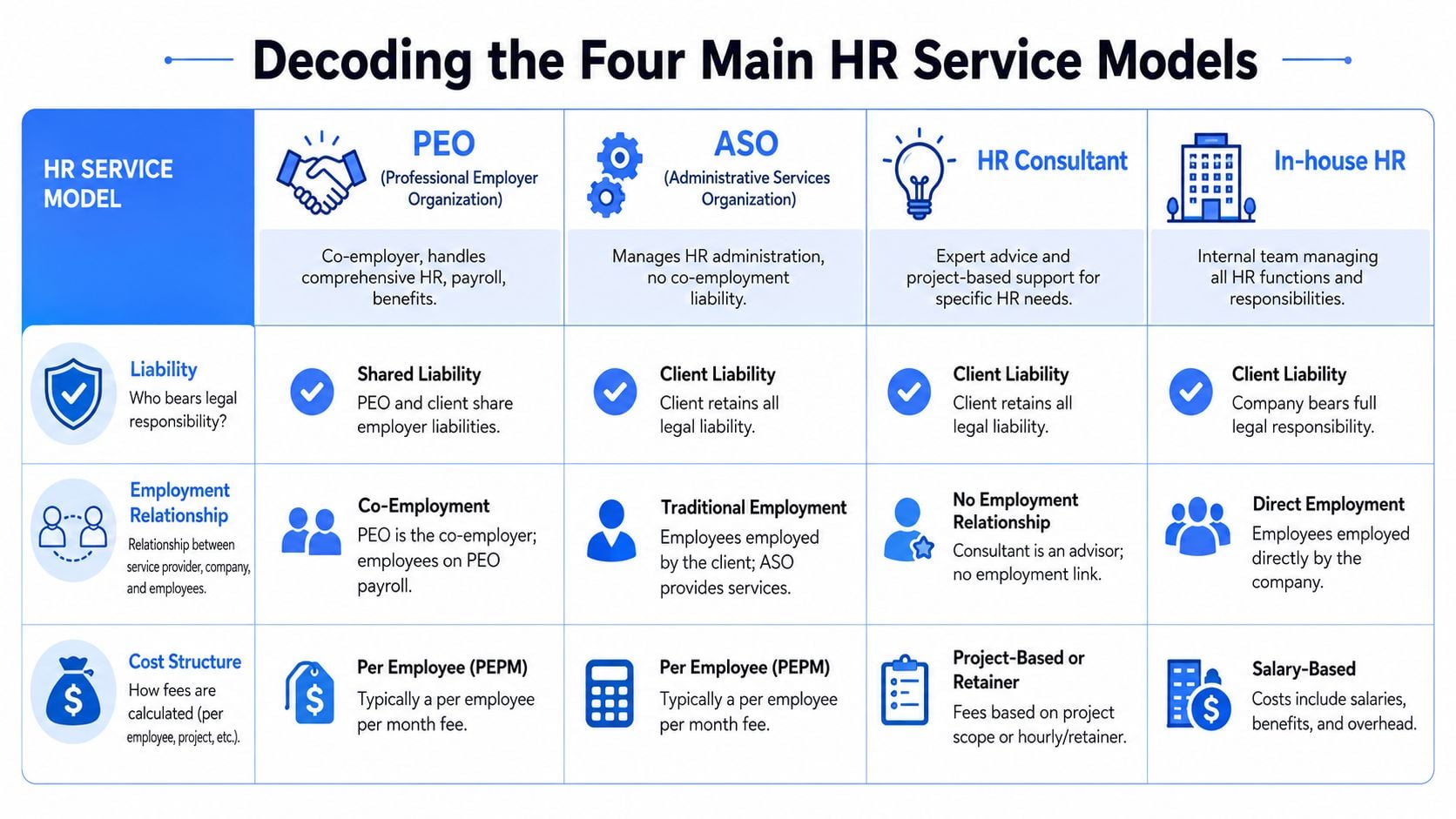
The four models most buyers run into are HR consultant, PEO, ASO, and benefits broker. Some employers also compare these against building more capability in-house, which is often a primary alternative.
Where the models actually differ
The biggest differences aren't in the sales deck. They're in liability, employment relationship, and cost structure.
| Model | Best fit | Liability posture | Typical cost shape |
|---|---|---|---|
| HR consultant | Defined projects or high-risk HR issues | Company remains the employer and executes decisions | Project fee, retainer, or scoped advisory fee |
| PEO | Companies wanting bundled HR, payroll, benefits, and compliance support | Co-employment structure changes how responsibilities are shared | Usually bundled per-employee or package-style pricing |
| ASO | Companies that want admin support without co-employment | Company remains employer of record | Administrative service fee, often modular |
| Benefits broker | Employers focused on plan design, renewals, and carrier strategy | No broad HR operating role | Typically tied to insurance placement and service support |
An HR consultant is the right answer when the problem is specific. Handbook redesign. Manager training. Compensation architecture. Sensitive employee-relations triage. This model is often underbought because it looks narrow, but narrow can be exactly right when the costliest issue is isolated.
A PEO is a broader operating model. It can make sense when the company needs payroll, HR support, compliance help, and benefits access under one umbrella. The upside is convenience and integration. The downside is that buyers often pay for breadth they don't fully use, or they accept a bundled package that hides weak economics in one area behind strength in another.
An ASO sits in the middle. It handles administration without the co-employment element. For companies with a capable internal HR lead, this can be a strong fit because it preserves control while offloading repetitive processing and selected back-office functions.
A benefits broker is narrower than many buyers assume. A good broker can materially shape the employee benefits experience and renewal strategy, but a broker isn't a substitute for broad HR operations, policy management, or payroll process discipline.
A fast way to sort the options
A practical sorting method is to ask four questions in order:
- Is the biggest problem strategic, administrative, or insurance-driven?
- Does the company want to retain full employer control, or is a co-employment structure acceptable?
- Is internal HR strong enough to execute after advice is delivered?
- Does the company need one bundled partner, or a smaller set of specialists?
If the need is broad but the internal team is thin, the search often moves toward bundled providers. If the need is targeted and internal execution is strong, the better buy is often a consultant, a broker, or a modular administrator.
Buyers evaluating providers in this market usually benefit from a structured HR services provider comparison that separates service model from service quality. Otherwise, a polished broker proposal gets compared to an ASO contract and a PEO benefits package as if they're the same product. They aren't.
The right question isn't "Who offers the most services?" It's "Which services solve the company's actual bottleneck without creating new cost or complexity elsewhere?"
Matching the Right HR Solution to Your Company Stage
The right model changes as the company changes. Headcount matters, but headcount alone doesn't decide the issue. Complexity does. Multi-state hiring, messy manager practices, weak reporting, fragmented systems, and thin HR leadership usually force a reevaluation faster than simple growth does.

Early-stage companies
A smaller employer with a straightforward workforce often doesn't need a full outsourced HR stack. If payroll is stable, employee relations are limited, and leadership is still hands-on, a practical combination can be payroll software, a solid benefits broker, and targeted consulting when policy or compliance issues surface.
This is especially true for startups that are still finding their operating rhythm. A founder-led team may need speed and flexibility more than a bundled enterprise-style relationship. For those evaluating a co-employment path early, a focused look at PEO options for startups is usually more useful than generic HR outsourcing content.
Growth-stage employers
The model often changes once the company starts hiring across states, adds layers of management, or sees recurring payroll and benefits questions consume internal bandwidth. At that point, implementation quality starts to matter as much as the service list.
According to HR University's explanation of HR technology consulting and implementation, complex HR solution rollouts typically follow planning, build and test, and go live phases. That's a useful lens for buyers. A provider that can't map workflows, test handoffs, and manage adoption will create downstream friction even if the proposal looks extensive.
A growing employer that also relies on freelance or flexible staffing may need adjacent hiring infrastructure, not just HR administration. In that context, resources on business solutions for talent can help leadership think through how talent acquisition model and HR service model interact.
Mid-market companies
At the mid-market level, many companies already have an HR leader or team that can own policy, employee relations, and manager support. Those companies don't always need a PEO. They may need an ASO for payroll and benefits administration, a broker for plan strategy, and occasional specialist consulting for compensation, org design, or compliance.
The trigger points are usually operational:
- Multi-state expansion starts creating policy and tax complexity.
- M&A or restructuring activity exposes process inconsistency.
- Manager quality varies and employee-relations issues become more expensive.
- Systems don't talk to each other and reporting credibility drops.
When those conditions show up, the question shifts from "Do we need outside HR help?" to "Which model handles our workflows with the least waste?"
Calculating the True Cost and Value of an HR Solution
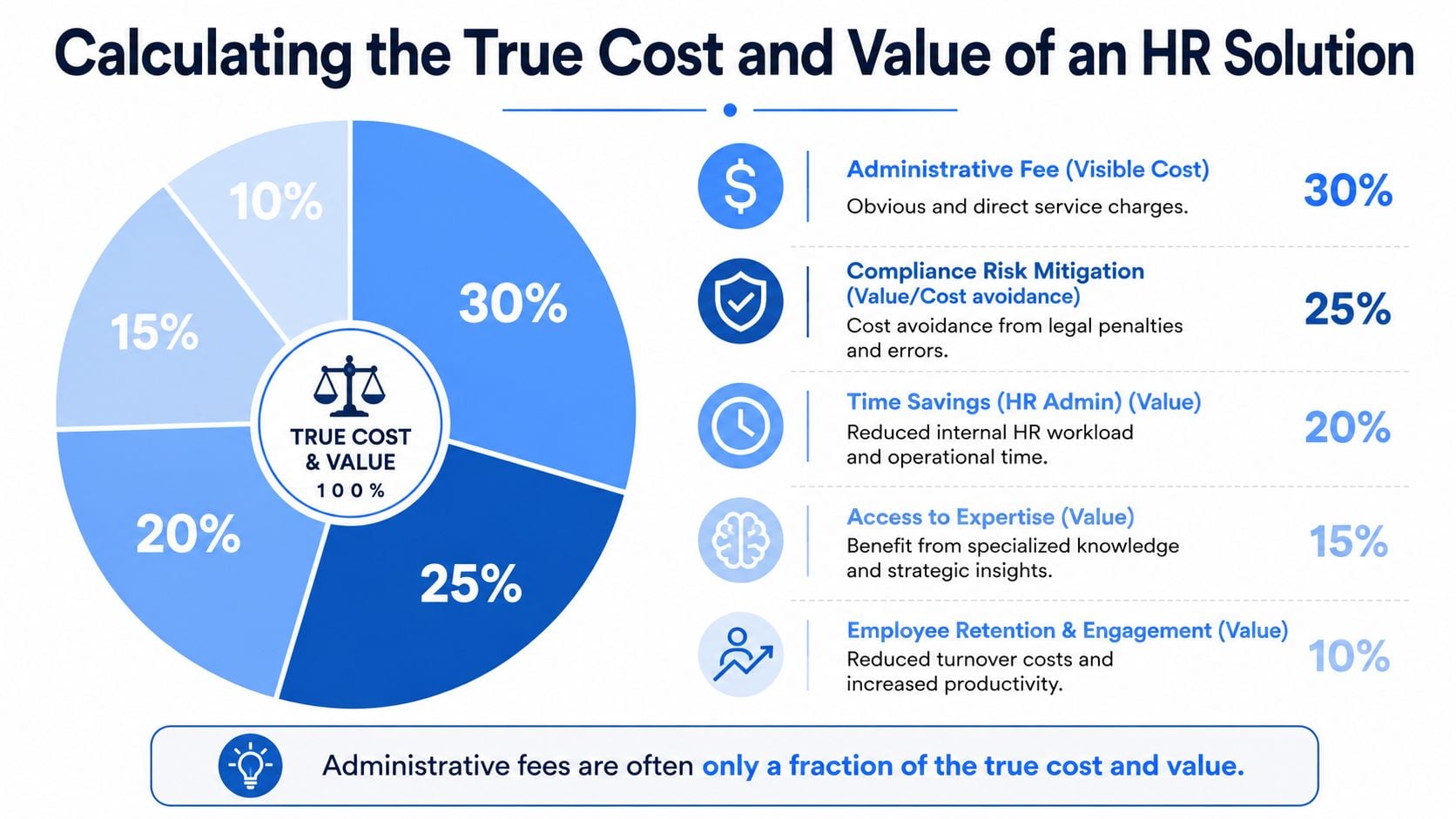
The most common buying mistake is simple. Teams compare admin fees and treat everything else as secondary. That's the wrong frame.
A cheaper administrative line item can still produce a more expensive overall result if the benefits package is weaker, implementation is rough, data reporting is poor, or the company ends up paying internally to fix process gaps the vendor didn't cover.
The wrong way to compare vendors
A narrow fee comparison usually misses five things:
- Benefits economics: A lower platform fee doesn't help if the medical offering is a poor fit for the workforce or if contribution strategy becomes harder to manage.
- Internal labor load: Someone still has to answer employee questions, reconcile data, manage exceptions, and chase deadlines.
- Risk concentration: Narrow HR errors aren't equally costly. A bad handbook, weak manager documentation, or payroll workflow failures can create outsized problems.
- Implementation friction: Bad onboarding creates rework. Rework creates cost.
- Contract drag: Exit charges, renewal mechanics, and vague pricing language all affect real cost.
The sharper question is when project-based consulting is smarter than ongoing outsourcing. As noted in HR University's discussion of HR consulting services for small business, many firms overbuy broad HR coverage when their highest-cost risks are narrow, such as handbook issues or inconsistent manager training.
Buy breadth only when the company has broad problems. If the expensive risk is concentrated, targeted consulting often delivers better economics than a permanent bundle.
A better total-value model
A usable framework has four buckets.
1. Direct service cost
This is the visible piece. Admin fees, consulting fees, implementation fees, and any add-on charges for services that looked included but aren't.
2. Workforce cost impact
For bundled models, benefits strategy matters. So do payroll process quality and leave administration discipline. Even when the proposal doesn't break these items out cleanly, the buyer should force the model to show where workforce-related costs may rise or fall.
3. Risk reduction value
Many CFOs get skeptical because vendors speak in vague promises. The discipline here is to stay specific. Which exact risks is the provider reducing? Wage and hour process errors? Employee documentation gaps? Policy inconsistency? ACA reporting support? If the answer is generic, the value claim is weak.
4. Operating efficiency
How much internal time gets eliminated, and whose time is it? An HR coordinator's time and a controller's time don't carry the same organizational value. Neither does executive time spent resolving recurring admin failures.
A short decision grid helps:
| Question | If answer is yes | Likely implication |
|---|---|---|
| Are the biggest HR problems isolated? | Targeted issue, not broad dysfunction | Consulting may beat full outsourcing |
| Is internal HR execution strong? | Team can implement advice | Modular support can work well |
| Are systems fragmented? | Data and process problems are frequent | Implementation capability becomes critical |
| Is leadership buying for convenience alone? | Broad bundle is the attraction | Risk of overbuying is high |
For more disciplined financial comparison, a PEO total cost of ownership analysis is the kind of exercise that forces all those hidden variables into one decision memo instead of burying them in separate vendor files.
How Independent Analysis Drives Better Outcomes
Most bad HR service decisions don't come from obvious negligence. They come from reasonable people reviewing incomplete information. The proposal looks detailed. The demo goes well. References are positive. Then the buyer discovers that one favorable line item masked a bigger disadvantage somewhere else.
Story one when the low fee was the expensive choice
A technology company with about sixty employees focused heavily on the administrative fee in a bundled HR proposal. On paper, the number looked competitive. Leadership was ready to sign because the vendor also promised a smoother support model and a cleaner employee portal.
The problem surfaced when the benefits package was reviewed side by side against comparable alternatives. The medical plan design and contribution impact didn't hold up well. The lower visible fee had distracted the team from the more expensive part of the decision. The proposal wasn't fraudulent. It just wasn't the lowest-cost option once the full package was evaluated.
Independent review matters most when two providers sound equally credible. That's usually where hidden cost differences live.
Story two when a company had outgrown the bundle
A larger employer with an established HR team assumed it had outgrown its PEO and needed to bring more work in-house. That instinct was partly right and partly wrong. The company didn't need the full co-employment bundle anymore, but it also wasn't ready to run every administrative process internally without creating strain.
A better answer was to separate the stack. Payroll and selected administration could sit with a narrower outside provider. Benefits strategy could move to a different lane. Internal HR could own employee-facing work that required judgment. That kind of restructuring often looks less elegant than a single-vendor model, but it can fit the operating reality much better.
For talent-heavy companies, the same principle applies on the recruiting side. A hiring team may also need independent validation of candidate quality rather than relying solely on platform claims, which is why resources like WorkSignal's unique screening comparison can be useful alongside HR vendor due diligence.
When buyers want a neutral view of pricing, benefits, contract terms, and provider fit, firms such as PEO Metrics and similar PEO advisory options can serve as a separate analytical layer before a contract gets finalized.
Your Provider Selection Checklist and Contract Red Flags
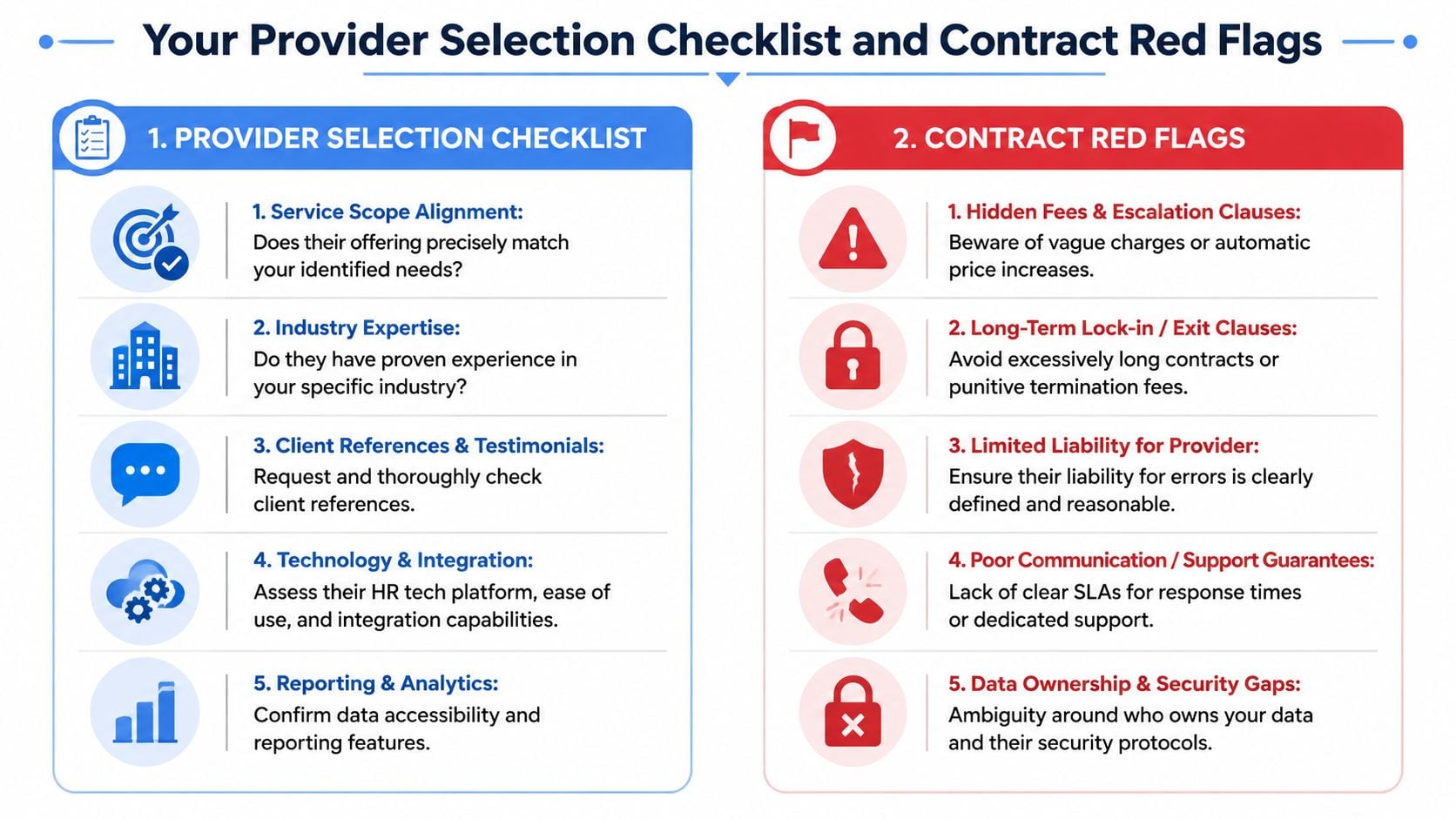
A strong proposal can still hide weak execution. The diligence process should test how the provider operates once employees start calling, payroll exceptions show up, and leadership asks for reporting on short notice.
What to verify before signing
The first diligence item is technology quality. According to Avado's guidance on measuring the ROI of HR consulting services, an effective solution should create a single source of truth for employee data, which improves reporting reliability and reduces reconciliation errors across HR, payroll, and benefits workflows.
That standard leads to a practical checklist:
- Data integrity: Ask how employee data syncs across payroll, benefits, and HR records. If exports and manual rekeying are common, reporting quality will suffer.
- Service model: Clarify whether support comes from a dedicated team, pooled service center, or hybrid structure.
- Workflow fit: Have the provider map a few real scenarios, not generic ones. New hire onboarding, off-cycle payroll change, leave request, and multi-state tax update are good tests.
- Reporting access: Confirm who can pull reports, how often data refreshes, and whether finance can get usable exports without opening a ticket.
- Reference quality: Speak with clients that resemble the company's size, state footprint, and workforce mix.
Contract terms that deserve pushback
The red flags are usually predictable.
- Auto-renewal traps: Watch for short notice windows that force renewal unless termination is submitted far in advance.
- Vague price increases: If annual adjustments aren't defined clearly, the vendor has room to reprice aggressively.
- Implementation charges: Push for specifics on setup work, data migration, training, and post-launch support.
- Exit friction: Check for termination fees, required notice periods, and extra charges tied to data extraction or transition support.
- One-sided liability clauses: If the contract sharply limits provider responsibility for errors while leaving the employer exposed, legal review should slow the process down.
A contract doesn't need to be perfect. It does need to be understandable, operationally workable, and balanced enough that the provider shares meaningful accountability.
Negotiating Your HR Service Agreement
Most HR service agreements are more negotiable than buyers assume. Negotiating power derives from clarity. A company that knows its must-haves, understands competing models, and has pressure-tested total value is much harder to oversell.
A short list of negotiation levers tends to matter most:
- Rate protection: Ask for multi-year administrative rate locks or clearly defined caps on increases.
- Implementation relief: Request waived fees, credits, or phased billing if the company is a clean implementation candidate.
- Service levels: Put response-time standards, escalation paths, and account-team structure into the agreement or an exhibit.
- Renewal language: Narrow the auto-renewal window and require advance notice of pricing changes.
- Scope clarity: List what is included, what is billable, and what triggers extra charges.
- Data and transition rights: Make sure the company can retrieve its data cleanly and exit without avoidable disruption.
The negotiating posture should be simple. If a provider wants a long relationship, it should be willing to document how that relationship will work when things are easy and when they aren't.
A disciplined evaluation usually saves more than a rushed one, especially when the buyer is comparing PEOs, ASOs, brokers, and consultants on different terms. PEO Metrics provides independent side-by-side analysis of provider pricing, benefits, contract terms, service models, and negotiation levers so HR and finance teams can make a cleaner decision before signing.
