
Most advice on HR consulting rates starts with the wrong question. Buyers ask, “What's your hourly rate?” and assume the lowest clean-looking number wins. That works for commodity work. It doesn't work for HR support tied to compliance, employee relations, benefits strategy, handbook updates, investigations, or a PEO transition.
A CFO might get three quotes for what sounds like the same need and still have no usable comparison. One consultant quotes hourly. Another quotes a monthly retainer. A third proposes a fixed fee with follow-on support billed separately. All three may be reasonable. All three may also produce very different total costs by the time the work is done.
That's why the useful question isn't “What are HR consulting rates?” It's “What will this cost in total, what outcome is included, and what risk is being reduced?”
Table of Contents
- Why Asking for an Hourly Rate Is the Wrong First Question
- The Four Common HR Consulting Pricing Models
- What Really Drives HR Consulting Costs
- Benchmarking Real-World HR Consulting Rates in 2026
- Consultant vs PEO or ASO Which Is Right for You
- How to Get Accurate Quotes and Negotiate with Confidence
Why Asking for an Hourly Rate Is the Wrong First Question
Hourly pricing sounds simple, but it hides the variables that determine cost. The clearest example is that HR support can be sold in several forms at very different price points. Paradigmie's 2026 guide on HR consultant hourly rates notes that fractional HR can run from $1,500 to $7,000 per month, retainers can reach $10,000 to $25,000+ per month, and project fees can range from $8,000 to $100,000+, which makes a simple hourly quote a weak comparison point.
That's why buyers who shop only on headline rate often end up with budget surprises. A lower hourly rate can still produce a higher invoice if the scope is vague, approvals are loose, or the consultant bills separately for implementation, manager training, policy rewrites, and follow-up calls. A higher rate can be the cheaper option if the work is tightly scoped and done by someone who gets it right the first time.
What the hourly number leaves out
A single rate usually doesn't tell a buyer:
- What's included: policy drafting, live advice, document review, training, vendor coordination, and implementation may all be priced differently.
- Who does the work: senior advisor time and junior support time may be blended, separated, or hidden.
- How much access exists: some firms quote a rate but require minimum blocks, monthly minimums, or rush fees.
- What risk is being transferred: the cost of basic handbook edits isn't the cost of multi-state compliance review.
Practical rule: If two HR proposals use different pricing models, they are not comparable until the buyer converts them into an estimated all-in cost for the same scope.
For companies evaluating broader support options, the better move is to benchmark the operating model first, then the rate. A business deciding between ad hoc consulting, outsourced HR, and a bundled provider should compare service structure before comparing hourly billing. That's also why many teams start with an HR services provider comparison instead of a narrow rate hunt.
The Four Common HR Consulting Pricing Models
The right pricing model depends on how defined the work is, how often support is needed, and whether the buyer wants advice only or actual execution. Four models show up most often in the market.
Hourly pay as you go
This is the easiest model to understand. The consultant tracks time and invoices for hours worked.
It fits short questions, one-off reviews, manager coaching, or situations where no one can define the full scope yet. It also works when a company wants to test the relationship before committing to a larger engagement.
The problem is cost drift. Hourly billing looks flexible at the start and messy by month two if nobody set approval thresholds.
Monthly retainer
A retainer buys ongoing access. Sometimes that means a fixed block of time. Sometimes it means a service bundle with recurring advisory support, employee relations guidance, and periodic policy help.
Retainers work well for companies that need frequent support but don't want a full internal hire. They also make sense when HR issues arrive unpredictably across payroll, performance management, leave questions, and compliance.
The catch is underuse or overuse. Some teams pay for access they barely use. Others assume “unlimited” means implementation is included and discover that project work is billed separately.
Project based fee
This model is best when the deliverables are concrete. An employee handbook update, a compensation framework, a compliance audit, an HR due diligence workstream, or a training rollout can all be scoped as projects.
A fixed fee improves budget predictability. It also forces both sides to define deliverables up front, which is healthy. But fixed fee pricing only works when the buyer is disciplined about scope. If the project starts as “update the handbook” and turns into “rewrite policies, train managers, align multi-state leave rules, and revise onboarding documents,” the fixed fee won't stay fixed for long.
Per employee per month
This is common with outsourcing arrangements and some broader HR support models. Instead of paying for hours or a project, the employer pays a recurring amount tied to headcount.
For a finance team, this model is clean. It scales with the workforce and is easier to forecast. It can also be the most practical model when the buyer wants recurring administration plus access to HR advice.
The downside is that PEPM pricing can hide the true service mix. A low per-employee fee may cover only light-touch support. A higher fee may include more hands-on administration, system support, or compliance help. Without a detailed service schedule, a PEPM quote can be just as opaque as an hourly quote.
HR Consulting Pricing Model Comparison
| Model | How It Works | Best For | Key Pro | Key Con |
|---|---|---|---|---|
| Hourly | Pay for time used | Ad hoc advice, undefined scope, short matters | Flexible entry point | Hard to budget if scope expands |
| Monthly retainer | Recurring fee for access or bundled support | Ongoing advisory needs | Predictable monthly spend | Risk of paying for unused access |
| Project-based fee | Fixed price for specific deliverables | Handbooks, audits, training, implementations | Budget clarity | Change orders if scope grows |
| Per employee per month | Recurring fee tied to headcount | Outsourced or scalable support | Easy forecasting | Service depth may be unclear |
Buyers comparing these models against outsourced operating structures should also review how human resources outsourcing changes who owns administration, advice, and execution. That distinction drives cost as much as the fee structure itself.
What Really Drives HR Consulting Costs
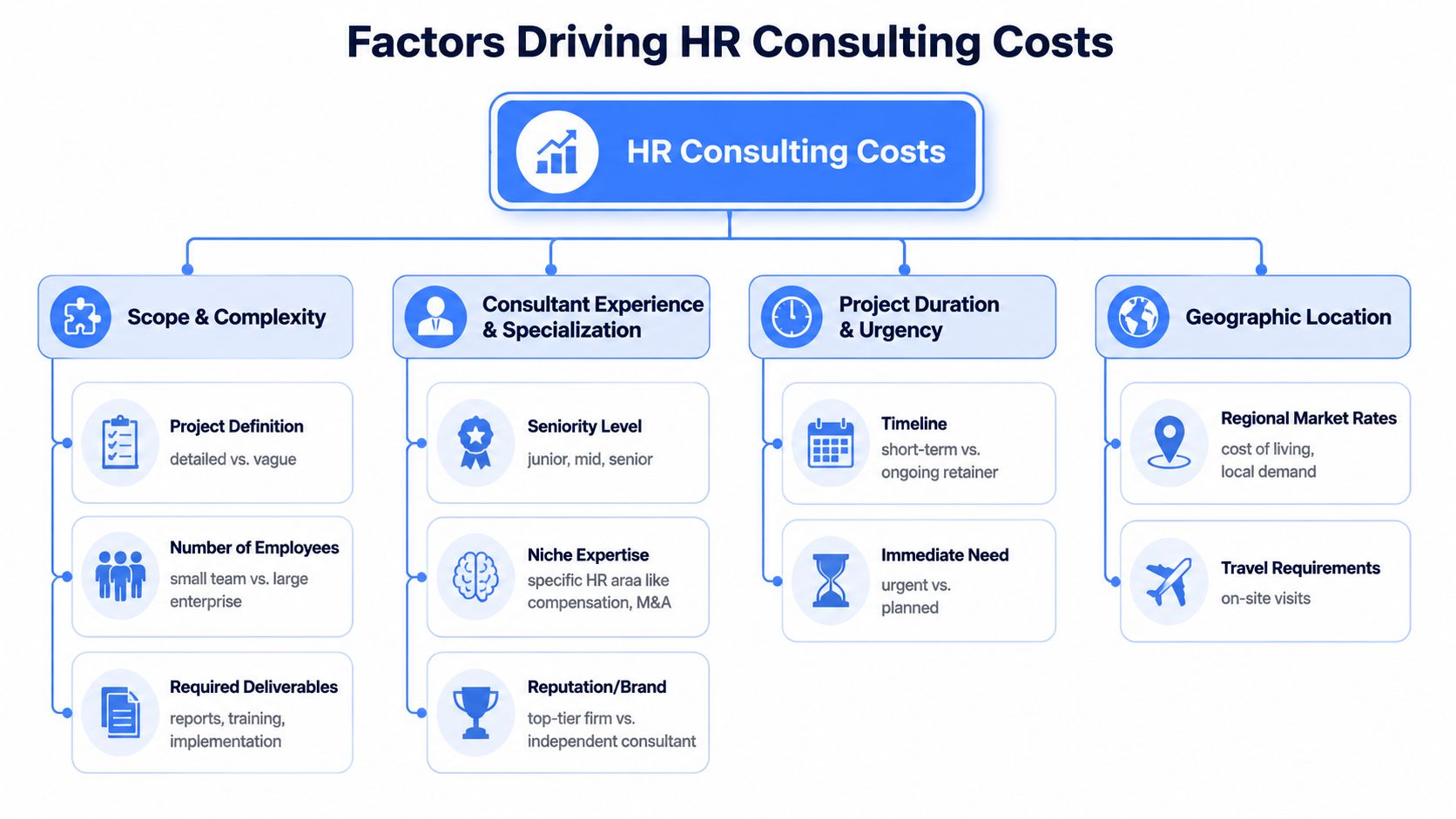
The invoice isn't driven only by the pricing model. Cost moves because the work itself changes. Scope, risk, urgency, and expertise all reshape the quote.
Scope changes the economics fast
A single-state policy review and a multi-state compliance overhaul aren't close to the same assignment, even if both are called “HR support.” One may involve light editing. The other may require legal issue spotting, documentation mapping, manager guidance, and implementation planning.
The same thing happens with employee count and internal complexity. A company with one decision-maker and straightforward operations is cheaper to support than a business with multiple departments, inconsistent manager practices, and legacy policies spread across different systems.
A useful test is to ask whether the consultant is being asked to advise, produce deliverables, or drive implementation. Those are three different scopes. Buyers often request all three while assuming they're paying for one.
Experience and specialization carry a premium
Specialization moves rates materially. Boardroom Advisors' pricing guide for HR consultants notes that general advisory work may fall in the $85 to $225 per hour range, senior consultants may charge $125 to $325 per hour, and high-stakes strategic work or advice from former HR executives can climb to $200 to $450+ per hour.
That spread makes sense in practice. Generalist support is useful for routine policy work, standard documentation, and day-to-day issue handling. A former HR leader or specialist becomes worth the premium when the company needs executive judgment, sensitive employee relations handling, compensation design, organizational change support, or compliance-heavy decision-making.
Paying senior rates for clerical policy cleanup is wasteful. Paying junior rates for a high-risk investigation is usually the more expensive mistake.
Urgency geography and delivery model matter
Urgent work costs more because it displaces other work. Buyers often miss that rush pricing may not appear as a separate line item. It can show up as a higher blended quote, a minimum fee, or a narrower scope with follow-on billing.
Geography also matters. Senior U.S.-based consultants can charge meaningfully more than offshore or lower-cost regional firms. That doesn't mean the cheaper option is wrong. It means the buyer has to test whether the lower-cost provider understands the labor rules, benefits environment, and operational context the company faces.
A final driver is how the work is delivered. Remote advisory support is usually simpler to price than on-site facilitation, executive workshops, or implementation meetings involving multiple stakeholders. More coordination means more billable time, even when the underlying advice is similar.
Benchmarking Real-World HR Consulting Rates in 2026
Buyers still need benchmarks. The mistake is treating the benchmark as the decision. A good benchmark tells a CFO whether a quote is inside the normal market band for the type of work being requested.
General advisory baseline
For U.S. buyers, Dakota Blue Consulting's 2025 HR consultancy pricing guide reports a median hourly HR consulting rate of $142.38, with a common range of $96.19 to $188.57. The same source reports that in the UK, pay-as-you-go HR advice typically runs £100 to £200 per hour and monthly retainers often range from £500 to £2,500.
Those numbers are useful as a baseline for generalist advisory support. They should not be treated as the right price for every engagement. They tell the buyer where ordinary market pricing tends to land before the work gets more specialized.
That same source also notes that hourly pricing is the most common model at 36%, followed by monthly retainers at 25% and fixed-price projects at 23%. That matters because buyers can often ask the same provider to quote the work in more than one format.
Senior and specialized support
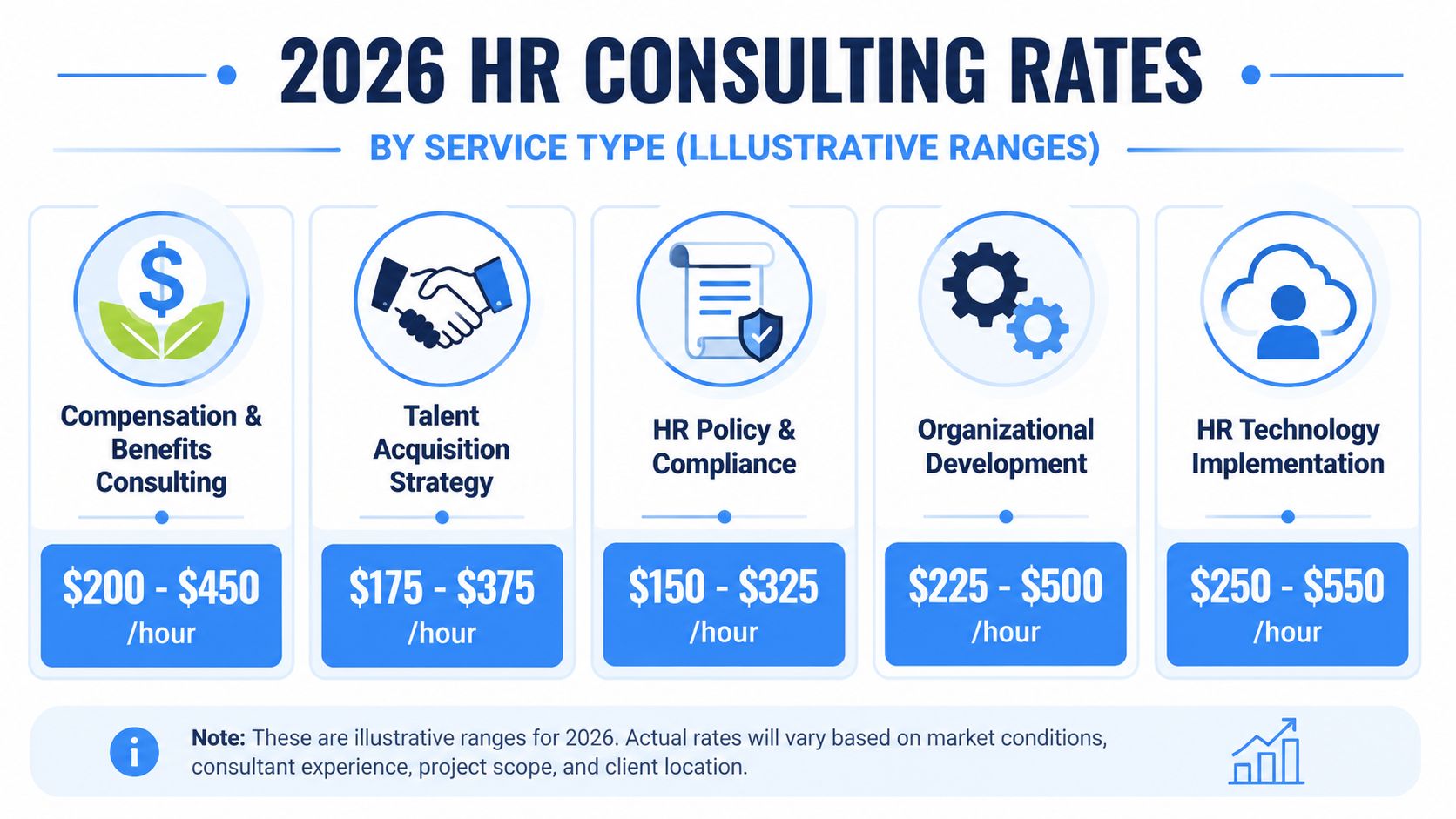
When the work requires strategic judgment, the benchmark moves. Verified U.S. market data places mid-level generalists at $125 to $175 per hour and senior-level practitioners with 15+ years of experience at $175 to $325 per hour. For higher-risk or executive-level work, other verified pricing guidance puts senior U.S.-based consultants in the $125 to $325 per hour band, while some specialized strategic advisors and former HR executives may quote $200 to $450+ per hour.
A buyer should expect those premiums when the assignment touches areas like:
- Compensation design: where a bad decision can create employee relations and retention problems.
- Organizational development: where leadership alignment and change execution matter as much as the recommendation.
- Fractional CHRO work: where the consultant is filling a strategic leadership gap, not answering occasional HR questions.
- Compliance-heavy advisory: especially when policies, leave rules, or employee actions span multiple states.
Retainers and fixed fee work
Project and retainer economics often matter more than hourly economics. Verified pricing guidance shows fixed project work such as creating or updating an employee handbook commonly costs around £350 to £750 in the UK market, based on the earlier Dakota Blue source. Verified U.S. guidance also places high-stakes projects such as change management or compliance audits in the $25,000 to $100,000+ range, depending on scope and risk.
For recurring strategic support, verified market data puts fractional HR at $1,500 to $7,000 per month and senior HR Business Partner or Fractional CHRO retainers at $6,000 to $25,000+ per month, with some broader retainer examples reaching $10,000 to $25,000+ per month depending on service level and expertise.
The practical takeaway is simple. HR consulting rates make sense only when tied to a use case. For companies comparing embedded support inside a broader outsourcing arrangement, PEO expense benchmarking is often more useful than an isolated consultant rate.
Consultant vs PEO or ASO Which Is Right for You
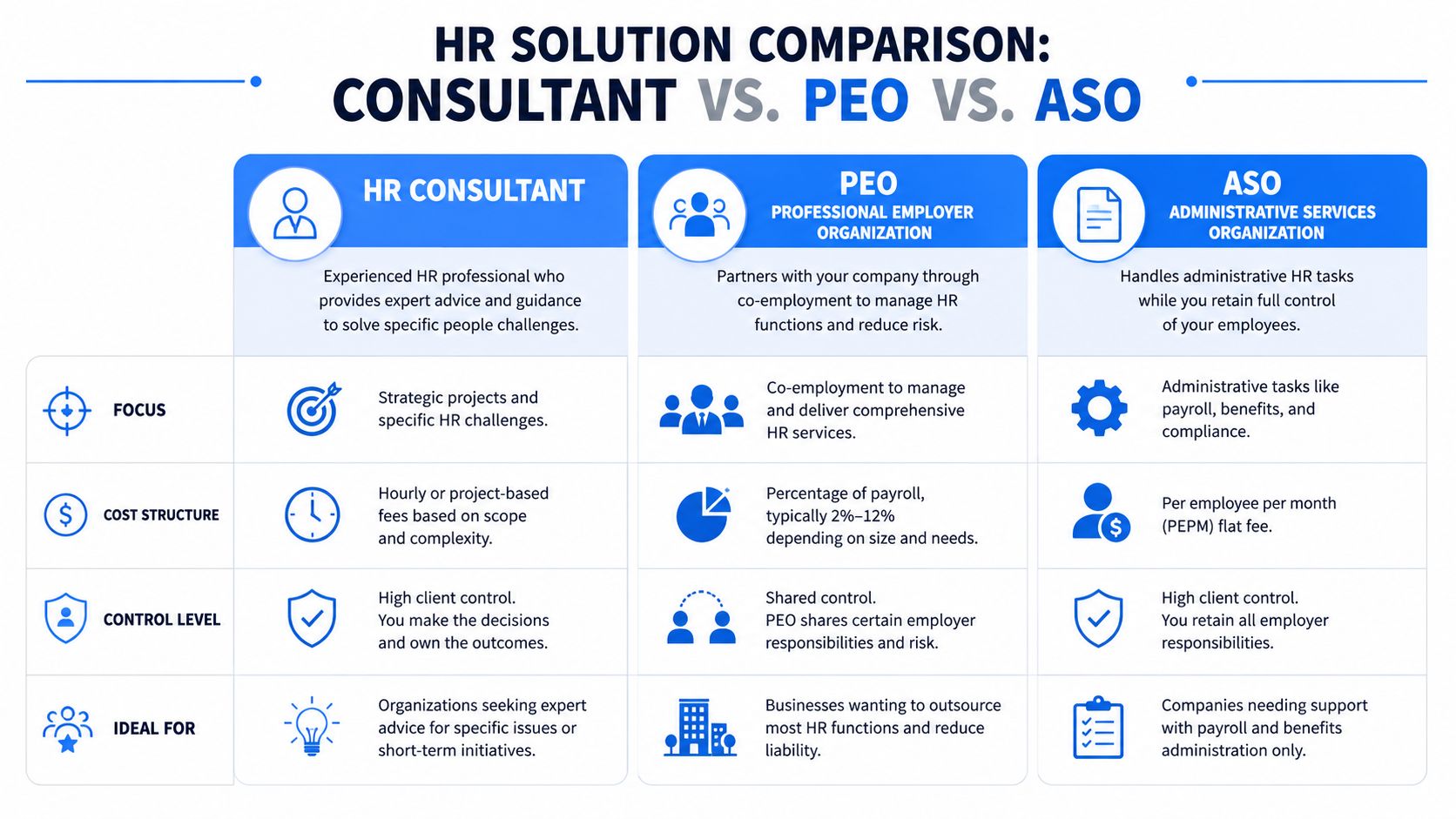
These options solve different problems. A consultant sells expertise. A PEO or ASO changes the service model behind payroll, benefits, HR administration, and support. Buyers get into trouble when they compare them as if they're substitutes in every situation.
The market is broad enough to support all three paths. Dataintelo's HR consulting service market report values the global HR consulting service market at about USD 34 billion in 2023 and projects it to reach roughly USD 54 billion by 2032, showing that buyers are choosing from a large and expanding set of service models rather than one dominant answer.
Choose a consultant when the problem is narrow or strategic
A consultant is usually the better fit when the company needs:
- Defined project expertise: handbook redesign, compensation structure work, investigation support, or an HR due diligence workstream.
- Independent judgment: especially when leadership wants advice that isn't tied to a bundled vendor relationship.
- Fractional strategic capacity: when the business needs CHRO-level thinking without buying a full administrative platform.
This path works best when internal staff can still execute most of the day-to-day work.
Choose a PEO or ASO when the issue is operating model
A PEO or ASO makes more sense when the employer needs recurring infrastructure. That usually means payroll processing, benefits administration, routine HR support, and a more systematized service model.
The distinction between those models matters. A PEO typically involves co-employment. An ASO provides administrative support without the same structure. For teams also weighing international employment models, Remotely's guide to PEO vs EOR is a useful reference because it clarifies where domestic outsourcing and employer-of-record arrangements diverge.
For buyers evaluating those trade-offs in the U.S. market, an HR consulting solutions comparison can help separate specialist consulting from bundled outsourcing options.
Where buyers get tripped up
The common mistake is buying a consultant to solve an infrastructure problem, or buying a PEO to solve a narrow strategic one.
A few examples make that clearer:
- Use a consultant: A company with an existing payroll and benefits setup needs a compensation redesign and executive coaching support.
- Use a PEO: A growing employer is tired of juggling payroll, benefits administration, employee onboarding, and general HR support across multiple vendors.
- Use an ASO: The business wants administrative help and systems support but wants to retain more direct control without a co-employment model.
A cheaper support model isn't better if it leaves the internal team doing the hard parts anyway.
One factual option in this decision process is PEO Metrics, which helps employers compare PEO providers on pricing, benefits, contract terms, service model, and fit. That's different from hiring an HR consultant for a narrow assignment.
How to Get Accurate Quotes and Negotiate with Confidence
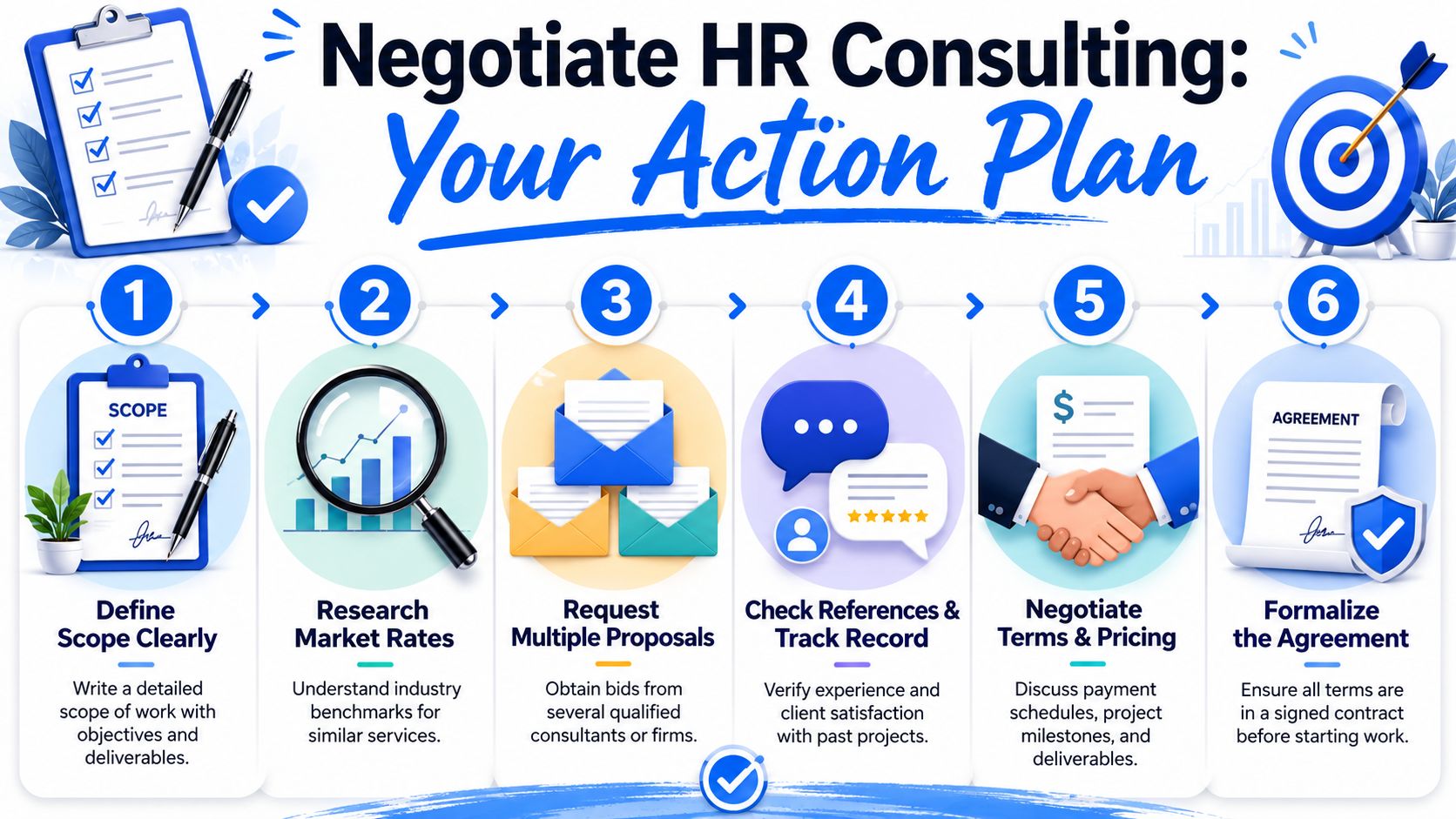
Most bad HR consulting deals start before the proposal arrives. The buyer gives a loose verbal brief, the consultant fills in assumptions, and both sides discover the mismatch after the work begins.
Build the quote request before speaking to vendors
A strong quote request should state the business problem, employee count, state footprint, required deliverables, who will review drafts, and whether implementation support is needed. If the company wants manager training, handbook rollout, system coordination, or post-project office hours, that should be written down.
Without that detail, pricing won't be comparable.
Ask for pricing in more than one format
A buyer doesn't have to accept the vendor's default model. Ask for the same scope as an hourly estimate, a project fee, and if relevant, a retainer option for follow-on support.
This does two things. It exposes where the consultant is making margin, and it shows which model best fits the company's usage pattern.
Verified market data also shows there is room to negotiate. Senior U.S.-based HR consultants may charge $125 to $325 per hour, while firms in other regions may offer similar service scopes for $50 to $80 per hour. That spread allows buyers to question whether the expertise level, service reliability, and compliance fit justify the premium.
Negotiate the parts that actually move cost
Price matters, but the bigger savings often come from terms.
Use a checklist like this:
- Approval controls: Require written approval before work exceeds a set threshold.
- Deliverable detail: Spell out draft count, meetings, implementation support, and response times.
- Role clarity: Ask who will do the work. Senior partner, manager, junior analyst, or a mix.
- Rate protection: If support may continue, ask for rate locks or capped increases.
- Exit terms: If the engagement turns into a retainer or outsourced arrangement, review termination rights and transition support carefully.
- Embedded costs: In a PEO or ASO context, ask what HR advisory cost is built into admin fees.
Buyers should negotiate the commercial structure with the same discipline they use to negotiate benefits rates or software terms.
For bundled HR arrangements, it also helps to review common PEO contract negotiation red flags before signing. The hidden cost is often in the contract language, not the opening quote.
The right goal isn't the cheapest HR consulting rate. It's the clearest scope, the most predictable total cost, and the right level of expertise for the risk involved.
If a company is comparing consultants, ASOs, and PEOs and wants an apples-to-apples view of pricing, benefits, service model, and contract trade-offs, PEO Metrics provides independent side-by-side analysis to help buyers make a more confident decision.
