
A familiar version of this problem plays out every week. A manager has lost confidence in an employee, the documentation is scattered across email and Slack, payroll doesn't know the timing, IT isn't looped in, and the company's PEO says it can “support the termination” without explaining what that means.
That's how routine separations turn into expensive mistakes. The employee leaves confused, the team starts speculating, access stays live too long, and HR is left reconstructing the file after the fact. In the worst cases, the company discovers too late that its PEO won't own much of the risk at all.
A strong termination process for employees fixes that. It turns a high-stress event into a controlled business process with clear approvals, evidence, meeting discipline, final pay handling, benefits notices, and immediate offboarding steps. It also protects dignity. A brief, direct, well-prepared termination meeting is better for everyone than a vague, emotional conversation that drags on and creates room for argument.
For companies using a PEO, there's another layer that many standard HR guides miss. The PEO can be a real compliance partner, or it can be an administrative middleman with contract language that leaves the employer carrying most of the liability. That distinction matters most during terminations, when timing, documentation, final pay, COBRA coordination, and state-specific rules all collide.
Table of Contents
- Introduction
- The Pre-Termination Audit Building a Defensible Case
- The Termination Workflow From Decision to Delivery
- Managing the Exit Final Pay Benefits and Offboarding
- The PEOs Role in Terminations Partner or Liability
- Evaluating a PEOs Termination and Compliance Support
- Conclusion
Introduction
The hard part usually isn't deciding that a termination may be necessary. The hard part is proving the company handled it correctly, consistently, and respectfully.
That distinction matters because U.S. employers often overread the phrase “at will.” In practice, terminations still need structure. They need a documented business reason, coordinated execution, and a post-meeting process that covers final pay, benefits, and system access. When any of those pieces are loose, the company invites avoidable risk.
The better approach is to treat termination as a workflow, not a confrontation. That means the manager stops improvising. HR builds the record. Payroll, IT, and legal or employee-relations support get clear instructions. The PEO, if there is one, gets pulled into the process at the right moment with specific responsibilities, not vague promises.
A clean termination process for employees doesn't make the decision easy. It makes the decision defensible.
What works is simple, but not casual. Build the file before scheduling the meeting. Write the script before speaking to the employee. Confirm final pay and benefit notices before the conversation happens. Revoke access at the right moment, not later in the afternoon when someone remembers.
What doesn't work is the common shortcut approach: “We're an at-will state, so let's just do it today.” That line has caused more trouble than most companies realize.
The Pre-Termination Audit Building a Defensible Case
A company's position gets stronger or weaker before anyone walks into the room.
At-will is not a documentation strategy
In the United States, 49 out of 50 states follow the at-will employment presumption, with Montana as the exception, but that doesn't prevent wrongful termination claims. The same guidance emphasizes preserving performance reviews, written warnings, and policy-violation records, and notes that replacing an employee can cost up to 200% of annual pay while lawsuits can exceed $100,000 according to wrongful termination and replacement-cost data summarized here.
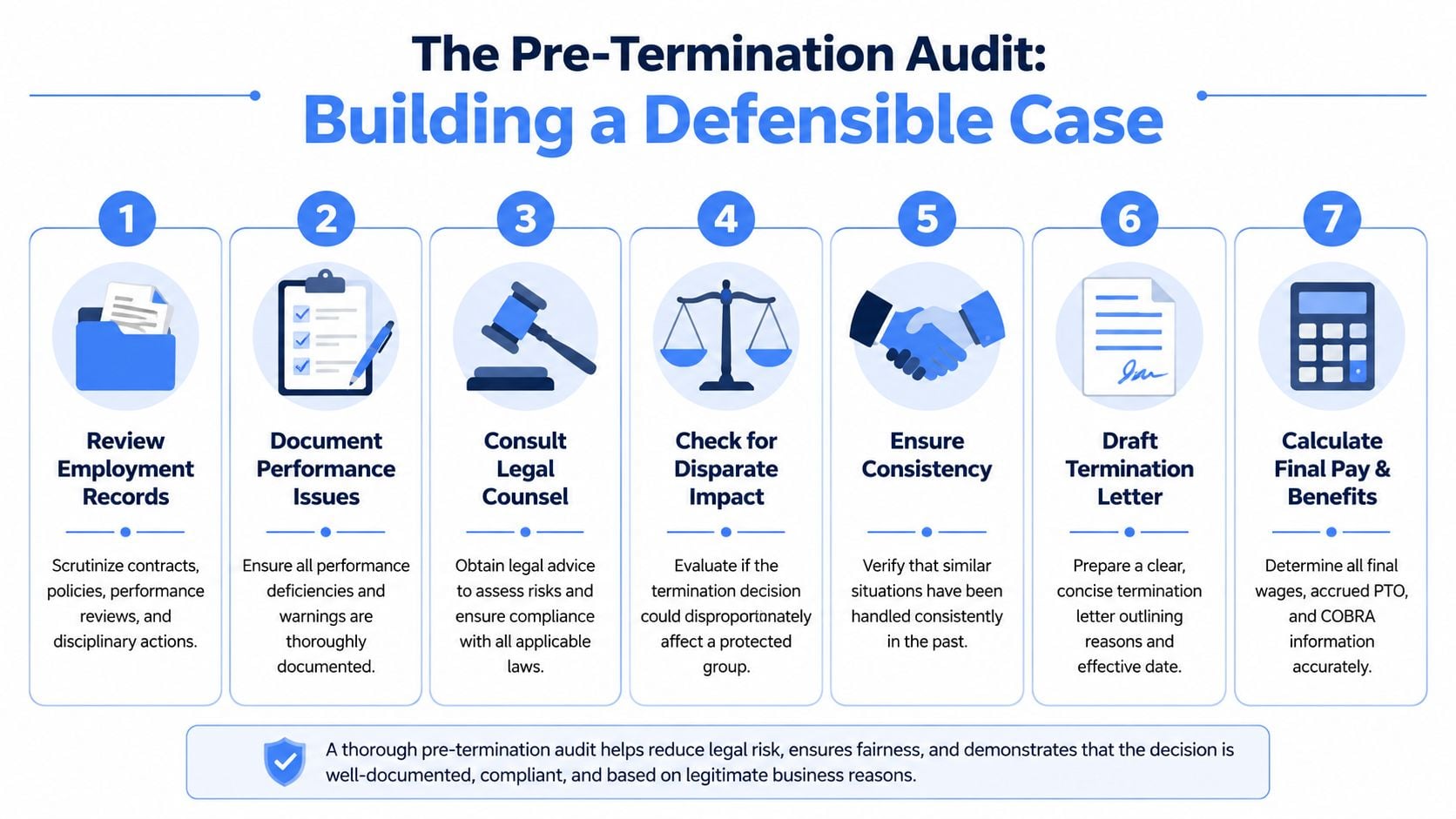
That's why the pre-termination audit matters. It answers a basic question: if someone outside the company reviewed this decision, would the file tell a clear factual story?
A weak file usually looks like this:
- Mixed messages: The employee's last review says “meets expectations,” but the manager now says performance has been poor for months.
- Missing chronology: There were coaching conversations, but no dates, no follow-up notes, and no record of what changed.
- Inconsistent enforcement: One employee was terminated for a policy violation that others were informally excused for.
A stronger file includes the basics and then goes one step further. It links the problem to business impact. Missed deadlines, customer complaints, attendance issues, failure to meet the PIP, repeated policy breaches. The file doesn't need legal theater. It needs facts.
Build the file before the meeting is scheduled
A practical audit should pull together these items in one place:
- Core employment records: Offer letter, job description, handbook acknowledgments, compensation changes, and policy acknowledgments. A clear handbook foundation matters, especially when attendance, conduct, or device-use rules are involved. With such a foundation, a solid employee handbook purpose becomes operational, not theoretical.
- Performance history: Reviews, PIP documents, written warnings, coaching notes, attendance records, and manager follow-up.
- Misconduct evidence: Complaint summaries, investigation notes, screenshots, witness statements, and policy references where relevant.
- Consistency check: Comparable cases from the same department or supervisor, so the company can see whether it handled similar situations the same way.
Practical rule: If the manager can explain the reason for termination in one sentence, the file should be able to support that sentence with dates and documents.
Many companies also benefit from building a one-page timeline. Not for the employee. For internal review. It should show when the issue began, what coaching happened, what warnings were issued, what support was offered, and why termination is now the recommended outcome.
That timeline does two things. It sharpens the company's own thinking, and it exposes weak spots early enough to fix them. Sometimes the result of the audit is termination. Sometimes it's a final warning, a revised PIP, or a decision to wait because the record still isn't strong enough.
The Termination Workflow From Decision to Delivery
A defensible termination process for employees isn't a meeting on the calendar. It's a chain of approvals, documents, logistics, and controlled execution.
Who approves what
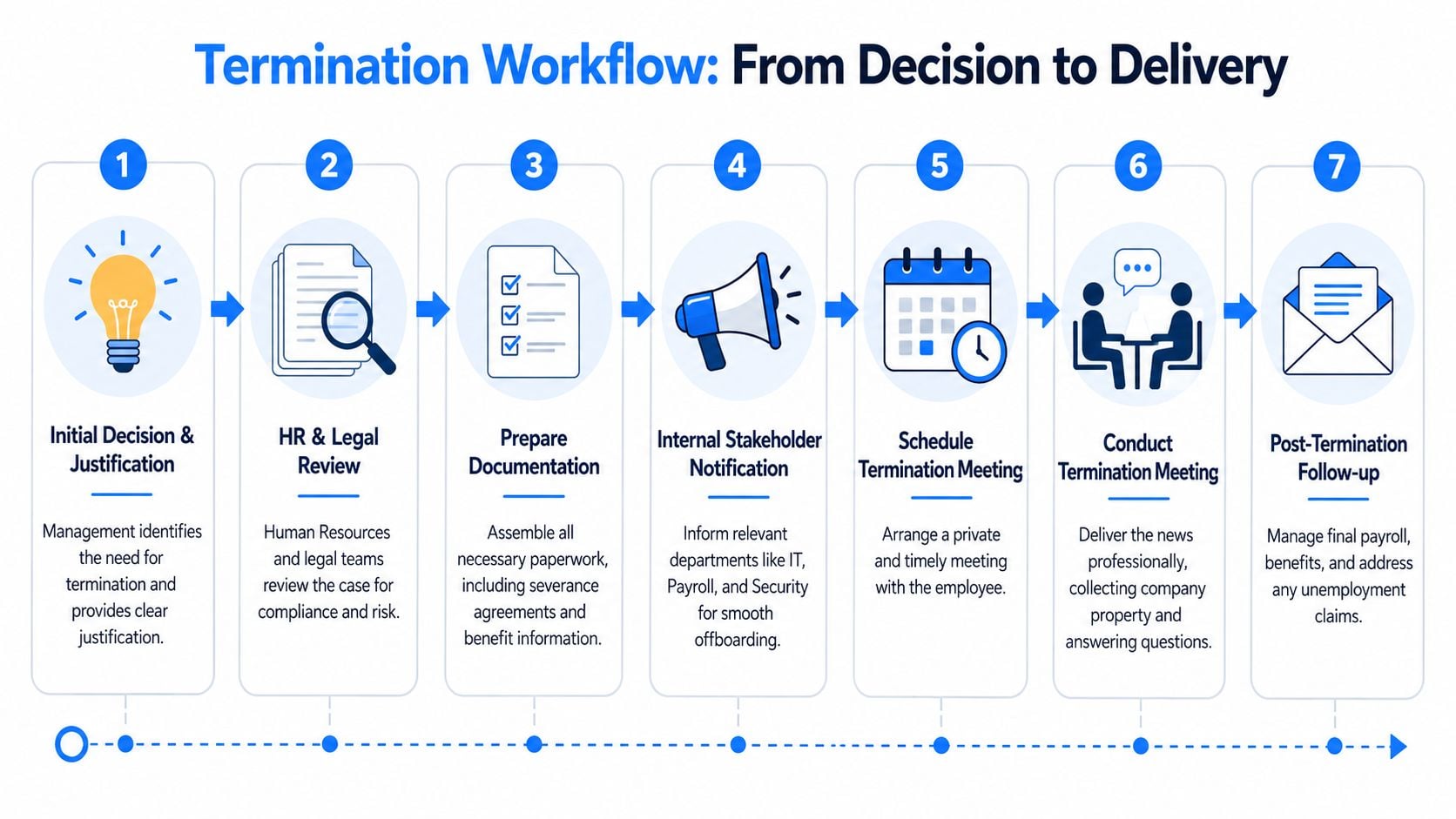
Once the case is documented, the company should define decision rights clearly. In smaller companies, that may mean the department head, HR lead, payroll contact, and outside counsel or PEO advisor. In larger organizations, employee relations, legal, IT, and security may all need a role.
The process should be documented because common failure points include moving forward without enough evidence and failing to prepare talking points or a written statement. Some high-risk processes, including a University of California benchmark, use about a two-week review window before final notice is issued, as outlined in this step-by-step termination guide.
A useful internal workflow often looks like this:
| Stage | Primary owner | What must be confirmed |
|---|---|---|
| Decision review | Manager and HR | Reason is documented and consistent with policy |
| Risk review | HR, legal, or employee relations | Protected activity, leave, complaint history, and consistency issues checked |
| Logistics | HR and operations | Meeting time, location, witness, final documents, property list |
| Offboarding prep | Payroll, IT, benefits, PEO | Final pay timing, access removal, benefits notices, account ownership |
For employers using a co-employment model, this is also the point to define whether the PEO is only advising or whether it is taking a documented role in review, paperwork, and dispute support. Companies that haven't clarified that in advance often discover the gap too late. A related issue appears in PEO termination dispute responsibility, especially when the provider's role sounds broader in sales conversations than it is in practice.
How to run the meeting without creating new risk
The meeting itself should be brief, private, and planned. A direct manager and an HR witness are usually the right combination. The manager should state the decision clearly, avoid debate, and explain next steps on pay, benefits, company property, and follow-up contact.
What works:
- Direct language: “Today is your last day of employment.”
- Fact-based explanation: “The decision is based on documented performance issues that were reviewed with you previously.”
- Controlled scope: “This decision is final. HR will walk through final pay, benefits, and property return.”
What causes problems:
- Overexplaining: Long narratives invite argument.
- Apologizing in a way that sounds uncertain: “I'm not sure this is fair, but leadership decided…”
- Freelancing: Managers adding personal opinions, promises, or side comments that conflict with the written notice.
Keep the meeting short enough that the employee leaves with clarity, not with three competing explanations.
Timing matters too. Many employers prefer earlier in the day when payroll, HR, and IT are fully available. Others choose late afternoon for team-disruption reasons. Either can work if the post-meeting steps are synchronized. What doesn't work is holding the meeting before the documents, final pay coordination, and access plan are ready.
Managing the Exit Final Pay Benefits and Offboarding
The meeting ends. The risk doesn't.
Treat post-meeting steps as a timed sequence
Best-practice execution requires immediate action on security and compliance. IT access should be disabled immediately after the meeting, company property collected, and final pay and benefits information delivered in a controlled sequence, as outlined in this employee termination process guide.
That sequence should already be assigned before the meeting starts. Payroll needs to know when final wages must be delivered under the relevant state rule. HR or benefits administration needs to trigger benefits continuation notices. IT needs a checklist that covers email, messaging platforms, HRIS access, VPN, CRM, cloud storage, and any shared credentials the employee used.
A simple post-meeting checklist often includes:
- Access shutdown: Disable core systems immediately after the meeting, not at end of day.
- Property recovery: Laptop, badge, keys, phone, documents, credit card, and any locally stored records.
- Final pay package: Final wages, unused PTO treatment where required, commissions if applicable under company policy and state law, and any separation documents.
- Benefits handoff: COBRA or continuation information, health plan timing, and the right point of contact for questions.
Companies that rely on a PEO should confirm who owns each benefits step. If that responsibility is vague, COBRA timing and notice delivery can become a blind spot. This is one place where COBRA administration responsibility under a PEO should be nailed down in writing, not assumed.
Where companies slip
The biggest operational mistake is delay. A terminated employee leaves the room, sends messages from a still-active account, downloads files, or accesses shared systems because IT wasn't aligned on timing.
Another common issue appears in notice-pay environments or multinational workforces, where the company owes pay in lieu of notice rather than active notice service. Teams that don't handle that often need a clean reference for how to calculate PILON payments so payroll and HR are using the same logic.
Security and payroll errors after a termination often look small in the moment. They become bigger when they stack together.
Offboarding should also include communication discipline. The team doesn't need details. They need continuity. A short internal note that the employee is no longer with the company, who is covering responsibilities, and where key work will transition is enough. Anything more tends to create gossip, inconsistency, or privacy issues.
The PEOs Role in Terminations Partner or Liability
A termination goes off track fast when the employer assumes the PEO is handling details that the PEO never agreed to own. I see this most often after a disputed exit. The company expects case guidance, state-specific final pay direction, and unemployment support. The provider points back to the service agreement and says the termination decision was the client's responsibility.
What a real partner does
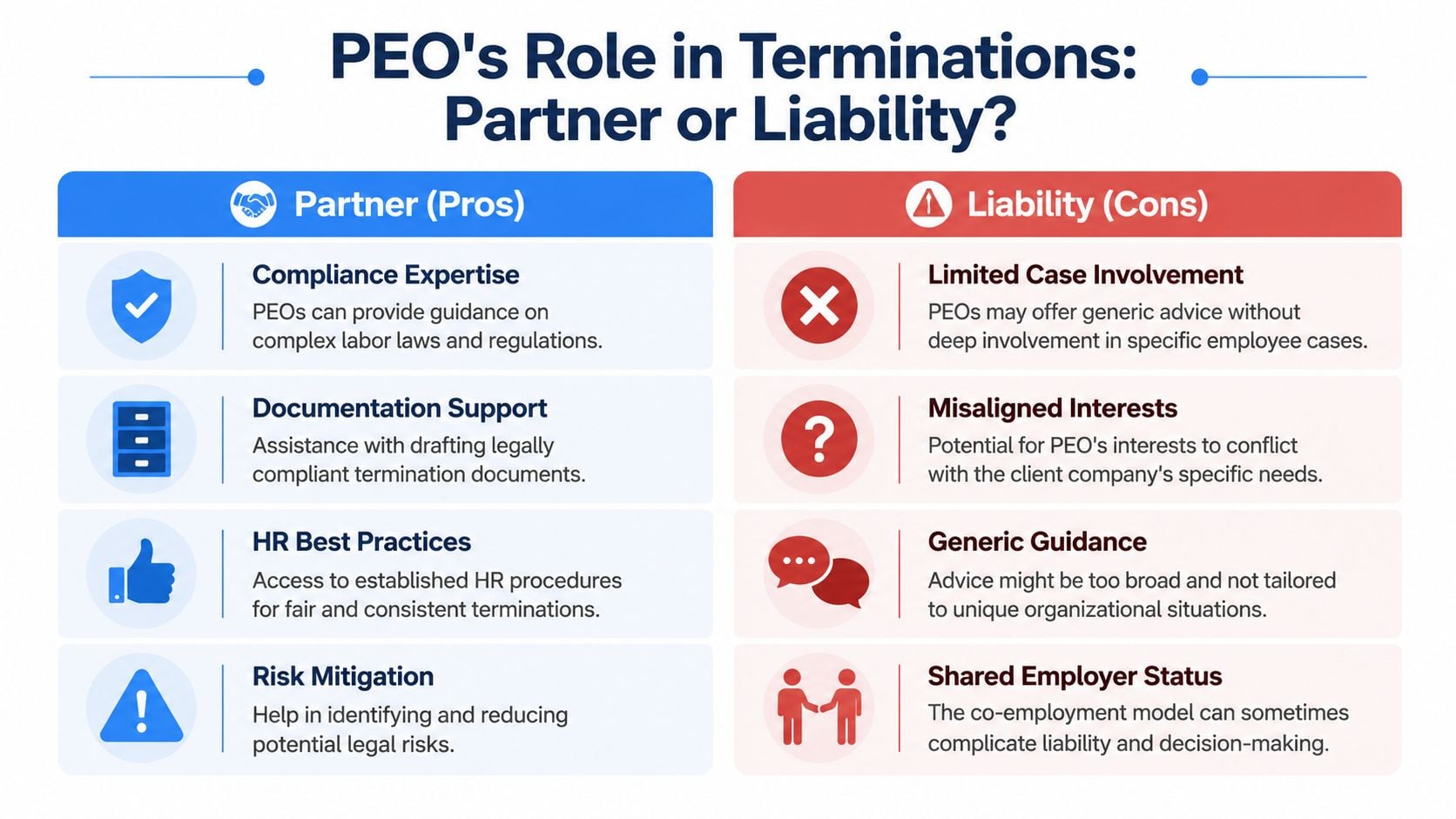
A solid PEO helps before the meeting happens, not just after paperwork is drafted. It reviews the facts you provide, checks whether the situation raises leave, retaliation, wage, or multi-state issues, and tells you if the case needs employment counsel instead of a standard HR workflow.
Good support is specific. The provider should tell you which policies apply, what approvals are needed, what documents it will prepare or review, and which tasks remain with your team. If the answer is “we provide general guidance,” treat that as a limit on accountability, not a comfort.
Ask direct questions tied to execution:
- Fact review: Will the PEO assess the employee's actual history, or only send standard policy language?
- Document ownership: Who drafts or reviews the notice, separation paperwork, and supporting file notes?
- Risk escalation: Who gets involved if the employee recently complained, took leave, or works in a different state from headquarters?
- After-action support: Who responds to unemployment notices, agency inquiries, and personnel file requests?
Those answers matter because termination mistakes are rarely caused by one dramatic error. More often, a weak handoff creates three smaller ones. An HR generalist uses an outdated template. Payroll follows the wrong state rule. The PEO declines involvement because the contract only covers administrative processing.
Contract terms that change the risk
The bigger risk usually sits in the service agreement. Many companies buy a PEO expecting shared responsibility, then learn the contract gives the provider broad discretion to advise while leaving the employer with most of the exposure if the decision is challenged.
That is why I tell clients to read the termination clauses like an insurance document. Look for who owns compliance tasks, what support is promised in writing, and what happens if the provider's guidance is incomplete or wrong. PEO Metrics has noted that employers often miss how much risk these clauses shift until a separation turns contentious.
The common problem areas are predictable:
- Broad liability waivers: The contract says the client is responsible for employment actions even when the PEO guided the process.
- Weak indemnification: The provider supports administration but does not defend or reimburse losses tied to its advice or forms.
- Vague service language: Terms like “HR support” or “compliance assistance” appear without naming final pay, notice timing, benefits continuation, or unemployment handling.
- National process language: The PEO offers one standard approach that may not match state or local termination rules.
For a closer look at how these provisions shift exposure, review this PEO termination clause risk analysis and mitigation strategy. The practical question is simple. If a termination gets challenged, can your PEO show what it reviewed, what it advised, what it owned, and where it accepted responsibility. If the contract does not answer that clearly, the PEO is an administrative vendor, not a true partner.
Evaluating a PEOs Termination and Compliance Support
Termination capability should be part of PEO selection, renewal, and quarterly service review. It's too important to leave in the category of “general HR support.”
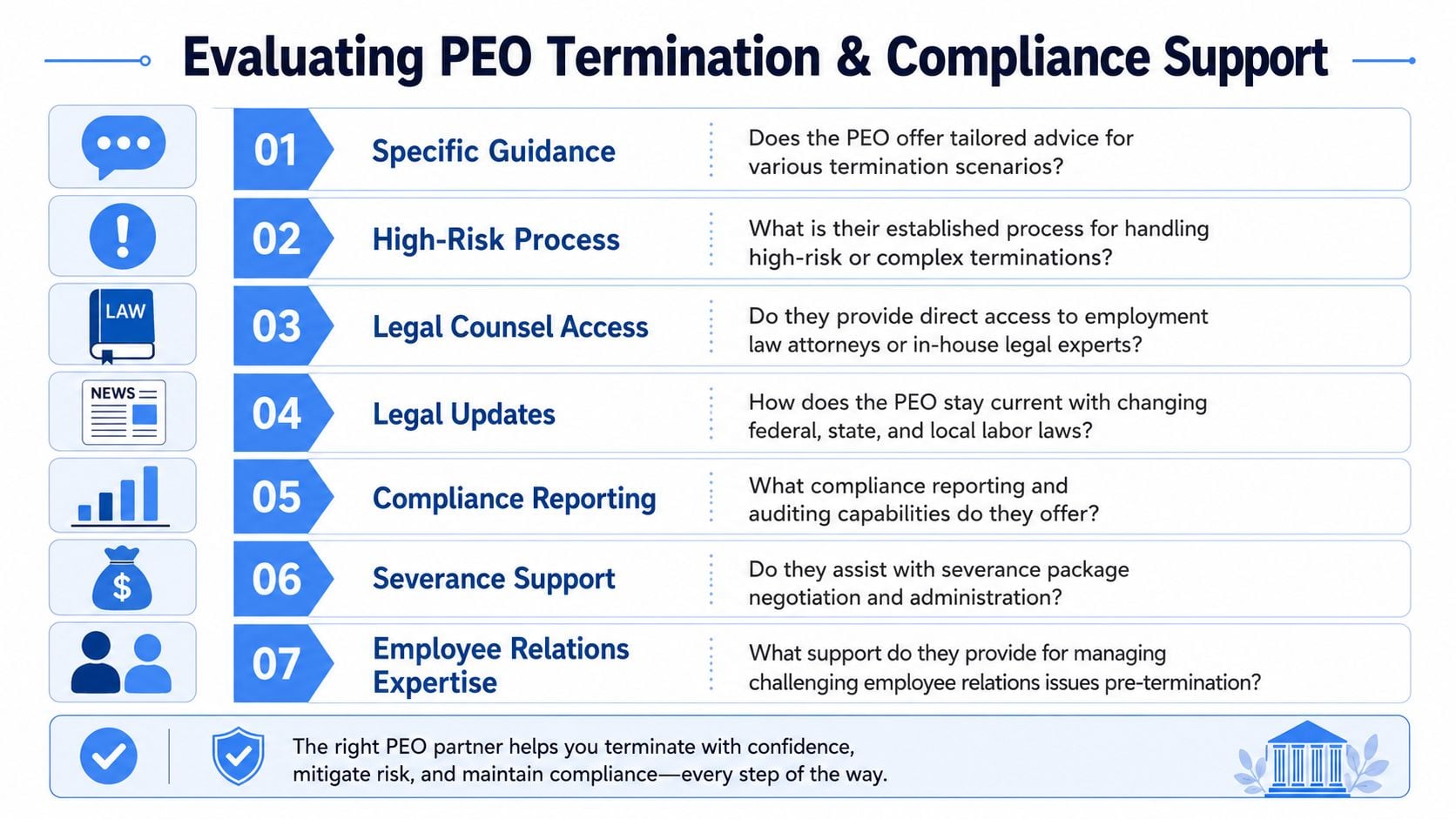
Questions that expose real capability
Start with scenarios, not marketing claims. Ask the provider to walk through a high-risk termination involving protected leave history, a remote employee in another state, disputed commissions, or misconduct with company data involved.
Useful questions include:
- What happens in a high-risk case? Ask for the actual workflow, approvals, documentation steps, and escalation path.
- Who reviews the facts? A generic HR service desk answer isn't enough if the case involves legal sensitivity.
- How do you handle state-specific final pay and notice rules? The answer should be operational, not vague.
- Who owns COBRA timing, unemployment responses, and records retention?
- Where does the contract define your liability if your guidance is wrong?
A provider that can't answer these cleanly will likely struggle under pressure.
The quality of a PEO's termination support shows up in specificity. If every answer sounds broad, the support model probably is.
This is also the point where some employers use an independent comparison process. One option in the market is PEO Metrics, which evaluates PEOs side by side on pricing, contract terms, service model, compliance support, and related risk factors. That kind of review is useful when a company needs to compare what providers commit to in writing.
A simple scorecard for remote and multi-state employers
Remote terminations add another layer because location changes the rules. According to the same PEO-focused data source, 48% of SMBs are projected to terminate at least one remote employee in 2025, and 34% of those terminations result in unintended violations of local labor laws, data privacy requirements, or notice rules, with an average cost of $18,500 per incident. That's summarized in remote termination compliance data.
A practical scorecard should test whether the PEO can handle:
| Capability | What good looks like | Red flag |
|---|---|---|
| Multi-state terminations | State-specific checklist by employee location | One national script for every case |
| Remote offboarding | Defined process for device recovery and access removal | “The client handles that” without coordination |
| Cross-border awareness | Clear statement of where support starts and stops | Compliance claims without country-specific process |
| Contract accountability | Named responsibilities for notices and errors | Soft language about “guidance” only |
The strongest buyers push providers on edge cases. A clean resignation is easy. A remote employee in another jurisdiction, with active benefits, company data access, and a complaint history, is the ultimate test.
Conclusion
A sound termination process for employees is a management system, not a one-time conversation. The companies that handle it well do three things consistently: they build the case before acting, they execute the meeting with discipline, and they control the post-termination sequence tightly.
For employers with a PEO, there's a fourth requirement. They verify exactly what the provider will do, what the contract says, and where the liability lands. That review often matters as much as the script used in the meeting.
Companies that want a clearer view of how PEOs handle termination support, contract liability, compliance responsibilities, and service trade-offs can review options through PEO Metrics. The service compares providers side by side and helps employers identify contract and process gaps before those gaps become expensive termination problems.
