
The popular advice says talent acquisition and retention are separate disciplines. That framing is convenient, and it’s wrong. In a PEO relationship, the way jobs are sourced, screened, onboarded, supported, and measured determines whether new hires stick long enough to matter, or leave before the organization gets any return on the recruiting spend.
For companies with 10 to 2,000 employees, that distinction isn’t academic. Hiring delays, weak onboarding, and generic benefits administration show up as empty seats, backfill costs, manager frustration, and a weaker employer story in the market. A PEO can either make that system run cleanly or add friction at every step.
Table of Contents
- Why Talent Acquisition and Retention Are the Same Problem
- The Metrics That Connect Hiring Quality to Staying Power
- How PEO Service Models Impact Each Stage of the Talent Lifecycle
- Your PEO Talent Capability Audit Checklist
- Contract Terms That Protect Your Talent Outcomes
- Building Retention Architecture Beyond Surface-Level Perks
- Deciding Whether Your PEO Is a Talent Asset or a Bottleneck
Why Talent Acquisition and Retention Are the Same Problem
Hiring and retention are usually managed by different people, with different dashboards and different budget owners. That split looks tidy in an org chart. In practice, it hides the issue, which is that a bad acquisition process creates immediate attrition before an employee ever becomes established.
The evidence points in the same direction. In 2024, 69% of organizations said competition for well-qualified talent had increased over the previous year, 84% had tried to fill vacancies, and 64% of those said attracting candidates was difficult, according to the CIPD resource and talent planning report. That same report found 41% of employers said new recruits selected in the last 12 months resigned within the first 12 weeks, and 27% said selected candidates sometimes or often failed to turn up on day one. That is not a retention problem separate from hiring. It’s a single failure chain.
The PEO changes the chain
A PEO relationship can shorten the chain between requisition and productive employee, or lengthen it with slow approvals, unclear benefits communication, and clumsy handoffs. When a candidate takes longer to get answers, the strongest applicants move on. When a new hire enters payroll, benefits, and onboarding through disconnected systems, early commitment drops.
That’s why a PEO buyer shouldn’t ask only whether the provider handles compliance and payroll. The better question is whether the provider helps the company create a reliable talent engine. McKinsey frames the goal plainly in its talent guidance, calling for an organization to “create a hiring engine that brings in the right talent to fill critical roles” and tying that to skills-based workforce planning, learning, performance, and HR stewardship in its talent article.
A PEO that speeds up paperwork but slows down candidate decisions is still slowing the business.
That’s the core trade-off. If a provider makes hiring easier but leaves retention unsupported, the company just funds a faster churn cycle. If it strengthens the entire path from sourcing to staying power, the PEO becomes part of workforce architecture, not just administrative plumbing.
The Metrics That Connect Hiring Quality to Staying Power
The cleanest way to judge a talent system is to stop treating each KPI as a separate story. Time-to-hire, offer acceptance, early turnover, and internal mobility belong on the same page because each one affects the next. Slow feedback drives candidate drop-off. Weak offers lower acceptance. Poor onboarding raises first-year exits. Limited internal movement forces more external hiring.
Benchmarks that matter in real hiring cycles
For individual contributor roles, Metaview cites 21 to 45 days for time-to-hire, best-in-class time-to-feedback under 24 hours, sometimes 10 to 20 minutes, and offer acceptance rates of 85% to 90% on strong teams, with interview-to-offer ratios of 3:1 to 5:1 in its recruitment analytics guidance. Those are operational signals, not vanity metrics. A team that takes four days to reply after the final interview is losing candidates before the offer is even built.
| Metric | Industry Benchmark | What It Signals |
|---|---|---|
| Time-to-hire for individual contributor roles | 21 to 45 days | Whether recruiting is moving fast enough to hold candidate interest |
| Time-to-feedback | Under 24 hours, sometimes 10 to 20 minutes | Whether interviewers and hiring managers are aligned and decisive |
| Offer acceptance rate | 85% to 90% | Whether compensation, process, and candidate experience are strong enough to close |
| Interview-to-offer ratio | 3:1 to 5:1 | Whether sourcing quality and screening are balanced |
| Retention rate | Calculated as total employees Jan. 1 minus leavers before Dec. 31, divided by total at Jan. 1, then multiplied by 100 | Whether hiring and onboarding changes are improving staying power as Greenhouse defines it |
| Cost-per-hire | The average external recruiting cost cited in talent-management summaries | What it costs to keep relying on outside hiring per the talent-management summary |
| Internal mobility hire cost | Roughly half the external cost in the same summary | Whether internal filling is a financially credible alternative |
For CFOs, the practical read is simple. If external hiring remains expensive and internal mobility is weak, the company is paying more to refill roles that could have been filled from within. If early turnover is high, recruiting spend gets used twice, once to hire and again to replace. That is the part many PEO buyers miss. A provider that handles payroll cleanly but slows manager decisions or leaves internal movement unsupported can improve administration while leaving real workforce cost untouched.
Practical rule: A talent dashboard is only useful when hiring speed, hiring quality, and staying power are reviewed together.
For companies evaluating a PEO, the question is whether the provider improves these metrics through speed and clarity, or whether it only processes them after the damage is already done. For a closer look at retention levers on the employee side, see this retention framework.
How PEO Service Models Impact Each Stage of the Talent Lifecycle
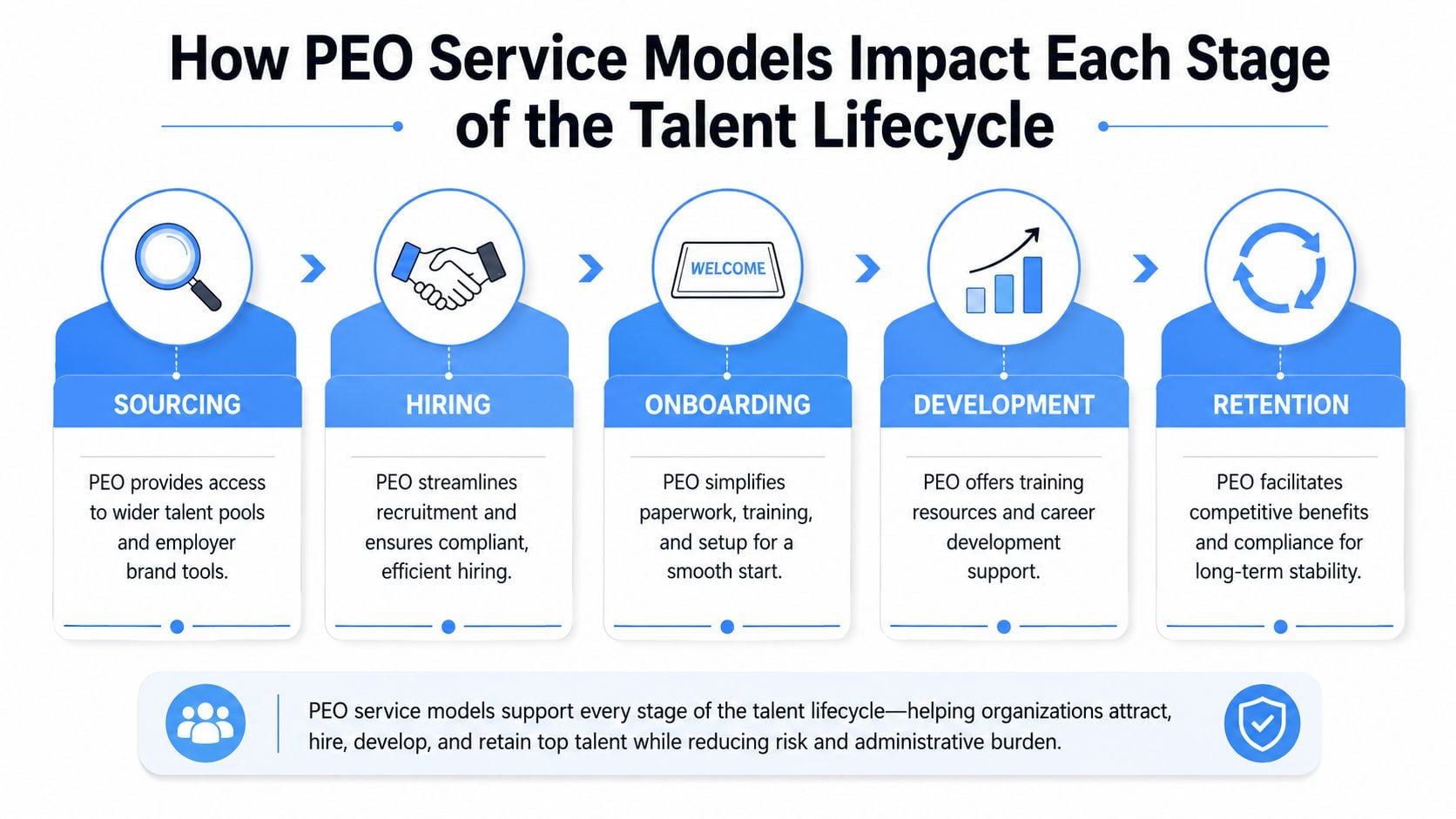
PEO service models do not affect talent outcomes evenly. Some are strong on payroll and benefits administration, but weak on recruiting support. Others create a polished front end while leaving onboarding, manager enablement, and retention measurement to the client. The talent lifecycle only works when each handoff is clear.
Where full-service support helps
A full-service model can support sourcing by improving employer-brand consistency, benefits messaging, and speed of response. It can help with hiring by tightening paperwork, compliance, and offer administration. It can also make onboarding feel more orderly, which matters because new hires decide quickly whether the organization looks competent or chaotic.
Development is where the difference gets sharper. Strong PEO support might include access to HR technology, learning infrastructure, and benefits administration that reduces the load on internal teams. In retention, the best providers make it easier to keep benefits competitive and compliant, so the company is not constantly reworking administration during already stressful periods.
Where limited models fall short
Administrative-only models usually stop at processing. They can keep the payroll train on the tracks, but they rarely solve recruitment friction, internal mobility, or manager capability. Benefits-focused models can help close candidates and reassure employees, but if the underlying onboarding and development systems are weak, the company still loses people after the start date.
The common failure mode is easy to spot during a sales cycle. The deck promises “talent support,” but the actual service scope covers benefits enrollment, payroll, and compliance notices. The client still writes the job ads, runs the candidate communications, fixes onboarding confusion, and coaches managers through early turnover.
That’s why buyers should compare providers against the whole lifecycle, not just the quote. A PEO can either compress the distance between sourcing and retention, or turn every stage into a handoff problem. For companies comparing broader outsourced HR options, this outsourced HR overview is a useful way to separate administrative support from actual talent architecture.
Your PEO Talent Capability Audit Checklist
A buyer gets more value from a PEO audit when the questions are specific and operational. Broad promises about “supporting your people” don’t tell a CFO whether the provider will help reduce recruiting waste or keep new hires from dropping out in week two. The test is whether the PEO can describe the process, the owner, and the timing.
Ask these five questions
Talent acquisition tools. Ask how the PEO supports sourcing and candidate communication. A strong answer mentions actual workflows, ATS integration, and how the provider helps reduce delays. A weak answer sounds like, “Your team handles recruiting, we support administration.”
Onboarding support. Ask whether the PEO offers structured onboarding programs, not just forms. Strong providers can explain how benefits enrollment, policy acknowledgment, and day-one readiness are coordinated. If the answer is vague, expect confusion at the start date.
Development programs. Ask what learning, career pathing, or manager training infrastructure is included. A credible answer will name tools, cadence, and ownership. If the provider only points to a portal, the internal team is still building the experience alone.
Retention analytics. Ask what the PEO helps measure beyond headcount and payroll. A solid partner should be able to discuss turnover trends, onboarding issues, and use of internal mobility data. For a reference point on HR technology support, this HRIS guide for small businesses helps frame the difference between software access and workforce insight.
Compliance alignment. Ask whether compliance support slows hiring or makes it faster. Good compliance should reduce risk without creating bottlenecks. If every hire requires a long manual process, the provider has shifted risk onto velocity.
A provider that cannot explain how it supports the first 90 days is not really supporting retention.
A buyer should push for examples, not slogans. If the PEO says it can help with retention, ask what data it reviews monthly, who gets the report, and what happens when early attrition spikes. If no one can answer that clearly, the contract is probably buying administration, not talent support.
Contract Terms That Protect Your Talent Outcomes
Most PEO agreements are negotiated like procurement documents. The discussion focuses on fee schedules, benefits access, and the administrative scope. That approach misses the point when hiring is active and the business can’t afford interruptions.
The clauses that matter most
Rate locks matter because talent strategy gets more expensive when pricing shifts mid-cycle. If recruiting is underway and the provider changes fees or support levels during renewal, the company can’t hold a stable cost model for open roles. Implementation credits matter too, because a poor transition can absorb the same internal time that should be used for sourcing and onboarding.
Service-level guarantees should cover responsiveness, not just compliance processing. If a candidate or new hire waits on answers, the cost shows up in drop-off, delayed starts, or poor first impressions. Exit provisions and renewal protections matter because a messy PEO change during a hiring push can force the HR team to stop focusing on talent and start cleaning up data, payroll, and benefits confusion.
The money angle is straightforward. If a company is replacing even one mid-level role, the recruiting cost, manager time, and onboarding drag can easily become a meaningful line item. A bad transition can also leave open roles unfilled long enough to push work onto the rest of the team, which often leads to more turnover.
What to ask for in negotiation
- Rate locks for the contract term so hiring budgets don’t drift unexpectedly.
- Implementation credits if the transition requires extra internal labor.
- Service guarantees tied to response times for candidate, employee, and manager issues.
- Renewal notice windows long enough to evaluate alternatives without panic.
- Exit support terms that preserve payroll continuity and employee communication.
The negotiation posture matters as much as the clause. This negotiation guide is useful because the wrong approach can win a discount and lose the operational protection that keeps hiring on track. A cheap contract that creates turnover friction costs more than a slightly higher-fee contract with clean service terms.
Building Retention Architecture Beyond Surface-Level Perks
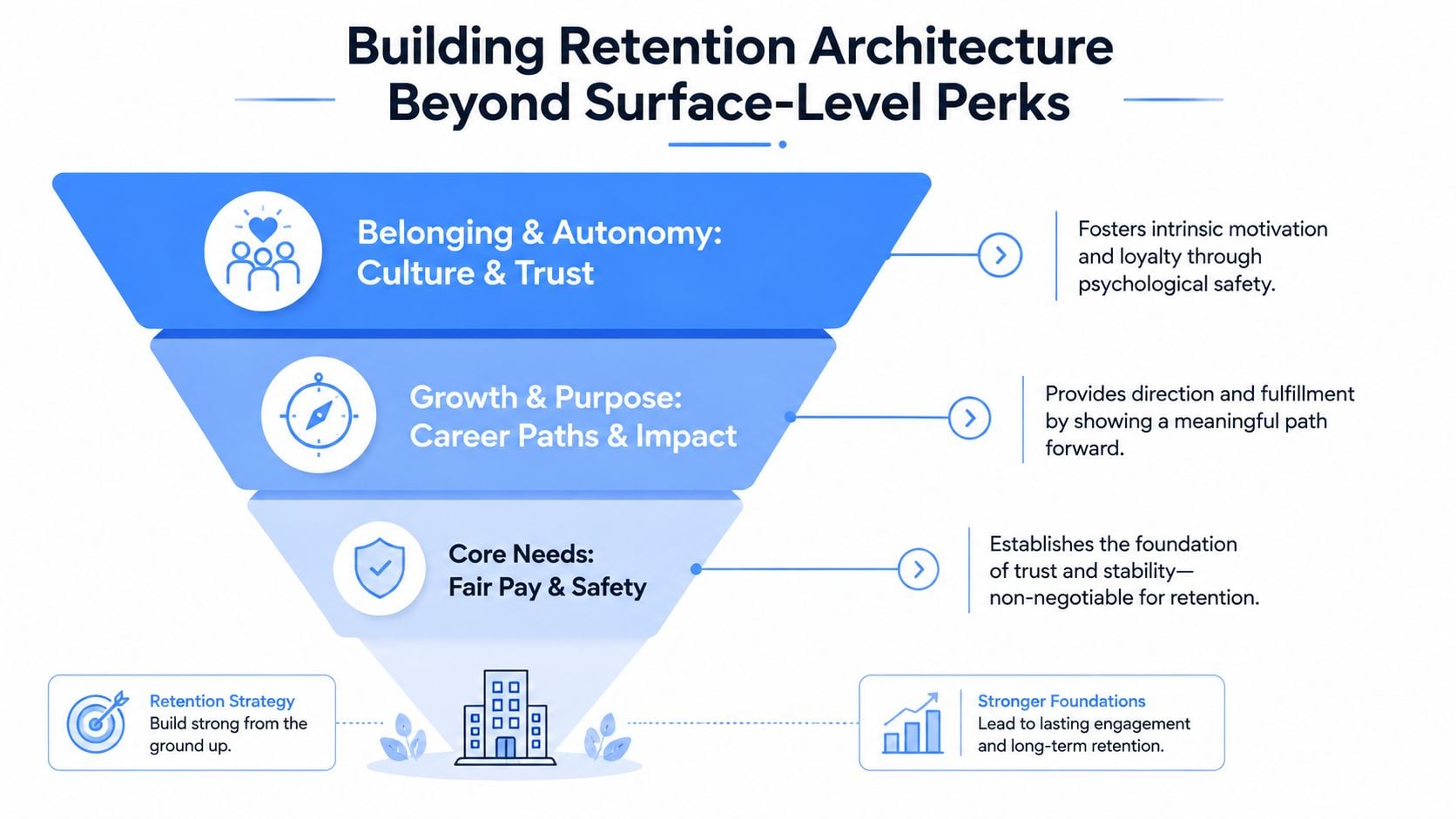
Retention still gets reduced to perks, culture statements, and compensation tweaks. Those matter, but they are not the architecture. The stronger model comes from role design, mobility pathways, manager quality, and non-monetary support that keeps people attached to the work and makes the job worth staying in.
What actually keeps people
Recent review work on retention in flexible workforces points to development opportunities, recognition, extra leave, and clear career support as meaningful retention levers, while Cornell’s talent-trends work emphasizes combining EVP design, humanized acquisition, and ongoing measurement of belonging and intent to leave across disaggregated organizations in the journal review. That matters in hybrid and remote settings, where employees do not absorb culture passively from office life. The system has to be designed on purpose, or it becomes a set of disconnected promises that managers interpret differently.
A PEO can support that architecture if it provides usable learning tools, benefits flexibility, and a clean employee portal that people use. It can also reduce friction around the practical pieces that create trust, like benefits access and policy clarity. A well-run portal from This employee portal resource is one way to check whether the technology helps employees stay informed, connected, and ready to act when they need something.
For a useful outside perspective on broader employee retention tactics, Virtustant’s retention guide is a solid reference point for how employers think about the issue beyond compensation.
Internal mobility is the cost lever
Internal mobility is not just a nice development story. In the talent-management summary, internal mobility hires cost less than average cost-per-hire, and companies investing in leadership development saw more internal promotions per the source. That changes the retention math. Filling roles from inside lowers recruiting spend and gives employees a visible path forward, which matters just as much as the cash outlay.
The hidden-worker research pushes the same logic from the other side. It argues that many employers screen out capable workers, including people without degrees, veterans, immigrants, people with disabilities, and the long-term unemployed, even when those candidates could fill skill gaps if hiring were redesigned around skills instead of pedigree in the Harvard Business School white paper. That is not only a hiring issue. It is a retention issue, because internal pathways and broader hiring standards reduce the need to keep replacing the same roles from scratch.
If the PEO offers portal access, learning infrastructure, and benefits support, the buyer should test whether those tools help managers move people around the business. If the answer is no, the company is still paying for surface polish instead of retention architecture. The true test is whether the PEO helps employees see a future inside the organization, not just a smoother way to enroll in benefits.
Deciding Whether Your PEO Is a Talent Asset or a Bottleneck
A PEO is a talent asset when it shortens the path from candidate to productive employee and supports internal movement after the hire lands. It becomes a bottleneck when the company still does the hard work itself, but now through a vendor layer that adds delay, confusion, or hidden cost. The difference shows up in the data, not the sales deck.
A practical decision rule works in three steps. First, if time-to-feedback is slow, offer acceptance is weak, or early turnover keeps showing up, the problem is probably not just recruiting. Second, if the PEO can’t explain its role in onboarding, development, and retention analytics, the relationship is too narrow for the company’s workforce needs. Third, if the contract lacks rate locks, service guarantees, or clean exit terms, the business is carrying avoidable risk during the most fragile part of the talent cycle.
If the PEO can’t improve hiring speed, first-year staying power, or internal mobility, it’s probably an administrative vendor, not a workforce partner.
That leaves three realistic moves. Optimize the current relationship if the provider already has the tools and the service team can tighten execution. Renegotiate if the provider is decent but the contract doesn’t protect talent continuity. Begin a structured transition if the provider is slow, opaque, or unable to support the talent system the business now needs.
PEO Metrics helps companies compare PEO options with a focus on pricing, benefits, contract terms, service quality, compliance support, and fit. For leaders trying to connect talent acquisition and retention to the actual PEO decision, that side-by-side view can expose where a current provider is helping and where it’s slowing the business. Visit PEO Metrics to benchmark the relationship before the next renewal, hiring surge, or provider switch.
