

A PEO renewal can go sideways in a single call. The buyer thinks the conversation is about rate locks, benefits, and a tidy redline, then the rep starts moving the pieces, pushing one concession hard, softening another, and making the whole deal feel friendly enough to trust. That is how a 180-person professional services firm can walk away with a 3 percent rate cap, a $4,000 implementation credit, and a 60-day exit window on the table, while still leaving value behind because the buyer misread a procedural tone as flexibility.
That mistake is common. Negotiation research has long pointed to four basic negotiator personality types, and the distribution matters because most counterparts are not neutral, and they are rarely random. In U.S.-based studies cited by Harvard’s Program on Negotiation, about 50% of negotiators were classified as individualists, 25% to 35% as cooperators, 5% to 10% as competitives, and altruists were rare in American samples Harvard Program on Negotiation. That means a PEO buyer usually sits across from someone who is trained to sound collaborative while still protecting the provider’s economics.
The buyer who wins does not “read” personality for sport. The buyer uses it to choose the right clause, the right script, and the right pace.
Table of Contents
- Why the Person Across the Table Matters More Than the Slide Deck
- The Four Negotiation Personality Types and Why Most Buyers Get the Distribution Wrong
- How to Identify Each Type in Conversations and RFPs
- Tailored Tactics and Sample Scripts for Each Personality Type
- When the Other Side Is Mixed, Situational, or Unreadable
- PEO Contract Clauses to Push for With Each Personality Type
- Why Process and Documentation Beat Personality Reading in High-Stakes PEO Deals
- Your PEO Negotiation Playbook and One Action for This Week
Why the Person Across the Table Matters More Than the Slide Deck
A national PEO can present a beautiful benefits deck and still be a mediocre negotiator. A specialist PEO can look smaller on paper and still squeeze the buyer harder on fee language, exit timing, or implementation credits. In renewals, the slide deck matters less than the person defending it, because that person decides whether a conversation stays transactional or turns into a package trade.
A 180-person professional services firm learned that the hard way. The sales lead sounded relaxed, the buyer read that as cooperative, and the buyer never forced the rep to put the rate cap, the implementation credit, and the exit window into a single written package. The rep was not being especially generous, just procedural, and procedure is where power often gets lost. The buyer gave away the sequencing, and sequencing is where the bargain usually gets decided.
Personality type is a lever, not a label
The useful move is not to guess who someone “is” as a person. The useful move is to decide whether the other side is trying to claim value, create value, protect the relationship, or control the process. Those are different behaviors, and in PEO negotiations they show up in how the rep handles pricing, implementation, service guarantees, and exit terms.
Practical rule: if the rep keeps drifting back to “how we usually do it,” that is not flexibility. It is a signal to force a written trade.
For HR directors, CFOs, and owners, the takeaway is blunt. The person across the table matters because the same pricing proposal can mean very different things depending on whether the rep is bargaining hard, looking for a win-win package, or trying to end the call with no commitment. Once that pattern is clear, the buyer can stop talking in generalities and start pressing the clause that moves money or risk.
A smart PEO buyer treats personality as a negotiation input, not a personality quiz. That difference is where power begins.
The Four Negotiation Personality Types and Why Most Buyers Get the Distribution Wrong
Negotiation research identifies four basic types, individualists, cooperators, competitives, and altruists. Harvard Program on Negotiation The mistake most buyers make is assuming the table is split evenly or that every rep wants the same thing. In practice, the mix skews toward self-interest, so the buyer should treat the first offer as a starting frame, not a final position.

What each type is really trying to do
Individualists want to maximize their own outcome. In a PEO deal, that usually means a hard focus on fee levels, concessions, and any language that protects provider economics. They can sound cordial and still be focused on claim value.
Cooperators are open to multi-issue trades. They are the easiest to build packages with because they will trade across price, service, implementation support, and contract terms if the deal feels balanced. That is the group you can press for rate locks, implementation credits, and service guarantees in one written package.
Competitives push hard on a narrow ask. They like pressure, short time windows, and a visible win. In a renewal, that can mean a sharp fight over one clause or a deadline, especially if the clause affects exit rights or control of the process.
Altruists are rare in American business samples. They care more about the relationship and the other side’s comfort than about squeezing every last dollar out of the exchange. In a PEO discussion, that can make them unusually open to service commitments, but it can also make them soft on documenting the trade in writing.
Why buyers keep getting it wrong
Most PEO reps are not pure cooperators. They are often individualists trained to sound collaborative. That is the trap. They will talk about partnership, then hold the line on rate increases, renewal windows, or indemnity language. A buyer who hears only tone and misses the underlying type will negotiate too softly and leave value on the table.
The right lens is simple. If the counterpart looks collaborative, test for package trading. If they look hard-nosed, narrow the ask. If they sound generous, check whether the concession costs them anything. That one adjustment changes the entire conversation.
How the distribution changes the buyer’s strategy
If a large share of the market is self-interested, the buyer should stop assuming the first friendly answer is the genuine one. The better play is to define the package early, force the rep to react to multiple terms at once, and never let the deal collapse into a single-issue price fight unless that is the only clause worth moving.
That is the part most buyers miss. Personality reading is not a substitute for contract discipline. It tells you where to start the conversation, then the clauses do the essential work.
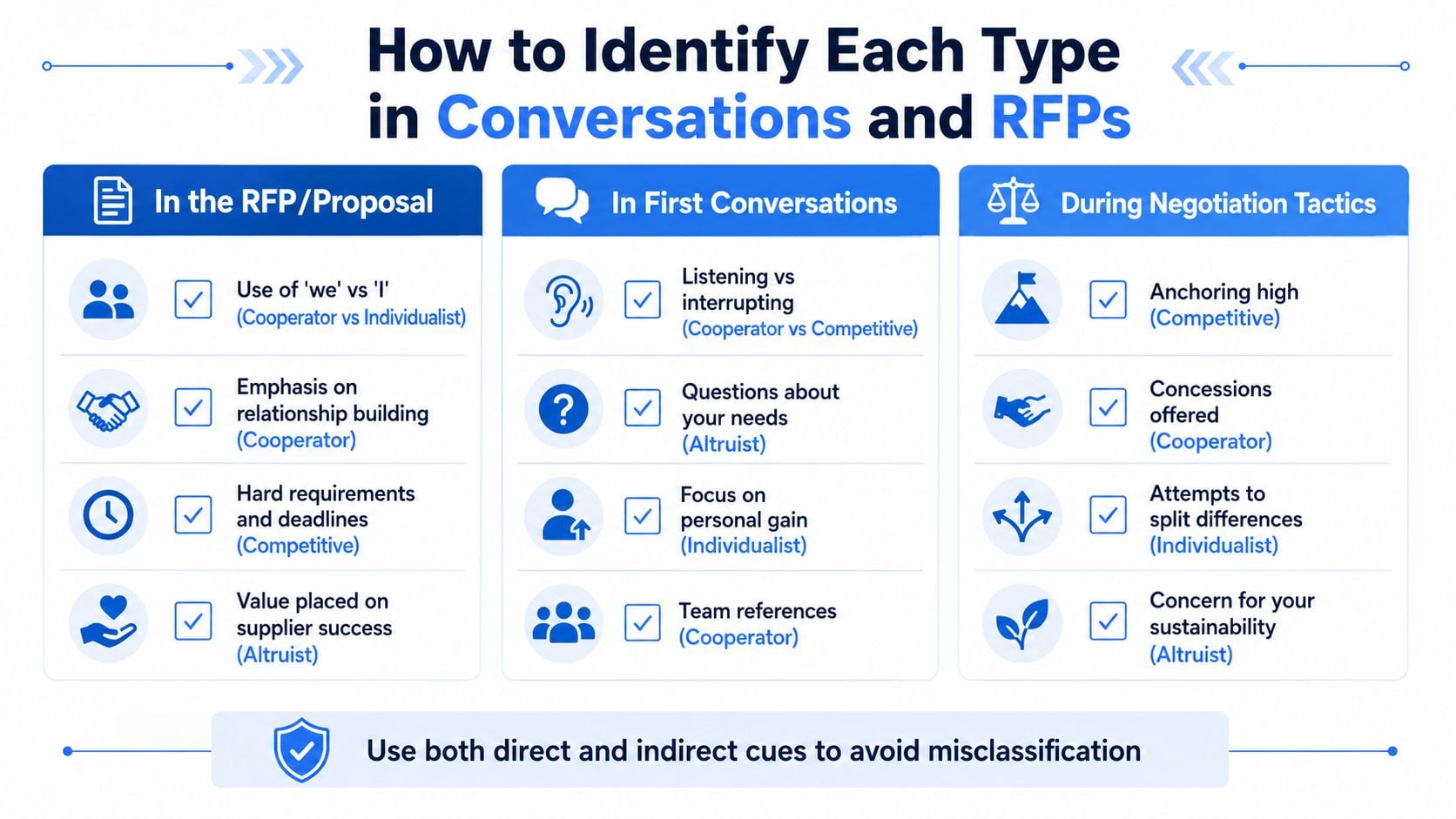
How to Identify Each Type in Conversations and RFPs
Start with the written response, then listen to the first call, then read the redlines. Those three moments tell you more than the polished pitch ever will. A rep can sound agreeable in a kickoff and still defend every cost term, every service boundary, and every exit restriction once the draft agreement shows up.
What shows up in writing and on the call
An individualist usually opens with per-employee-per-month pricing and tries to keep the conversation there. The writing is efficient, but the scope stays narrow. A cooperator uses trade language early, the kind that sounds like, “we can do X if you can do Y.” A competitive pushes for a single decision-maker, a short decision window, and language that makes the buyer feel late before the deal has even started. An altruist volunteers concessions before being asked and keeps steering the conversation back to trust and fit.
The RFP itself often gives the first clean signal. If the response is organized around package trade-offs, implementation support, service credits, and renewal mechanics, you are probably dealing with someone who can work across issues. If the response keeps returning to hard deadlines, fixed scope, or one narrow commercial point, the buyer should expect less flexibility later.
What the redlines reveal
The redline stage strips away a lot of theater. An individualist keeps returning to economics and tries to split differences line by line. A cooperator is more willing to build a package across price, service, and process, which is where the buyer should press for rate locks, implementation credits, and a cleaner exit clause. A competitive may ignore broad edits but fight hard on one clause, usually the one that protects control. An altruist often softens first and asks more about the buyer’s comfort than the provider’s exposure.
One clean test exposes the pattern fast. Say no to the first ask and watch what happens next. A cooperator usually tests a trade. An individualist recalculates the numbers. A competitive tightens the frame. An altruist keeps trying to preserve the relationship while still moving the terms.
For buyers who want a practical reference on how pressure changes behavior in contract talks, Pounds Health Insurance bill help is useful because it shows how closely people respond when money, process, and friction all hit at once.
A written RFP also reveals tone before the meeting starts. Responses that use “we” language, acknowledge the buyer’s constraints, and reference implementation support usually point to a more collaborative style. Responses that hammer deadlines, scope limits, or rigid structures usually point to a harder line. For the buyer, that means the first job is not personality spotting for its own sake. The job is deciding whether to press for a multi-issue package, a tighter rate lock, or stronger service language before the conversation gets trapped in a price-only fight.
A practical internal reference for this kind of clause discipline is indemnification negotiation tips, because even cooperative conversations still need hard boundaries on risk.
Tailored Tactics and Sample Scripts for Each Personality Type
The wrong tactic is usually too generic. The right tactic changes depending on whether the other side is trying to claim value, build value, or protect the relationship. That is why the buyer should not use the same script with every rep.
Against an individualist
Lead with the walk-away number and stay disciplined. Trade concessions one for one, and make the trade visible. If the buyer wants a multi-year rate lock, the rep should have to earn it with implementation credits, a cleaner exit clause, or a stronger service guarantee. The point is to stop one-sided movement.
“If the annual fee increase is capped for the full term, the buyer can extend the commitment. If not, the term stays shorter and the package stays narrower.”
That script works because it turns the conversation into a direct exchange instead of a vague partnership discussion.
Against a cooperator
Use a package, not a line item. Cooperators respond well when the buyer puts pricing, implementation support, service levels, and renewal language on the same page. They are usually the easiest counterpart for trade-based structure, which is why the buyer should surface trade-offs early and keep the deal balanced.
A useful internal reference for this type of risk control is indemnification negotiation tips, because cooperative conversations still need hard boundaries on liability. That is where many buyers get too polite.
Against a competitive
Slow the pace. Require written redlines. Use silence after the first anchor and do not try to outtalk the rep. Competitive negotiators often want the room to feel urgent, and urgency can push the buyer into a bad concession, especially on a clause like a fee cap or a short exit window.
“That offer is noted. The buyer will review the written version and come back on the clause that matters most.”
That line keeps the focus narrow and stops the rep from turning the whole exchange into a contest.
Against an altruist
Protect the relationship without letting generosity become one-way traffic. Tie any concession to a renewal protection, a service-level commitment, or a concrete implementation milestone. An altruist will often accept that structure because it feels fair and preserves trust.
For a broader comparison of contract terms, the buyer can also review the practical context in contract essentials for startups, since the same discipline around written terms and trade-offs applies in PEO work.
When the Other Side Is Mixed, Situational, or Unreadable
Most PEO negotiations are messy in practice. The rep may sound cooperative on the first call, turn rigid once legal gets involved, and then soften again when renewal timing gets close. That pattern is common, and fixed personality labels break down fast once real pressure enters the deal.
Use process to test style
The sharper move is to use multi-issue framing as a test. If the rep will trade across price, service, and exit terms, there is some cooperative wiring there. If the rep only reacts to one clause and ignores the rest, keep the ask narrow and structured. In harder conversations, the buyer should use written agendas, a shared redline tracker, and a single decision-maker on each side.
The Harvard Business School paper makes the point plainly, negotiation behavior is shaped by multiple traits and by context, not by one clean label. That fits PEO deals exactly. A person can be extroverted, agreeable, and conscientious, then turn difficult when internal approval, legal review, or quota pressure enters the room.
Build flexibility into the deal process
Do not wait for perfect clarity. Lock in process controls early, confirm concessions by email, and keep a written summary after every call. A shared agenda keeps the conversation from drifting. A redline tracker stops the rep from rewriting history. A single point of contact on each side reduces confusion when the style shifts.
For difficult counterpart behavior, use conflict and confrontation guidance, because process discipline matters most when the conversation starts to wobble.
A flexible structure beats a perfect read of the person. If the rep keeps changing style, stop trying to solve the personality puzzle and tighten the process. That is how you keep the deal moving without giving away control.
PEO Contract Clauses to Push for With Each Personality Type
Personality matters most when it tells the buyer which clause to push first. In a PEO deal, the key levers are pricing, implementation credits, service guarantees, and exit and renewal terms. Anything else is noise until those four are handled.
Contract asks by personality type
| Personality Type | Primary Tactic | Contract Clause to Push | Sample Script Line | Risk to Manage |
|---|---|---|---|---|
| Individualist | Trade one concession for another | Multi-year rate lock and written cap on annual fee increases | “If the buyer gives term, the provider gives price protection.” | One-sided commitments |
| Cooperator | Build a package | Stronger service-level agreement and dedicated account team | “If service is tightened, the term can be extended.” | Overly soft trade language |
| Competitive | Hold the line on a single point | 60-day exit window with no early-termination fee | “The buyer will only move on the clause that controls exit risk.” | Letting the rep turn it into a contest |
| Altruist | Preserve the relationship with guardrails | 90-day notice for major changes and a price-match review against market benchmarks | “Fairness requires notice and a market check before any change.” | Accepting goodwill instead of written protections |
The buyer should not chase everything at once. An individualist deserves a clean economics trade. A cooperator deserves a structured package. A competitive needs one high-impact ask and a hard written record. An altruist needs protection against generosity becoming vague promise language.
For more background on contract risk flags, the related PEO contract negotiation red flags resource is a smart companion because the same clause discipline helps the buyer avoid hidden fees, sloppy exit language, and weak liability allocation.
Why Process and Documentation Beat Personality Reading in High-Stakes PEO Deals
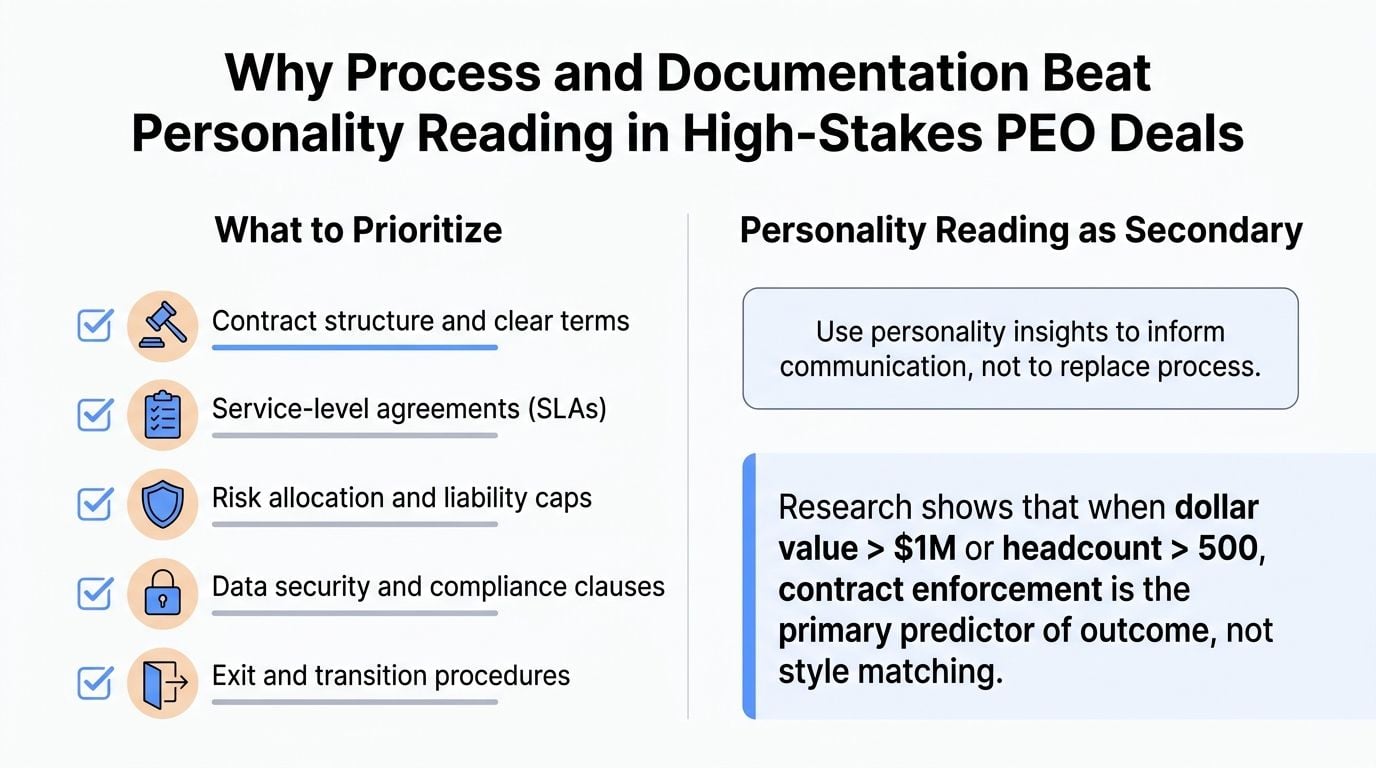
A PEO buyer can read the room correctly and still lose the deal on paper. The rep sounds cooperative, the conversation feels productive, and the draft agreement still leaves the buyer exposed. In high-stakes negotiations, personality tells the buyer how to speak, but process and documentation decide what survives after the call ends.
Research on negotiating with difficult personalities recommends concrete controls. Put everything in writing, keep a witness present when needed, and stay direct and calm, because verbal exchanges can be manipulated or mischaracterized MIT negotiation article. That advice fits PEO work exactly. End every call with a written recap. Confirm every concession by email. Track every redline in one shared document. Name the escalation path before the deal gets tense.
The clauses that never belong to tone alone
The buyer should never leave fee escalation language, exit and termination liability, co-employment and joint-employer allocation, or indemnification scope to trust and rapport. Those are written-term issues. If the rep will not put them in plain language, the deal is not ready for signature.
A useful companion on broader deal discipline is the negotiation strategy for business owners, because the most expensive mistake is still giving away protection before the contract is final.
For fee context, the related PEO membership fee page is worth comparing against the final paper, because process only helps if the numbers and terms are pinned down.
A written summary should be specific enough to enforce. Use language like this, “Here is our understanding from today’s call, the provider will send redlines on the exit clause and fee cap, the buyer will review by Friday, and no term is agreed until both sides sign the revised draft.” That kind of recap forces accountability and makes it harder for either side to rewrite the conversation later.
The rule is direct. Personality helps the buyer choose how to speak. Documentation decides what the buyer gets.
Your PEO Negotiation Playbook and One Action for This Week
Save this: individualist, cooperator, competitive, altruist. Read the first three emails, label the style, and choose one clause to press, rate lock, service guarantee, exit term, or implementation credit. Then pull the last three messages from the PEO counterpart, tag them against those four types, and walk into the next call with one written ask, not five.
For a tighter contract checklist, the related master service agreement checklist is a good companion. Buyers who do the reading, the labeling, and the written follow-through usually negotiate better than the ones who only try to be liked.
PEO Metrics helps buyers compare PEO options, pressure-test contract terms, and spot the clauses that matter before they sign. If this playbook fits the kind of renewal or selection conversation happening now, visit PEO Metrics and use the framework to press for stronger pricing, cleaner exit language, and better protection in the next round.
