
A PEO renewal lands in the inbox late on a Thursday. The admin fee is up, the benefits package has shifted, and the explanation is thin. The account manager says the market changed, the carrier changed, or the underwriting changed. None of that answers the question a CFO or HR director has to answer on Monday morning. Is this justified, negotiable, or a sign the relationship is drifting out of control?
That moment gets labeled as a pricing issue, but it usually isn't just pricing. It's conflict and confrontation in a vendor relationship that touches payroll, benefits, compliance, employee trust, and cash flow. The conflict already exists before anyone says a word. The confrontation comes later, if leadership chooses to address it directly and with structure.
Most companies don't need softer advice. They need a way to tell the difference between a minor service miss and a relationship problem that deserves escalation, strategic pressure, or a market check.
Table of Contents
- The PEO Renewal Is In And The Price Is Wrong
- Conflict vs Confrontation A Critical Distinction
- Why PEO Relationships Are Conflict Hotbeds
- The Triage Framework Assess Your PEO Conflict
- The Productive Confrontation Playbook
- Knowing When to Escalate Or Walk Away
- Conclusion Turn Friction Into Leverage
The PEO Renewal Is In And The Price Is Wrong
The pattern is familiar. A company has been with a PEO long enough that the implementation pain is forgotten, but the day-to-day annoyances are piling up. Payroll corrections take too long. Support quality depends on who picks up the ticket. Renewal arrives, and instead of a clean explanation, leadership gets a packet full of broad statements and a signature deadline.
That's when many teams make the first mistake. They treat the renewal shock like an isolated event instead of what it usually is: evidence that the value exchange needs to be re-tested.
A disciplined approach matters here. The International Conflict Data Project's long-run conflict database was built from about 35,000 historical sources, covering 1816 to 2014, with more than 30,000 international events and about 1,900 international confrontations. The business takeaway isn't geopolitical. It's methodological. Serious analysis works when people stop reacting to anecdotes and start benchmarking recurring patterns with consistent definitions.
That's exactly how a renewal should be handled.
What a weak renewal response looks like
A weak response sounds like this:
- Accepting the provider's framing: “They said rates are moving everywhere, so there's probably not much to do.”
- Arguing from frustration instead of records: “Support has felt off lately.”
- Signing under deadline pressure: If execution timing is the issue, it helps to understand practical options for e-signing contracts without recurring fees so the process itself doesn't become another source of advantage for the provider.
None of that creates negotiating power.
What a stronger response looks like
A stronger response starts with a comparison file, not a complaint. Pull the current agreement, the last renewal, recent invoices, open service issues, benefit changes, and any promises made during implementation or prior renegotiation. Then compare what changed.
Practical rule: If a provider can explain a pricing increase only in broad language, leadership should assume the quote still needs to be tested.
The renewal discussion also needs to move beyond rate alone. A lower fee with weaker service ownership, vague escalation rights, or tighter exit language can still be a worse commercial outcome. A focused review of PEO renewal clause negotiation strategy often reveals that exposure sits in terms, not just price.
The point isn't to start a fight. It's to stop treating a contract renewal as a courtesy notice. It's a re-underwriting of the relationship.
Conflict vs Confrontation A Critical Distinction
Conflict and confrontation get lumped together, and that confusion costs buyers money.
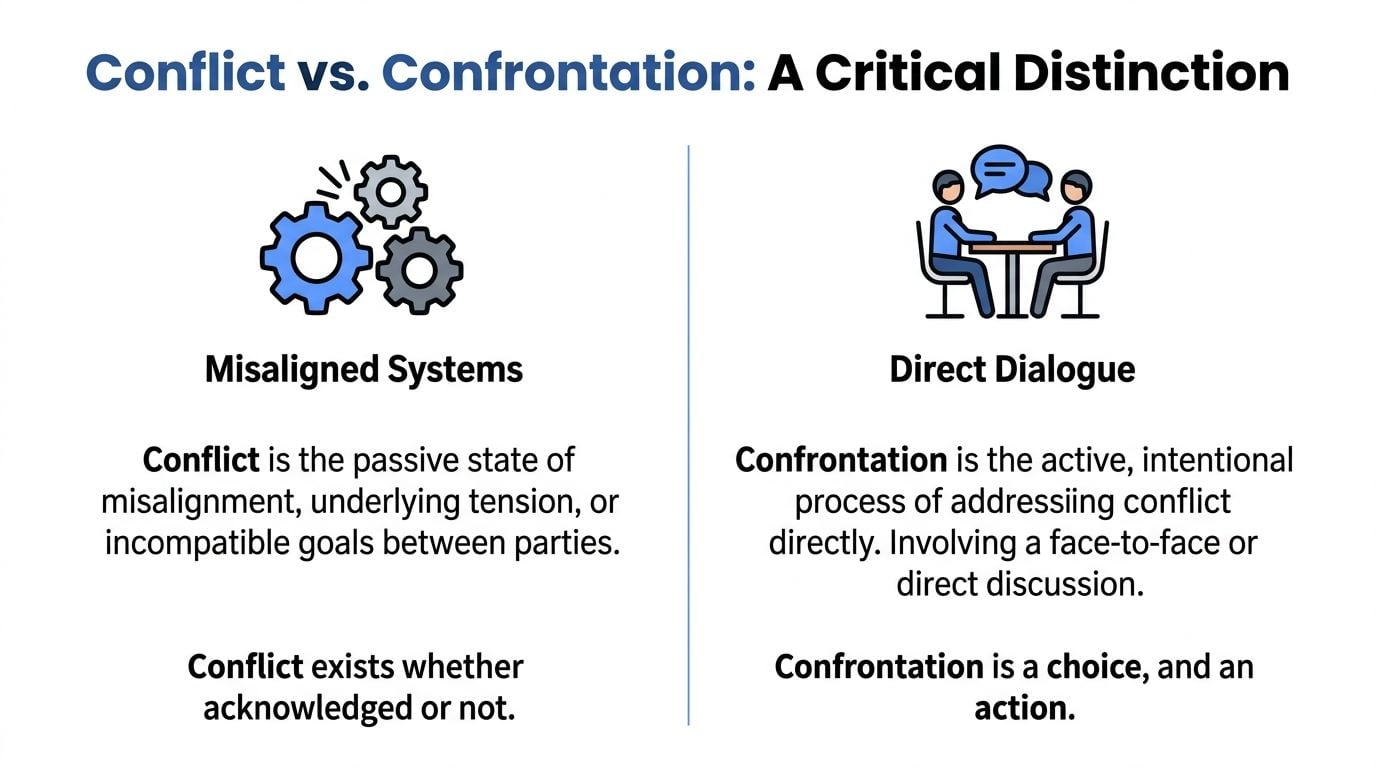
Conflict is the underlying misalignment. It's the check-engine light. Billing disputes, unclear ownership, delayed responses on employee issues, and renewal terms that don't match the lived service experience all fall into that bucket. The conflict exists whether leadership acknowledges it or not.
Confrontation is the deliberate act of addressing that misalignment. It's booking the mechanic, handing over the service record, and asking what exactly needs to be fixed.
Conflict can sit quietly for months
In PEO relationships, passive conflict often hides behind operational noise:
- Service drift: The assigned HR contact changes, but no one formally resets expectations.
- Administrative friction: The client team keeps correcting payroll or benefit enrollment issues and starts treating that extra work as normal.
- Commercial slippage: Fees increase, but leadership never gets a clean explanation tied to actual service or claims drivers.
None of those require a shouting match. But all of them create exposure if they're left alone.
Confrontation is a management tool
Confrontation should be treated as a structured business event. It is not the same thing as aggression. It's the meeting where leadership says, “These are the issues, this is the pattern, this is the impact on the company, and this is what needs to change.”
That distinction matters because many buyers say they “don't want conflict” when what they really mean is they want to avoid an uncomfortable conversation. The result is predictable. They tolerate ongoing friction, then react too late when the provider sends renewal terms or mishandles a sensitive employee matter.
Conflict ignored becomes cost. Confrontation handled well becomes leverage.
A useful diagnostic question is simple: is the company experiencing a disagreement, or has it addressed the disagreement with the people who can fix it? If the answer is no, then leadership is living with conflict while avoiding confrontation.
That's also why communication advice often feels shallow. “Be clear” doesn't help much if the underlying issue is that the provider controls the draft agreement, has more information, and knows switching is disruptive. A more concrete look at PEO communication breakdown examples can help separate a messy email chain from a genuine governance problem.
The goal isn't more confrontation. It's better-timed, lower-heat confrontation before the relationship hardens into resentment.
Why PEO Relationships Are Conflict Hotbeds
A PEO isn't a basic software subscription. The provider touches payroll, benefits, compliance support, onboarding, employee records, and often sensitive conversations around leave, terminations, and handbook enforcement. That level of integration creates more points of friction than a vendor that only sends invoices and login credentials.
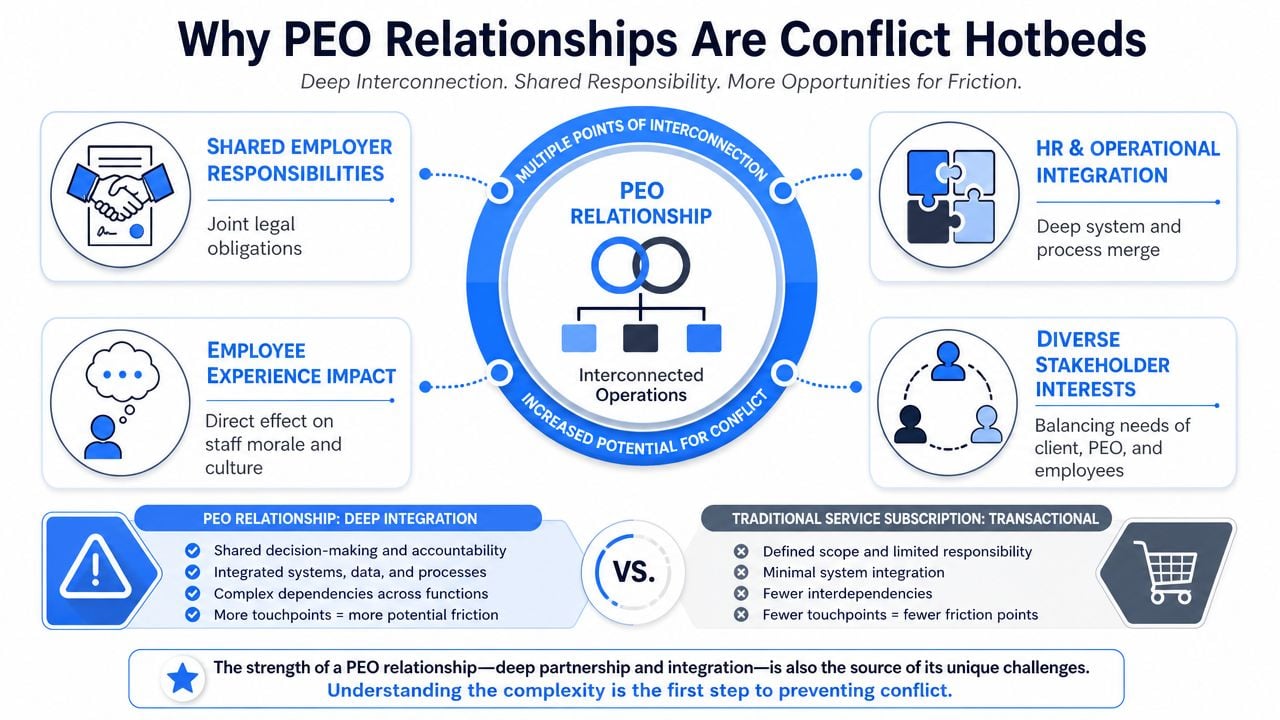
When friction shows up, companies often personalize it. They blame the account manager, the payroll lead, or the implementation specialist. Sometimes that's fair. Often the bigger issue is structural.
The big four conflict triggers
Opaque pricing and renewal shock
The fee architecture in many PEO agreements isn't easy to parse under pressure. Admin fees, carrier changes, ancillary product shifts, payroll-related charges, and renewal clauses can move at the same time. A buyer may think the argument is about price when the deeper issue is visibility.
Benefits administration mismatches
The provider may say the plan design is competitive. The employer may hear from staff that payroll deductions changed, provider networks narrowed, or enrollment support felt chaotic. Those are not soft complaints. They hit retention, employee trust, and leadership credibility.
Service inconsistency
Many relationships start strong and then flatten out. The senior implementation team exits, day-to-day support gets fragmented, and nobody is clearly accountable for recurring errors. One month it's manageable. Three months later the client team is doing shadow work the PEO was supposed to absorb.
Restrictive contract mechanics
Some agreements make it hard to exit cleanly, challenge fees, or get timely attention from senior leadership. That's where conflict stops being operational and becomes political.
Power imbalance makes simple issues harder
The emotional overlay matters. As Beyond Intractability's discussion of conflict overlays notes, disputes become harder to resolve when core issues get tangled with power, status, respect, inequality, siege mentality, or victim mentality. In a PEO context, a “standard contract” can feel less like a routine document and more like a pressure tactic when the client knows payroll continuity, employee benefits, and compliance processes are tied up in the relationship.
That's why some renewal meetings feel strangely charged. The visible issue may be a fee or service level. The underlying issue is control.
Why this matters operationally
A PEO conflict doesn't stay in procurement. It spills into finance, HR, legal review, and employee experience.
A quick scan of PEO client control limitations often explains why executives feel stuck. The model itself creates shared responsibility and blurred authority. That doesn't make the relationship bad. It does mean conflict should be expected and managed with more discipline than a normal vendor review.
The Triage Framework Assess Your PEO Conflict
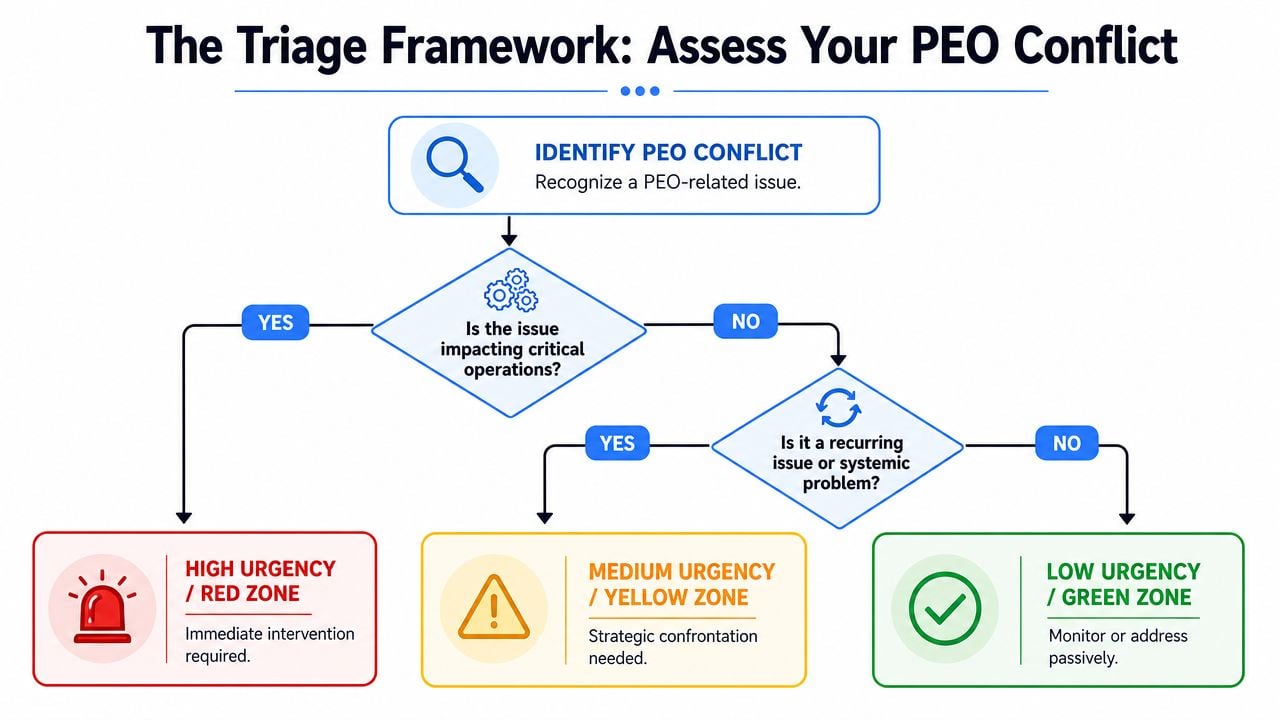
Not every PEO problem deserves the same response. A first-time payroll miss, a confusing invoice line, and a broken renewal process shouldn't all trigger the same meeting, the same tone, or the same escalation path.
The better approach is to classify the issue before reacting.
A useful technical principle comes from the CCRP's confrontation analysis work. Analysis improves when it builds specific models for each confrontation, identifying the actors, influence, and decision points instead of forcing every dispute into a generic playbook, as described in the CCRP Confrontation Analysis framework. In practical terms, a triage model works better than blanket advice to “communicate better.”
Three paths, not one
Document and monitor
Use this when the issue is isolated, low-impact, and fixable without senior involvement. Keep records, confirm the correction in writing, and watch for recurrence.
De-escalate and clarify
Use this when the issue may be a misunderstanding, a handoff failure, or a problem that's material but still solvable within normal account management channels. The objective is to narrow ambiguity fast.
Prepare for productive confrontation
Use this when the issue is recurring, financially meaningful, operationally disruptive, or tied to terms, accountability, or trust. This path needs preparation before the meeting request goes out.
PEO Conflict Triage Matrix
| Conflict Trigger | Initial Assessment | Recommended Path |
|---|---|---|
| Single payroll correction issue caught quickly | Low pattern risk, limited immediate disruption | Document and monitor |
| Invoice line item that doesn't match prior explanation | Possible error or unclear billing logic | De-escalate and clarify |
| Repeated benefits enrollment mistakes affecting employees | Recurring issue with employee-facing consequences | Prepare for productive confrontation |
| Renewal terms that arrive late with weak justification | Commercial and governance concern | Prepare for productive confrontation |
| Slow response on a one-off HR policy question | Likely service bandwidth issue, not yet systemic | De-escalate and clarify |
| Multiple unresolved ownership disputes across payroll, HR, and benefits | Structural failure in service model | Prepare for productive confrontation |
The fastest way to use the framework
Ask three questions:
- Is the issue recurring or isolated?
- Does it affect money, compliance, or employee trust?
- Does the current contact have authority to fix it?
If the answer to the first two is yes, and the third is no, the company is usually past routine service recovery.
A billing error is an event. A pattern of billing confusion is a management problem.
A formal PEO HR escalation protocol framework becomes particularly valuable. It gives leadership a way to escalate proportionally instead of bouncing between frustration and passivity.
The Productive Confrontation Playbook
Once a conflict qualifies for real intervention, the objective isn't emotional release. It's a controlled negotiation that protects the relationship if possible and improves the terms if not.
That requires a low-heat structure.
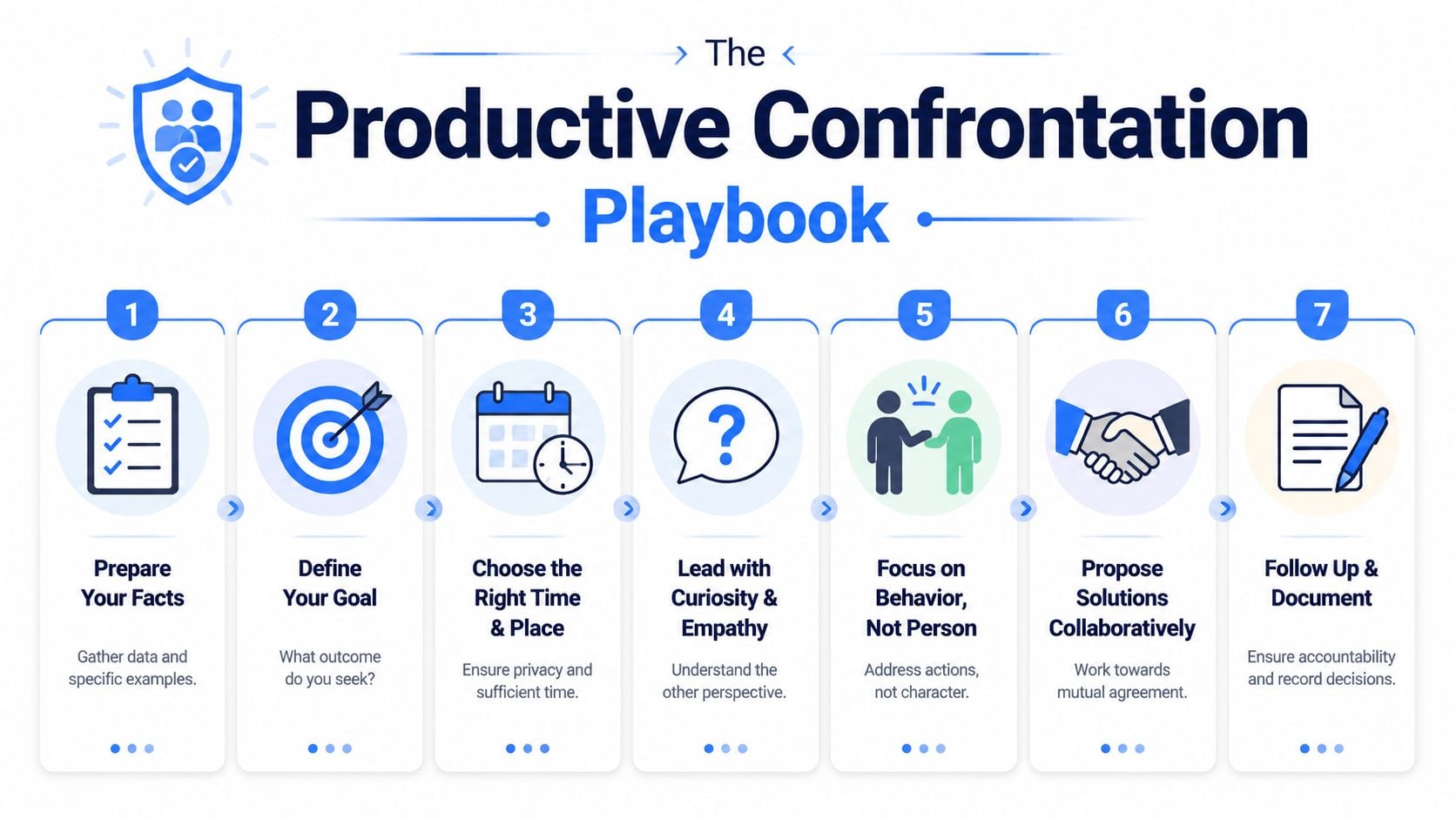
Research on conflict management is often right about tone and wrong about execution. The key practical question is how to confront a more powerful counterpart without weakening one's position. A stronger answer is to structure a conversation around specific asks and mutual purpose, rather than vague appeals to communicate better, as discussed in this conflict management review.
Preparation before the call
Most buyers rush this part and weaken their own position.
Build a file with the current agreement, prior renewal terms, invoices, implementation promises, service tickets, payroll corrections, and a short chronology of what happened and when. Keep it factual. No adjectives. No editorializing.
Then define the outcome. Not “better service.” Something usable:
- Clarify fee logic and identify which charges are fixed, variable, or carrier-driven
- Set service ownership for payroll, benefits, and escalation issues
- Request a concession such as implementation support, fee relief, or tighter renewal language
- Create a timeline for written answers and revised terms
How to open the conversation
The first two minutes matter. A poor opening invites defensiveness. A good opening signals control.
Try language like this:
“The company wants to continue this conversation constructively. Several issues have moved beyond isolated service misses, and leadership needs clarity on pricing, accountability, and next steps before making a renewal decision.”
That opening does three things. It lowers the temperature, frames the issue as business governance, and reminds the provider that renewal is still in play.
What to say when the issue is price
Avoid broad accusations such as “this increase is unreasonable.”
Use language tied to decision-making:
- “The renewal package doesn't give leadership enough detail to evaluate the change. The provider should walk through each material cost driver and identify what is contractual, what is experience-based, and what is discretionary.”
- “If the economics have changed, the client needs corresponding clarity on service scope, risk allocation, and renewal protection.”
- “A revised proposal should reflect the current service reality, not only the default contract template.”
What to say when the issue is service failure
Service confrontations work best when they connect effort, impact, and remedy.
Use statements like:
- “The internal HR team is spending time correcting issues that were expected to sit with the provider. Leadership needs a plan to stop the rework.”
- “This problem now affects employees directly, so a normal support-ticket cycle isn't sufficient.”
- “The company wants one accountable owner, written turnaround expectations, and a senior escalation path if those expectations are missed.”
Follow-up is where leverage sticks
After the meeting, send a written summary with decisions, open items, owners, and dates. If the provider pushes back later, that document becomes the record.
For teams that need a broader communication model, this mastering difficult conversations guide is a useful supplement. The value isn't in generic empathy language. It's in keeping a hard conversation organized when stakes are high and power isn't equal.
Operating principle: Don't leave a confrontation with “we'll work on it.” Leave with owners, edits, and dates.
Knowing When to Escalate Or Walk Away
Some PEO relationships can be repaired. Some can't. The expensive mistake is staying too long because leadership wants to avoid the disruption of a market review.
Escalation is appropriate when the frontline team acknowledges the problem but lacks authority to solve it. That usually means the issue has crossed from service into economics, legal terms, or account governance. A senior meeting is warranted when the provider keeps recycling explanations, misses agreed deadlines, or treats every concern as a one-off despite a visible pattern.
Signs the relationship may still be fixable
- The provider responds with specifics: Clear owners, dates, redlined terms, and direct answers.
- Leadership gets access to decision-makers: Not just an account manager buffering the issue.
- Corrections happen fast enough to rebuild trust: Not perfection, but visible control.
Signs it's time to test the market
Some patterns justify a formal review of alternatives:
- Recurring operational friction: The client team is repeatedly doing work the PEO was supposed to absorb.
- Commercial opacity: Renewal logic stays vague even after direct requests for detail.
- Contract rigidity: Reasonable asks on accountability, notice, or renewal protections get dismissed as impossible.
- Trust erosion: The provider says one thing in meetings and documents something else later.
When a company keeps absorbing avoidable friction to preserve the relationship, it's usually subsidizing the provider's operating model with internal labor.
At that point, confrontation has done its job. It has produced evidence. Leadership can now make a cleaner decision about whether to escalate one last time or start planning an exit. A practical starting point is a structured review of leaving a PEO and managing the cancellation and exit process.
Walking away doesn't mean the prior confrontation failed. It means the confrontation clarified that the gap wasn't a misunderstanding. It was structural.
Conclusion Turn Friction Into Leverage
Conflict and confrontation are not the same thing. Conflict is the misalignment already sitting inside the relationship. Confrontation is the decision to address it directly, with facts, control, and a clear commercial objective.
That distinction matters in PEO relationships because the stakes are unusually high. Payroll, benefits, compliance support, employee experience, and contract risk all sit close together. Small issues can stay small, but only if leadership identifies them early and responds in proportion.
The stronger approach is straightforward. Benchmark the renewal instead of reacting to the narrative. Separate passive conflict from active confrontation. Triage the issue before choosing a response. When a real confrontation is necessary, prepare the record, define the ask, control the tone, and document the outcome.
Handled that way, friction becomes useful. It reveals whether the provider can solve problems, negotiate in good faith, and support the company at the level the contract implies.
That's why conflict and confrontation shouldn't be treated as soft-skill topics. In a PEO relationship, they are operational and financial disciplines. Teams that handle them well usually get clearer terms, firmer accountability, and better decisions.
If a company needs an independent view of whether its PEO pricing, service model, or contract terms still make sense, PEO Metrics helps HR and finance leaders compare options, benchmark renewal terms, and negotiate from a stronger position without relying on provider sales narratives.
