
Employee leasing is a temporary workforce arrangement in which a third-party firm is the employer of record, while a PEO is usually a long-term co-employment model built to support a company's own workforce. It's also far from a niche model. In 2017, employee-leasing businesses employed 2.7 million workers, after 682% growth since 1992.
A lot of advice on what is employee leasing gets the first half right and the second half wrong. It explains the definition, then treats employee leasing, staffing, and PEOs as if they're close substitutes. They aren't. That shortcut leads companies into the wrong pricing model, the wrong contract structure, and sometimes the wrong legal exposure.
For a CFO or HR director, the question isn't “what is employee leasing?” It's “when does employee leasing solve the problem, and when does it create a more expensive one?” A project-based workforce spike, a seasonal ramp, or a short-duration assignment can fit the model. A stable team that needs benefits continuity, retention, and long-term HR infrastructure usually points somewhere else.
Table of Contents
- The Critical Difference Between Employee Leasing and PEOs
- How Employee Leasing Works Operationally
- Employee Leasing vs PEO vs EOR A Clear Comparison
- Strategic Benefits and Hidden Risks
- Understanding the Cost Structure and Financial Impact
- Making the Right Choice A Decision Framework
- Contract Red Flags and Negotiation Points
- Frequently Asked Questions About Employee Leasing
The Critical Difference Between Employee Leasing and PEOs
The biggest mistake in this market is treating employee leasing and a PEO as interchangeable labels. They solve different problems.
Employee leasing became a major labor-market channel over time, not a fringe workaround. The U.S. Census Bureau reported that 3,769 employee-leasing businesses employed 2.7 million workers and generated $177.8 billion in revenue in 2017, and employment at those firms increased 682% between 1992 and 2017 according to the U.S. Census Bureau's employee leasing analysis. That scale is exactly why the distinction matters. A model this large can be useful, but it can also be misapplied at scale.
The relationship is different from day one
A PEO supports a company's existing employee base through co-employment. Employee leasing usually supplies labor through a separate employer structure for a defined need. That difference shows up immediately in onboarding, payroll setup, workers' expectations, and what happens when the contract ends.
A practical way to think about it is this. A PEO helps manage your team. Employee leasing gives access to their workforce infrastructure for a period of time.
Practical rule: If leadership wants to build a stable employee population and keep those people attached to the business long term, the company should slow down before using a leasing model.
That's why finance and HR teams often need a cleaner framework than vendor marketing provides. A better starting point is understanding how a professional employer organization works in practice before comparing it with leased staffing.
Why this confusion gets expensive
When companies use employee leasing for long-running roles, several problems appear.
- Budget distortion: Hourly markups can look manageable in a short project but become heavy when used for recurring roles.
- Retention friction: Workers who know they are attached to a third party often feel temporary, even when managers want continuity.
- Contract mismatch: Exit terms that make sense for project labor can be disruptive for core departments.
- Compliance drift: If the arrangement lasts long enough, legal and benefits questions get more complicated.
The decision shouldn't start with a vendor category. It should start with the business problem. If the need is short-term labor capacity, employee leasing may fit. If the need is long-term HR administration, benefits support, and a scalable operating model, a PEO is usually the better lens.
How Employee Leasing Works Operationally
Operationally, employee leasing works a lot like leasing a fleet of vehicles. The business uses the vehicles every day, but another company owns the administrative burden behind them. The key difference is that people aren't cars, so control, supervision, payroll, and compliance have to be divided carefully.
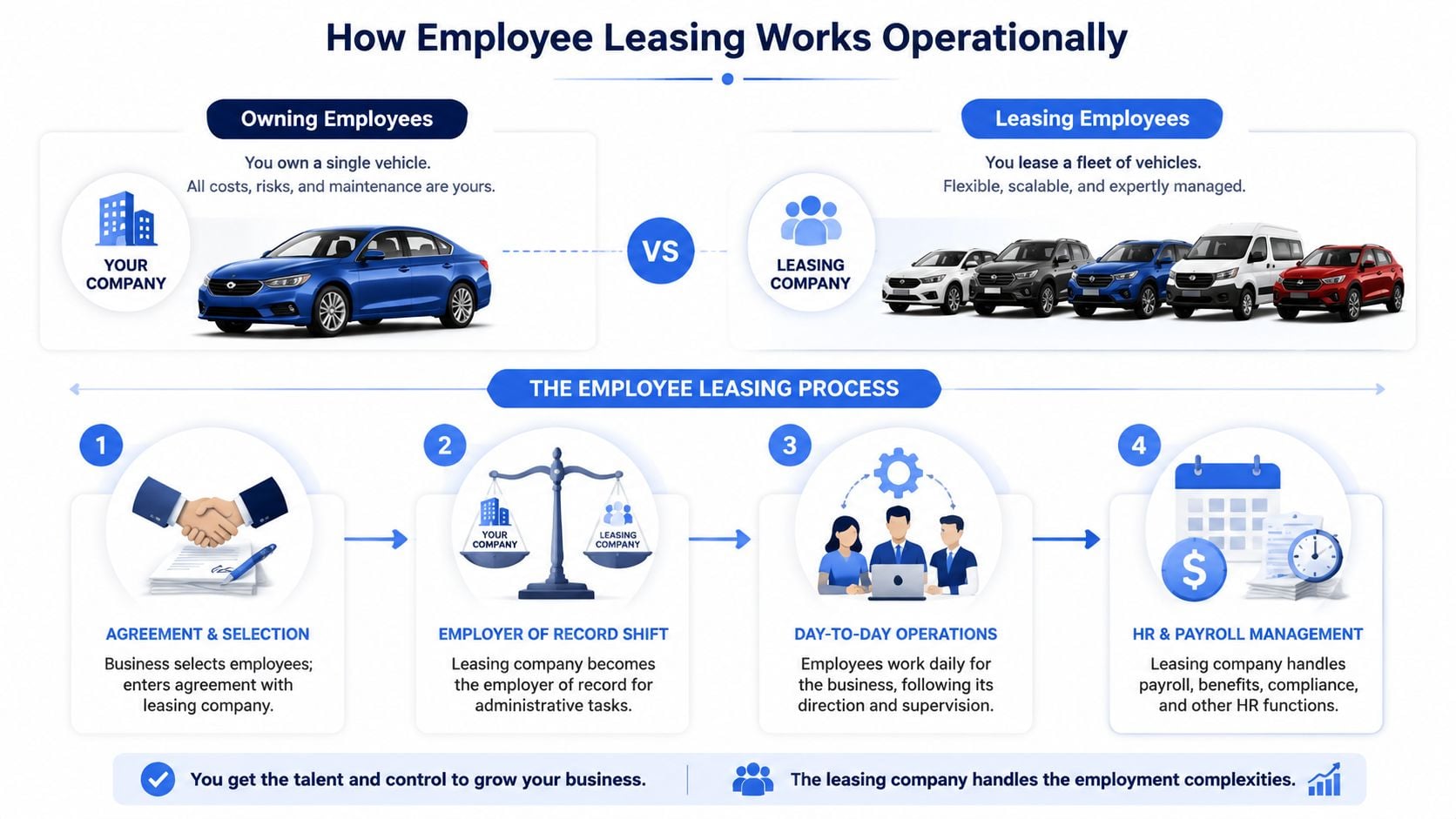
In a true employee leasing arrangement, the leasing firm is the employer of record and handles payroll, tax withholding, and benefits administration, while the client company pays the leasing firm a markup on wages. That structure is generally a better fit for short-term work where flexibility and administrative relief offset the premium, as described in this overview of employee leasing mechanics.
Who does what
The cleanest arrangements spell out responsibilities in writing before the first worker starts.
The client company directs the work
Managers assign duties, set schedules, supervise performance, and control the day-to-day environment.The leasing firm runs the employment administration
That usually includes payroll processing, payroll taxes, benefits administration, and related paperwork.The worker sits in the middle
The worker performs services for the client company, but the formal employment administration sits with the leasing provider.
This split sounds simple until a problem appears. If someone gets injured, disputes pay, asks about benefits eligibility, or needs leave coordination, the answer depends on the contract and the operating process, not on assumptions.
The handoff points matter most
Most failures in leasing arrangements happen at the handoff points between HR administration and local management. That's where companies need a clear boundary map, especially for supervision, leave requests, discipline, onboarding documents, and offboarding timing. A useful companion is this guide to PEO service boundaries and who owns which responsibilities.
The company still manages people. The leasing firm manages employment administration. If either side assumes the other is handling an issue, that issue usually lands on the CFO's desk later.
A solid operational checklist includes:
- Timekeeping ownership: Who approves hours and by what deadline.
- Policy authority: Which handbook applies to attendance, conduct, and leave administration.
- Incident reporting: Who gets notified first if there's a workplace issue.
- End-of-assignment process: Who communicates the end date to the worker and when pay or benefit changes take effect.
This explains what employee leasing is in practice. It's not just outsourced payroll. It's a three-party operating model that only works when the boundaries are explicit.
Employee Leasing vs PEO vs EOR A Clear Comparison
Most companies don't choose between abstract acronyms. They choose between three employment structures that allocate control, liability, and continuity in very different ways.
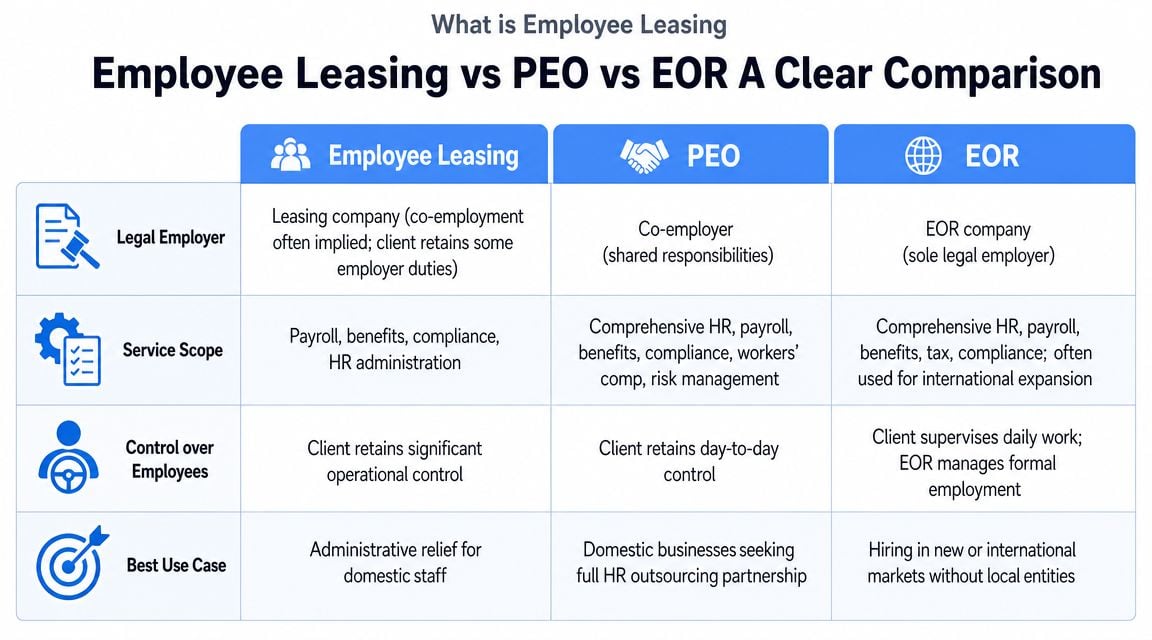
The cleanest dividing line is what happens when the relationship ends. In an employee leasing or staffing arrangement, the worker typically returns to the leasing firm's employee pool. In a PEO co-employment model, the employees remain with the client company even if the PEO relationship ends, as explained in BambooHR's overview of employee leasing. That single point often decides the issue for companies that care about retention and institutional knowledge.
HR outsourcing models compared
| Attribute | Employee Leasing | PEO (Co-Employment) | EOR (Employer of Record) |
|---|---|---|---|
| Legal employer structure | Leasing firm acts as employer of record for the assigned workers | Shared employment responsibilities between provider and client | EOR is the formal employer |
| Best fit | Project-based, seasonal, or temporary staffing needs | Long-term support for an existing domestic workforce | Hiring where the company needs formal employment infrastructure outside its normal setup |
| Day-to-day supervision | Client directs daily work | Client directs daily work | Client usually directs daily work, while the EOR handles formal employment administration |
| What happens at contract end | Workers usually return to the leasing firm | Employees remain with the client company | Depends on the EOR structure and local arrangement |
| Core strategic trade-off | Flexibility, but less continuity | Stability and HR infrastructure, but with shared administrative structure | Market-entry or remote hiring flexibility, but less direct employment ownership |
Where each model usually wins
Employee leasing is strongest when labor demand has a shelf life. Retail ramp-ups, plant support during a surge, short-term administrative backlogs, and defined implementation projects often fit.
A PEO usually wins when the workforce is meant to stay. Benefits consistency, payroll administration, risk support, and HR process maturity matter more there than labor flexibility. For teams comparing those two paths with global or out-of-market hiring, this breakdown of PEO vs employer of record models helps frame the decision.
EOR is a different tool again. It's often considered when a company wants to hire in a jurisdiction where it doesn't want to build its own local employment setup. In those cases, the paperwork around independent contractor status also matters. For example, companies reviewing overseas contractor structures may want to compare local employment options with resources on compliant freelance agreements in Israel.
If the company wants to keep the people, build culture around them, and preserve know-how after a vendor exit, employee leasing is usually the wrong default.
Strategic Benefits and Hidden Risks
Employee leasing has real benefits. It can remove administrative drag fast. It can help a business cover a defined labor need without expanding internal HR infrastructure. It can also create problems that don't show up in the sales presentation.
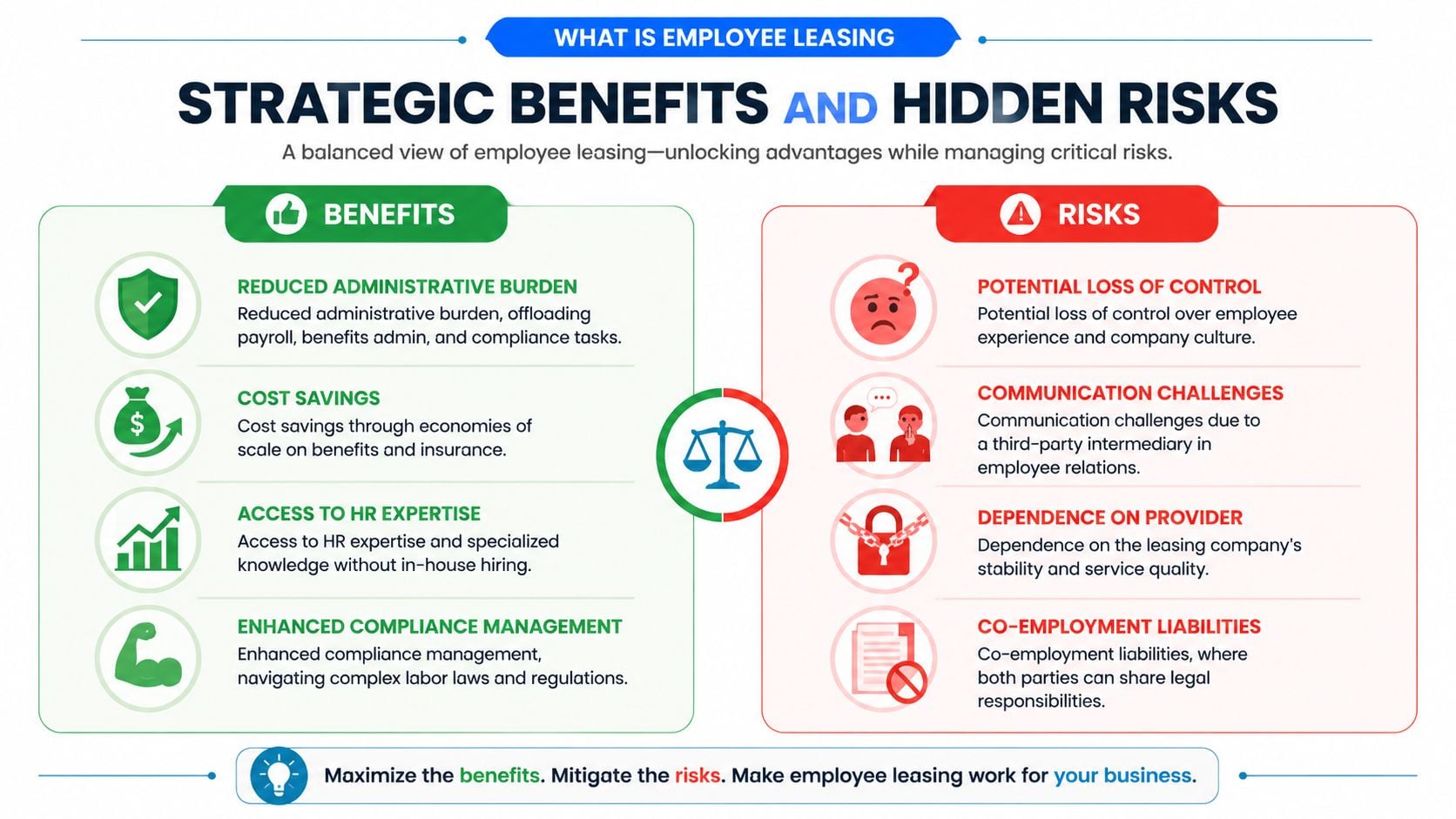
The strongest use case is narrow and disciplined. A company has a surge, a facility launch, a temporary line of work, or a project with a clear end point. In that setting, employee leasing can keep managers focused on operations instead of payroll setup, tax filings, and benefits administration.
The upside is operational speed
The model works well when leadership values speed and flexibility more than long-term workforce continuity.
- Administrative relief: Payroll processing, wage withholding, and benefits administration move to the leasing firm.
- Faster capacity changes: Headcount can often scale up or down more easily than direct hiring allows.
- Useful separation for short projects: The assignment has a built-in end point, which can reduce the need to redesign internal employment processes for temporary demand.
These benefits are real. They just don't stay free forever.
The risk starts when temporary becomes normal
The legal issue many buyers miss is misclassification over time. One major U.S. source notes that, for retirement plan purposes, a leased employee may be defined through a substantial-hours test tied to Internal Revenue Code Section 414(n)(2)(B), using a benchmark of 1,500 hours in a 12-month period or 75% of a typical employee's hours, according to Indeed's summary of leased employee rules. Once an arrangement crosses into long-term, full-time reality, benefits and retirement-plan consequences can change.
That risk has second-order effects.
- Benefits exposure: A worker treated as “temporary” for too long may raise eligibility questions leadership didn't budget for.
- Culture split: A two-track workforce can damage morale if leased workers do core work beside direct employees but operate under different structures.
- Knowledge loss: If the assignment ends and the worker leaves with the leasing firm, the company loses routines, process memory, and training investment.
- Vendor dependency: A strong operating team can become too reliant on a provider whose service model doesn't match the company's long-term goals.
Caution: Employee leasing is often efficient at the start of a problem and inefficient at the end of one. The longer the role lasts, the more likely the model stops matching the work.
Used carefully, it's a tool. Used as a substitute for workforce strategy, it becomes an expensive patch.
Understanding the Cost Structure and Financial Impact
Cost is where bad outsourcing decisions finally become visible on the income statement.
Leaders often compare an employee leasing quote to a PEO quote as if both vendors are selling the same service with different packaging. They are pricing different risk, different administration, and different employment structures. That distinction matters more than the headline rate.
Employee leasing usually applies a markup to labor. A PEO usually charges an administrative fee tied to headcount or payroll while the company keeps the employees. If the role is short-term, the markup may be a fair trade for speed and reduced hiring friction. If the role is stable and expected to stay, that same markup can keep draining margin long after the original staffing problem is gone.
For a finance team, the practical question is simple. Are you paying a temporary premium to solve a temporary problem, or are you accepting a permanent layer of cost on a permanent role?
A useful benchmark for the PEO side is this breakdown of PEO pricing models and cost structure. Use it to compare billing mechanics, not just vendor promises.
A simple comparison for ongoing roles
Take a team of 10 people working in steady roles at the same hourly pay rate. Under a leasing arrangement, the vendor markup applies every hour worked. That means the premium scales with overtime, schedule growth, and tenure. Under a PEO model, the company still carries wage cost, but the fee structure is usually more predictable because it is not built as an hourly spread on each worker.
That difference changes budget behavior. A leasing model can look convenient in month one and expensive by month twelve. A PEO can feel more administrative at the start but cheaper to run once the workforce becomes part of normal operations.
This is the mistake I see most often in budget reviews. The buyer focuses on startup convenience and ignores cost persistence.
What CFOs should model before signing
Translate the quote into annual operating cost, not just an hourly bill rate.
- Underlying wage rate: What is the actual pay rate before the vendor adds its margin?
- Markup rules: Does the markup change by job class, overtime, location, or shift type?
- Time horizon: How much does the arrangement cost over a quarter, a full year, and a likely renewal period?
- Conversion fees: What does it cost to hire the worker directly later, and when does that fee expire?
- Included services: Confirm what the vendor handles for payroll, claims, leave, onboarding, timekeeping, and separation processing.
- Rate adjustment terms: Can the vendor raise pricing mid-contract due to insurance costs, claims history, or labor market pressure?
Tax handling belongs in the model too, especially if the workforce spans multiple states or countries. Finance teams dealing with cross-border exposure or more complex withholding questions should review guidance on financial tax before treating the vendor quote as the full cost picture.
One more point deserves attention. Markup pricing hides easily inside operating budgets because it rides along with labor. Administrative pricing is easier to isolate and challenge. That alone can make a PEO the cleaner option for a company that wants tighter cost control and fewer surprises at renewal.
The right comparison is total cost over the expected life of the role. If the work is core, ongoing, and tied to future headcount plans, leasing deserves harder scrutiny than its speed suggests.
Making the Right Choice A Decision Framework
The wrong model can look cheap in quarter one and expensive by renewal. That is why this decision belongs in the same room as headcount planning, margin targets, and legal review. Employee leasing is a tool, not a default setting.
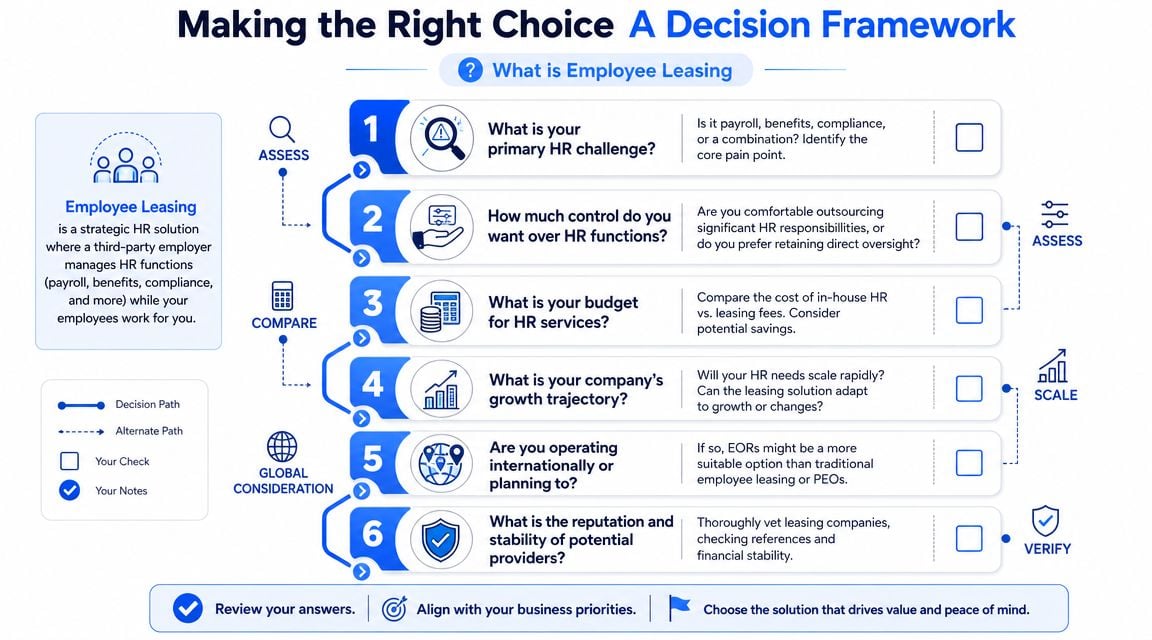
Start with the economic life of the work
A simple test cuts through a lot of sales language. Ask how long the role should exist if business conditions stay roughly on plan.
Is the need time-bound or ongoing?
A defined project, seasonal spike, or temporary backfill points toward leasing. A role that should still exist next year usually deserves a harder look at direct hiring or a PEO-supported structure.Is the company buying labor capacity or building an employment system?
Those are different purchases. Leasing fills seats quickly. A PEO helps run payroll, benefits, HR administration, and compliance for a standing workforce.What is the expected end state if the hire works out?
Teams often get trapped here. If leadership hopes to retain the worker, promote the worker, or build a department around that role, a temporary labor model can become an expensive detour.
Questions that reveal whether leasing will create drag later
These are the questions I push leadership teams to answer before they review vendor decks.
- Who needs to stay after the contract ends? If the answer is the people, not just the output, leasing may be the wrong structure.
- How much workforce separation can managers handle? Mixed teams often create differences in pay practices, benefits access, and loyalty. That can be manageable, but it rarely manages itself.
- Can HR handle another layer of contract administration? A lean HR team may prefer one operating model for the core workforce instead of a patchwork of vendors and exceptions.
- Is the hiring need domestic, or does the company need a legal employment setup in another country or state? If the issue is market entry or formal in-country employment, EOR may solve the problem more cleanly.
- What happens if demand softens or grows faster than forecast? Leasing can help with volatility. It can also become expensive if temporary headcount becomes permanent reliance.
As noted earlier in the article, leadership should weigh short-term labor flexibility against the cost of running a longer-term HR model. The right answer depends less on labels and more on duration, control, and where the company wants headcount to sit six to twelve months from now.
A practical decision rule
Use this table as a first-pass filter.
| Business reality | Usually the stronger fit |
|---|---|
| Short assignment, seasonal volume, defined coverage gap | Employee leasing |
| Stable team, retention goals, benefits strategy, ongoing HR administration | PEO |
| Hiring in a market where the company lacks a formal employer setup | EOR |
One more rule matters. If the role touches customer relationships, core operations, or future leadership bench strength, treat leasing with caution. Companies rarely regret using leasing for a true short-term need. They do regret letting a temporary structure become a permanent operating habit.
Before signing, review the service agreement with the same discipline you would apply to any material vendor contract. This checklist of PEO contract negotiation red flags is also useful for spotting vague responsibilities, weak exit terms, and liability language that can erase the savings that made leasing look attractive in the first place.
Contract Red Flags and Negotiation Points
The sales call explains possibilities. The contract explains consequences.
That matters more in employee leasing than many buyers expect because the arrangement divides supervision, payroll, and legal responsibility across more than one party. If the agreement is vague, the company usually discovers the gap during a claim, a billing dispute, or a messy exit.
Clauses that deserve immediate scrutiny
Some provisions should slow the review process right away.
- Unclear role definitions: If the contract doesn't clearly separate who handles payroll, benefits administration, discipline support, leave handling, and workplace incidents, the company is buying ambiguity.
- Broad indemnification language: A vendor may market the arrangement as risk relief while shifting large chunks of liability back to the client in the contract.
- Automatic renewals with weak exit rights: A short-term staffing solution shouldn't trap the company in a long renewal cycle.
- Conversion restrictions: If a worker becomes valuable, the business should know whether direct hire is allowed and under what terms.
- Data ownership silence: HR records, payroll data, and employee documents should not sit in a gray zone.
A deeper review checklist for these issues appears in this guide to PEO contract negotiation red flags. The same discipline applies to leasing agreements.
Negotiation points worth pressing
The strongest negotiation stance is simple. If the vendor is handling a function, the contract should say so plainly. If the client is retaining a risk, the contract should say that plainly too.
Contract language should track operational reality. If managers are told one thing and legal signs another, the contract wins.
Specific questions to press in negotiation:
Termination mechanics
How much notice is required, and what happens to workers already on assignment?Fee-change rules
Can the vendor raise markups during the term, and under what conditions?Claims handling
Who takes the lead if a wage dispute, benefits issue, or employment complaint arises?Transition support
If the company exits the arrangement, what files, data, and employee information must the vendor provide?
A useful test for every clause
A practical standard is this. Ask what happens if the relationship goes badly, not if it goes well.
If the answer isn't clear on billing, liability, data, worker transition, or termination, the agreement needs revision before signature. That's especially true when the leased workforce is supporting a critical operation rather than a purely temporary project.
Frequently Asked Questions About Employee Leasing
Is employee leasing the same as using a staffing agency
No. The terms sometimes overlap in casual conversation, but they aren't always the same in structure or scope.
A staffing arrangement may focus primarily on sourcing labor. Employee leasing usually goes further into payroll administration, tax handling, and benefits-related administration because the leasing firm serves as the employer of record for the assigned workers. The company still supervises the work, but it doesn't directly carry the same employment administration.
Can employee leasing work for long-term roles
It can, but that doesn't mean it should.
Once the work becomes stable and central to the business, the company should revisit whether the arrangement still fits. Long-duration leased labor can create cost drag, retention problems, and benefits or retirement-plan complexity. For many companies, that's the point where a PEO or direct hiring becomes the cleaner model.
Who controls the employees day to day
The client company usually does.
Managers set priorities, direct tasks, review output, and control the workplace environment. The leasing firm handles the administrative employer functions. This split is why operational discipline matters so much. The people doing the work usually look and feel like part of the client's team, even though the formal employment administration sits elsewhere.
What should finance ask before approving a leasing deal
Finance should ask four hard questions:
- How long is this workforce expected to stay in place
- What is the full cost compared with direct employment or a PEO
- What liabilities remain with the company despite the vendor's marketing
- What happens if leadership wants to retain the workers later
If those answers stay vague, the company isn't ready to sign.
When is a PEO usually the better choice
A PEO is usually better when the company wants to support its own ongoing workforce rather than borrow employment infrastructure for a temporary assignment.
That often applies when leadership cares about retention, benefit consistency, payroll stability, and HR process maturity across a lasting employee population. In plain terms, if the business is building a company rather than covering a temporary labor gap, a PEO often aligns better.
What is employee leasing in one sentence
It's a temporary workforce model where another company formally employs the workers and handles employment administration, while the client company manages the day-to-day work.
Companies comparing employee leasing with a PEO often need more than vendor demos and pricing sheets. PEO Metrics helps HR and finance teams compare providers, pressure-test cost structures, and spot contract terms that can become expensive later, so the final decision is based on fit rather than sales language.
