
A 40-person company can have solid revenue, capable managers, and a dependable payroll process, yet still carry an avoidable HR risk. The owner may discover that nobody tracked a state-specific wage-and-hour requirement, classified a newly hired contractor correctly, or updated benefits documentation after the workforce expanded. At that point, the question isn't which HR platform has the cleanest dashboard. It's who owns the consequences when the process fails.
That's the central decision behind HR services for small business. Payroll software, payroll providers, administrative services organizations, and professional employer organizations solve different problems. The right choice depends on headcount, geography, workforce complexity, and the level of employment risk leadership is prepared to retain.
Table of Contents
- When HR Services Become an Operating Risk Decision
- The Four Ways Small Businesses Buy HR Services
- What Each HR Service Actually Costs to Outsource
- How PEO Pricing Actually Works
- When a PEO Is the Wrong Answer
- Choosing and Negotiating the Right HR Partner
- A Simple Rule of Thumb and Your Next Step
When HR Services Become an Operating Risk Decision
A 40-person company owner receives a $40,000 state wage-and-hour fine after nobody tracks multi-state compliance. The immediate reaction is usually to shop for better payroll software. That response is too narrow. Payroll may have processed every paycheck correctly while the business still failed on state requirements, worker classification, or required workplace notices.
Small businesses usually develop risk in three places:
- State-specific requirements: A remote employee can introduce new posting, leave, pay, and termination obligations that the existing HR process doesn't cover.
- Worker classification: Rapid hiring can leave contractors performing employee-like work without a documented classification review.
- Benefits governance: A first group health plan creates administrative and fiduciary responsibilities that deserve more than an informal spreadsheet.
The right time to formalize HR delivery isn't when payroll feels messy. It's when the business hires its first remote employee in a new state, reaches its 15th W-2 employee, or adopts its first group health plan. Those events change the company's exposure, even if the payroll run itself remains straightforward.
Practical rule: Choose an HR delivery model based on which risks the owner can absorb personally, not on which software demo feels easiest.
A payroll automation tool can remove repetitive work, but automation doesn't automatically transfer compliance ownership. Businesses evaluating integrations can review this resource on Toast POS payroll integration for context on connecting operational systems to payroll workflows. The broader question remains whether the company needs transaction execution, employment expertise, or shared responsibility for HR administration.
A useful starting point is a written risk inventory covering each state, worker type, benefit plan, workers' compensation arrangement, and employee-relations process. The HR compliance resources can help leadership organize that review before comparing vendors.
The Four Ways Small Businesses Buy HR Services
The four main models are easier to understand through a truck analogy. DIY HR software rents the cab, a payroll provider leases the operating controls, an ASO gives the company more ownership while adding professional support, and a PEO outsources much of the engine and risk infrastructure.
DIY software is a dashboard, not an HR department
With DIY software, the company owns the employment relationship and most HR decisions. The platform may handle employee records, payroll calculations, onboarding forms, time tracking, and basic reporting. It doesn't decide whether a contractor is properly classified or whether a manager handled a termination consistently.
This model fits a small, single-state employer with a straightforward workforce and an internal owner who can manage policy and employee questions. It becomes fragile when the business adds states, benefits complexity, or frequent hiring.
Payroll providers execute transactions
A payroll provider generally runs payroll, supports tax filings, and may offer timekeeping or employee self-service. The employer still carries the core compliance, benefits, workers' compensation, and employee-relations responsibility.
This is often the right middle ground for a stable company that wants payroll accuracy without purchasing a broader HR operating model. It isn't a substitute for an HR advisor.
ASOs add HR capability without the same structure as a PEO
An Administrative Services Organization, or ASO, supports functions such as benefits administration, policy development, compliance guidance, recruiting, and employee relations while the client remains the employer. The business retains more control over plan design, vendors, and employment decisions.
ASOs suit companies that need professional HR capacity but don't want a PEO's co-employment arrangement. They're especially useful when leadership has an experienced finance or operations team that wants outside expertise without transferring as much administration.
PEOs bundle infrastructure and shared administration
A Professional Employer Organization, or PEO, operates through a co-employment arrangement. The PEO may coordinate payroll, benefits, workers' compensation, unemployment administration, and HR support, which explains why its fee is usually higher than payroll-only software.
The IRS says the tax code doesn't define “co-employer,” but Treasury Regulation 31.3504-2 allows a PEO to be designated to perform employer acts for wages paid under a service agreement. The IRS also distinguishes certified PEO treatment, with a CPEO treated as the employer only for remuneration it pays to worksite employees. IRS guidance on PEO arrangements provides the governing context.
| Model | Co-Employment | Services Bundled | Risk Owner | Best Fit Headcount | Pricing |
|---|---|---|---|---|---|
| DIY HR software | No | Software, records, basic workflow | Client | Small, single-state teams | Software subscription |
| Payroll provider | No | Payroll, tax filing, often timekeeping | Client | Small to mid-size teams with simple HR needs | Per-employee fee or payroll fee |
| ASO | No, client remains employer | HR consulting, benefits administration, compliance support | Mostly client, with contract-specific support | Growing teams needing expertise and control | Service fee, often PEPM |
| PEO | Yes | Payroll, benefits, workers' compensation, HR, compliance support | Shared by agreement, with important exclusions | Multi-state or higher-complexity employers | Payroll percentage or PEPM |
Companies comparing these structures should start with the practical small business HR outsourcing framework rather than assuming every outsourced provider offers the same risk transfer.
What Each HR Service Actually Costs to Outsource
A 75-person company with $4.2 million in annual payroll may buy six separate HR capabilities: payroll processing, benefits administration, compliance support, recruiting and onboarding, handbook development, and employee-relations assistance. Each model packages those capabilities differently, so comparing only the monthly platform charge produces a misleading result.
The following ranges illustrate the buying differences. Standalone payroll may run $4 to $8 per employee per month, while benefits administration may add $5 to $15 per employee per month. Compliance postings may cost $300 to $800 per year, recruiting fees may run 15% to 25% of base salary per hire, custom handbook work may cost $1,500 to $5,000, and ASO employee-relations support may cost $150 to $300 per hour. These figures come from the worked pricing assumptions for this comparison and should be validated in each proposal.
| Service | DIY / Software | Payroll Provider | ASO | PEO |
|---|---|---|---|---|
| Payroll processing | Software workflow, client-managed oversight | Payroll execution and filings | Usually bundled or coordinated | Bundled into broader service |
| Benefits administration | Client or broker managed | May be an add-on | Core service in many arrangements | Often bundled with plan access |
| Compliance and postings | Client responsibility | Limited reminders or add-ons | HR guidance and monitoring | Broader support, subject to contract |
| Recruiting and onboarding | Client-led, software-assisted | Basic onboarding tools | Consulting and workflow support | Often bundled at a service level |
| Handbook and policy | Client-created or project-based | Usually not core | Common consulting service | Often included, with scope limits |
| Employee relations | Manager or outside counsel | Usually separate | $150 to $300 per hour in the example | May be bundled at 2% to 4% of payroll in the example |
For the 75-person example, the combined annual cost is approximately $18,000 for a DIY stack, $42,000 with an ASO, and $95,000 through a PEO. That is roughly a fivefold spread, driven by the amount of infrastructure and risk support included, not merely by vendor markup.
Benefits deserve separate scrutiny. Employers reviewing essential small business benefits should distinguish plan cost from administration cost, then ask whether a PEO's benefit access justifies its broader fee. A detailed HR outsourcing cost analysis can help finance teams compare fully loaded alternatives.
How PEO Pricing Actually Works
PEO pricing usually appears in one of two forms: a percentage of payroll or a per-employee monthly charge. Industry guidance places common pricing around 2% to 12% of total payroll or approximately $40 to $160 per employee per month. ADP's PEO cost guidance emphasizes the point finance teams often miss: the headline fee isn't the fully loaded cost.
A percentage model scales with payroll. A PEPM model is easier to budget when salaries vary, but it can feel expensive for lower-paid workforces. Neither structure is automatically cheaper because benefits, workers' compensation, implementation, technology, and other HR charges may sit outside the advertised service fee.
| Pricing Model | Headline Fee | Bundled In | Typical Pass-Throughs | Effective Cost |
|---|---|---|---|---|
| Percentage of payroll | 2% to 12% of payroll | Core HR administration and agreed services | Benefits, workers' compensation, implementation, special projects | Must be calculated against total payroll and pass-throughs |
| Per employee per month | $40 to $160 PEPM | Core platform and defined support | Benefits, insurance, compliance projects, extra service tiers | Varies with headcount and excluded services |
A CFO should reconcile four line items before approving a proposal:
- Service fee: The percentage or PEPM charge shown in the sales proposal.
- Benefits cost: Premiums, plan fees, broker compensation, and any minimum participation requirements.
- Insurance and statutory charges: Workers' compensation, unemployment-related items, and other pass-through costs.
- Implementation and exception fees: Setup, special payrolls, custom reporting, recruiting, handbook work, or termination support.
A proposal advertising a 3% fee can become a 7% effective cost once excluded items are added. That example is a calculation, not a universal market rate. The finance team should request a monthly invoice simulation using the company's actual payroll, benefits, work locations, and expected service usage. The PEO cost comparison guide offers a useful structure for that exercise.
When a PEO Is the Wrong Answer
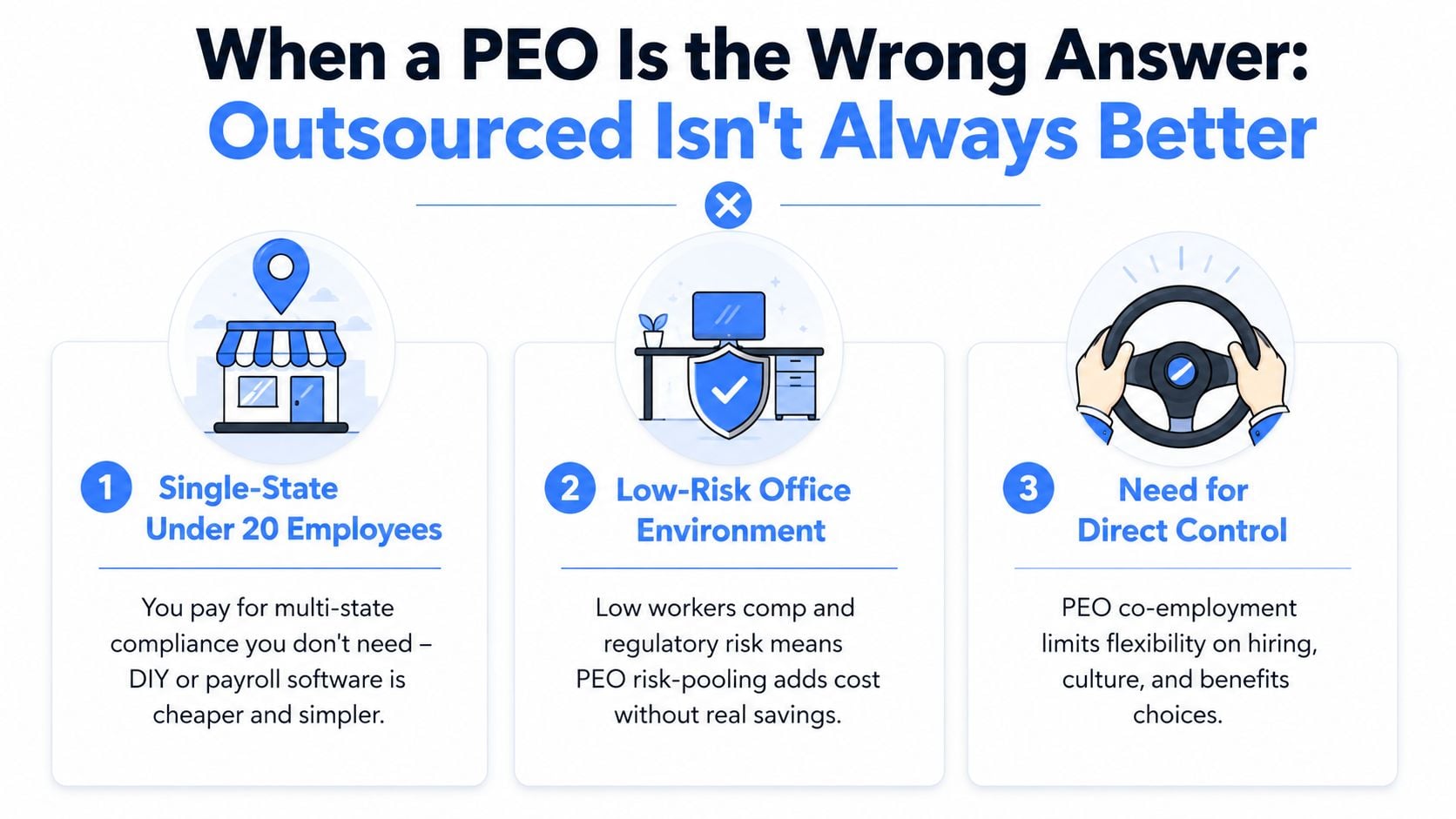
Outsourced HR isn't automatically better HR. A PEO can make a simple business more expensive and less flexible when the company has little regulatory exposure, operates in one state, and has no need for pooled benefits or extensive HR guidance.
The first poor-fit scenario is a single-state business with fewer than 20 employees. A 12-person consulting firm with one office may pay approximately $31,000 more per year for PEO services it rarely uses, based on the worked comparison in this decision framework. If its workforce has predictable roles, low workers' compensation exposure, and limited benefits complexity, payroll software plus targeted HR advice may provide better value.
The second is a low-risk office environment. A desk-based professional-services company doesn't automatically benefit from a PEO's risk-pooling structure in the same way a business with more complex workplace exposure might. Leadership should compare the actual workers' compensation and compliance needs rather than paying for every bundled feature.
The third is a founder who needs direct control and flexible contracting. A PEO may standardize benefit options, approval workflows, hiring processes, and termination procedures. That consistency can help a growing employer, but it can frustrate a company that needs unusual compensation, independent benefits decisions, or rapid policy changes.
Decision test: If the business can't identify the compliance, benefits, or insurance problem the PEO solves, the company is probably buying a bundle instead of buying an outcome.
A payroll provider tends to break when the employer needs ongoing HR judgment. DIY software breaks when managers lack the time or expertise to maintain compliance. An ASO can be the wrong choice when the business needs stronger insurance pooling or a more formal allocation of payroll-tax responsibilities. A PEO becomes more defensible as states, employee categories, benefit needs, and regulatory exposure multiply, but the contract still determines how much risk the provider accepts.
Choosing and Negotiating the Right HR Partner
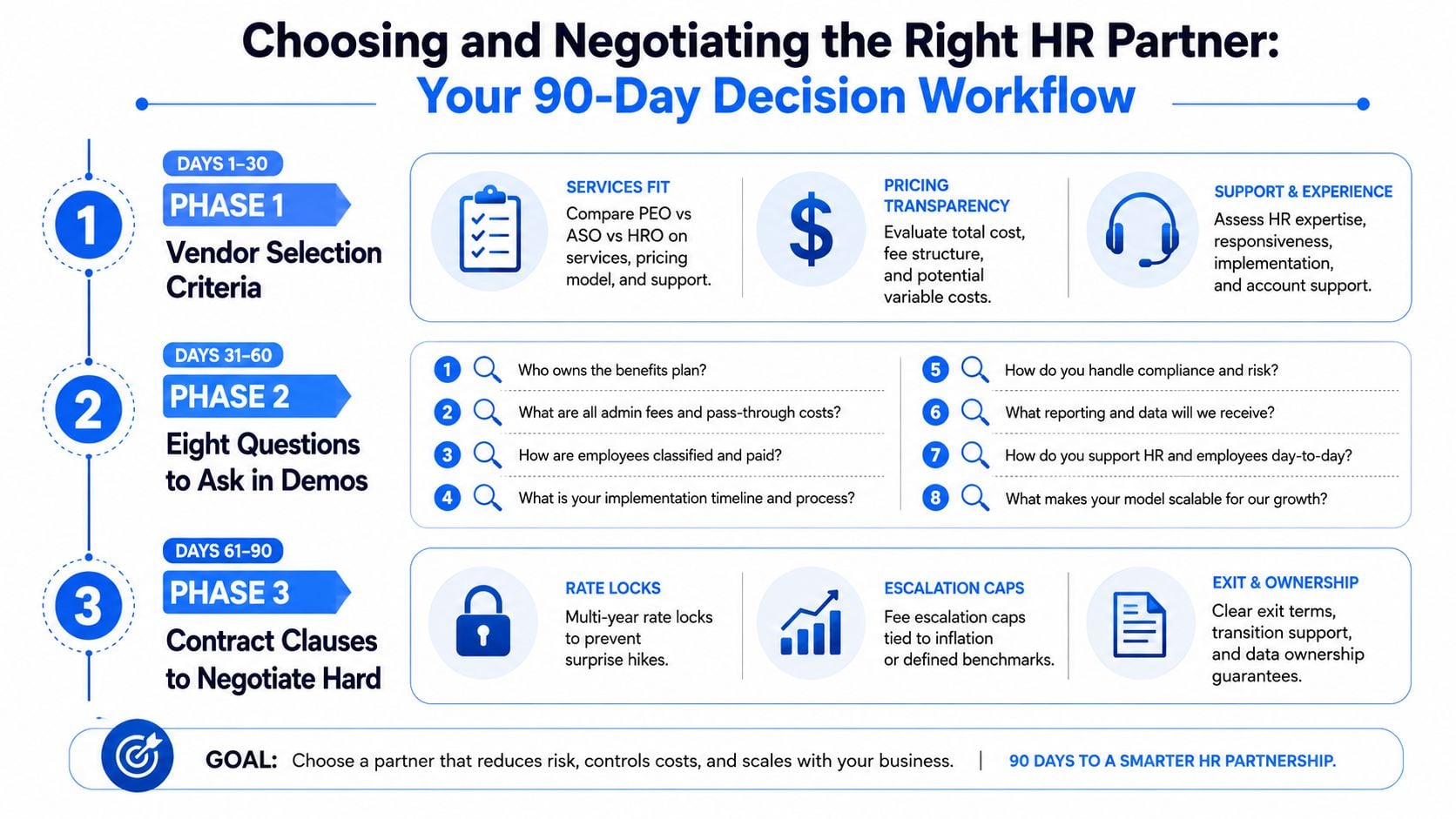
A disciplined selection process should take 90 days, not a rushed sales cycle. The timeline gives finance, HR, legal, and operations enough time to test the service model and review contract mechanics.
Days 1 through 30 define the buying requirement
The company should assemble payroll registers, employee locations, benefit invoices, workers' compensation information, current policies, open employee-relations matters, and the existing HR technology map. Leadership should then score each model against four criteria: service coverage, total cost, control, and risk allocation.
The first demo questions should expose the operating reality:
- Who owns the benefits plan and makes renewal decisions?
- Which services are included, and which trigger separate fees?
- Who handles a state compliance question?
- How does the provider document payroll-tax and benefits payments?
- What happens when an employee leaves or the company exits?
- What data can the client export, and in what format?
- Which compliance errors does the provider indemnify?
- Who serves the account after implementation?
Days 31 through 60 test the promised service
Ask each finalist to price the same employee census and the same payroll assumptions. Require a sample invoice, implementation schedule, escalation path, service-level commitments, and benefits renewal explanation.
Accreditation can add useful verification. ESAC says accredited PEOs must timely and accurately pay wages, payroll taxes, benefit contributions, workers' compensation premiums, and health insurance premiums, with quarterly confirmation by an independent CPA. ESAC also says accredited PEOs are backed by more than $15 million in surety bonds held in trust. ESAC's accreditation standards should be treated as one diligence input, not a replacement for contract review.
Days 61 through 90 negotiate the agreement
The contract deserves as much attention as the sales presentation. Push for:
- Multi-year rate locks: Prevent the provider from repricing core services immediately after implementation.
- Fee escalation caps: Limit increases and define exactly which charges are excluded.
- Implementation credits: Offset the internal labor required to move payroll, benefits, and employee records.
- Exit terms: Set notice periods, transition duties, final payroll support, and data portability.
- Liability allocation: Specify responsibility for provider-caused payroll, tax, benefits, or compliance errors.
- Co-employment disclosures: Identify which decisions remain with the client and which the PEO controls.
Red flags include unilateral pricing changes, undefined “additional services,” broad client indemnification, automatic renewal without practical notice, data access that ends before transition, and language allowing the provider to change benefit terms without a clear client process.
A buyer comparing providers can use questions for PEO providers to structure demos and expose differences that pricing sheets often hide. Before signing, the company should request the master service agreement, fee schedule, benefits documentation, insurance terms, implementation plan, service-level commitments, data-security materials, accreditation details, and a sample renewal notice.
A Simple Rule of Thumb and Your Next Step
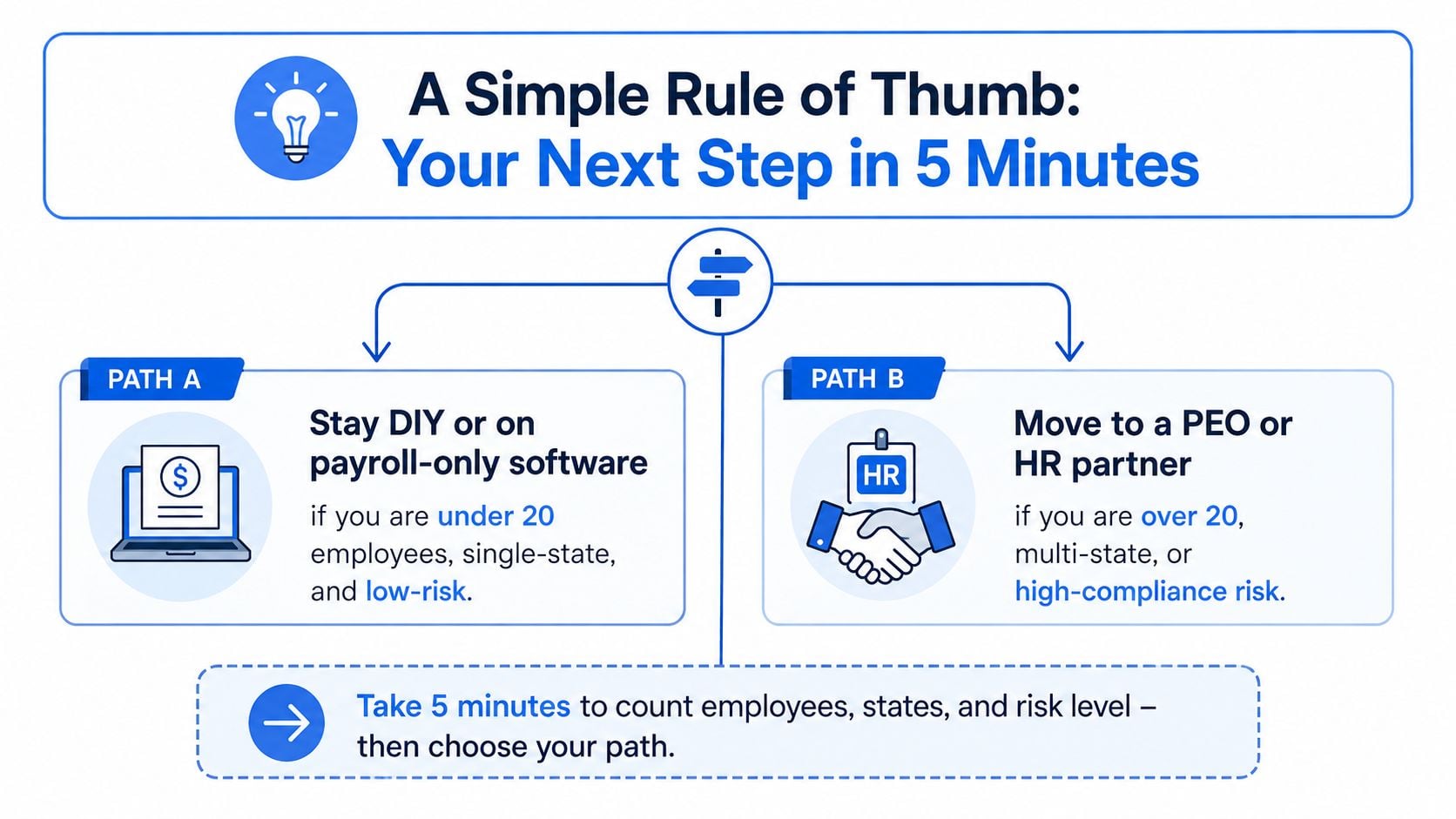
The fastest triage rule uses three variables: W-2 headcount, state footprint, and risk level.
Stay with DIY HR software or payroll-only support when the company has fewer than 20 W-2 employees, operates in one state, and works in a low-risk industry. Move toward an ASO when headcount reaches the 20 to 50 range or the business operates across two or more states, especially when managers need recurring policy and employee-relations support.
A PEO becomes a serious option at 50 or more employees, in regulated industries, or whenever the cost of one compliance failure could exceed a year of PEO fees. That isn't a mandate. It's a financial-risk test. A company with fewer employees may still need a PEO if its workforce is distributed, benefits are difficult to procure, or regulatory exposure is unusually high.
The cost comparison should include more than vendor invoices. One benchmark places total HR administration at about $2,000 per employee annually in-house versus approximately $1,395 with a PEO, implying roughly a 30% reduction in direct HR administration spend. G&A Partners' PEO cost benchmark notes that the economics are strongest when the employer can spread fixed HR and compliance costs but lacks the scale to negotiate benefits and payroll terms independently.
This week, finance and HR leaders should pull payroll and headcount data, then run three lines: annual payroll multiplied by a 3% to 7% effective PEO cost assumption, annual fully loaded HR staff cost, and the estimated cost of the risks the current model leaves unmanaged. The company should book two demos and require both vendors to price the same facts. The best HR service is the one finance, legal, and people leaders can all defend at renewal.
PEO Metrics helps employers compare PEOs, ASOs, brokers, and payroll providers by reviewing pricing, benefits, service models, contract terms, compliance support, and fit. Visit PEO Metrics to request an independent comparison, identify negotiation risks, and evaluate the terms before choosing or renewing an HR partner.
