
Most advice about choosing a PEO broker starts with the wrong question. It asks whether a broker can find the “right” PEO, as if the broker were a neutral search engine for HR providers. The more important question is blunt: who pays the broker, and how does that payment shape the recommendation?
A broker can save an HR team weeks of work, expose contract risks, and create influence during a renewal. The same channel can also steer a buyer toward providers that pay more, move faster, or offer better placement economics. That distinction matters in a market valued at USD 58.46 billion in the United States in 2025, projected to reach USD 120.40 billion by 2034, according to United States PEO market data.
For a company with 10 to 2,000 employees, the practical standard is simple. A PEO broker should disclose compensation, prove market coverage, document the evaluation process, and remain accountable after the contract is signed. If those commitments stay verbal, the buyer is relying on trust where the engagement should rely on evidence.
Table of Contents
- The Misconception at the Center of Every PEO Broker Conversation
- What a PEO Broker Actually Does
- How PEO Brokers Get Paid and Why It Matters
- Conflicts of Interest You Should Probe Before Engaging One
- What to Demand in Writing From Any PEO Broker
- A Realistic Scenario for Switching or Renewing With a Broker
- A Practical Framework for Deciding Whether You Need a Broker
The Misconception at the Center of Every PEO Broker Conversation
The popular definition of a PEO broker is an independent matchmaker. That description is incomplete. The selected PEO typically compensates the broker, with the payment built into the provider's pricing rather than billed separately to the client, as outlined in PEO broker compensation guidance.
This arrangement does not prove that a broker is dishonest. It does mean the employer must test whether the shortlist is independent. A broker paid only after a placement may favor providers that respond quickly, accept the account, and pay through an established channel. A PEO that fits the employer better but pays less, moves slowly, or sits outside the broker's active network may never be considered.
The distribution problem
A broker often operates less like an employer-paid consultant and more like a distribution partner for PEOs. The broker brings qualified prospects to providers, manages the sales process, and receives compensation when the relationship closes. That model can reduce the buyer's workload, but the broker's revenue interests and the employer's priorities are not perfectly aligned.
Judge the provider universe before judging the presentation. Ask for the broker's active market coverage, exclusions, compensation terms, shortlist methodology, and post-sale responsibilities in writing.
A serious buyer should ask:
- Market coverage: Which PEOs does the broker actively place, and which providers are excluded?
- Compensation: Does every participating PEO pay the same amount, or do rates vary?
- Shortlist logic: What objective criteria eliminated each provider?
- Ongoing economics: Does the broker receive renewal compensation or other trailing payments?
- Accountability: What work continues after implementation, and who handles disputes?
A website statement calling a broker “independent” does not answer these questions. Independence is demonstrated through written disclosure and documented process, not branding.
Practical rule: Evaluate who funds the recommendation before evaluating the recommendation itself.
The commercial stakes have grown as the PEO category expanded beyond its early roots. One legal and academic account traces the first PEO to California in 1972, notes approximately 200 PEOs by the mid-1980s, and records 386% growth from 1992 to 2002 in the historical record of the PEO industry. As the category grew, distribution channels became more important to how PEO contracts reached employers. That makes compensation disclosure and documented selection criteria buyer requirements, not optional courtesy.
What a PEO Broker Actually Does
A PEO broker is an intermediary that helps an employer assess, compare, negotiate, and sometimes implement a professional employer organization relationship. The broker doesn't become the service provider. The PEO delivers payroll, benefits administration, HR support, risk services, and related functions under a co-employment arrangement.
The broker channel sits between two alternatives. One is going directly to a PEO sales team. The other is choosing an ASO, or administrative services organization, where the employer generally retains more direct control and purchases underlying payroll, HR, benefits, or insurance components separately. Neither route is automatically superior. The right choice depends on complexity, internal capacity, risk tolerance, and the type of support the employer needs.
A 75-person example
Consider a 75-person professional services firm operating across several states. Its HR director needs payroll administration, competitive benefits, employee support, and help interpreting multi-state requirements, but the company doesn't have time to run separate discovery calls with every major provider.
A capable broker can conduct the needs assessment, translate the firm's priorities into an RFP, manage provider questions, normalize pricing, and explain contract differences. That work is useful when the buyer needs market context and negotiation power.
Going direct can make sense if the firm already has a strong internal procurement process, knows which provider it wants, and can compare contract terms without outside help. A direct PEO representative may also be the fastest route when the buyer has a narrow requirement and doesn't need a market scan.
An ASO may be preferable when the employer wants to retain greater control over benefits and employment administration, has internal HR expertise, or wants to buy only selected services rather than adopt a broader PEO structure.
Expected broker deliverables
Before engagement, the buyer should define what the broker must produce:
- Needs assessment: A written summary of workforce structure, states, industry risks, benefits priorities, and service requirements.
- RFP management: A controlled process that gives participating providers the same information and response requirements.
- Shortlist rationale: A written explanation of why each recommended PEO fits and what trade-offs remain.
- Contract review: A comparison of fees, escalation language, termination rights, liability allocation, and implementation obligations.
- Renewal support: A defined process for benchmarking pricing and challenging proposed changes before the renewal deadline.
The employer should also understand the difference between a broker that forwards brochures and one that performs analysis. A broker adds value only when the work produces better information, stronger terms, or lower decision risk. Companies comparing advisory paths can review the scope of HR consulting solutions as a reference point for the type of support an employer may require.
PEO Access Channels Compared
| Channel | Who Pays the Intermediary | Typical Buyer Experience | Best Fit |
|---|---|---|---|
| Direct PEO access | No intermediary | One provider controls discovery, pricing, and contract presentation | Buyers with a defined provider preference and strong internal review capacity |
| Commission-based broker | The selected PEO generally pays, with compensation embedded in pricing | Multiple provider conversations are consolidated, but incentive disclosure becomes critical | Buyers needing market access, negotiation help, and process management |
| Fee-for-service advisor | The employer pays an agreed advisory fee | Deliverables, evaluation criteria, and accountability are defined contractually | Buyers prioritizing transparent incentives and independent analysis |
| ASO channel | The employer usually contracts directly with service and coverage providers | The employer retains more responsibility for assembling and managing the solution | Employers with capable HR infrastructure and a preference for direct control |
How PEO Brokers Get Paid and Why It Matters
Broker compensation shapes the shortlist, even when the employer sees no separate broker invoice. Independent brokers are typically paid by the selected PEO, with that cost built into the provider's pricing rather than added as a distinct buyer-facing charge. The practical question is not whether a fee appears on your invoice. It is whether the compensation structure influences which providers receive serious attention. Buyers should ask for the arrangement in writing before sharing detailed workforce information.
Compensation may be tied to placement, payroll volume, or continuing account activity. Discussions of first-year and renewal commissions sometimes cite 3% to 8% of payroll, but that range is not verified data for this article. Treat it as unconfirmed. Request the broker's actual compensation schedule instead of relying on a generic market figure.
Placement creates pressure
A broker paid only after a deal closes has a commercial reason to keep the process moving. That can help a decisive buyer, yet it can also shorten the time available for diligence. A broker may favor a PEO that produces a proposal quickly over one that requires deeper underwriting. A provider offering lower compensation may receive less attention even when its service model, benefits structure, or contract terms fit the employer better.
The distortion often appears in ordinary process decisions:
- A narrow shortlist: The broker presents providers already familiar with the account rather than explaining the full screening criteria.
- Fast placement language: Speed becomes the headline before contract risks, exclusions, and implementation requirements receive proper review.
- Incomplete pricing normalization: One provider's administrative fees are compared with another provider's broader all-in estimate.
- Weak renewal support: The broker stays involved during selection, then offers little help when rates and terms change.
A larger PEO may have more room to support referral relationships, preferred-provider arrangements, or volume incentives. That does not prove the provider is a poor fit. It does require the buyer to ask whether commercial terms affect the providers included, excluded, or prioritized.
Compare the economics, not just the fee
PEO pricing commonly uses a percentage of gross payroll or a flat PEPM, or per-employee-per-month, fee. Published pricing benchmarks show broad variation by company size and risk, including approximately USD 110 to USD 200 PEPM for 5 to 25 employees, USD 90 to USD 165 PEPM for 26 to 50 employees, and USD 50 to USD 100 PEPM for 251 to 500 employees, according to PEO pricing benchmarks. These ranges are not quotes for a specific employer. They show why the broker's comparison method can affect the total cost.
Demand a side-by-side view of administrative fees, payroll charges, workers' compensation, benefits costs, pass-through items, implementation charges, renewal mechanics, and termination obligations. A lower visible fee can conceal a less favorable allocation of risk or a more expensive renewal structure.
Use PEO cost analysis resources to organize the review around total cost, contract exposure, and service scope, rather than the single line item a broker chooses to emphasize.
Conflicts of Interest You Should Probe Before Engaging One
A buyer should not share employee census data until the broker explains every material source of compensation. Census information can include salaries, locations, classifications, benefits elections, claims details, and other sensitive workforce data. The broker needs a legitimate evaluation purpose, a security process, and a compensation structure the employer understands.
The main risks are structural rather than dramatic. A broker may receive different compensation from different PEOs, retain residual payments after placement, receive incentives tied to volume, or have an ownership relationship with an affiliated provider. A broker may also receive non-cash commercial benefits, such as event access, leads, travel, or preferred status. Each arrangement can influence behavior without appearing on the buyer's invoice.
Questions that expose alignment
The buyer should ask for direct answers, preferably in the engagement agreement:
- Provider economics: What does each PEO pay for a new placement?
- Renewal economics: Does the broker receive trailing compensation while the employer remains with the provider?
- Revenue concentration: What proportion of the broker's revenue comes from each PEO or carrier?
- Unequal incentives: Is the broker paid more for recommending one provider over another?
- Ownership: Does the broker, its principals, or an affiliate own an interest in any recommended PEO?
- Shortlist completeness: Will the broker include providers that don't pay commission?
- Post-placement role: What support is included during renewal, disputes, billing review, and termination?
A disclosure page can be useful, but disclosure alone doesn't create neutrality. The buyer needs to know whether the broker's process changes when compensation changes.
Two advisory models
A commission-driven broker can still provide valuable market access and negotiation support. The problem arises when the buyer assumes the broker's services are independent without testing that assumption. A fee-for-service advisor creates a different alignment because the employer pays for defined work, although the buyer still needs to verify expertise and scope.
| Dimension | Commission-Driven Broker | Fee-for-Service Advisor |
|---|---|---|
| Primary payer | Usually the selected PEO | The employer |
| Buyer-facing fee | Often no separate fee, with compensation embedded in provider pricing | Agreed advisory fee |
| Incentive | Placement and continuing account economics may matter | Delivery of contracted work and client satisfaction |
| Provider coverage | Depends on active relationships and participating providers | Should be defined by the engagement scope |
| Negotiation objective | May include placement speed and provider acceptance | Usually tied to stated pricing and contract outcomes |
| Renewal support | Must be confirmed, especially if residual compensation exists | Can be written into the statement of work |
| Independence test | Compensation disclosure and non-paying-provider representation | Scope, methodology, conflicts disclosure, and deliverables |
Employers assessing these trade-offs can review PEO broker conflict analysis before selecting an advisory model.
What to Demand in Writing From Any PEO Broker
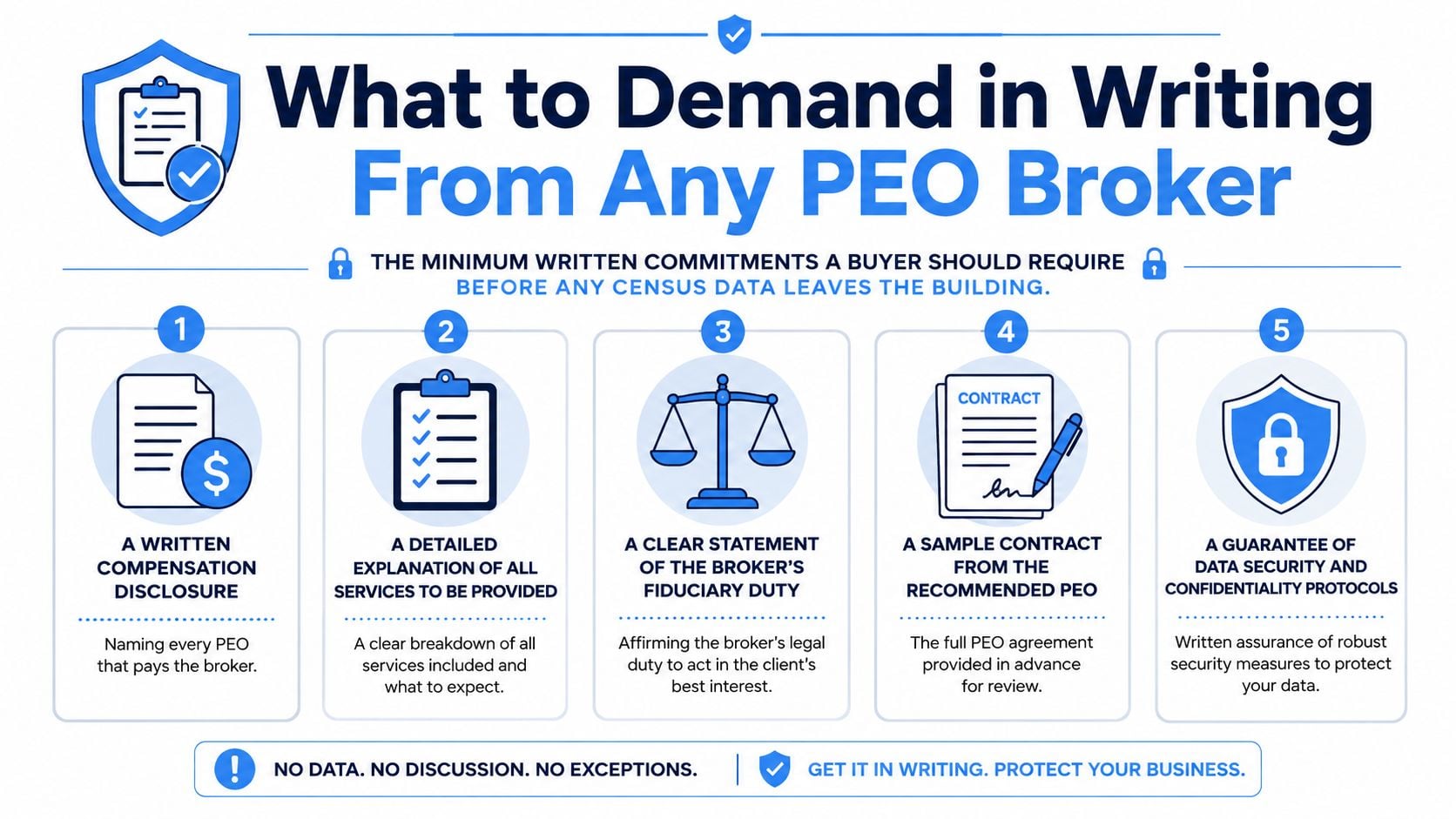
Verbal assurances don't survive pressure from a renewal deadline. Before employee data leaves the company, the buyer should require a written engagement agreement that explains compensation, scope, confidentiality, and post-selection responsibilities.
The minimum package should include five documents or commitments:
- Compensation disclosure: Every PEO that pays the broker should be named, along with the exact percentage or flat amount, payment timing, renewal compensation, and any trailing residual.
- Service description: The agreement should identify whether the broker will perform a needs assessment, run an RFP, compare proposals, review contracts, support implementation, and assist at renewal.
- Fiduciary representation: If the broker claims to act as a fiduciary or client advocate, that representation should appear in writing with a clear explanation of its practical obligations.
- Recommended-provider contract: The buyer should receive a sample or proposed PEO agreement early enough for legal and finance review.
- Data-security commitment: The broker should document confidentiality controls, permitted data use, retention rules, and the process for deleting or returning census information.
Clauses that protect the buyer
The engagement should include a non-circumvention clause that prevents the broker from using the buyer's information to solicit the client directly after a switch or from redirecting the relationship without consent. It should also define the RFP requirements, the number and type of providers to be evaluated, the decision timeline, and the employer's right to reject every proposal.
The agreement should state whether the broker will support renewal negotiations. If that obligation isn't written down, the buyer may discover later that the broker's role ended at signature.
Contract review should also cover the employer's main PEO agreement. A buyer evaluating that document can use a PEO master service agreement checklist to organize questions about liability, termination, fee increases, implementation, and service commitments.
Written disclosure beats verbal comfort. If a broker won't document how the relationship is funded, the buyer shouldn't provide the data needed to create a proposal.
A Realistic Scenario for Switching or Renewing With a Broker
A 180-employee manufacturing company reaches the end of a three-year PEO contract. Its workers' compensation rates are rising, the benefits design has become stale, and finance suspects the administrative fee no longer reflects the company's scale. The incumbent broker schedules a renewal call, forwards the provider's proposal, and recommends signing before the deadline.
Under that path, the employer accepts a 14% cost increase. That figure is a hypothetical scenario, not a market statistic. The important issue isn't the precise increase. It's that the company never receives a competitive benchmark, never tests a different co-employment structure, and never asks whether the existing benefits design still supports hiring and retention.
The rubber-stamped renewal
The incumbent broker's role is limited to forwarding documents. The company receives no written market scan, no fee comparison, and no contract redline. The renewal proceeds because changing providers feels disruptive, while the cost increase gets treated as unavoidable.
That process creates several unanswered questions:
- Were the workers' compensation assumptions tested against another provider?
- Did the provider's administrative fee reflect the employer's larger payroll base?
- Could a different benefits structure improve employee value without increasing total cost?
- Were stop-loss terms, attachment points, or exclusions compared?
- Did the contract include rate protection or a meaningful exit right?
The broker may still have a relationship with the incumbent that creates residual economics. Even if no improper conduct occurs, that relationship can make “renew as-is” easier than a full market test.
The scoped competitive process
A different engagement begins before the renewal notice arrives. The broker receives a written mandate to run a competitive RFP, compare the incumbent against alternatives, identify a benefits and co-employment option, and negotiate payroll fees and stop-loss attachment terms.
The decision points are clear:
- Before the renewal proposal: Gather current invoices, claims information, benefit elections, contract schedules, and service issues.
- During the RFP: Give every provider the same workforce and risk information.
- At proposal review: Separate administrative fees from insurance costs and pass-through charges.
- During negotiation: Request payroll-fee concessions, service guarantees, implementation support, and clearer stop-loss language.
- Before approval: Compare the incumbent's revised offer against the strongest alternative and document the reason for the final decision.
The company may stay with the incumbent. That can be the correct result if the provider improves its terms and remains the best operational fit. The value of the broker comes from creating credible alternatives and forcing the incumbent to earn the renewal, not from switching for its own sake.
Companies planning a transition should map data, employee communications, benefits continuity, payroll timing, and termination obligations using a structured switching service providers process.
A Practical Framework for Deciding Whether You Need a Broker
A broker earns the engagement when the employer faces a genuine market, pricing, contract, or negotiation problem. PEO selection can feel complicated, but that alone does not justify paying for representation. HR, finance, and ownership teams should apply four questions before sharing workforce data or signing a broker agreement.
Can the internal team run a credible market test?
Direct sourcing may be efficient if HR and finance can define requirements, contact multiple PEOs, normalize proposals, review contract language, and negotiate without delaying core work. Request a complete fee schedule and require providers to use comparable proposal formats. Without that discipline, a direct process can create false comparisons.
If the internal team cannot run those steps in parallel, a broker or independent advisor can reduce the workload. Limit the engagement to provider selection when the company does not need ongoing advocacy. A fee-for-service advisor is often better when the buyer wants analysis without tying the recommendation to provider commissions.
Does workforce complexity exceed internal capacity?
A multi-state workforce, varied job classifications, benefits pressure, workers' compensation exposure, or multiple legal entities can make PEO comparison materially harder. A company with 10 employees may need help because its HR function is limited. A company with 2,000 employees may need help because its structure is complex. Headcount does not decide the question.
Require a written scope that states which risks the advisor will examine and which remain with internal counsel, benefits consultants, or the PEO. The scope should also identify the documents the advisor will review, the decisions it will support, and the deliverables due before a provider is selected.
Is strengthening renewal leverage a realistic objective?
An employer already using a PEO should not accept a renewal recommendation without comparing the current agreement with market alternatives. Request the fee schedule, renewal calendar, contract redlines, and negotiation plan in writing. If switching is impractical, focus the engagement on rate locks, fee caps, service-level guarantees, implementation credits for needed changes, and termination protections.
A broker that only supplies a new-business shortlist is not enough for a renewal. Renewal benchmarking and contract-term comparison must be explicit deliverables. The buyer should also ask whether the broker receives compensation when the incumbent is retained, because that payment can affect the recommendation.
Will the broker disclose compensation?
This is the decisive filter. The broker should name the PEOs that pay it, explain material rate differences, identify trailing compensation, and state whether non-commission providers can be included. If it refuses, the buyer should walk away before sharing census data. A fee-for-service structure may be the better choice when transparency matters more than avoiding a separate advisory fee.
| Buyer Situation | Recommended Path | Defining Action |
|---|---|---|
| Limited HR capacity and several providers may fit | Engage a broker or independent advisor | Require a needs assessment, RFP, shortlist rationale, and contract review |
| Strong internal procurement and a preferred provider | Go direct | Assign legal and finance owners for pricing and agreement review |
| Existing PEO with a difficult renewal | Use a scoped renewal advisor | Demand market benchmarking, fee analysis, and documented negotiation targets |
| Employer wants maximum incentive transparency | Prefer fee-for-service advice | Agree to a written fee schedule and named deliverables |
| Broker refuses compensation disclosure | Do not engage | Stop before sharing census data |
| Employer only needs selected administrative functions | Evaluate ASO options | Compare retained responsibilities, coverage, service scope, and total cost |
Two warning signs justify leaving the process midstream. First, the broker adds a provider without explaining its fit or compensation. Second, it discourages contract review, refuses to share proposal assumptions, or uses the renewal deadline to avoid competition.
PEO Metrics helps employers compare PEOs, review pricing and contract terms, identify provider trade-offs, and negotiate fee increases, exit terms, implementation costs, and renewal protections. HR and finance leaders can visit PEO Metrics to evaluate an independent comparison and negotiation process before committing to a broker or provider.
