
Most employers don't have a benefits problem first. They have a cash-flow problem wearing a benefits costume.
Renewal season exposes it fast. The broker brings three quotes, the carrier blames claims, the PEO says the bundle is simpler, and the CFO wants to know one thing, how much risk stays on the company's balance sheet if a bad year lands in the middle of payroll. That is the core question behind employer health insurance options.
Table of Contents
- What Employers Should Really Ask About Health Insurance Options
- The Five Funding Models That Shape Every Decision
- What Drives Your Health Benefits Costs
- Comparing Options for SMBs and Multi-State Employers
- A Real Scenario That Shows What Changes
- How to Evaluate and Negotiate Your Options
- Making a Confident Decision on Employer Health Insurance
What Employers Should Really Ask About Health Insurance Options
Plan names are the wrong starting point. The better question is how much claim volatility the business can absorb, because that determines whether a plan feels manageable in January or painful by November.
The market already shows how common employer coverage is. In 2025, 60.0% of people under age 65, about 165.6 million people, had employer-sponsored health insurance, and 80.4% of adult non-elderly workers worked for an employer offering it to at least some employees, with 74.6% eligible at their job in March 2025 (KFF). At that scale, renewals shape compensation, retention, and labor cost control.
A 40-person accounting firm and a 600-person retailer can buy from the same menu, but they do not carry risk the same way. One bad claimant can be background noise in one company and a budget event in another.
Practical rule: the right plan is the one whose worst-case year the company can fund without cutting payroll, freezing hiring, or raiding reserves.
That is why the five models below should be read as risk contracts, not marketing labels. Fully insured shifts uncertainty to the carrier. Self-funded keeps the risk with the employer. Level-funded splits the difference. SHOP is a tax-credit play for smaller groups. A PEO-sponsored arrangement bundles administration and often spreads purchasing power across multiple clients.
The Five Funding Models That Shape Every Decision
A renewal discussion gets clearer when each model is translated into who holds the downside. Once that's visible, the “cheapest” option usually stops looking cheapest.
Fully Insured
Fully insured is the simplest risk transfer. The employer pays a fixed premium, the carrier takes the claims hit, and the company gives up most of the upside and most of the control. That usually fits a 25-person law firm with thin HR support, where stability matters more than squeezing every dollar out of a good claims year.
The tradeoff is obvious. The company gets budget predictability, but it also buys whatever renewal the carrier prices into the next cycle. If claims move, the premium moves with them.
Self-Funded
Self-funded plans keep the claims risk with the employer, then use stop-loss to cap catastrophic exposure. That tends to make sense for a 250-person manufacturer with steady cash reserves, because larger groups can absorb routine claims better and may prefer the transparency. KFF reports that 67% of covered workers are in self-funded plans overall, but only 27% at firms with 10 to 199 workers, versus 80% at larger firms (HL.com spotlight).
This model is not cheap by default. It only works when leadership is willing to manage claims as a financial line item, not as a mystery item on a carrier invoice.
Level-Funded
Level-funded blends fixed monthly payment structure with claims funding and stop-loss protection. It usually fits a 90-employee tech firm that wants the feeling of a flat bill without fully surrendering claims insight. A good year may produce a refund or credit, but that outcome is never guaranteed.
SHOP
SHOP is the ACA marketplace path, and it can matter for small employers chasing tax relief. The federal small-business health coverage tax credit under Section 45R is generally worth 50% of an eligible small employer's premium contributions, but the employer must make nonelective contributions of at least 50% of each enrolled employee's premium for qualified coverage offered through an exchange (U.S. Code Section 45R). That makes SHOP a real tool for some very small employers, not a universal answer.
PEO-Sponsored Plans
PEO-sponsored plans pool employees across client companies and centralize a lot of the administrative burden. That is helpful when a business has employees in multiple states and wants one benefits framework instead of a patchwork of local carrier headaches. The catch is that the structure can also carry a management fee and a different contract layer, so the economics have to be checked line by line.
For a broader comparison, a buyer can also look at a neutral compare health insurance plans resource before narrowing the field.
The best way to compare these choices is with a risk-allocation lens, not a sales pitch lens.
| Funding Model | Who Carries Claim Risk | Best Fit | Cash Flow Profile |
|---|---|---|---|
| Fully Insured | Carrier | Smaller employers that want predictability | Fixed premium, less surprise |
| Self-Funded | Employer, with stop-loss | Larger firms with cash reserves | Variable claims, potential upside |
| Level-Funded | Shared between employer structure and stop-loss | Mid-size firms wanting budget stability | Flat monthly funding, possible year-end settlement |
| SHOP | Carrier structure, with employer premium contribution rules | Very small employers pursuing tax credit eligibility | Premium-based, compliance-driven |
| PEO-Sponsored | PEO and carrier structure, with employer participation | Multi-state employers and teams with thin HR | Bundled admin, contract and fee scrutiny needed |
For buyers comparing funding mechanics with service layers, the internal guide on what is an ASO is worth reading before any renewal meeting. It helps separate administration from actual insurance risk.
What Drives Your Health Benefits Costs
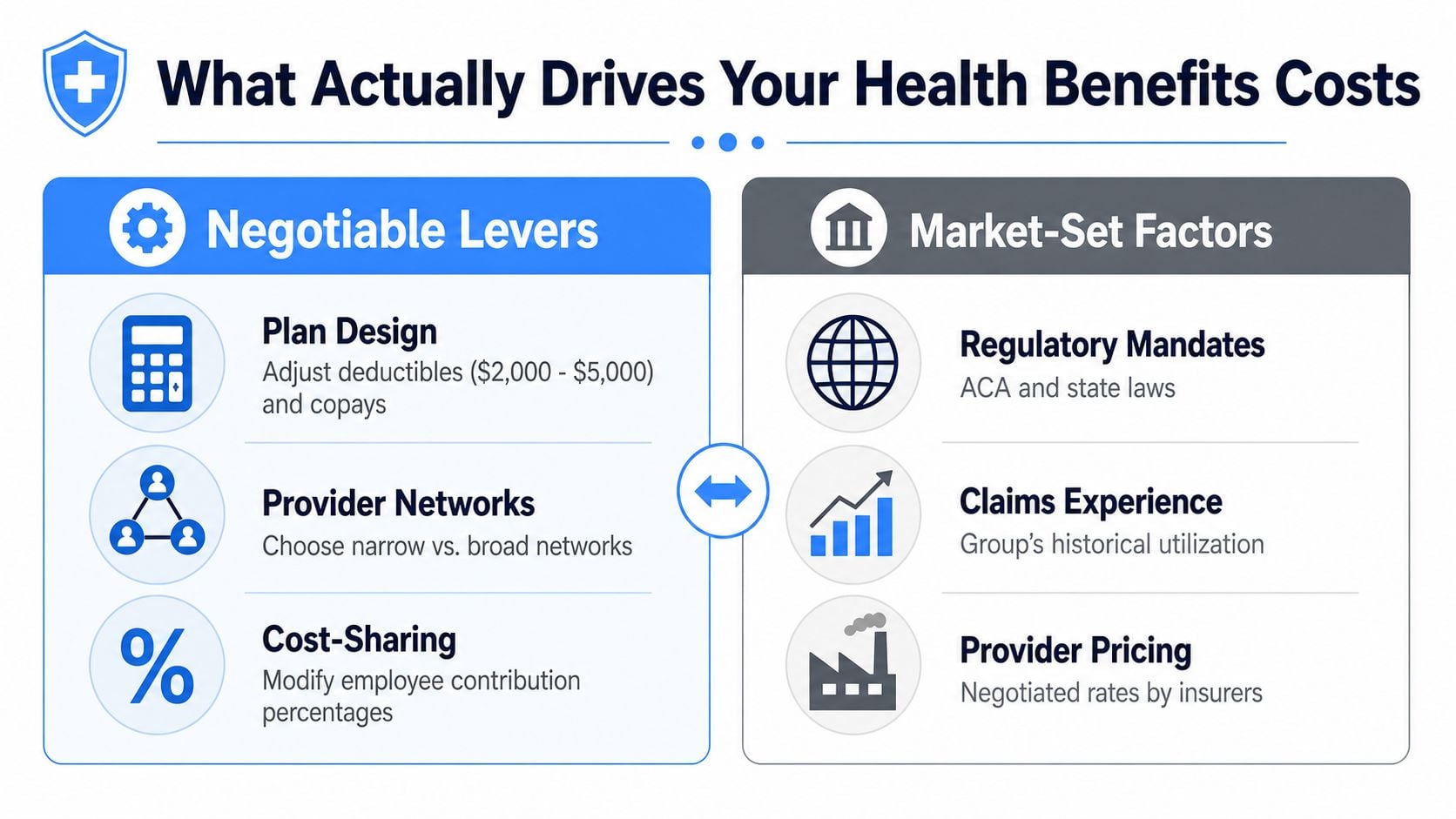
Most renewal increases come from a stack of smaller choices, some negotiable and some fixed. Treat them as a procurement problem first. If you try to bargain with every line item the same way, you miss where the significant money moves.
The Levers a Buyer Can Pull
Plan design is where employers still have room to act. Deductibles, copays, formulary depth, network breadth, and employee contribution strategy all change the bill. In SMB plans, deductibles around $2,000 to $5,000 are common in the market, and plan design can swing premiums by 15 to 25 percent according to the benchmark data in the brief (Robinson benchmark report).
That matters because a richer plan often looks like a retention win while shifting more fixed cost onto the employer. The company pays that subsidy whether employees use care or not.
A generous benefit can buy goodwill fast, then keep charging the company long after the employee has forgotten why the plan felt generous.
The same benchmark data shows monthly employee contributions as low as $40 to $70 for single coverage in some tiers and $134 to $632 for family coverage. That is the range a CFO should watch closely, because contribution design can pull budget exposure back into line without changing the whole plan.
The Costs the Market Sets
Some costs are fixed by the market and the rules around it. ACA essential health benefits, state-mandated benefits, and demographic risk pooling are baked into pricing. Carriers price them into the quote whether the plan is fully insured or wrapped in another structure.
Hidden fees matter too. Broker compensation commonly sits as a percent of premium, ASO administration adds per-employee fees, and stop-loss takes another bite when a company self-funds. Those charges often sit in separate lines, which is why renewal surprises keep showing up.
If therapy access is part of the conversation, employers should verify therapy benefits with reVIBE before the plan is finalized.
For a closer look at renewal pricing, the internal article on health insurance premium increases covers the mechanics that drive the jump.
Comparing Options for SMBs and Multi-State Employers
The right answer changes fast once payroll crosses state lines. A single-location company can often optimize for one carrier relationship, one set of state rules, and one worksite census. A multi-state employer has to manage compliance drift, network gaps, and different benefit expectations at the same time.
SMBs Need Simplicity Until They Need Control
Under roughly 200 employees, most buyers are still deciding between predictable administration and better cost control. SHOP can make sense for eligible small groups because the tax-credit math matters more there than it does for larger firms. Fully insured is still the cleanest option when the company wants minimal admin and no claims exposure.
A PEO starts to make sense when the employer values one benefits structure more than it values direct carrier control. That can be a smart trade if the team is spread thin and payroll, compliance, and benefits all need to move together.
Multi-State Employers Need Portability, Not Just a Menu
Payroll spread across 3 or more states changes the game. Duplicate filings, state-specific mandates, and network limitations become real operational costs, not theoretical annoyances. PEO-sponsored plans can collapse a lot of that admin burden into one framework, but they can also introduce a fee layer that eats savings for smaller headcounts.
The brief's planning assumption around minimum participation also matters. If the company is trying to sponsor a group plan, carrier appetite can tighten when participation falls away from the roughly 70% level often used as a practical benchmark in the market note. That means the buyer has to manage enrollment as part of procurement, not as a last-minute HR chore.
For teams comparing PEO structures, the internal page on professional employer organization health insurance helps frame how the structure changes the deal.
| Plan Type | Best Fit (Employees) | Multi-State Handling | Admin Burden | Cash Flow Impact |
|---|---|---|---|---|
| Fully Insured | Small to mid-size single-state groups | Weak to moderate | Low | Predictable premium |
| SHOP | Very small eligible employers | Limited, depends on state setup | Moderate | Tax-credit dependent |
| Level-Funded | Mid-size groups | Moderate, but still carrier-dependent | Moderate | Flat funding with settlement risk |
| PEO-Sponsored | Small to mid-size multi-state employers | Stronger portability | Lower internal burden | Fees can offset savings |
| Self-Funded | Larger employers with strong finance support | Strong if the plan is built well | Higher internal oversight | Variable claims exposure |
A buyer comparing models across states should also look at a practical comparison tool like the step-by-step health insurance guide, especially before carriers start steering the conversation toward the easiest quote instead of the right fit.
A Real Scenario That Shows What Changes
A 120-employee professional services firm moved from a fully insured plan at $1,280 per employee per month into a level-funded arrangement at renewal. That sounds like a simple swap on paper. It wasn't.
Month one brought three changes that surprised the finance team. First, the company had to set up a separate bank account for claims funding. Second, the new stop-loss policy came with a $25,000 specific attachment. Third, the broker finally showed the carrier margin, which sat around 8 to 12%, and that made the team realize how much of the old premium had been pure packaging.
The year played out well enough at first. With a 70% loss ratio, the company saw a $90,000 surplus returned. That looked like savings, but it was not a guaranteed income stream, just a settlement based on that year's claims performance.
Then year two turned ugly. One claimant hit the $400,000 range, and the stop-loss corridor mattered immediately. The stop-loss premium also climbed 15%, so the renewal win from year one stopped looking like a permanent victory.
That's the part buyers miss. Level-funded plans can improve visibility and smooth budgeting, but they don't eliminate claims volatility. The CFO had to move from annual forecasting to monthly claims runs just to avoid a cash crunch.
The internal example library on PEO examples is useful for teams trying to benchmark how different structures behave under pressure.
Bottom line: a refund is not a strategy. If the company can't survive the bad claims year, the plan design was too optimistic from day one.
How to Evaluate and Negotiate Your Options
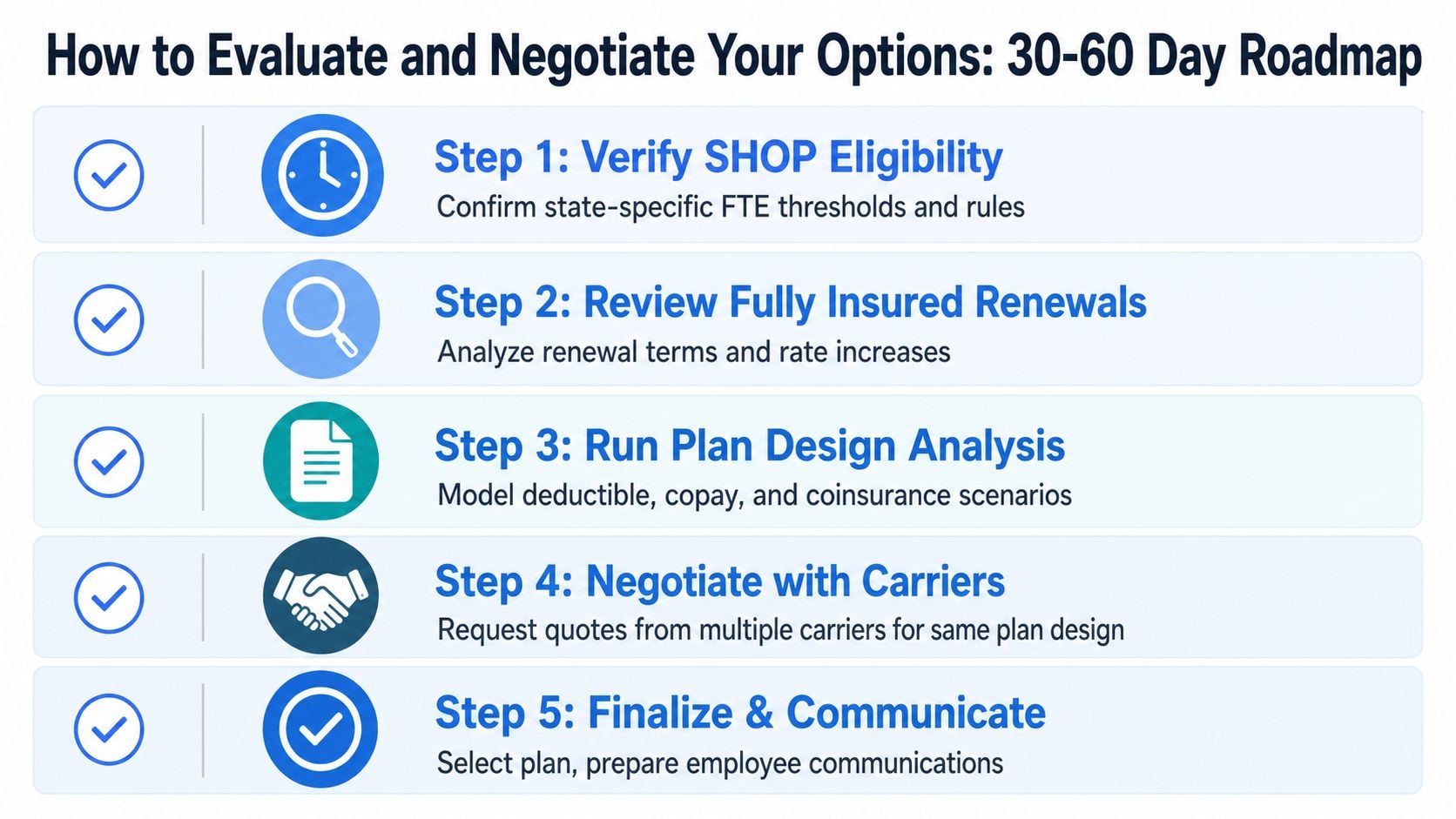
A serious buyer can run a clean process in 30 to 60 days if the team stops treating renewal like a one-call event. The goal is not to collect the most quotes. The goal is to compare the same risk transfer on the same terms.
Start With Eligibility and Structure
First, verify whether the company qualifies for SHOP based on state thresholds and FTE counting rules. Then separate fully insured, self-funded, level-funded, and PEO-sponsored quotes so the pricing isn't distorted by mismatched assumptions.
Next, check whether the plan is built around the company's real headcount and geography. If the worksite census spans multiple states, a plan that looks cheap on paper can become expensive once compliance and network access are counted.
Then Read the Contract Like a CFO
Level-funded plans need close review for refund eligibility windows, surplus vesting rules, and stop-loss corridor gaps. Fully insured renewals need scrutiny around underwriting and whether a carrier change makes sense at year three, not just at the first ugly renewal.
PEO arrangements deserve the same discipline. The buyer should check the master policy terms, wage-plan compliance, and what happens to portability if the relationship ends. Those details matter more than the sales presentation.
For buyers comparing options, the internal guide on PEO benefits negotiation leverage explained is a good starting point.
Negotiate the Terms That Move Real Money
The best strategies are plain but easy to miss. Bundling pharmacy carve-outs, asking for multi-year rate guarantees where possible, and pushing back on carveback language can change the economics more than another round of logo slides ever will.
A good scorecard should weight cash flow tolerance, risk appetite, and administrative capacity ahead of premium alone. Premium by itself is a weak decision metric because it hides volatility, fees, and the cost of internal labor.
Making a Confident Decision on Employer Health Insurance
The decision should follow company size and balance-sheet strength, not vendor enthusiasm. Under 25 FTE, SHOP or a PEO usually makes the most sense. Between 25 and 100, level-funded plans deserve a serious look. At 100+, self-funded with traditional stop-loss or a captive-style structure becomes a real option. Multi-state employers often default to a PEO or a national carrier because portability and compliance get expensive fast.
Three rules of thumb keep the decision grounded. First, reserve about two months of expected claims before self-funding. Second, cap the specific stop-loss deductible at $50,000 for groups under 250 when possible. Third, benchmark admin fees at 3 to 5% of premium equivalent so the quote doesn't get padded in the fine print.
| Employer Profile | Best Fit Model | Watch Out For | Typical Renewal |
|---|---|---|---|
| Under 25 FTE, single-state | SHOP or PEO | Eligibility rules and participation requirements | Annual review |
| 25 to 100 employees | Level-funded | Refund promises that depend on claims | Annual settlement cycle |
| 100+ employees | Self-funded with stop-loss | Cash reserve pressure and claims volatility | Monthly claims review |
| Multi-state employer | PEO or national carrier | Duplicate compliance work and network gaps | Renewal tied to state footprint |
A buyer who wants a clean path should use a 90-day action sequence. Weeks 1 to 2, collect census and claims data. Weeks 3 to 6, issue an RFP. By week 10, compare final proposals and score them on cost predictability, cash flow, plan flexibility, and administrative burden. That process beats gut feel every time.
PEO Metrics helps companies compare and negotiate PEO options with a side-by-side review of pricing, contract terms, benefits, compliance support, and service fit. For teams weighing employer health insurance options inside a PEO decision, visit PEO Metrics and use the comparison process before the next renewal locks in the wrong risk.
