
An ASO is an HR outsourcing model where the employer keeps full legal responsibility, and the provider handles administration, unlike a PEO, which can share employer functions through co-employment. In practical terms, that means the employer keeps the risk, the EIN, and the liability, while the ASO handles work like payroll, benefits administration, and compliance support.
Popular advice says HR outsourcing is mostly a cost question. That’s the wrong starting point. For a CFO, what is an ASO really comes down to control, risk placement, and whether the company is prepared to own the financial consequences that sit behind the admin layer.
Table of Contents
- Beyond the Acronym The Core Function of an ASO
- ASO vs PEO vs Payroll Decoding the Service Models
- The Financial Mechanics of an ASO Arrangement
- When an ASO Is the Right Strategic Choice
- Evaluating ASO Risks and Hidden Contract Costs
- Making a Confident Decision on Your HR Model
Beyond the Acronym The Core Function of an ASO
The assumption that all HR outsourcing works the same way creates expensive mistakes. An ASO is not a diluted PEO, and it is not a shortcut that removes accountability. It is an arrangement where the employer keeps the employment relationship intact while a provider handles administrative work, often including payroll, benefits, and compliance support, without becoming a co-employer.
Control matters more than the label
That distinction matters because the employer stays on the hook for the work that moves financial statements and audit risk. The company keeps its own EIN, remains the employer of record, and still owns hiring, firing, tax filings, labor-law compliance, and the resulting liabilities. That is the trade-off CFOs need to price into the decision, because a lower admin fee does not reduce exposure if the company still carries the underlying employment risk. Industry sources also note that the term ASO was established in the late 1990s by the PEO industry to separate limited admin support from full-service co-employment arrangements (Rippling’s ASO glossary).
A CFO comparing outsourcing models should read ASO as a control-first model, not a bargain-bin version of a PEO. For some companies, that is the right fit, especially when the internal team wants to keep policy decisions, benefits design, and risk governance close to the business. It also matters more in self-funded benefits environments, where administration mistakes can create claims, coordination, and cash-flow problems that sit with the employer rather than a co-employer. For broader support around HR structure, a useful starting point is streamlined HR solutions for benefits from Duncan & Associates Insurance Brokers, especially when the conversation includes outsourcing without giving up ownership.
Practical rule: if the board wants reduced admin load but not shared employment liability, an ASO can fit. If the board wants risk transfer, it usually cannot.
An ASO can also sit naturally beside other outsourced HR options. Readers comparing structures can use this HR outsourcing overview to map which functions stay in-house and which move out.
ASO vs PEO vs Payroll Decoding the Service Models
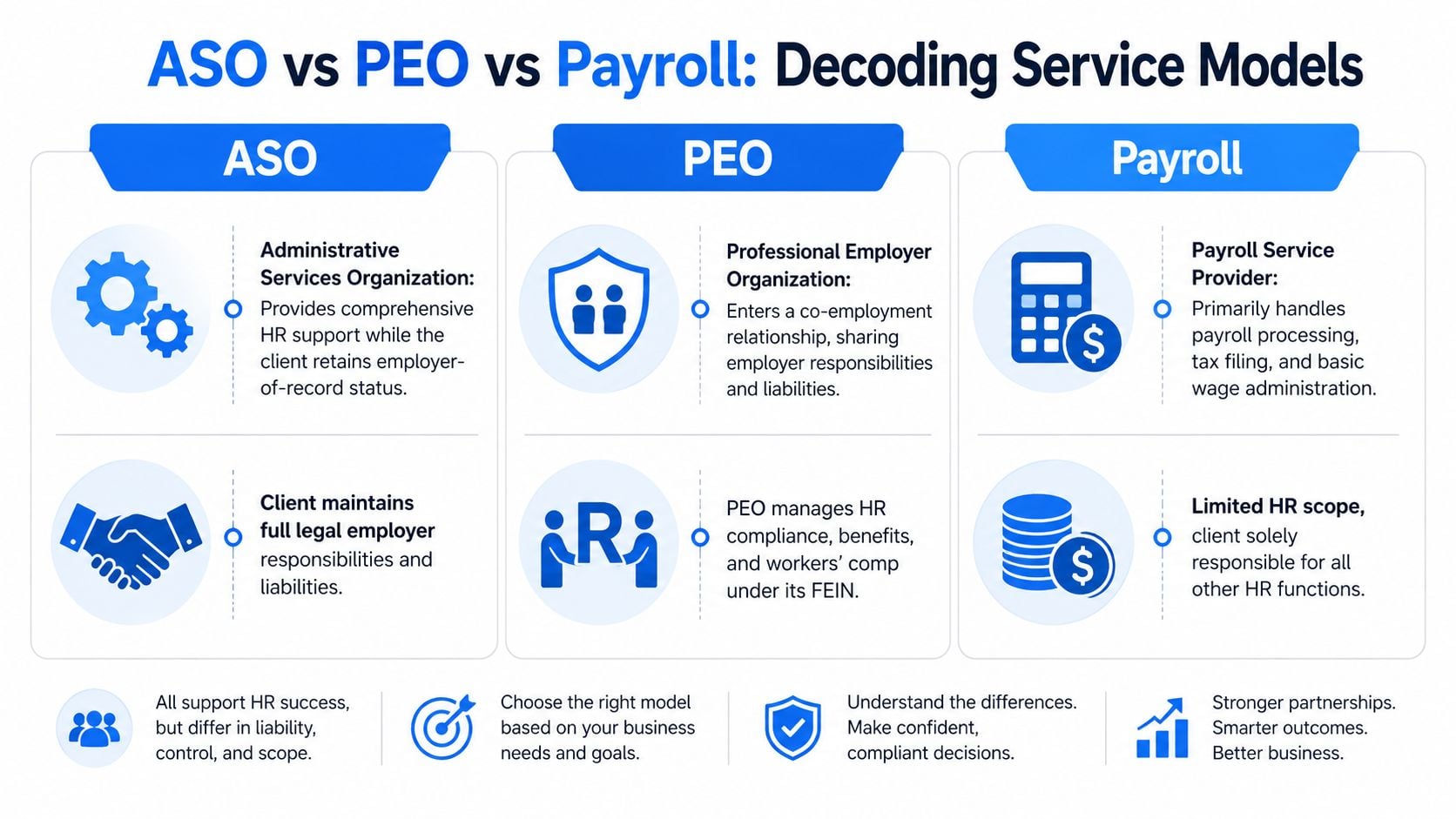
The cleanest way to read these models is to separate who employs the worker, who runs the administration, and who holds the risk. An ASO, a PEO, a payroll platform, and an insurance broker can all touch HR, but they operate in different parts of the stack. A company that treats them as interchangeable usually pays for that mistake twice, once in vendor fees and again in internal confusion.
Side by side, the boundaries are different
| Feature | ASO (Administrative Services Only) | PEO (Professional Employer Org) | Payroll / HRIS Platform | Insurance Broker |
|---|---|---|---|---|
| Employer of record | Employer | Shared through co-employment | Employer | Employer |
| Tax filings | Employer retains responsibility, often with admin support | Shared service structure under the PEO arrangement | Usually processed by the platform, employer remains responsible | Not a filing provider |
| Compliance liability | Employer retains employment-related risk and liability (Paycor) | Some employer functions and risks are shared | Employer retains responsibility | Limited to brokerage placement and plan support |
| Benefits handling | Can administer benefits, especially in self-funded arrangements | Often bundled with master-plan access | Limited to enrollment and payroll-adjacent setup | Sources plans and negotiates coverage |
| Workers’ comp | May support administration, not risk transfer | Often bundled into the employer-sharing model | Usually outside scope | Helps source policies, not administer HR |
| Best fit | Mid-market employers wanting control | Employers wanting broader outsourcing and shared employer functions | Employers needing software, not a service relationship | Employers needing market access and plan shopping |
The financial trade-off becomes clearer here. ASO keeps the employer in control, but it also keeps the employer on the hook. PEO moves further into shared employer functions, which can reduce internal workload, yet it also changes how liability and benefits administration are structured. Payroll software is narrower still, because it processes pay without taking on the broader HR service layer.
A PEO is closer to a shared employment arrangement. An ASO is a service layer over a company that still owns the people decisions, the plan design, and the risk. That difference matters most when benefits are self-funded, because the company can keep the savings from better claims experience, but it also keeps the downside when claims run hot or administration slips.
Why the differences change cost and compliance
A payroll or HRIS platform can process wages, but it will not manage the wider compliance burden or benefits governance. An insurance broker can shop plans, but it will not run the back-office work needed to keep employee data, enrollment, and payroll aligned. Those gaps show up fast in a self-funded environment, where a mismatch between payroll, eligibility, and carrier data can create cash-flow strain that lands with the employer.
For a closer look at where the legal and operating lines sit between the two models, this ASO vs. PEO breakdown is a useful reference. It shows why a company can outsource administration without outsourcing employment responsibility.
A company that wants tighter payroll discipline, especially in a labor-heavy operation, may also use payroll best practices for restaurants as a practical benchmark. Payroll automation can reduce manual work and cut errors, but it does not turn software into an employer of record, and it does not absorb employment risk.
A provider can move work off the internal team, but it can only move liability if the legal structure actually says so.
The Financial Mechanics of an ASO Arrangement
The most common misunderstanding around ASO pricing is that the admin fee is the whole story. It isn’t. The service line may look straightforward on a proposal, but the complete cost picture depends on what the company is funding behind it, especially if the ASO is attached to a self-funded benefits structure.
Fee structure is only the visible part
At the service level, ASO pricing is usually framed as a recurring administrative charge tied to employee count, with add-ons layered in for extra services. That part is easy to model. The harder part is the risk sitting underneath the benefits arrangement, because the employer is often paying claims directly while the vendor handles administration as a third-party administrator, or TPA.
That’s where the stop-loss discussion matters. In self-funded plans commonly used with ASOs, employers often set a stop-loss threshold of around $10,000 to $15,000 per employee, at which point an insurer begins covering claims above that level to protect the employer from catastrophic losses (Indeed’s ASO guide).
What finance leaders need to model
The right question isn’t just, “What is the monthly admin fee?” It’s, “What happens to cash flow when claims run hot?” In a fully insured arrangement, the premium bundles more of that uncertainty into a fixed payment. In an ASO structure, the employer keeps more of the volatility, and that can help in a low-claim period while also exposing the company to a worse year if claims spike.
For a finance team, that means the ASO budget has at least three layers.
- Administration fee: the service charge for HR, payroll, benefits, and compliance support.
- Claims funding: the money the employer sets aside for the health plan.
- Stop-loss protection: the backstop that begins after the defined threshold.
The model can be smart for a company that wants to keep plan design flexible and manage risk directly, but it requires disciplined forecasting. A benefits administrator can make enrollment smoother. It can’t make claim volatility disappear.
If the team is benchmarking service costs, this cost guide for outsourcing HR is a useful companion for separating administrative pricing from the broader cost of ownership.
When an ASO Is the Right Strategic Choice
An ASO fits best when the business already has enough internal structure to own the employment relationship but wants to remove transactional friction. That usually means the company values policy control more than it values handoff. It also means the CFO is comfortable with a model that trades bundled convenience for clearer internal ownership.
The profile that tends to fit
A 300-employee tech company with an HR business partner team is a strong example. The team may already handle recruiting strategy, performance processes, and manager coaching, but it doesn’t want to spend its week on payroll corrections, benefits enrollment issues, and compliance reminders. An ASO can offload that volume without taking away the company’s ability to shape culture and benefits design.
A multi-state construction firm is another common fit. The company may want to design a self-funded health plan that reflects its workforce mix instead of joining a PEO’s master plan. That choice can matter when the business wants more direct control over benefits economics and doesn’t want to fit into a one-size-fits-all package.
What usually points toward ASO
- Existing HR capacity: There’s already someone inside the business who owns strategy and vendor oversight.
- Desire for control: Leadership wants to keep benefits design, policies, and employee experience decisions in-house.
- Operational scale: The company is large enough to benefit from outsourcing admin without losing visibility.
- Risk tolerance: Finance can handle variability in claims funding and compliance oversight.
- Growth across states: The business wants support, but not a shared-employer structure that changes how decisions are made.
An ASO is less persuasive for a small employer that mostly wants simplicity. If the internal team is tiny and the business wants broad risk transfer, a PEO may create a cleaner operating model. If the company only needs payroll processing, the answer may be software rather than a service relationship.
For a broader look at the benefits of outsourcing the right HR functions, this HR outsourcing benefits resource gives useful context without assuming that every company needs the same setup.
Evaluating ASO Risks and Hidden Contract Costs
The biggest ASO risk isn’t the service itself. It’s the fact that the employer still owns the mess if the provider misses something. That’s why the due diligence process has to go beyond demos and pricing sheets. An ASO can reduce administrative load, but it can also hide contract details that become expensive once the agreement is signed.
The real exposure sits with the employer
If the ASO makes a payroll tax error, the liability still sits with the employer’s EIN. If benefits administration is sloppy, employees blame the company, not the back-office vendor. And if the business runs self-funded benefits, the employer keeps the claims volatility even when the provider is managing enrollment and processing.
That trade-off is why the critical choice isn’t lower fees. It’s whether the company is prepared to carry more risk and more internal oversight in exchange for a more flexible structure (Investopedia on administrative services only).
Contract terms deserve the same attention as pricing
A strong review should cover the following.
- Service scope: What’s included, and what gets billed separately.
- Termination terms: What happens when the company wants out.
- Fee changes: Whether annual escalators are automatic.
- Data handling: How employee and payroll records are returned or deleted.
- SLA detail: Whether response times and escalation paths are written down.
- Implementation work: Whether setup, reporting, or special projects create hidden charges.
That diligence matters even more in multi-state environments, where compliance and benefits governance can change the total cost of ownership in ways that aren’t obvious on the first proposal. A lean contract that looks cheaper at signing can become the more expensive option once the employer starts paying for every exception.
For a closer look at contract ambiguity and the language that creates trouble later, this PEO contract ambiguity analysis is a useful reference point for reading service terms with a sharper eye.
Contract rule: if the vendor won’t spell out what happens when service quality slips, the company is probably underwriting that gap itself.
Making a Confident Decision on Your HR Model
There isn’t a universal winner among ASO, PEO, payroll platforms, and brokers. The right choice depends on whether the company wants to transfer risk, reduce admin, or preserve control over benefits and employment policy. An ASO makes the most sense when leadership wants outsourcing without surrendering the employment relationship, and when the finance team is prepared to own the cost and liability structure that comes with it.
The fastest way to decide is to ask three questions. Does the business want co-employment or not? Does it want self-funded benefits control or a fully insured bundle? Does it need a service partner, software, or a risk-sharing arrangement? The answers usually point toward the right model long before any sales demo does.
Before any vendor call, an internal audit should come first. Review current HR costs, admin workload, compliance exposure, benefits structure, and contract pain points. That clarity makes the ASO conversation much more useful, because the business can evaluate a service model against its own operating reality instead of a polished pitch.
A CTA for PEO Metrics.
