
Standard payroll outsourcing typically costs roughly $20 to $200 per employee per month or 2% to 6% of payroll, while PEO pricing commonly runs about $40 to $160 per employee per month or 2% to 12% of payroll. The final payroll outsourcing cost depends on headcount, payroll complexity, jurisdictions, pay frequency, and the service scope transferred to the provider.
A CFO comparing two proposals may see nearly identical monthly rates and still face very different annual bills. One quote may include tax filings, year-end forms, time tracking, and implementation. The other may charge separately for each item, along with off-cycle runs and amendments. The difference becomes material as employee count grows, particularly for employers operating across multiple states or entities.
Table of Contents
- Introduction Why Payroll Outsourcing Cost Is Harder to Compare Than It Looks
- How Payroll Outsourcing Pricing Models Actually Work
- What Drives Your Payroll Outsourcing Cost Up or Down
- Benchmarking What Companies Actually Pay for Payroll Outsourcing
- Payroll Outsourcing vs PEO and ASO Cost Comparison
- How to Reduce and Negotiate Your Payroll Outsourcing Fees
- Conclusion Your Next Steps to Control Payroll Outsourcing Cost
Introduction Why Payroll Outsourcing Cost Is Harder to Compare Than It Looks
A 75-employee company receives two payroll proposals. Vendor A quotes a PEPM rate with a modest monthly base fee. Vendor B quotes a slightly higher rate but includes tax registration, year-end reporting, and employee support. On the first page, Vendor A looks cheaper. After implementation, quarterly filings, time-and-attendance integration, and correction charges are added, Vendor B may produce the lower annualized cost.
That's why a payroll outsourcing cost comparison shouldn't stop at the advertised rate. The relevant question is: what will the employer spend over a full year, divided by the number of employees, for the exact service and risk transfer required? A buyer needs to include the recurring fee, base charge, setup work, compliance support, integrations, filing obligations, and any event-based charges.
Payroll providers generally use either a flat base fee plus a per-employee-per-month charge or a percentage-of-payroll model. Each model behaves differently as wages, headcount, and payroll frequency change. A service designed only to calculate pay will also price differently from one that manages tax filings, benefits administration, onboarding, HR data, and compliance support.
The market's scale reinforces why the comparison deserves CFO-level attention. One market-size report places global payroll outsourcing at roughly $10.5 billion in 2025, with a projection of $15.0 billion by 2032 and a 5.2% compound annual growth rate over that period, as reported in payroll outsourcing market statistics and trends. Another forecast estimates $12.34 billion in 2025 and $20.71 billion by 2034, with a 5.92% CAGR from 2026 to 2034, using a different market definition and forecast period.
Practical rule: A quote isn't comparable until every provider has priced the same employee population, pay frequency, jurisdictions, integrations, and add-ons.
This guide gives HR directors, CFOs, and owners a normalization method, cost benchmarks, a direct payroll versus PEO comparison, and negotiation tactics. Employers also evaluating broader HR support can use HR services for small business as a reference point when deciding whether payroll should remain a standalone function or sit inside a wider operating model.
How Payroll Outsourcing Pricing Models Actually Work
The two dominant models are easiest to understand through familiar purchasing patterns. PEPM pricing resembles a phone plan, with a recurring charge for each active employee. A percentage-of-payroll model resembles a commission, because the provider's fee rises with the payroll value processed.
Under the PEPM structure, the basic calculation is:
Annual cost = annual base fees + employee count × PEPM fee × billing periods + variable charges
For example, a provider may charge a monthly base fee and a per-employee fee. The buyer should multiply both recurring components across the contract year, then add implementation, tax filings, year-end forms, integrations, and expected exceptional events. If a proposal uses per-pay-period pricing rather than monthly pricing, the buyer must model the actual pay schedule rather than assume monthly processing.
Percentage pricing uses a different formula:
Annual cost = total payroll processed × provider percentage + fixed fees + variable charges
The percentage model can look attractive for a smaller or lower-wage workforce because the fee follows payroll volume. It can become more expensive as average compensation rises, even if headcount remains unchanged. PEPM pricing is more predictable for budgeting, but it can become costly when a company carries a large workforce with limited payroll complexity.
The service tier changes the equation
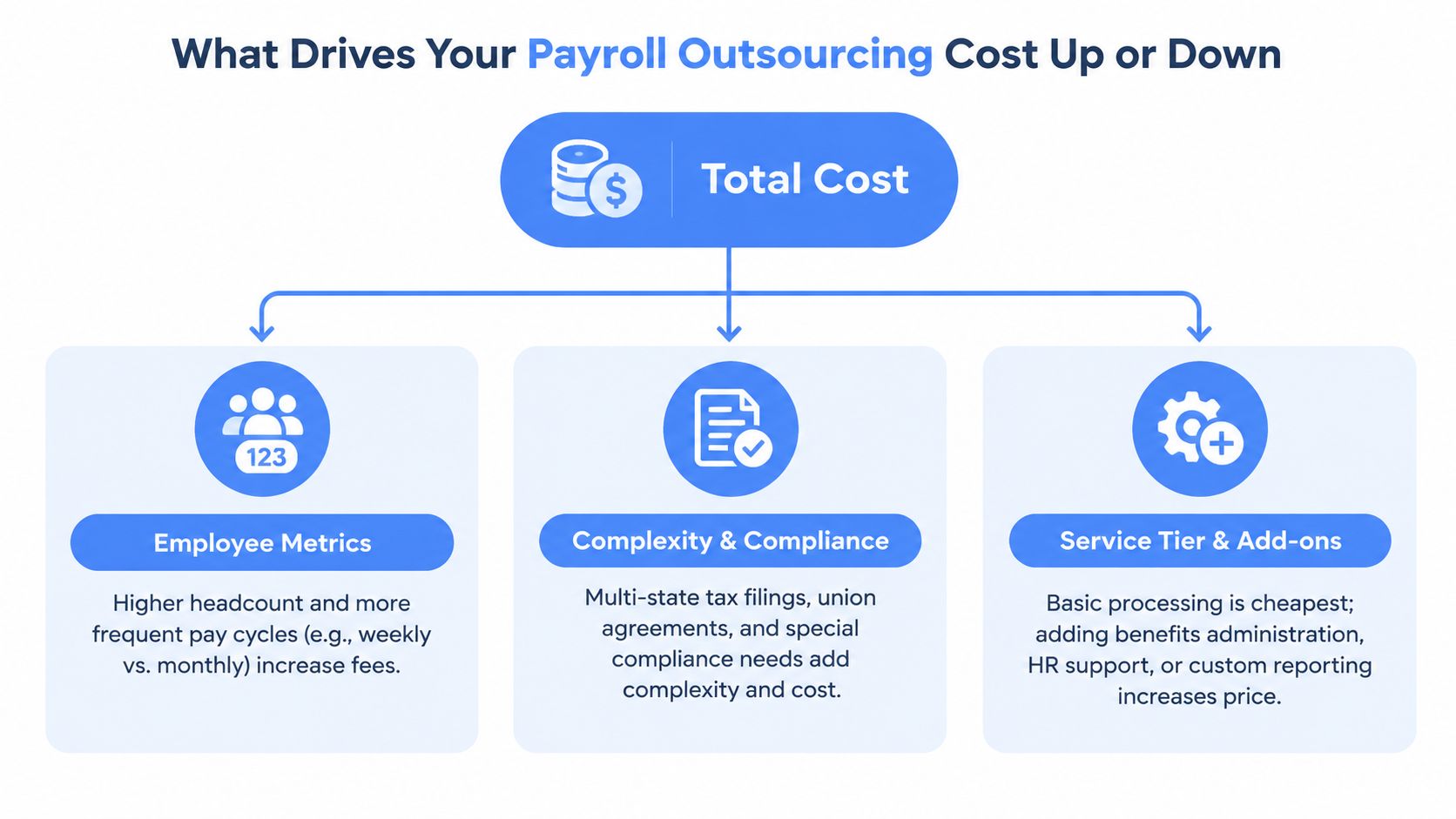
A basic calculation and filing package may exclude time tracking, onboarding workflows, benefits administration, HR data maintenance, custom reporting, or dedicated support. Adding those services raises the effective cost because the provider performs more work and accepts more operational responsibility. Xero's payroll outsourcing overview describes PEPM pricing as commonly clustering around $20 to $200 per employee per month, while percentage-based pricing is often cited at 2% to 6% of payroll.
For buyers comparing adjacent technology and staffing decisions, Talent Pronto pricing plans can provide useful context on how recurring service pricing is presented outside traditional payroll contracts. It shouldn't replace a payroll quote, but it can help finance teams distinguish a platform subscription from a managed administrative service.
The most useful output is annualized cost per employee, not the headline rate:
Annualized cost per employee = total expected first-year cost ÷ average employee count
Use average headcount when hiring or turnover is significant. Then run a second scenario for expected growth, because a low PEPM rate may still create a large absolute increase as the workforce expands. A detailed payroll service comparison should show both the recurring price and the responsibilities attached to it.
What Drives Your Payroll Outsourcing Cost Up or Down
A provider doesn't price payroll from headcount alone. Five variables usually move the quote: employee volume, processing frequency, compliance complexity, service scope, and implementation or exception work.
Employee volume and pay frequency
Headcount drives PEPM fees directly. Pay frequency changes the provider's workload, especially where pricing is tied to each payroll run or payslip. Weekly payroll creates more approval, calculation, funding, and reporting activity than monthly payroll, so a company should request separate scenarios for each schedule.
The quote should identify whether employees are billed when active, when paid, or when stored in the system. Seasonal workers, contractors, terminated employees, and employees on leave can produce different billing outcomes. A company with fluctuating headcount may prefer per-payslip pricing, while a stable workforce may receive better predictability from PEPM pricing.
Jurisdictions and compliance
Multi-state payroll adds tax registrations, local filing requirements, withholding rules, and exception handling. Union arrangements, unusual earning codes, garnishments, equity compensation, and multiple legal entities can also require specialized configuration.
The buyer should ask whether the base price includes state and local registrations or only routine processing after registrations are complete. Tax liability allocation also matters. A payroll provider may process filings without accepting responsibility for every employer obligation. Guidance on PEO payroll tax liability transfer rules helps separate administrative processing from actual liability transfer.
Service scope and integrations
Basic payroll calculation is only one layer. Time tracking, benefits deductions, onboarding, HR data administration, custom reports, and employee self-service each affect the total. Integrations with systems such as time clocks, accounting platforms, or benefits tools can carry setup charges or ongoing fees.
A low headline rate may be unsuitable if the employer still needs internal staff to reconcile data, prepare files, answer employee questions, and monitor filings. The correct comparison measures the work that remains inside the company.
Implementation and year-end work
Setup fees cover data migration, payroll configuration, testing, employee records, tax settings, and training. UK providers may charge one-time setup fees of roughly £30 to £150 for small businesses and £150 to £500 for more complex payroll or legacy-system migrations, according to UK payroll outsourcing cost guidance. Other providers may charge as much as £100 to £1,000, depending on migration complexity and employee count, as described by Expert Market's payroll fees guide.
Year-end forms, amendments, off-cycle payroll, and special reports may sit outside the base package. A buyer should request a schedule showing each possible charge, its trigger, and whether the contract includes an allowance.
Benchmarking What Companies Actually Pay for Payroll Outsourcing
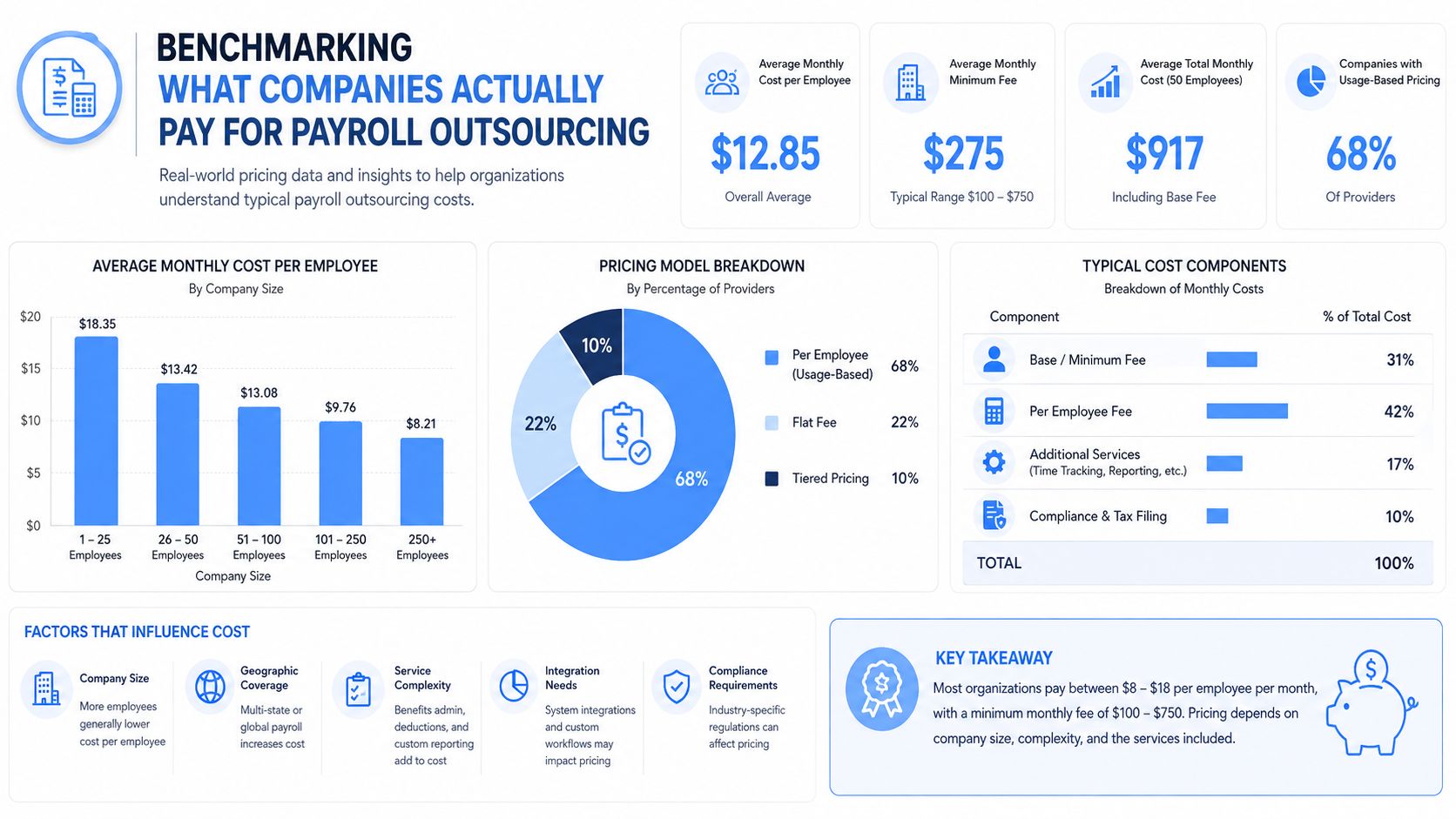
Benchmarking requires separating broad market ranges from a quote for a specific employer. A standard payroll-only arrangement shouldn't be judged against a fully managed HCM package, because the second service includes more administration and support.
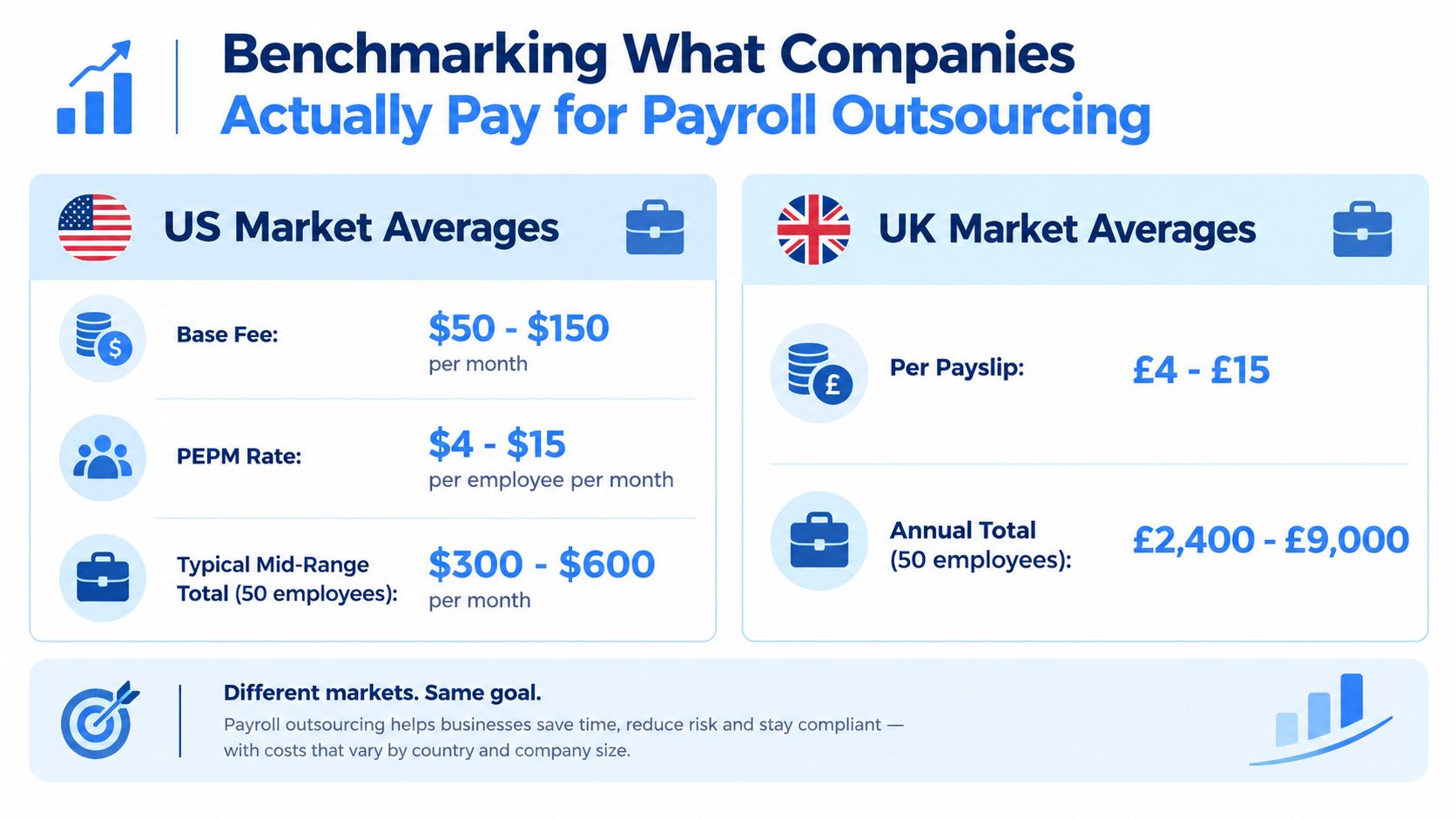
For small businesses, collected pricing benchmarks describe basic outsourced payroll at roughly $20 to $250 per month in base fees, plus $2 to $15 per employee per pay period, depending on workforce size and filing complexity. Fully managed payroll and HCM packages can reach $40 to $160 per employee per month, particularly when the provider adds broader HR administration and compliance services, according to in-house versus outsourced payroll cost analysis.
Another 2025 to 2026 pricing guide places standard payroll at about $30 to $100 per month plus $2 to $15 PEPM, while fully managed outsourcing can rise to $15 to $25 or more PEPM. UK arrangements may use £4 to £12 per payslip, with pension administration and year-end reporting priced as add-ons, according to payroll outsourcing fee analysis.
What the benchmarks mean for a buyer
A quote at the bottom of a range may exclude precisely the services a growing company needs. A quote near the top may be reasonable if it includes multi-jurisdiction filings, time and attendance, benefits administration, employee support, reporting, and clear error-liability terms.
Independent benchmarking cited in an industry market report found that organizations outsourcing payroll and time-and-attendance functions spent 43% less on average than organizations administering those functions internally. Outsourcing payroll alone was associated with 30% lower average spend per paycheque, while organizations outsourcing payroll, time and attendance, HR data administration, and health and benefits spent 27% less on average than organizations using a manual approach, according to payroll outsourcing market benchmarking.
These figures support a total-process view, not a promise that every employer will achieve the same result. Internal labor, rework, process errors, and administrative overhead belong in the comparison. For large organizations with more than 700 employees, the same source estimated average spending of $722.46 per payroll run when four key HR-administration functions were considered.
A buyer should use PEO cost analysis when the comparison expands beyond payroll processing into benefits, workers' compensation, HR support, and co-employment. The central test is whether the provider's additional cost removes enough internal work or employer-side exposure to justify the premium.
Payroll Outsourcing vs PEO and ASO Cost Comparison
Payroll-only outsourcing, an ASO, and a PEO can all appear in the same vendor search, but they transfer different responsibilities. Payroll outsourcing generally handles calculation and filing. An ASO may add HR administration while leaving the employer as the direct sponsor of benefits and employer obligations. A PEO bundles broader services and typically introduces a co-employment structure.
| Model | Typical Pricing | What Is Included | Best Fit |
|---|---|---|---|
| Payroll outsourcing | Roughly $20 to $200 PEPM or 2% to 6% of payroll | Payroll calculation, tax filing, employee records, and selected reporting or integrations | Employers seeking payroll administration without broader HR transfer |
| ASO | Pricing varies by service scope and contract | Payroll plus selected HR administration, benefits support, compliance assistance, or technology | Employers wanting support while retaining direct control of employment responsibilities |
| PEO | Roughly $40 to $160 PEPM or 2% to 12% of payroll | Payroll, HR support, benefits access, workers' compensation administration, and co-employment-related services | Employers prioritizing bundled support, benefits infrastructure, and broader risk allocation |
PEO administrative fees are also commonly structured at 2% to 12% of total payroll or approximately $40 to $160 per employee per month, with pricing affected by provider, workforce size, employee locations, industry, job roles, and claims history, according to PEO cost benchmarks.
The price difference reflects more than payroll
A PEO's higher administrative fee doesn't automatically mean payroll is overpriced. The employer may receive access to benefits infrastructure, workers' compensation administration, HR guidance, and a defined allocation of certain compliance responsibilities. The buyer must confirm exactly what the agreement transfers, because co-employment language, tax responsibility, claims handling, and employer obligations vary by contract.
A payroll-only provider may be cheaper when the company already has strong HR, benefits, and risk-management capabilities. An ASO can suit an employer that wants technology and administrative capacity without changing its employment structure. A PEO may make more sense for a growing or multi-state company that would otherwise build those capabilities internally.
The right comparison is not payroll versus PEO on sticker price. It's total employer spend versus the responsibilities and liabilities transferred.
The difference between a PEO and an ASO becomes especially important during renewal. A company may discover that its PEO fee includes services it no longer uses, while another employer may be paying for payroll alone and carrying HR or compliance work that a PEO would absorb. The decision should follow the operating model, not the lowest isolated administrative rate.
How to Reduce and Negotiate Your Payroll Outsourcing Fees
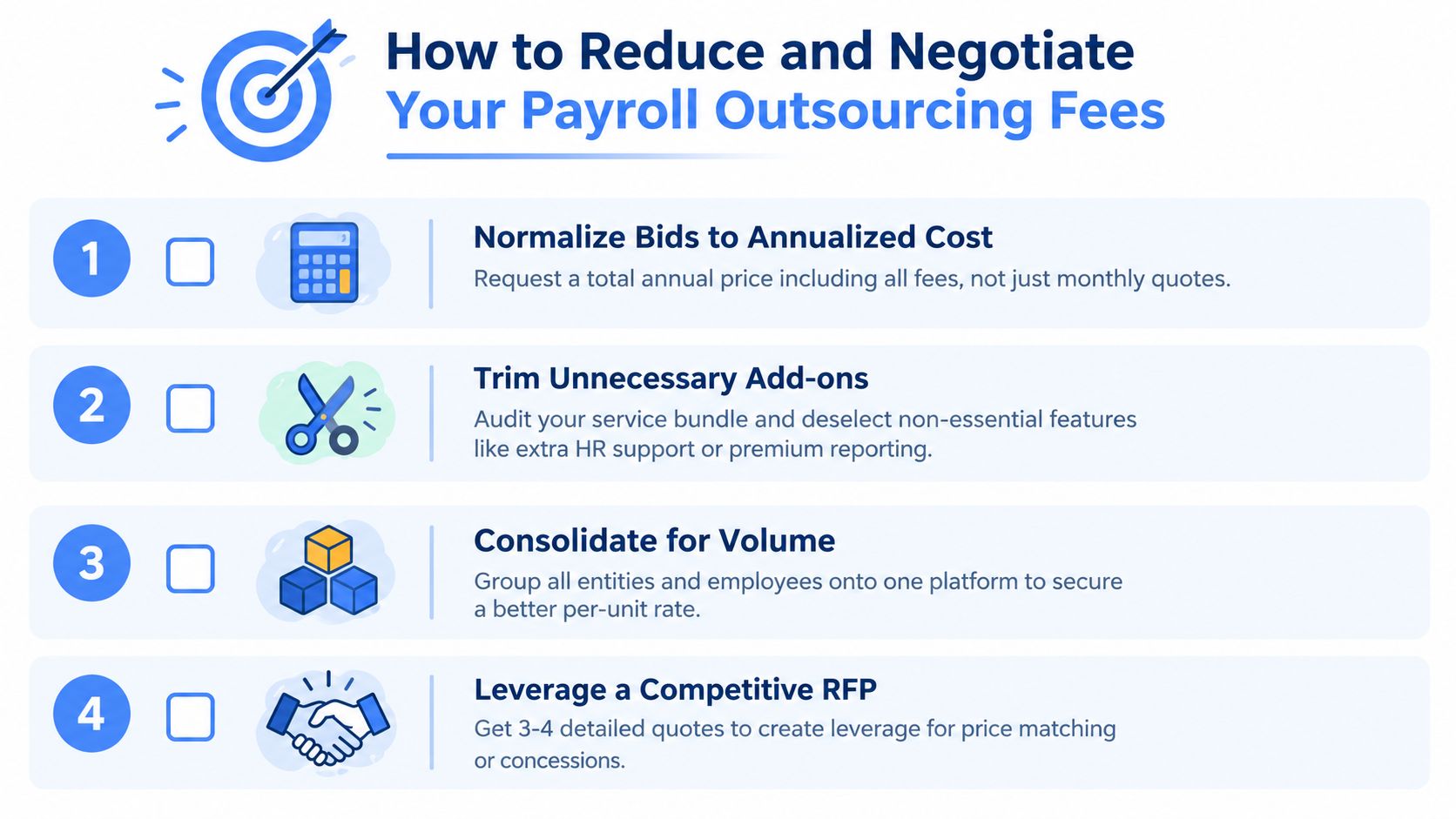
Negotiation starts before a vendor presents a final price. The buyer should issue a consistent scope document, request the same employee and payroll assumptions from every provider, and compare first-year and recurring annualized cost per employee.
Normalize every proposal
Ask each provider for a one-page pricing schedule that includes:
- Recurring fees: Base charges, PEPM rates, percentage fees, and minimums.
- Implementation costs: Data migration, configuration, testing, training, and tax setup.
- Event fees: Off-cycle payroll, amendments, new hires, terminations, and special reports.
- Annual work: Year-end forms, renewals, audits, and compliance updates.
- Exit costs: Data extraction, transition assistance, notice periods, and termination charges.
A finance team can then compare like with like instead of negotiating against a low headline rate that excludes required work.
Trade commitment for protection
Providers may waive or reduce setup charges when an employer signs a 12-month contract, as noted in payroll service pricing guidance. That concession only helps if the contract also defines renewal pricing, exit rights, service levels, and responsibility for provider-caused errors.
Useful requests include:
- Rate lock: Hold the quoted PEPM or percentage rate through the initial term.
- Renewal protection: Cap increases or require advance notice before renewal.
- Implementation credit: Apply waived or reduced setup fees against the first invoices.
- Included allowances: Specify the number of amendments, off-cycle runs, and support events included.
- Service remedy: Define credits or corrective obligations when the provider misses agreed deadlines.
- Data exit terms: Require usable payroll data and transition cooperation at termination.
Remove unused scope, not necessary controls
Unbundling premium reporting, extra HR support, or unused modules can reduce the total bill. Cutting tax filing oversight or compliance support may lower the invoice while increasing internal exposure, so the cheaper option isn't necessarily the safer one.
For a broader finance review, an independent strategic expense reduction guide can help place payroll within the wider operating-cost agenda. The strongest negotiation outcome usually combines a competitive bid process with a precise service specification, rather than relying on a single provider's discretionary discount.
Conclusion Your Next Steps to Control Payroll Outsourcing Cost
The most defensible payroll outsourcing cost is the annualized total per employee for a defined service scope. PEPM and percentage rates provide a starting point, but they don't show implementation, tax registrations, integrations, year-end forms, off-cycle work, or the internal labor that remains after outsourcing.
A practical review can happen this week:
- Define the population: List employees, entities, jurisdictions, pay frequencies, contractors, and expected hiring changes.
- Normalize three bids: Require each vendor to show base fees, recurring rates, one-time charges, add-ons, and first-year totals.
- Separate models: Compare payroll-only, ASO, and PEO proposals based on the responsibilities and liabilities each arrangement transfers.
- Audit the contract: Check rate locks, renewal increases, error responsibility, service levels, data ownership, and exit terms.
- Negotiate the gaps: Request setup credits, clear allowances for amendments, predictable renewal pricing, and transition support.
Market benchmarks can identify an outlier, but they can't determine value without service context. A low-cost payroll platform may be sensible for a straightforward workforce. A more expensive PEO or managed arrangement may produce a lower total operating burden when a company has multiple jurisdictions, growing compliance requirements, or limited internal HR capacity.
The right decision isn't the provider with the lowest advertised rate. It's the arrangement that gives the employer a reliable annual cost, appropriate operational support, and a clearly documented allocation of responsibility.
PEO Metrics helps HR, finance, and leadership teams compare PEOs, ASOs, and payroll providers using pricing, service scope, benefits, contract terms, compliance support, and total-cost considerations. Visit PEO Metrics to benchmark options, identify negotiation points, and evaluate the responsibilities transferred before signing or renewing an agreement.
