
The payroll run is due tomorrow, and the office manager is still reconciling withholding rules across several states. Employees are asking why a benefits deduction changed, a new hire's work authorization file is incomplete, and the CFO is trying to determine whether the proposed PEO fee includes implementation, compliance support, and a clean exit.
That situation makes small business HR outsourcing feel urgent. But urgency creates bad buying decisions. A provider can offer an attractive headline price while leaving the buyer exposed to vague liability language, automatic renewal, weak transition support, or benefits costs that change outside the quoted administrative fee.
The right question isn't “How much does outsourcing cost?” It's, “Which responsibilities move, which risks remain, and what does the contract require the provider to deliver?”
Table of Contents
- Why HR Outsourcing Feels Urgent Right Now
- Assess What Your Business Actually Needs
- PEO vs ASO vs EOR vs Broker
- Running a Vendor Selection Process That Works
- Contract Terms That Decide Whether the Deal Works
- Managing the 90-Day Transition
- Measuring Vendor Performance After Launch
Why HR Outsourcing Feels Urgent Right Now
Consider a 45-person professional services firm with employees in Texas, California, New York, and Illinois. Its office manager spends 14 hours a week reconciling payroll across four state withholding regimes, correcting W-2 data, and answering benefits questions that require more expertise than the role was designed to provide.
That workload is an operating problem, not just an administrative inconvenience. A 2025 Paychex business leader survey found that one-third of respondents spend at least 11 hours per week, or about 570 hours per year, on HR administration. The same survey reported that this burden can cost companies as much as $413,000 annually, while 61% of business leaders planned to use outsourcing to meet their HR administration objectives in the coming year.
Three pressures are converging
Multi-state employment creates work that basic payroll software can't solve by itself. Leave requirements, pay-transparency rules, wage-and-hour classifications, workers' compensation administration, and benefits notices all require ownership, documentation, and timely follow-through.
Payroll and benefits are the functions businesses most commonly hand to outside providers. Industry reporting cites payroll processing at 73% of companies that outsource HR, benefits administration at 61%, and compliance management at 54%. A separate small-business survey cited payroll outsourcing at 68% and benefits administration at 52% in the same HR outsourcing statistics compilation.
Those figures explain why outsourcing often starts with repetitive, compliance-heavy work. The business may still keep hiring decisions, culture, performance management, and employee leadership in-house.
The decision is bigger than headcount
The Paychex findings point to a practical conclusion. External HR specialization can give leaders time back for hiring, operations, and growth, but the provider relationship also changes how payroll, employee records, benefits, and compliance work gets performed.
Practical rule: Treat outsourcing as an operating-system change and a contract-risk decision before treating it as a savings exercise.
A PEO adds another layer because it generally involves co-employment and shared responsibilities. The buyer should understand those responsibilities before reviewing sales projections or comparing administrative fees. The latest HR outsourcing trends are useful background, but the decision still depends on the company's states, workforce profile, benefits strategy, and tolerance for transferred or retained liability.
Assess What Your Business Actually Needs
A vendor demo should never be the first diagnostic tool. Sales teams naturally steer buyers toward the model, package, and implementation path they sell. A written assessment gives the buyer a factual baseline before any provider frames the problem.
The assessment should cover the next 24 months, not just the current payroll. A company with 18 employees today and planned hiring across several states may have a different outsourcing requirement from a stable 40-person company with one location.
Score the operating environment
Rate each input from 1 to 5. A low score signals manageable complexity. A high score indicates that software alone may leave too much responsibility with the internal team.
| Input | Low (1) | Medium (3) | High (5) | Your Score |
|---|---|---|---|---|
| Headcount trajectory | Stable workforce | Moderate planned hiring | Rapid growth or restructuring | |
| State exposure | One state | Several states with limited movement | Multiple states or frequent remote hiring | |
| Benefits complexity | Simple fully insured plan | Multiple plan options | Self-funded or level-funded arrangements | |
| Internal HR capacity | Dedicated HR coverage | Partial HR support | Administrative owner with limited weekly capacity | |
| Compliance exposure | No known issues | Open questions or inconsistent records | Unresolved payroll, classification, leave, or documentation risk |
The scoring isn't a substitute for diligence. It forces the leadership team to identify what's driving the decision and whether the preferred solution matches that driver.
A low-complexity company with strong internal HR ownership may need payroll software or a limited service arrangement. A company with several states, expanding benefits, and little internal capacity may need an ASO or PEO. An employer with significant compliance exposure should get legal and tax advice instead of assuming a provider will automatically absorb every historical problem.
Measure capacity in hours
“HR is busy” isn't precise enough. The office manager in the example should record time spent on payroll reconciliation, employee questions, benefits changes, onboarding, reporting, and compliance administration. That record shows whether outsourcing would remove a recurring operational burden or merely add another vendor to manage.
The most common misdiagnosis is using current headcount as the deciding factor. A business can outgrow an ASO within 18 months if its 24-month plan includes multi-state hiring, new benefits structures, or frequent employee movement. A migration after that growth can create avoidable data conversion, employee communication, and contract termination problems.
The HR services provider guide can help organize the provider evaluation, but the internal score should come first. The buyer needs to know which tasks require a system, which require a specialist, and which must remain directly owned by company leadership.
PEO vs ASO vs EOR vs Broker
These models solve different problems. Confusing them is one of the fastest ways to buy the wrong service.
A PEO creates a co-employment relationship. The business continues directing daily work, managing performance, and making employment decisions, while the PEO typically supports payroll, tax administration, benefits, workers' compensation, and compliance workflows. For approved certified professional employer organizations, the IRS requires aggregate Form 941 reporting under the provider's EIN, with Schedule R allocating liabilities across clients, as described in the IRS Form 941 instructions.
A CPEO arrangement also matters for risk allocation. The tax-law rationale for the regime is that the CPEO becomes solely liable for payroll taxes on wages paid to client employees, according to The Tax Adviser's explanation of the CPEO regime. That protection is meaningful only if the provider is currently certified and the contract clearly addresses indemnification, excluded liabilities, and historical tax issues.
An ASO provides administrative support without co-employment. The client remains the employer and keeps employment liability, while the provider may process payroll, administer workflows, supply technology, or support benefits administration. This model fits a company with capable HR or legal oversight that wants infrastructure without transferring employer status.
An EOR becomes the legal employer for a defined employee population. It can help a company hire workers in a jurisdiction where the company has no entity, but it isn't a complete substitute for a domestic payroll and HR strategy.
A broker is a paid intermediary, not a full operating model. Brokers can provide carrier access and benefits advice, but they don't automatically own payroll accuracy, employee records, compliance workflows, or service delivery.
| Model | Employment Status | Pricing Structure | Liability for Wage & Hour | Best Fit Buyer |
|---|---|---|---|---|
| PEO | Co-employment relationship | Often a percentage of payroll, per-employee fee, or both | Shared or allocated by contract and applicable rules | Growing, multi-state employers seeking integrated HR support |
| ASO | Client remains employer | Usually a per-employee administrative fee | Primarily retained by client | Employers with internal HR capacity and a need for systems or processing |
| EOR | Provider is legal employer for defined workers | Usually tied to the supported employee population and services | Provider carries employer responsibilities for that population, subject to contract | Companies hiring where they lack a local entity |
| Broker | No employment relationship | Commission or agreed advisory compensation | Client retains employer liability | Employers needing benefits placement or carrier guidance |
Recruitment outsourcing is separate from these structures. A company evaluating sourcing or hiring support may find Talantrix's resource on RPO useful because RPO addresses recruiting operations, not the broader payroll, benefits, and co-employment questions handled by a PEO.
The difference between PEO and ASO deserves careful review before a buyer accepts a bundled proposal. The correct model follows the company's actual risk appetite and internal capability, not the provider's preferred sales category.
Running a Vendor Selection Process That Works
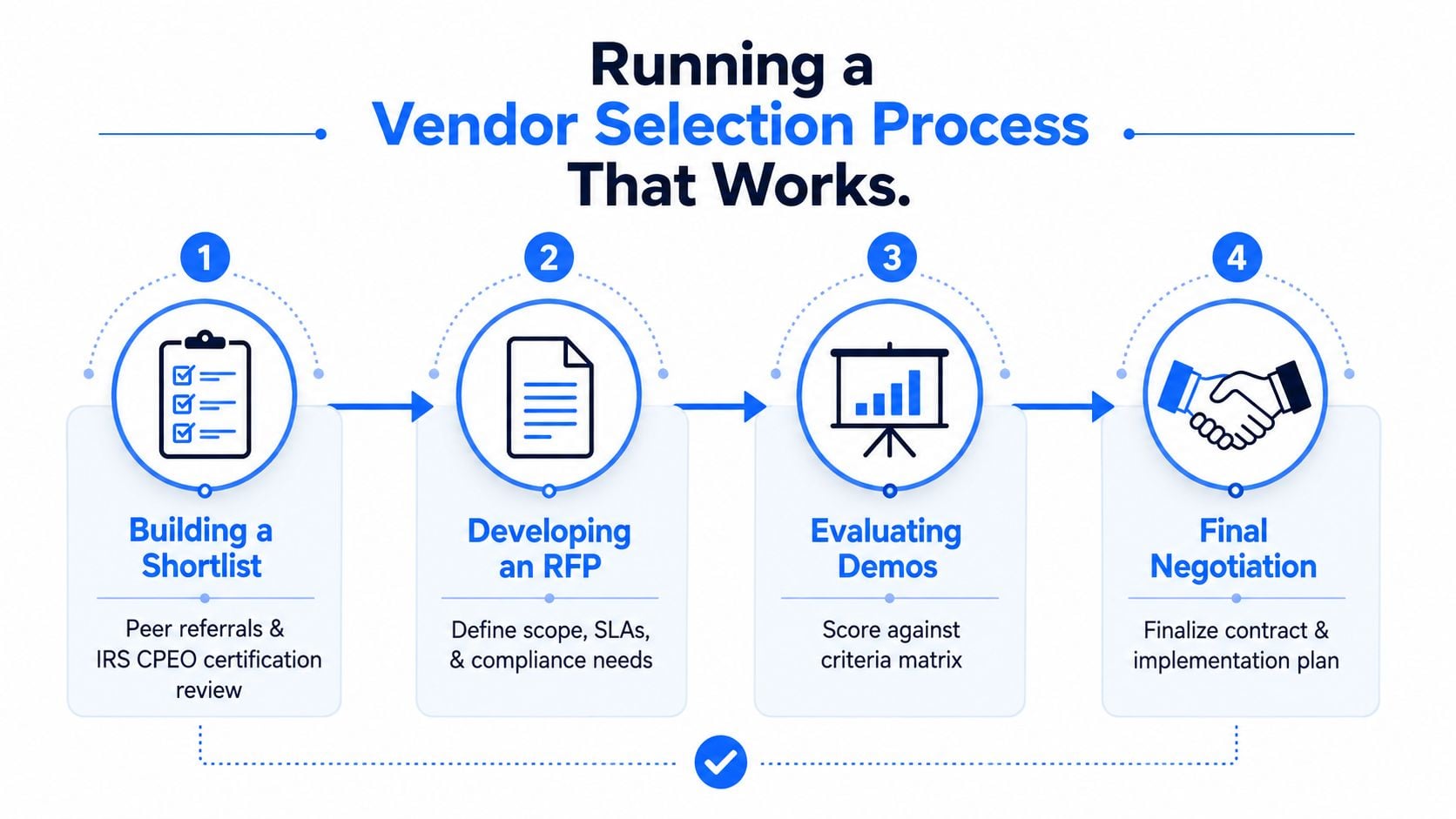
A PEO selection should look like procurement, not a sequence of friendly demos. The strongest buyer teams create comparable requirements, score evidence, validate references, and negotiate the contract before enthusiasm takes over.
Start with a shortlist of three to five providers. Use peer referrals, verify current CPEO certification where relevant, and look for documented experience in the company's industries and states. A national brand isn't automatically the right choice for a specialized workforce or a complex benefits structure.
Force comparable responses
The RFP should require each provider to answer the same questions:
- Pricing detail: State the administrative fee, per-employee charges, technology fees, benefit costs, and potential pass-through expenses.
- Service ownership: Name the implementation lead, account manager, payroll contact, benefits contact, and escalation path.
- Implementation schedule: Identify data deadlines, parallel testing, employee communications, open enrollment work, and go-live dependencies.
- Benefits access: List carrier options, plan structures, eligibility rules, renewal treatment, and any separate per-life charges.
- Compliance support: Describe state coverage, tax filing responsibility, wage-and-hour guidance, workers' compensation support, and document retention.
Require the actual implementation lead to attend the finalist meeting. The sales representative may be excellent, but the implementation team will determine whether payroll data, employee records, and benefits elections arrive correctly.
Score what affects the relationship
A defensible scoring model assigns 30% to price, 20% to benefits access, 20% to service model, 15% to technology, and 15% to references. Those weights prevent a polished platform demo from overwhelming weak service commitments or poor contract language.
References should include at least three employers with similar headcount and multi-state exposure. The best question isn't, “Do you like the provider?” It's, “What went wrong during onboarding, who fixed it, and how long did resolution take?”
Hidden costs often appear in small operational transactions:
- Benefits administration: Per-life charges or separate enrollment fees.
- Payroll changes: Off-cycle payroll, special checks, and correction fees.
- Employee setup: New-hire or termination processing charges.
- Compliance administration: Garnishment processing and special reporting.
- Year-end work: W-2 preparation, corrections, and amended filings.
A structured selection generally takes 6 to 8 weeks. That time allows the company to compare total cost, service commitments, and exit terms instead of selecting the provider that gives the most persuasive presentation. For broader process design beyond HR, the outsourcing business processes guide offers useful context on defining scope and accountability across outsourced work.
The questions to ask PEO providers should be used during demos and contract review, not saved for a final sales call.
Contract Terms That Decide Whether the Deal Works
Most outsourcing failures don't appear in the proposal. They appear in the master services agreement, exhibits, benefit documents, renewal language, and implementation addendum.
The first negotiation concerns fee architecture. Buyers should request a clear per-employee-per-month structure where possible, identify every administrative and technology charge, and cap annual increases. A CPI plus 2% cap can be a reasonable negotiating position, while administrative fees locked for 24 months give finance teams a stable planning period.
Benefits require separate scrutiny. Administrative pricing may look attractive until health renewal costs pass through without protection. A 10% health renewal can eliminate projected savings if the buyer has modeled only the provider's administrative fee. The contract should state whether carrier changes, plan changes, commissions, and renewal adjustments are controlled, passed through, or subject to notice and approval.
Put liability in writing
Verify that the provider is currently CPEO-certified if the proposal relies on CPEO treatment. The contract should require indemnification for unpaid employment taxes during the contract term, while distinguishing provider-caused errors from client-caused omissions and pre-existing liabilities.
Wage-and-hour language needs equal attention. Ask who pays penalties arising from a payroll processing error, whether defense costs are included, and whether the indemnity has a dollar cap. An indemnity with a low cap may offer little practical protection against a serious failure.
Make exit operationally possible
Auto-renewal clauses with 60-day notice windows create unnecessary risk. Buyers should seek 90-day notice, full data extraction, usable payroll history, employee records, benefits files, and a defined transition-assistance period of 60 to 120 days after termination.
Service-level agreements should include credits tied to missed payroll runs, benefits enrollment errors, and other measurable failures. A $500-per-incident credit can sound meaningful until four quarterly failures produce only a limited remedy while employees and finance staff absorb the operational damage.
| Clause Family | What to Demand | Acceptable Range / Red Flag |
|---|---|---|
| Administrative fees | Itemized pricing and predictable billing | CPI plus 2% cap is a reasonable position; uncapped increases are a red flag |
| Benefits pass-through | Renewal notice, rate visibility, and defined approval rights | Unexplained carrier or plan charges are a red flag |
| CPEO status | Current certification and tax indemnification | Unclear certification or broad exclusions are a red flag |
| Liability allocation | Responsibility for provider-caused payroll and tax errors | Low indemnity caps or broad disclaimers are a red flag |
| Renewal and exit | 90-day notice, data return, and transition support | 60-day auto-renewal windows and vague extraction rights are a red flag |
| Service guarantees | Credits and cure rights tied to measurable failures | Service promises without remedies are a red flag |
The PEO master service agreement checklist should sit beside the contract during negotiations. Buyers shouldn't approve a proposal until every fee, responsibility, remedy, and exit dependency has an owner.
Managing the 90-Day Transition
A disciplined transition prevents the new provider from becoming the scapegoat for incomplete data or unclear ownership. The transition team should include finance, HR, IT, benefits, the current provider where applicable, and the incoming implementation lead.
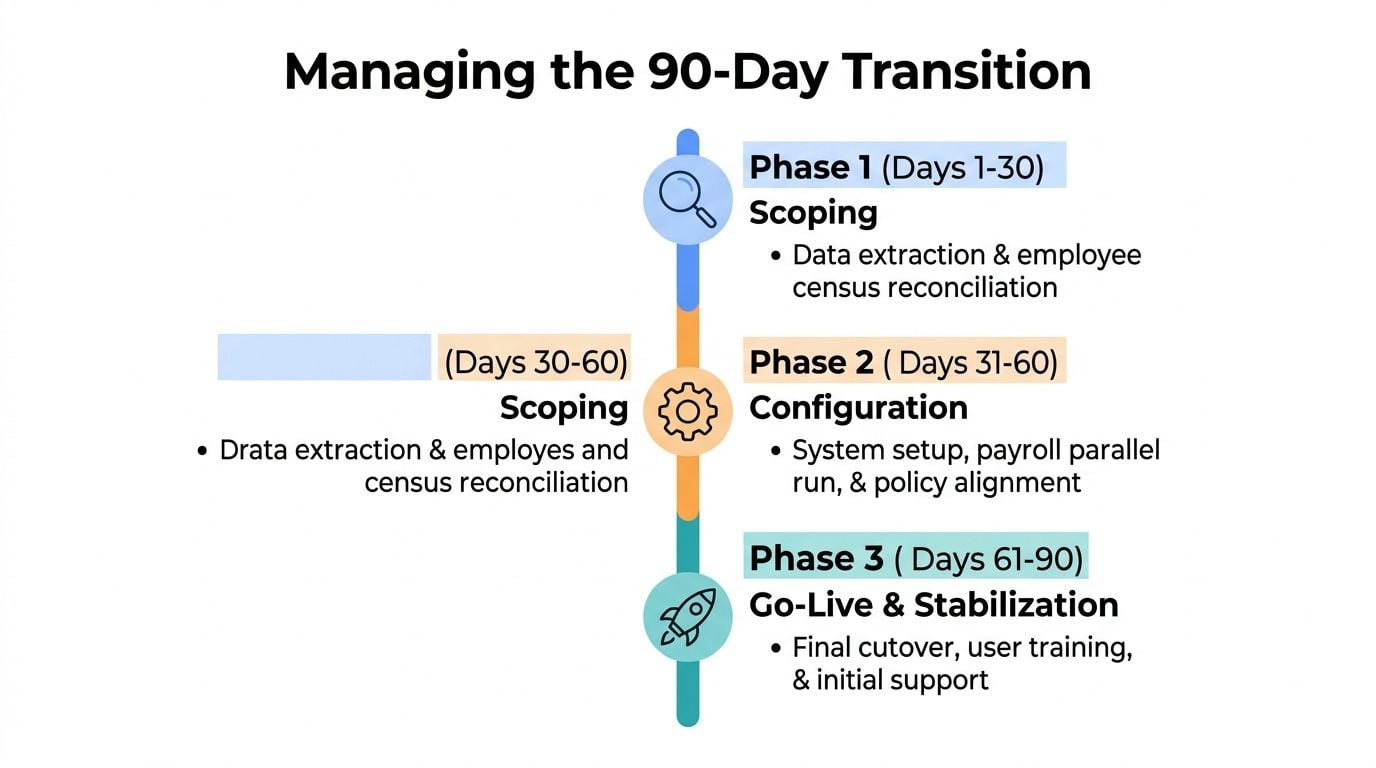
Days 1 through 30 focus on scoping
The team extracts payroll data, reconciles the employee census, transfers policy documents, confirms benefits eligibility, and coordinates with carriers. Employee names, addresses, tax elections, compensation, deductions, employment dates, and benefit elections should be checked against source records rather than assumed correct.
A frozen pay period should support a parallel payroll test around day 30. Finance should compare gross wages, deductions, taxes, employer contributions, garnishments, and reporting outputs before approving live processing.
Days 31 through 60 move to employee readiness
The provider configures workflows, benefit plans, policies, and access roles. Employees receive plan summaries, enrollment instructions, contact guidance, and answers to practical questions such as who handles a paycheck issue and whether the internal HR team remains available.
Managers need training on the new ticket or case-submission process. A town hall is worthwhile because uncertainty spreads quickly when employees don't know whether to contact payroll, the PEO, HR, or a manager.
Days 61 through 90 stabilize the operation
The team resolves remaining data discrepancies, confirms the workers' compensation audit baseline, completes I-9 reverification where required, and transfers the open-issue log to the steady-state service team.
Three warning signals deserve immediate escalation:
- Parallel payroll misses: A late or incomplete test run suggests configuration or data problems.
- Benefits ID mismatches: Carrier records that don't match employee records can delay access or create billing errors.
- Aged employee tickets: Unanswered tickets older than 48 hours indicate that the service model may not be ready for live volume.
The implementation lead should provide a named owner and deadline for every open issue. A transition isn't complete when the system goes live. It's complete when payroll, benefits, employee support, and compliance work reliably without constant intervention from the project team.
Measuring Vendor Performance After Launch
The contract marks the beginning of vendor management. A provider can meet the implementation schedule and still deliver weak payroll support, slow employee responses, inconsistent benefits administration, or poor issue ownership after launch.
A monthly dashboard and quarterly business review should compare actual service with contractual commitments. The dashboard should distinguish initial response time from resolution time, because a quick acknowledgment doesn't compensate for an unresolved payroll or benefits issue.
| Category | Measure | Review cadence | Escalation trigger |
|---|---|---|---|
| Payroll | Accuracy, timeliness, corrections, and missed runs | Every payroll cycle and monthly | Repeated errors or a missed deadline |
| Employee support | Initial response and resolution time | Monthly | Guaranteed response times missed |
| Benefits | Enrollment accuracy, carrier files, and billing discrepancies | Monthly and quarterly | Recurring ID or eligibility errors |
| Compliance | Filings, notices, audits, and required deliverables | Monthly | Late or incomplete compliance work |
| Open tickets | Severity, age, owner, and resolution status | Weekly and monthly | Critical issues remain open |
| Implementation follow-through | Completion of remaining project commitments | Monthly until closed | Action items lack owners or dates |
| Employee experience | Complaint themes and recurring service failures | Monthly | Complaint volume or severity rises |
| Total cost | Fees, credits, rate changes, and headcount billing | Monthly and quarterly | Spend exceeds the agreed baseline |
Escalate before frustration becomes inertia
Use four escalation levels: service representative, account manager, executive sponsor, then formal cure or renegotiation. Every material gap needs a written action plan, named owner, deadline, and follow-up date.
The incident record should be severity-weighted. A minor profile correction shouldn't receive the same treatment as a missed payroll filing, but repeated minor failures can reveal a deteriorating service model.
Quarterly reviews should examine fees, credits, rate changes, benefits performance, headcount reports, and vendor staffing. If performance remains below contract standards, leadership should calculate the operational and financial impact, issue any required cure notice, and rely on the agreement's termination, transition-assistance, data-return, and fee-reconciliation provisions.
A single bad payroll run deserves investigation. An exit decision should rely on the trend, the contract, and the cost of continued failure.
PEO Metrics offers independent side-by-side analysis of PEO pricing, benefits, service models, compliance support, and contract terms for companies comparing or renegotiating HR outsourcing relationships. Visit PEO Metrics to benchmark options, identify contract risks, and prepare a more defensible selection or renewal decision.
