
Most advice on how much it costs to outsource HR starts and ends with a per-employee-per-month number. That’s the wrong starting point for any CFO, HR director, or owner who needs to budget, compare vendors, and live with the contract after signature.
A quote can look cheap and still produce a bad financial outcome. A low PEPM fee may exclude the compliance support, employee relations coverage, or recruiting help the company will need six months later. A percentage-of-payroll model may look simple at first and then climb fast as compensation rises. A flat monthly fee may feel predictable but become wasteful if the service scope is thin.
The question isn’t just price. It’s total cost of ownership, including pricing model fit, service scope, implementation friction, contract terms, and the cost of mistakes. That’s where many buyers get trapped. They compare vendor quotes as if every line item reflects the same liability, the same service depth, and the same operational burden. It doesn’t.
Table of Contents
- Why Simple HR Outsourcing Cost Answers Are Wrong
- The Three HR Outsourcing Pricing Models Explained
- PEO vs ASO vs Payroll What Are You Actually Paying For
- Factors That Drive Your PEO Costs Up Or Down
- Calculating Total Cost: Worked Examples
- Beyond the Admin Fee Negotiating Your PEO Agreement
- Conclusion From Cost Comparison to Value Calculation
Why Simple HR Outsourcing Cost Answers Are Wrong
The market keeps pushing a neat answer because neat answers sell. But clean pricing ranges often hide the part that matters most. Whether the model fits the company.
Most guides assume a flat PEPM model, yet 2% to 12% of pretax income models and per-service fees can cause up to 30% to 40% cost volatility when staff pay scales or service needs shift, especially for multi-state employers, according to Deloitte human capital trends coverage. That’s the issue many finance teams miss. The vendor quote is static. The workforce isn’t.
A company with rising salaries, bonus-heavy compensation, or aggressive hiring can see a percentage-based arrangement become materially more expensive than a PEPM structure. The opposite can also happen. A company with volatile headcount but lower average wages may prefer a model that scales differently. The cost problem isn’t only “what does the vendor charge today.” It’s “what happens when payroll, geography, and support needs change.”
Practical rule: If the pricing model moves with payroll, hiring mix, or add-on services, finance should model at least one growth case and one stress case before treating the quote as budget-ready.
There’s also a second error in the usual advice. It treats all outsourced HR as interchangeable. It isn’t. Payroll processing, ASO support, and a PEO arrangement don’t carry the same service scope or the same liability structure. Comparing them on one fee number creates false confidence.
Buyers evaluating outsourced HR need to look past the sticker quote and test where the model breaks. A useful starting point is a pricing transparency framework like this PEO pricing opacity analysis, which helps expose what’s included, what’s excluded, and which fees move later.
The hidden cost isn’t always on page one
Some costs show up only after implementation.
A provider may quote basic administration cleanly, then charge separately for recruiting support, employee relations help, compliance projects, benefit plan changes, or renewal increases. Another vendor may include more support but wrap it into a higher base fee. Neither is automatically better. The wrong move is pretending those quotes are equivalent.
For a finance leader, the right question is simple. What will this arrangement cost over the life of the agreement if the business grows, enters another state, upgrades benefits, or needs more hands-on HR support?
The Three HR Outsourcing Pricing Models Explained
Cheap HR outsourcing quotes usually stay cheap only on the first page. The core issue is pricing mechanics. A model that looks modest at signature can become expensive once payroll changes, support requests increase, or the company adds states, classes of employees, or a more complex benefits setup.
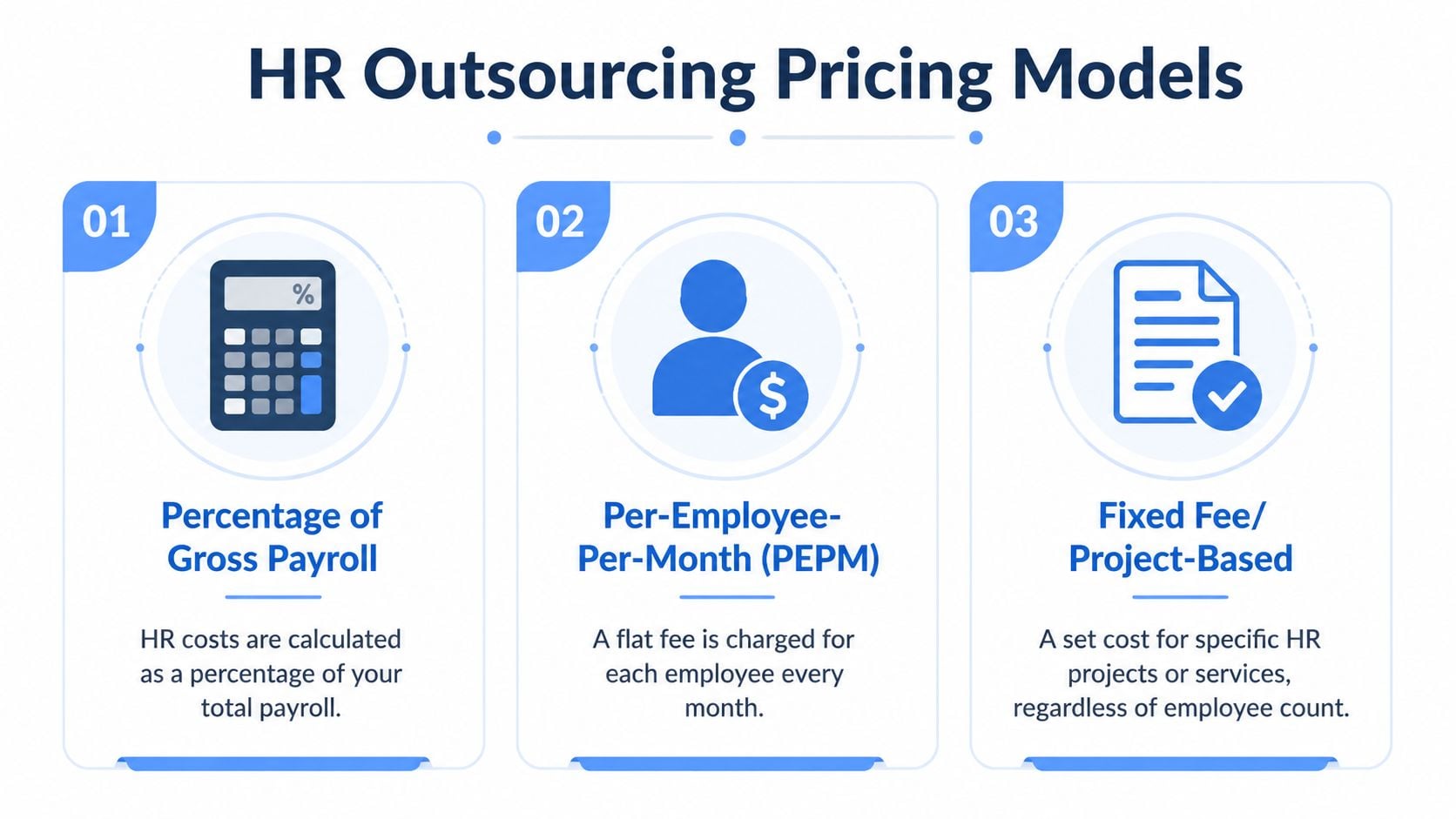
The market generally uses three pricing methods. Percentage of payroll, per employee per month, and flat fee or project pricing. Buyers comparing those models should also separate broad service arrangements from narrower support categories. The menu of human resources outsourcing models helps clarify which fee structure usually sits behind which service scope.
Percentage of payroll
This model ties the vendor fee directly to wages. Payroll goes up, the bill goes up.
CFOs often underestimate how volatile this gets. Headcount can stay flat while outsourced HR spend rises because of annual increases, incentive pay, overtime, or a shift toward higher-paid roles. The fee also grows even if the provider’s day-to-day workload does not change at the same rate.
That makes percentage pricing workable for some companies, but only if finance accepts that compensation strategy and vendor cost are now linked.
Best fit: companies that want HR spend to scale with labor spend and can tolerate budget movement.
Common pitfall: approving a low percentage without modeling bonus cycles, hiring mix, or salary inflation.
Per employee per month
PEPM is the cleanest model on paper. Each active employee carries a monthly charge, which makes budgeting easier and board reporting simpler.
The problem is false comparability. One PEPM quote may include employee relations guidance, onboarding support, handbook updates, multistate compliance help, and benefits administration. Another may cover basic payroll processing and ticket-based support with extra charges for anything more involved. The same headcount can produce very different total cost of ownership.
A low PEPM quote can also leave the employer carrying more exposure than leadership realizes. Labor mistakes still land with the business, and in some states that can extend beyond the entity itself. Lerner & Weiss APC employment law guidance is a useful reminder that compliance failures are not just an admin nuisance. They can turn into personal liability issues.
A PEPM quote is only useful after you confirm what is included, what triggers extra fees, and which compliance responsibilities stay with the employer.
Best fit: companies with stable headcount and a finance team that wants cleaner monthly forecasting.
Common pitfall: treating PEPM as all-in pricing when the contract is really a base fee plus exceptions.
Flat fee and project based pricing
This model uses a monthly retainer, a defined project fee, or both. It can look attractive because the number appears stable regardless of headcount, at least within a stated scope.
That stability is real only if the scope is tight and the business is predictable. Flat-fee arrangements often work for one-time policy work, handbook revisions, implementation support, or a narrow HR support package. They get expensive when managers assume the retainer covers investigations, terminations, leave issues, recruiting support, benefits changes, or multistate compliance work that the contract treats as out of scope.
Flat fee pricing rewards disciplined buyers. It punishes assumptions.
HR Outsourcing Pricing Model Comparison
| Model | How It’s Calculated | Best For… | Potential Pitfall |
|---|---|---|---|
| Percentage of Gross Payroll | Fee rises with total wages or payroll spend | Businesses that want fees tied to payroll levels | Costs climb as compensation rises, even if service demands do not |
| Per-Employee-Per-Month | Fixed monthly fee for each employee | Companies that want easier headcount-based budgeting | Low quotes often exclude advisory support, compliance work, or service-intensive issues |
| Fixed Fee/Project-Based | Monthly retainer or scoped fee for a defined service set | Smaller firms or companies buying limited support | Scope creep and change orders can turn a predictable contract into a series of extra charges |
PEO vs ASO vs Payroll What Are You Actually Paying For
The biggest pricing mistake I see is treating payroll, ASO, and PEO bids as interchangeable. A lower monthly quote often reflects a smaller transfer of work, risk, and accountability, not a better deal.
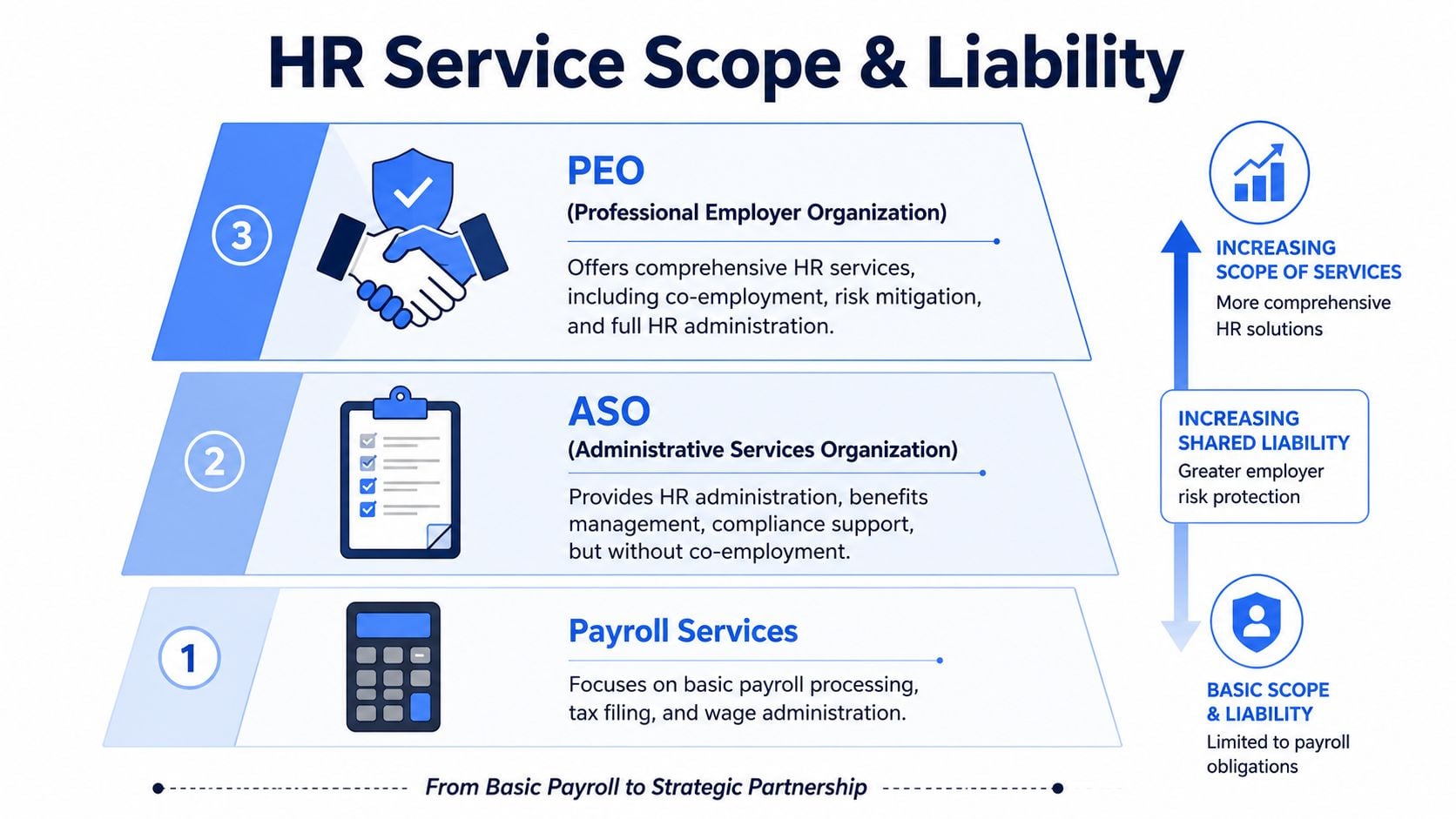
Payroll is transaction processing
Payroll vendors handle pay runs, tax filings, W-2s, and basic wage administration. That can save time and reduce clerical errors. It does not remove the employer’s responsibility for classification decisions, handbook quality, leave administration, manager conduct, terminations, or wage-and-hour mistakes.
That distinction matters to a CFO because the invoice may be small while the retained liability stays large.
A payroll provider can process overtime correctly based on the data it receives. It usually will not decide whether the employee should have been nonexempt in the first place, whether a meal-break policy is enforceable in a given state, or whether a termination should be delayed until final pay rules are met. The admin fee looks efficient until one avoidable issue turns into legal spend, back pay, penalties, or management distraction.
ASO adds support, but the employer keeps more of the exposure
An ASO sits between payroll and a PEO. It often adds HR administration, benefits coordination, onboarding support, and some compliance guidance without the co-employment structure tied to a PEO.
That usually means more help with process, less help with risk transfer.
For some companies, that is the right trade-off. If leadership wants better HR administration but prefers to keep benefits, insurance arrangements, and employer control more directly in-house, an ASO can fit well. The problem starts when buyers assume ASO pricing includes the same backing they would get under a PEO model. It usually does not. The contract may provide tools, templates, and advice while leaving key legal and insurance obligations with the client.
PEO fees buy a broader operating model
A PEO quote is higher because the company is paying for more than task completion. It is paying for an operating structure that can include payroll administration, HR support, benefits access, workers’ compensation coordination, compliance assistance, and a co-employment arrangement that changes who handles what.
That does not mean every PEO is a bargain. Some are underbuilt on service. Some look cheap because support is thin, the benefit options are weak, or the implementation work gets pushed back onto your team. But the right comparison is total cost of ownership, not admin fee versus admin fee.
Cost volatility is often missed. A payroll vendor may charge less each month while leaving the employer to absorb legal review, policy cleanup, HR headcount, multi-state compliance work, and claim management separately. An ASO can narrow that gap, but many employers still keep more downstream cost than they expected. A PEO may consolidate more of those functions into one relationship, which can look expensive on paper and cheaper over a year if it reduces internal labor, avoids fragmented vendors, and lowers avoidable compliance errors.
California is a good example of why the cheapest category can become the most expensive. Wage-and-hour failures can create exposure beyond the business entity itself. Lerner & Weiss APC employment law guidance highlights how labor code violations may create personal liability for owners and employees in some situations. A low-cost administrative vendor does not remove that risk.
The practical question is simple. What remains on your balance sheet and management team after the vendor goes live? If the answer is policy ownership, employee relations, leave compliance, claim coordination, and multistate risk review, then the lower quote is only lower on the front page. For a more grounded way to compare scope, this HR outsourcing versus payroll comparison is more useful than lining up vendor fees without examining who retains the hard problems.
Factors That Drive Your PEO Costs Up Or Down
Two companies with the same headcount can receive very different PEO quotes. That isn’t always vendor gamesmanship. Often, it reflects differences in workforce profile, service demands, and risk.
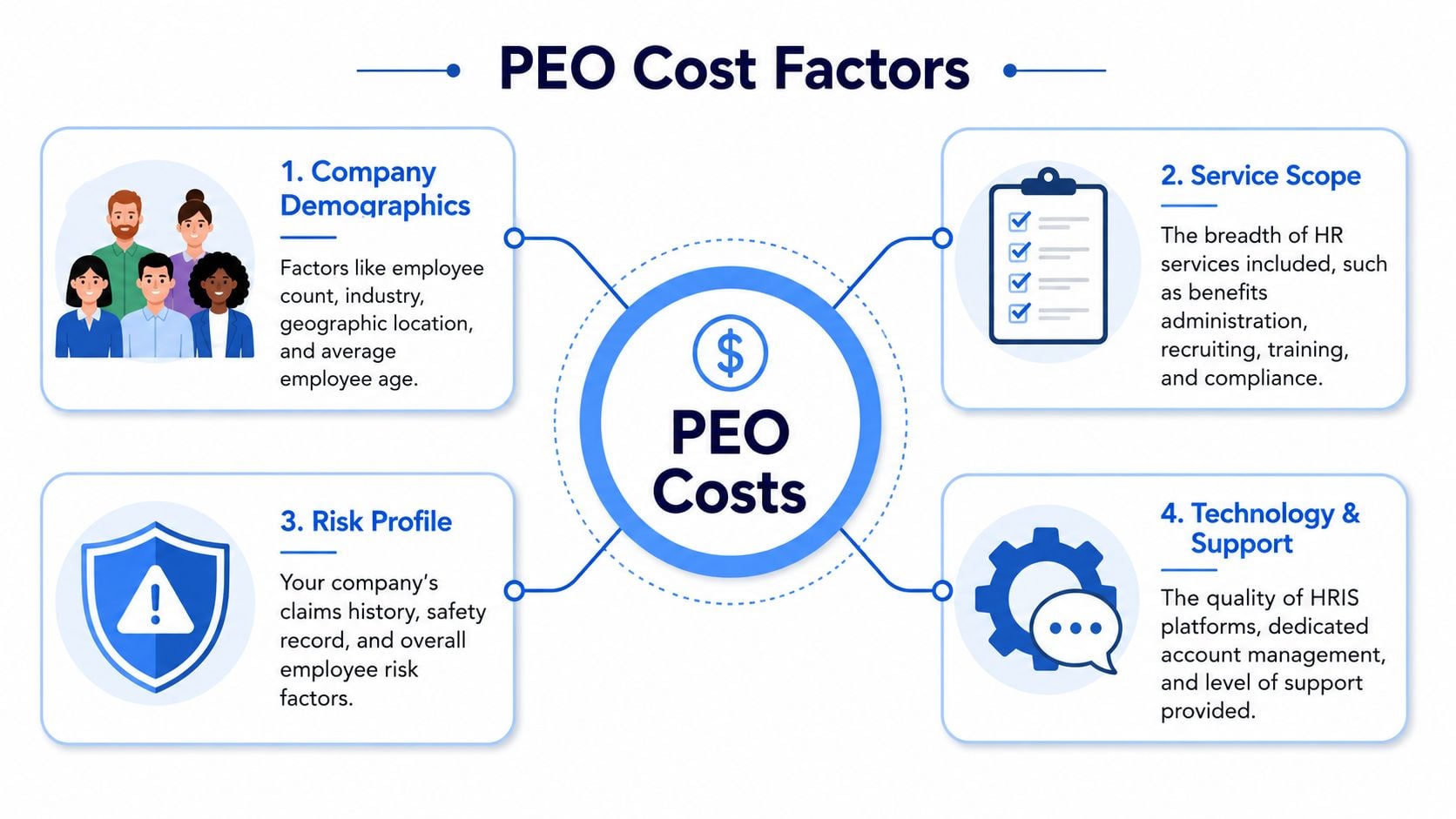
Company profile changes the quote fast
Headcount is obvious, but it’s only part of the cost picture. Salary mix, location profile, industry, and employee classification shape the quote just as much.
A 30-person software company with multi-state remote staff and higher wages often creates a different pricing outcome than a 30-person local operation with a simpler payroll profile. The first employer may need more state-specific compliance help and more careful support around onboarding, leave, and handbook administration. The second may face less policy complexity but heavier attention on field operations or benefits participation.
The benefits package also matters. Richer medical options, broader ancillary coverage, and stronger retirement administration can improve recruiting and retention, but they also affect total spend. For owners trying to compare plan quality instead of only admin fees, this overview of group health and retirement benefits is useful context.
Service scope is where cheap quotes break down
The market has a habit of making basic support look complete. It isn’t.
Some low-cost arrangements cover payroll, tax filing, and light benefits administration. Others include compliance support, handbook help, employee relations guidance, recruiting coordination, and strategic HR access. Those are markedly different services, even when the quotes sit close together on a spreadsheet.
A buyer should ask questions such as:
- Compliance support: Does the provider only answer questions, or does it actively help manage policy updates, notices, and issue escalation?
- Employee relations: Is manager guidance included, or billed separately when problems arise?
- Benefits service: Who handles enrollment errors, carrier disputes, and employee questions during renewal?
- Recruiting and onboarding: Are those included, lightly supported, or entirely separate?
- Dedicated support: Is there a named contact team, or a general queue?
Cheap outsourced HR often becomes expensive when the business discovers it bought software and ticketing, not actual problem ownership.
Technology support and buyer discipline matter
Technology quality can raise or lower the overall cost even when the admin fee looks similar. A weak HRIS creates manual reconciliation, duplicate entry, and payroll clean-up. A stronger platform reduces friction, but only if the support team knows how to configure and maintain it.
The buyer’s own procurement discipline also affects cost. Companies that don’t define service scope, implementation ownership, escalation paths, and renewal mechanics usually end up paying through change orders, service gaps, or avoidable renewals at higher rates.
Three habits improve quoting accuracy:
- Map the workforce first. Count states, employee classes, support needs, and likely pain points before taking demos.
- Audit exclusions early. Ask what isn’t included before debating headline fees.
- Model change, not just current state. A quote should survive growth, compensation shifts, and operational complexity.
Calculating Total Cost: Worked Examples
A CFO should not ask, “What’s the PEPM fee?” The better question is, “What will this arrangement cost after payroll changes, renewals, service exceptions, and compliance exposure are added back in?”

Baseline pricing can still be useful if it is treated as a starting point, not an answer. Optima Office’s HR outsourcing cost example shows how a small employer’s monthly spend rises quickly as service depth increases. That matters because many buyers compare low-touch and high-touch quotes as if they are the same product. They are not.
A finance team that wants cleaner scenario planning can run quote sensitivity through a PEO cost per employee modeling tool before signing. That exercise usually exposes more risk than the vendor summary page does.
Scenario one high salary multi-state team
Take a 25-employee company with employees spread across several states, above-average compensation, and managers who need regular guidance. A PEPM quote may look manageable on first review because the math is simple and the fee is easy to annualize.
The problem shows up when compensation is high enough that a percentage-of-payroll proposal climbs much faster than headcount. A company can stay relatively small by employee count and still produce a much larger vendor bill because payroll, bonuses, and raises push cost up automatically.
That pricing model deserves closer scrutiny in executive review. If compensation is expected to rise, percentage pricing transfers that growth directly into the provider’s fee whether service effort changes or not. Vendors rarely frame it that way.
For this type of workforce, the cost model should include at least four pressure points: expected raises, incentive pay, hiring in new states, and off-cycle HR issues. A quote that looks cheap in Q1 can look very different after merit increases and one employee relations matter.
Scenario two larger workforce with broader support needs
Now take a 150-employee employer that wants broader coverage across payroll administration, benefits support, HR help desk access, and compliance coordination. At that size, a narrow PEPM comparison can hide more than it reveals.
A lower quote often reflects a stripped service package, slower response model, or heavier dependence on internal staff to solve exceptions. A higher quote may include more direct support, cleaner case handling, and fewer surprise invoices when issues move beyond routine processing. That difference affects labor cost inside your own finance and HR team, not just the vendor bill.
Large-group pricing also creates a false sense of efficiency. Buyers assume scale will automatically lower unit cost. Sometimes it does. Sometimes the provider prices in complexity from multiple locations, benefit plan administration, higher employee inquiry volume, and implementation burden.
The finance view should be a full cost stack. Include the admin fee, implementation charges, support that is billed outside scope, expected annual increases, internal time required to manage the vendor, and the cost of mistakes if compliance ownership is vague.
The cheapest quote often becomes the most expensive one after a renewal increase, an out-of-scope issue, or a compliance miss that the client assumed the provider was handling.
That is why worked examples matter. They force the buying team to model volatility, not just first-year fees.
Beyond the Admin Fee Negotiating Your PEO Agreement
A lot of buyers spend too much time pushing on the visible fee and not enough time negotiating the clauses that create future cost.
The admin fee matters. It just isn’t the only place money leaks. The stronger negotiation happens in the contract mechanics. That’s where companies either protect themselves or hand the provider room to raise cost later.
Terms that deserve more attention than the headline price
Rate protection often matters more than a small discount. A modestly lower fee can disappear quickly if the contract allows broad renewal increases.
Implementation treatment matters too. Some agreements include onboarding charges, setup work, and conversion costs in ways that don’t show up clearly in early discussions. Buyers should ask whether implementation fees can be waived, reduced, or credited.
Exit language deserves close review. If service quality slips, the company needs a practical path out. A weak termination clause can trap the buyer in a poor relationship at the exact moment leadership wants flexibility.
Indemnification and responsibility allocation also belong in the negotiation. If the contract is vague on who owns which mistake, the company may discover the answer only after a problem. This is why a focused checklist like these PEO indemnification negotiation tips is more valuable than generic procurement advice.
What strong buyers ask before signing
The best negotiation questions are operational, not theatrical.
- Ask for renewal guardrails: What limits fee increases at renewal?
- Ask for service specificity: Which support items are included versus billed separately?
- Ask about transition risk: Who owns implementation tasks, data migration, and payroll conversion timing?
- Ask about termination mechanics: How much notice is required, and what happens to fees during the exit period?
- Ask about support structure: Is the company getting named contacts or a rotating queue?
A disciplined buyer also keeps one practical rule in mind. If a provider resists clear language on pricing changes, scope boundaries, or exit terms, that resistance is part of the product.
Conclusion From Cost Comparison to Value Calculation
The question isn’t only how much does it cost to outsource HR. The better question is what the company is buying, how the pricing behaves over time, and which risks stay in-house after the contract is signed.
A PEPM quote can be sensible. A percentage-of-payroll model can be sensible. A flat fee can be sensible. The right answer depends on workforce shape, support needs, compliance exposure, and the terms attached to the agreement. That’s why simplistic pricing articles usually fail the people making the decision. They answer the search query, not the operating reality.
Good buyers treat outsourced HR as a financial model, not a vendor slogan. They test pricing against hiring plans, compensation shifts, service exclusions, renewal terms, and exit risk. They also look beyond obvious administration and think about adjacent exposures, including internal controls and conduct oversight. For teams reviewing broader people-risk issues, this piece on preventing insider misconduct is useful context because HR cost decisions often connect to governance and policy enforcement.
The clearest takeaway is practical. Before taking the first serious sales call, build a simple model with three columns: base fee, likely add-ons, and contract risk items. That exercise usually tells leadership more than the vendor’s pricing sheet.
Companies that want an independent way to compare PEO quotes can use PEO Metrics to review pricing models, benefits costs, service scope, and contract terms side by side before making a decision.
