
An 18-person startup has employees in three states, a senior engineer has just accepted a competitor's offer because the benefits are better, and the head of people is weighing a PEO against a full-time HR hire. The founder wants the benefits fixed before the next recruiting cycle, but every dollar of Series A capital still has a job in product and engineering.
That decision is becoming common. Remote hiring creates state payroll and employment obligations, candidates expect credible health and retirement benefits, and lean leadership teams need administrative capacity before they can justify a large internal HR function. A PEO can address those pressures, but it can also create expensive constraints if the contract, benefits structure, and exit terms don't match the company's growth path.
The right question isn't whether a PEO sounds attractive. It's whether the model fits the startup's headcount, hiring geography, benefits needs, operating maturity, and likely exit point.
Table of Contents
- Why Founders Are Evaluating PEOs Right Now
- What a PEO Actually Does for a Startup
- Benefits That Move the Needle for Startups
- Risks and Trade-offs Most PEO Guides Skip
- PEO vs ASO vs Payroll vs EOR for Startups
- How Much a PEO Really Costs at Startup Sizes
- Evaluating and Negotiating a PEO Contract
- When the PEO Move Makes Sense for Your Startup
Why Founders Are Evaluating PEOs Right Now
The founder in that three-state scenario has three problems, not one. The engineer's departure exposes a benefits gap. The remote team creates payroll and compliance work in several jurisdictions. The proposed HR hire adds fixed overhead before the company has built the people processes that would make that hire productive.
A PEO moves those problems into a bundled operating model. It can provide access to benefits, payroll administration, workers' compensation support, and HR compliance infrastructure without requiring the startup to build every process internally. That doesn't make the PEO a replacement for HR leadership. It makes the PEO a potential back-office foundation while the company decides when to add strategic HR capability.
The market is already large enough that startups shouldn't treat PEOs as an unusual workaround. More than 230,000 U.S. businesses currently partner with a PEO, representing about 15% of employers with 10 to 499 employees, according to NAPE O's research on PEO client growth. The same source reports that PEO users were more likely than non-users to report growth in 2025, 80% versus 67%, and to expect growth in 2026, 83% versus 75%.
The startup pressure is operational, not fashionable
Those figures don't prove that a PEO causes growth. They do show that PEO use is material among smaller employers and that users are operating in a population reporting strong growth expectations. For a startup, the practical implication is clear: the PEO deserves a serious comparison with payroll-only providers, ASOs, benefits brokers, and internal hiring.
Insurance access is another reason the decision keeps returning to the executive agenda. Small employers may have limited choices, inconsistent plan quality, or pricing that makes recruiting difficult. A PEO's pooled benefits structure can improve the menu, but the startup gives up some direct control over carrier selection and plan design.
The strongest use case usually appears when growth has created multi-state exposure and benefits pressure at the same time. A single-state company with a handful of employees may need only payroll and a broker. A distributed team approaching a meaningful hiring wave needs a more deliberate comparison. Growth stage, not startup identity, should drive the decision.
What a PEO Actually Does for a Startup
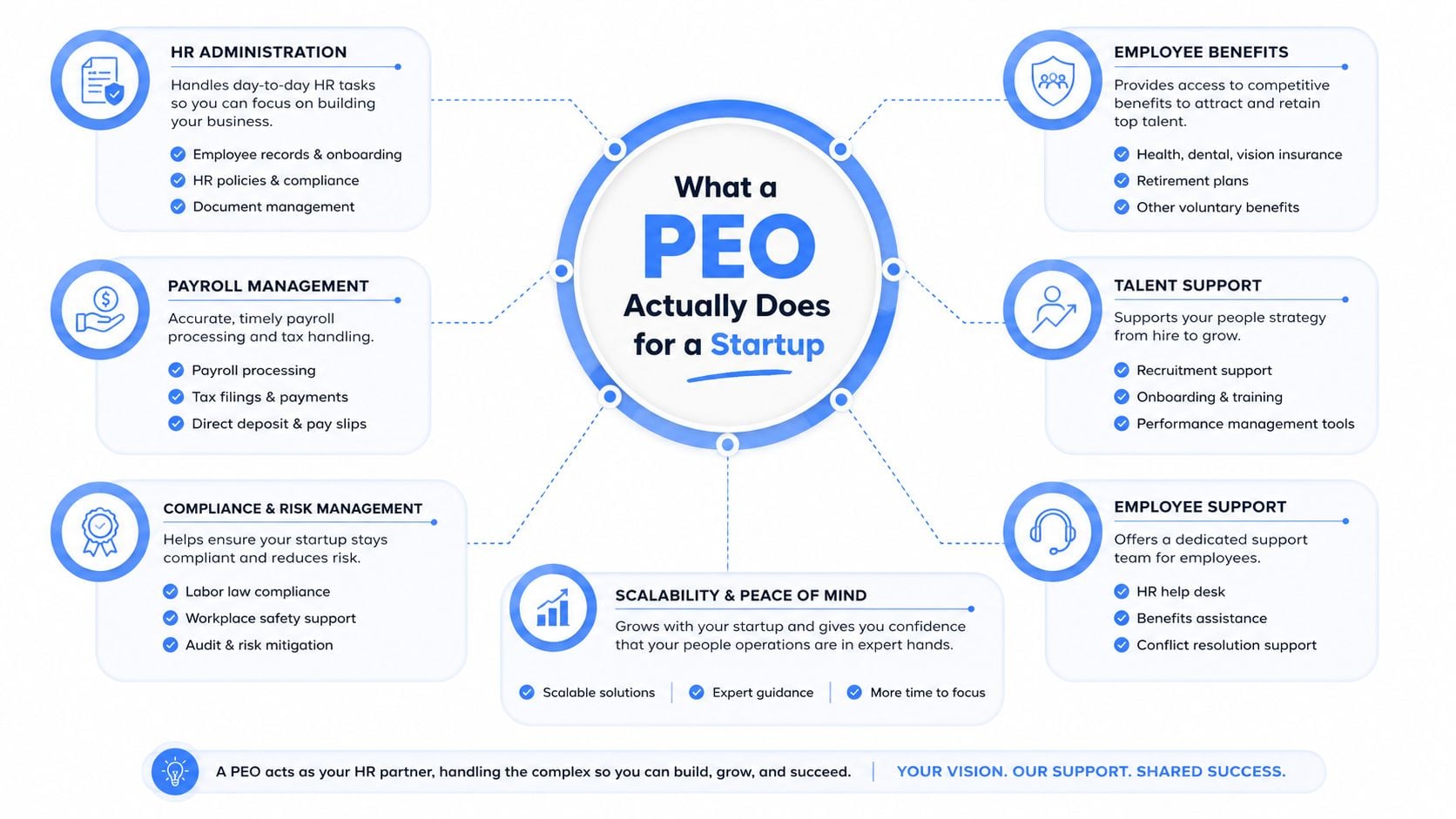
A professional employer organization enters a co-employment relationship with the startup. The startup continues to run the business, direct employees, set compensation, assign work, and make hiring and termination decisions. The PEO becomes the administrative employer for payroll, taxes, benefits, and selected HR administration.
The simplest analogy is two employers on paper, one manager in practice. Employees work for the startup operationally, while the PEO handles defined employment administration. A detailed explanation of the structure appears in what a professional employer organization does.
The administrative split
Under a standard arrangement, the PEO processes payroll, withholds and remits federal payroll taxes, supports unemployment administration, manages workers' compensation administration, and administers employee benefits. It may also provide handbooks, compliance training, HR templates, and guidance on state employment requirements.
The IRS describes the arrangement as one where the client and PEO share employer responsibilities. In a standard PEO relationship, the client company can still retain liability for employment-tax errors, while an IRS-certified CPEO may be treated as the sole employer for federal employment-tax purposes under Section 3511. That distinction matters for startups without deep payroll expertise or with employees spread across states. The federal treatment is explained in the IRS guidance on third-party payer arrangements and PEOs.
The startup still owns the employment decisions that shape the employee relationship:
- Hiring and termination: Company leaders decide who joins and who leaves.
- Compensation and equity: The startup sets salary, bonus, and equity arrangements, subject to proper legal and administrative handling.
- Daily management: Startup managers direct work, evaluate performance, and set priorities.
- Business liability: The company remains responsible for how it operates and supervises its workforce.
A PEO is therefore infrastructure, not a complete people strategy. Founders comparing HR systems may also find the HR startup playbook by Credit for Startups useful for separating software, administration, and strategic HR responsibilities.
Benefits That Move the Needle for Startups
Benefits are often the first reason a founder considers a PEO, but the value changes sharply by stage. A very small team may need basic payroll more than a advanced benefits platform. A distributed Series A company may need stronger plan access and state administration immediately.
The PEO's main benefits advantage comes from pooling employees across client companies and negotiating access to large-group plans. The result can be a more credible benefits package than a young company could secure independently, although the startup must inspect the actual networks, deductibles, employee contributions, and exclusions rather than relying on plan branding.
Compliance relief is equally important. Multi-state payroll tax registration, unemployment administration, workers' compensation, and ACA tracking can overwhelm a founder who still owns recruiting, fundraising, and product decisions. A PEO can create a repeatable onboarding process when the company hires in another state, but it doesn't eliminate the need for the startup to provide accurate employee and compensation data.
Value by operating stage
A pre-seed company may value speed and minimum viable administration. A Series A company usually needs repeatability. A Series B company should scrutinize whether the PEO still provides enough value compared with an ASO or internal team.
| Benefit Category | Pre-Seed / Seed (1-15) | Series A (15-50) | Series B+ (50-200) |
|---|---|---|---|
| Benefits access | Basic medical and retirement access can support early recruiting | Broader plan choice and more consistent enrollment processes | Benefits governance, renewal management, and employee support become more important |
| Compliance | Payroll setup, workers' compensation, and core onboarding | Multi-state registrations, leave rules, and reporting need stronger coordination | Internal ownership and audit readiness may justify a more customized model |
| Hiring speed | Useful when the founder needs a compliant first-hire process | Valuable for repeated hiring across states | Valuable only if service levels remain reliable at higher volume |
| HR leverage | Administrative relief without an immediate HR department | Lets HR focus more on recruiting, managers, and retention | May complement internal HR, but shouldn't replace strategic capability |
| Financial fit | Bundling may justify the cost when benefits are otherwise difficult to access | Comparative modeling becomes essential as payroll and headcount grow | ASO, broker-led benefits, or internal administration may become more efficient |
A startup recruiting investors should also separate employee benefits from fundraising strategy. Resources such as Gritt's search for employee-benefits investors can help teams researching the capital environment, while the PEO decision should remain grounded in workforce economics and operational needs.
The recommendation is straightforward. Use a PEO when benefits access and multi-state administration are blocking growth. Don't use it because the platform has a polished dashboard or labels every feature “HR.”
Risks and Trade-offs Most PEO Guides Skip
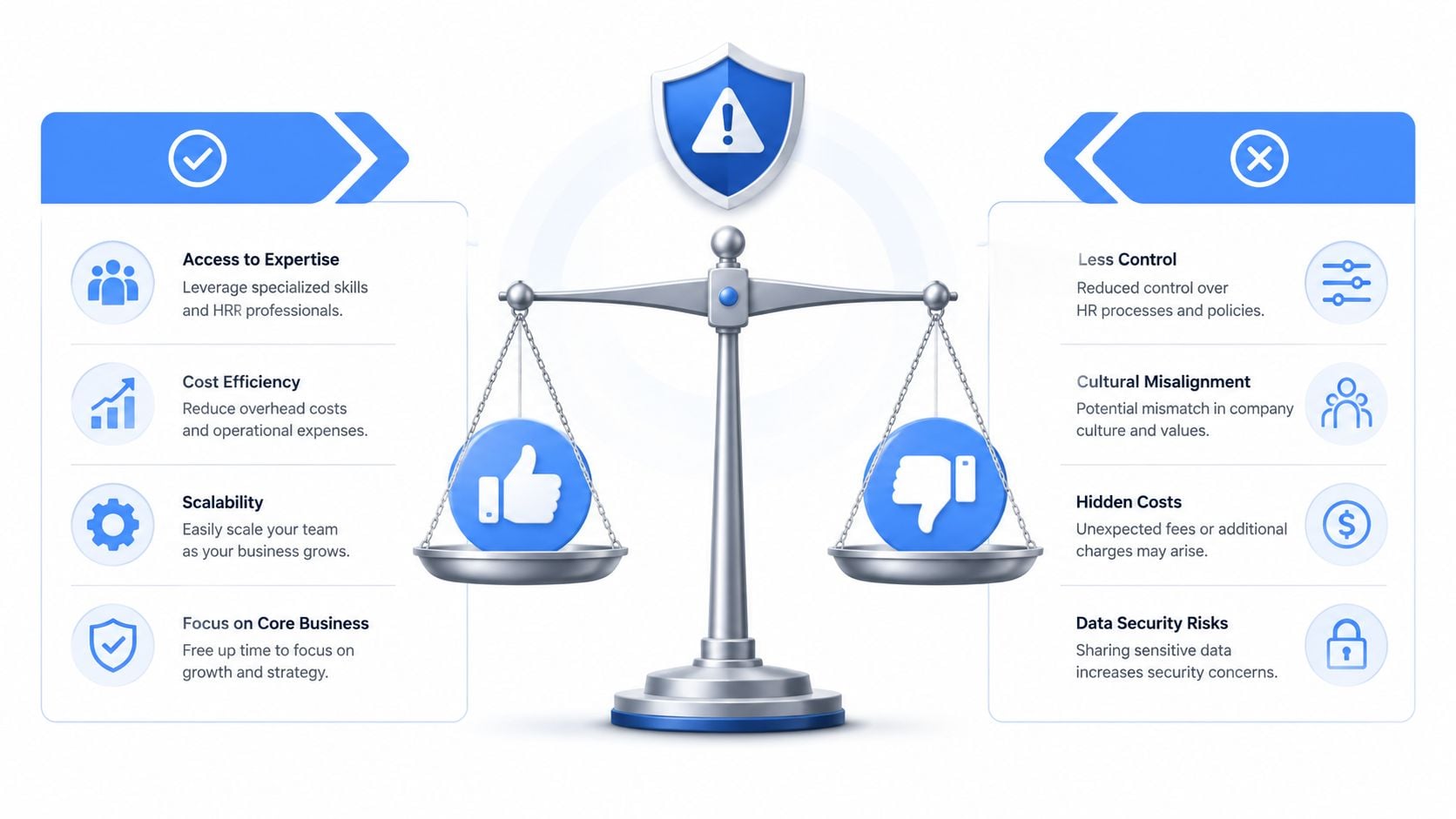
A PEO can improve administration while reducing the startup's direct control over important employment infrastructure. The biggest trade-off is usually the loss of a direct carrier relationship. If the startup wants a highly specific plan design or access to a niche provider such as Carrum or Apostrophe, the PEO's master-plan structure may not accommodate that preference.
Co-employment also creates confusion when company leaders assume the PEO controls every employment decision. The PEO handles defined administrative responsibilities, but the startup still manages people. Equity grants, international hiring, discipline, and termination should be reviewed carefully so the operating agreement doesn't create uncertainty about who is responsible for what.
Switching is an operating project
Leaving a PEO isn't a vendor toggle. The company may need to migrate payroll history, benefits elections, retirement balances, workers' compensation claims, employee records, and state registrations. That work can disrupt HR, finance, employees, and leadership during a period when the startup is trying to grow.
The contract deserves the same attention as the platform demonstration. Buyers should look for:
- Automatic renewal: A short opt-out window can force a company to negotiate under pressure.
- Repricing triggers: Payroll or headcount changes may alter the fee schedule.
- Plan substitution rights: The PEO may reserve the ability to change benefit options mid-term.
- Indemnification language: Broad clauses can shift operational risk back to the client.
- Exit notice: A sample PEO agreement requires 90 calendar days' written notice from the client to terminate at the end of a term, while the PEO can terminate on 30 calendar days' notice if it stops providing services, as shown in this sample PEO client service agreement.
Contract rule: A startup should negotiate its exit rights before discussing implementation dates. Exit leverage disappears once the team is dependent on the platform.
A PEO is often the wrong fit for a company that needs highly specialized technical HR support, is approaching an IPO, or has more than 150 employees in a single state. At that point, an internal HR and finance infrastructure can offer more control and may cost less than a bundled arrangement. The broader trade-offs are also covered in this guide to professional employer organization pros and cons.
PEO vs ASO vs Payroll vs EOR for Startups
The right model depends on growth stage, headcount, hiring geography, and the amount of HR control the startup can support internally. Compare each option by cost, control, and compliance scope, not by vendor category alone.
A PEO combines co-employment, payroll, benefits administration, workers' compensation, and compliance support. It suits a domestic startup that is growing across states and wants one operating layer for several employer tasks. An ASO provides administrative support without becoming a co-employer, so the startup buys benefits and insurance separately while retaining more direct oversight.
Payroll-only software handles pay processing and related filings. It can fit a small team with straightforward hiring, limited benefits, and little multi-state complexity, but it does not provide the same benefits administration or broader HR infrastructure. An EOR serves a different need. It employs workers in another country on the client's behalf, making it appropriate for international hiring rather than domestic benefits administration. The structural distinction is outlined in this PEO versus EOR comparison.
| Model | Typical Cost | Compliance Scope | Best-Fit Headcount | Control |
|---|---|---|---|---|
| PEO | PEPM or 2% to 12% of payroll, depending on structure and services | Payroll, benefits, workers' compensation, unemployment, and HR compliance support | Small to mid-sized domestic teams with multi-state exposure | Shared administrative responsibility |
| ASO | Administrative fee plus separately purchased benefits and insurance | Operational support without co-employment | Growing domestic teams that want more control | Higher client control |
| Payroll | Payroll fee and employee charges | Payroll processing and related filings, with narrower HR scope | Small teams with limited benefits and straightforward hiring | High operational control |
| EOR | International employment service priced per foreign worker | Country-level employment, payroll, and compliance | Teams hiring internationally | Client directs work, EOR employs locally |
Use headcount and exposure to set the shortlist. A domestic company with fewer than 5 employees and no benefits need can stay with payroll. A domestic team of roughly 5 to 80 employees, especially one hiring across states, should compare PEOs seriously. From about 80 to 150 employees, an ASO or internal model deserves equal consideration because the startup may need greater autonomy and vendor flexibility. International hiring calls for an EOR alongside the domestic structure, not a domestic PEO presented as a global solution.
The all-in cost matters more than the quoted administrative fee. Count benefits, insurance, state work, implementation, and the internal time required to manage exceptions. A PEO earns its cost when multi-state compliance and benefits administration consume finance or HR capacity. ASO or payroll is usually stronger when the startup already has that capacity and needs direct control over plans, vendors, or unusual workforce requirements.
How Much a PEO Really Costs at Startup Sizes
A startup with five employees can overpay for a PEO if it buys enterprise-style administration before benefits or multi-state compliance create real workload. A team hiring across several states can reach the opposite conclusion quickly. Price the service against headcount, salary mix, states, and the internal hours it replaces, not against the headline PEPM.
PEO quotes usually use either a per-employee-per-month fee or a percentage of payroll. Small-business guidance places PEPM pricing around $40 to $150 per employee per month, with premium tiers above $200. Percentage-based pricing commonly falls between 2% and 12% of payroll. Treat those figures as an opening range, not an all-in quote.
The percentage model needs close review in engineering-heavy companies. Applying the same rate to a senior engineer and a coordinator creates a much higher fee for the engineer. PEPM is easier to forecast, but tiers, minimums, implementation charges, and separate benefit costs can change the result.
Pass-through healthcare costs, implementation charges, state registrations, and other line items also affect the effective rate, as described in this startup PEO cost analysis.
Model both structures before selecting one
Request a full fee schedule before comparing proposals. Include administrative fees, benefit pass-throughs, workers' compensation treatment, retirement administration, state charges, implementation, termination, and renewal pricing. The internal cost of managing payroll exceptions, benefit questions, and state filings belongs in the model too.
| Headcount | Dominant Pricing Model | Base Fee / Employee / Month | Add-on Costs | All-In Annual Cost / Employee |
|---|---|---|---|---|
| Early team | PEPM often provides clearer forecasting | $40 to $150, with premium tiers above $200 | Benefits, setup, registrations, and retirement charges may apply | Must be calculated from the proposal, not inferred from PEPM |
| Growing team | PEPM and payroll-percentage quotes should be modeled side by side | Compare the quoted PEPM against the payroll percentage | Benefit passthroughs and state-specific items can change the result | Varies with salary mix, plan selection, and service scope |
| Larger startup | Percentage pricing can become less predictable as payroll rises | Request tier schedules and renewal terms in writing | Add-ons, repricing triggers, and service exclusions matter more | Compare with ASO, broker-led benefits, and internal administration |
A percentage model may look attractive with lower salaries, then become expensive after senior engineering hires. PEPM may look costly at low headcount but become more competitive as the team grows. Use the startup's roster, salary mix, states, benefit elections, and hiring plan to test both models.
One industry source places many mid-market PEOs around 3% to 6%, with benefits administration sometimes bundled while premium passthrough is billed separately, according to this breakdown of PEO fee structures. The useful benchmark is the effective cost per employee after every pass-through. For a structured comparison, use these PEO cost analysis resources.
Evaluating and Negotiating a PEO Contract
A PEO proposal should be evaluated like a financial and operational outsourcing agreement, not a software subscription. The sales presentation matters less than the fee schedule, service responsibility matrix, carrier documents, renewal mechanics, and termination process.
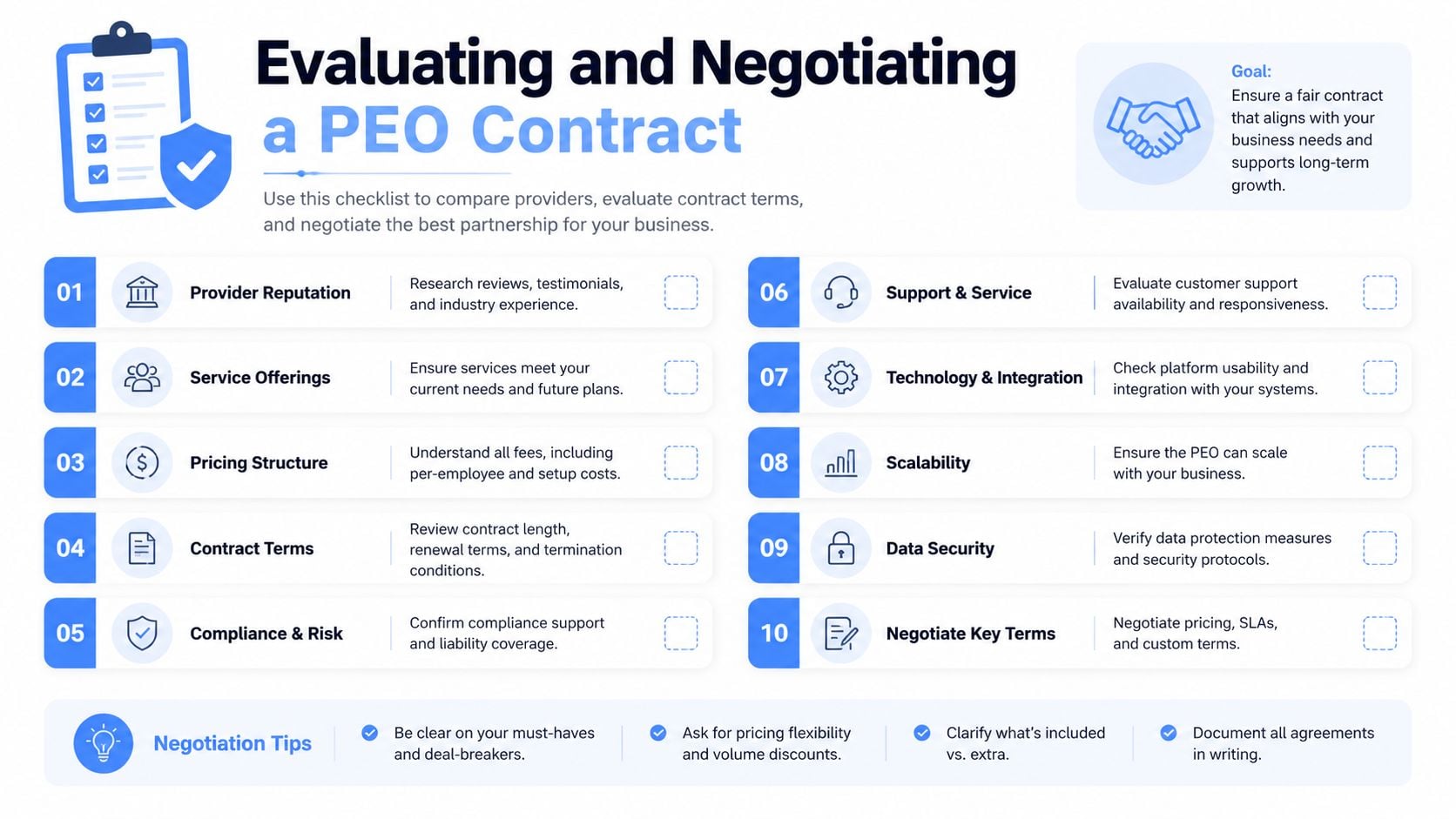
The first review should cover five areas:
- Tax status: Confirm whether the provider is an IRS-certified CPEO and understand what liability remains with the client.
- Benefits structure: Review actual plan documents, carrier networks, employee contributions, participation rules, and portability.
- Technology: Test payroll workflows, HRIS integrations, reporting, onboarding, and data export.
- Risk administration: Examine workers' compensation experience, claims handling, unemployment support, and state coverage.
- Service model: Identify named contacts, escalation paths, response expectations, and the work retained by the startup.
Measure the proposal after the sales call
The most useful metrics are operational and financial. Calculate the effective PEPM after wrap fees, the blended cost as a percentage of payroll, renewal increases over the expected relationship, and the time required to enroll a new employee in benefits. A low administrative fee doesn't compensate for payroll corrections that consume finance capacity or benefit enrollment delays that damage the recruiting process.
Negotiation should begin with competing proposals. A startup should benchmark at least two alternatives, then ask for:
- A first-year rate lock.
- A cap on implementation charges.
- A service-level agreement for payroll accuracy and benefits administration.
- Clear data export rights.
- A termination clause with 60 to 90 days' notice, aligned with the company's operating needs.
- Protection against unilateral plan substitutions where feasible.
- Written treatment of equity administration and employment authority.
Negotiation position: The startup is buying continuity, data access, and predictable administration. Those terms deserve the same attention as the initial fee.
Red flags include multi-year auto-renewal, benefits that can't be ported, unclear renewal pricing, and co-employment language that appears to restrict the company's ability to issue equity or manage employees. Contract language should be reviewed by employment counsel before signature. Teams can also use a guide to negotiation personality types to prepare for different sales and renewal styles, but the agreement itself remains the controlling document.
When the PEO Move Makes Sense for Your Startup
A founder or HR director can make the initial decision quickly by checking four conditions. The PEO deserves a serious proposal when the company has crossed roughly 10 to 15 employees, operates in at least two states, can't match market benefits independently, and has an HR leader spending more than 30% of working time on administration instead of people strategy.
The decision should then be tested against the cost model. If the blended PEO cost remains below 8% of total payroll and the company gains meaningful multi-state compliance support plus better benefits access, engaging a PEO is reasonable. If the blended cost exceeds that threshold without a corresponding benefits or risk advantage, the default should be payroll plus a benefits broker, an ASO, or a delayed decision.
Three quick outcomes
- Engage now: The team is distributed, hiring is accelerating, benefits are affecting recruiting, and internal HR capacity is administrative rather than strategic.
- Compare alternatives: Headcount is growing, but the company has finance and HR capability to manage separate payroll, benefits, insurance, and compliance vendors.
- Hold off: The company has fewer than 10 employees in one location, no urgent benefits problem, and straightforward employment administration.
A PEO is usually the wrong move above 150 employees when the workforce is concentrated in one state, because dedicated HR infrastructure may provide better control and economics. It also deserves caution when the cap table, equity administration, international workforce, or investor requirements create complications that the co-employment contract doesn't handle cleanly.
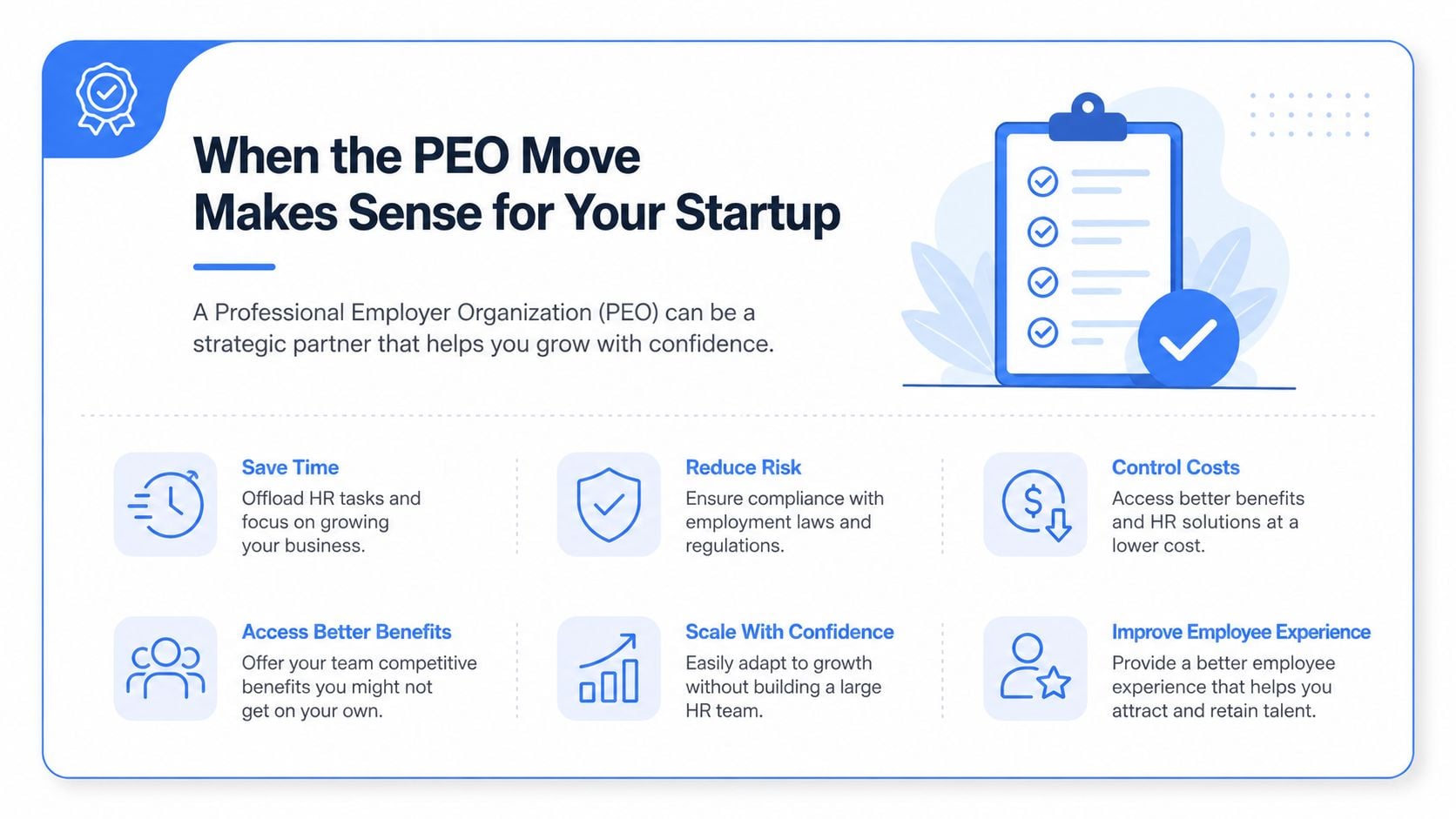
The actionable test is simple: map current headcount, next-stage headcount, states, salaries, benefits, and exit timing into competing proposals. A startup shouldn't sign because a PEO promises simplicity. It should sign when the all-in economics and contract protections make complexity cheaper to manage than building the infrastructure alone.
PEO Metrics helps companies compare, select, and negotiate PEO relationships by reviewing pricing, benefits, service models, compliance support, and contract risks. Visit PEO Metrics to benchmark options, identify practical provider matches, and prepare stronger terms before signing or renewing.
