

A finance leader may start with a simple question: How much will a professional employer organization cost per employee? That question matters, but it won't reveal whether the arrangement is safe, flexible, or sustainable. The more consequential questions concern control, tax responsibility, benefits access, contract renewal, and what happens to payroll and claims data if the relationship ends.
That's why a serious evaluation of professional employer organization pros and cons must go beyond a fee comparison. A PEO can give a growing employer access to HR infrastructure that would be difficult to build alone. It can also introduce bundled services, provider constraints, approval requirements, and an exit process that becomes painful if the contract was negotiated casually.
Table of Contents
- The Honest Truth About PEO Evaluations
- How a PEO Relationship Actually Works
- Where a PEO Delivers Real Value
- The Constraints and Hidden Costs to Watch
- Which Companies Benefit Most From a PEO
- How to Negotiate Stronger PEO Terms
- Making a Confident PEO Decision
The Honest Truth About PEO Evaluations
Most buyers approach PEO selection like a software purchase. They compare the monthly fee, review the feature list, and choose the option that appears to deliver the most for the least money. That method works reasonably well for a project-management platform. It breaks down when the vendor becomes part of the employer infrastructure surrounding payroll, benefits, compliance, and employment risk.
The visible price is only one part of the decision. The less visible value includes access to pooled benefits, specialist compliance support, workers' compensation administration, and processes that can reduce the burden on a small HR team. The less visible risk includes restricted carrier choice, contractual liability language, renewal increases, and the possibility that important records won't be immediately usable after termination.
A useful starting point is an independent review of the provider's pricing model, service quality, contract terms, benefits structure, and exit obligations, rather than a sales presentation alone. Buyers evaluating providers can use professional employer organization reviews as one input, then verify every material claim against the proposed client service agreement.
The question buyers should ask
The practical question isn't “Is a PEO good or bad?” It's “Which parts of this arrangement solve a current business problem, and which costs or constraints will remain after implementation?”
A 15-person startup may value benefits access and payroll administration because it doesn't have dedicated HR infrastructure. A 200-employee employer may already have capable payroll and benefits teams, making the PEO's incremental value narrower. A multi-state company may accept less administrative control because compliance coordination is consuming senior HR capacity.
Practical rule: Evaluate the PEO as a risk-and-operating model, not merely as a payroll subscription.
The strongest decision includes a written baseline of current costs, internal hours, benefits gaps, compliance responsibilities, and switching requirements. Without that baseline, the buyer may confuse a lower visible fee with a lower total cost, or mistake a polished implementation process for a contract that protects the company over time.
How a PEO Relationship Actually Works
A PEO arrangement creates a contractual relationship in which the provider takes responsibility for specified employer functions while the client continues directing the workforce's daily activities. The exact allocation matters because “co-employment” can sound more precise than it is.
The IRS states that the concept of “co-employer” isn't recognized under federal tax law. Federal tax treatment instead depends on the applicable Certified PEO rules and the terms of the service agreement. That makes the provider's certification status and contractual language more important than the label used in a sales conversation. The IRS explanation of third-party payer arrangements provides the federal framework buyers should review with tax and legal advisers.
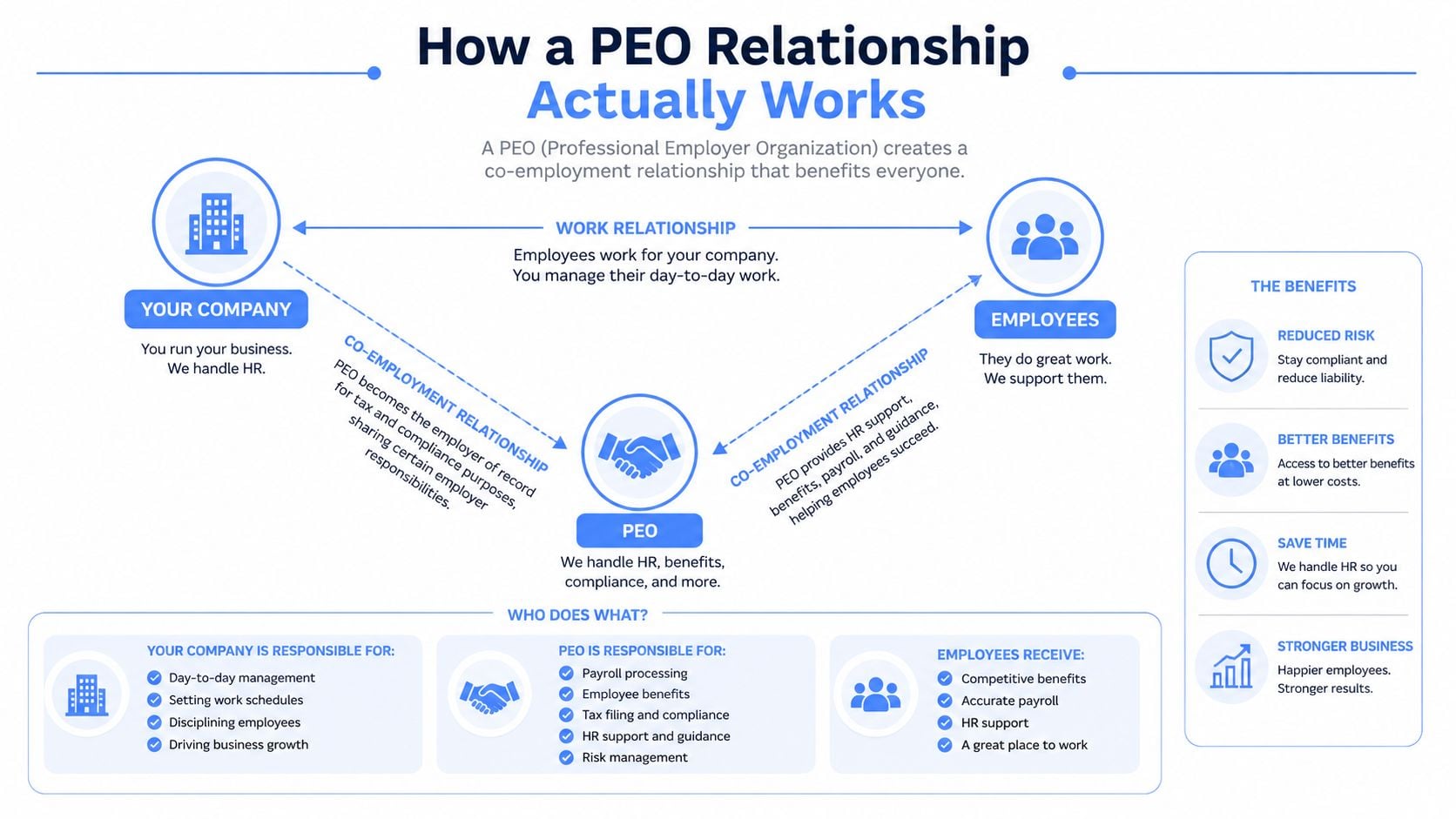
The responsibility split
In a typical arrangement, the client continues to decide who performs the work, how operations run, and what business objectives employees pursue. The PEO generally administers functions such as payroll, benefits, employment-tax processes, HR administration, and compliance support, subject to the agreement and service scope.
For federal payroll-tax purposes, the IRS says a Certified PEO is treated as the employer for covered workers and is generally solely liable for paying the customer's employment taxes, filing returns, and making deposits for remuneration it pays to worksite employees. The IRS guidance for CPEO customers explains why this status can shift important federal payroll-tax administration responsibilities, while also making clear that the client must understand which obligations remain outside the transfer.
The service agreement should therefore answer practical questions, not just describe the relationship:
- Payroll authority: Who approves payroll, corrects errors, and handles late or inaccurate filings?
- Benefits administration: Who determines eligibility, manages enrollment, and communicates carrier changes?
- Employment decisions: Which decisions require PEO review or approval?
- Tax scope: Does CPEO treatment apply to the company's entire workforce or only covered workers and specified remuneration?
- Client duties: Which records, notices, classifications, and workplace obligations remain with the company?
A detailed step-by-step guide to how a PEO works can help non-specialists understand the operating flow, but the signed agreement controls the relationship. Buyers should have counsel and tax advisers review the actual language before treating a provider's explanation as a commitment.
Where a PEO Delivers Real Value
A ten-person employer trying to compete for skilled hires may face two separate problems: limited benefits expertise and too little time to build reliable HR processes. A PEO can address both by providing access to broader benefits arrangements, structured administration, and support across employment requirements. The value comes from added capacity and market access, not from assuming every provider delivers the same results.
For businesses with 10 to 49 employees, 52% of PEO users offer a retirement plan versus 23% of non-PEO companies, according to NAPEO industry research. The comparison does not establish that a PEO caused each company's benefits decision. It does show how pooled purchasing and administration may help a smaller employer offer programs it might otherwise postpone.
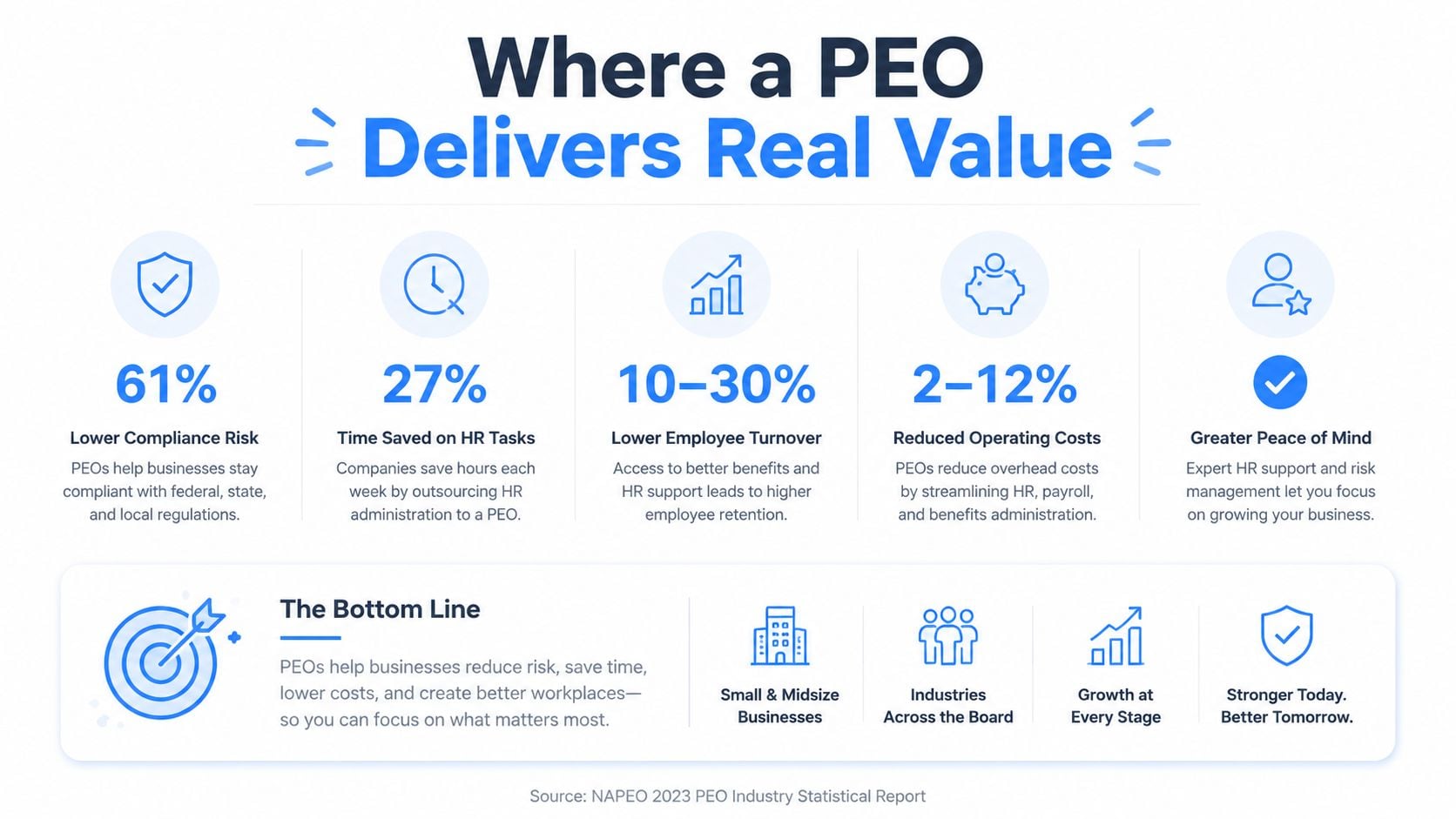
The operating benefits
A PEO can deliver value in several connected areas:
- Benefits competitiveness: Group access may help a smaller employer offer retirement and insurance programs that appeal to employees.
- Administrative consistency: Standardized onboarding, payroll, documentation, and employee support reduce reliance on one overextended HR generalist.
- Compliance coordination: A provider can help monitor requirements across states and organize recurring employment processes.
- Scalability: A company entering additional states may avoid creating separate administrative routines for each location.
- Employee experience: Centralized support gives employees a clearer route for payroll and benefits questions.
The reported outcomes are relevant to due diligence. One industry source reports that PEO clients grow 7% to 9% faster, experience 10% to 14% lower turnover, and are 50% less likely to go out of business than comparable small businesses, while retaining about 89% of clients year to year. Those figures appear in industry data on PEO outcomes. NAPEO separately reported that small and mid-size businesses using a PEO had a growth rate more than twice as high as comparable businesses in its September 2024 release, described in NAPEO's economic data announcement.
Treat these figures as evidence to investigate, not as a promised return. Results depend on provider execution, workforce characteristics, benefits fit, leadership discipline, and whether the PEO addresses a real capacity or risk problem.
A small employer without internal benefits expertise may capture substantial value. A larger company with mature payroll, benefits, legal, and HR teams may gain less, especially if standardized processes limit choices it already manages well.
For a practical explanation of what PEO benefits mean in practice, buyers should compare the promised advantages with written service commitments, employee needs, and the provider's approach to contract exit.
The Constraints and Hidden Costs to Watch
A PEO relationship exchanges some direct control for operating support. The client usually directs employees' daily work, while the provider may control or limit payroll administration, benefits-carrier selection, HR workflows, and bundled service design. That division matters when an executive needs a policy change quickly, wants a specialized benefit, or prefers a carrier outside the PEO's network.
Forvis Mazars' discussion of PEO advantages and disadvantages identifies several practical trade-offs, including underwriting requirements, bundled structures, carrier limitations, and billing that may be difficult to interpret. A provider can also require approval based on its underwriting standards, particularly when workforce composition, claims history, or industry risk affects the arrangement.
Exit friction deserves executive attention
The question buyers often underweight is what happens after termination. A PEO may hold loss-run and payroll data, and contract terms can make a provider change or return to internal administration harder than expected. The business.com analysis of PEO pros and cons explains how data ownership can affect a company's ability to switch providers or bring functions in-house.
Exit terms deserve review before the first renewal, not after a dispute. Clarify who owns payroll, claims, benefits, and employee records; the format for exporting them; the notice period; and the support available during transition. Ask whether the PEO can charge for data conversion, impose minimum terms, or delay delivery while fees remain outstanding.
| Constraint | What It Means | Impact Level | Mitigation Strategy |
|---|---|---|---|
| Carrier limitations | The employer may need to choose from the PEO's available benefit plans and carrier relationships. | High | Require a written description of available plans, renewal rights, and change-notice procedures. |
| Bundled billing | Payroll, benefits, workers' compensation, and HR services may appear in one structure with limited visibility. | High | Request a complete fee schedule, pass-through terms, and examples of renewal adjustments. |
| Underwriting approval | The PEO may assess workforce composition, claims history, and operating risk before accepting or renewing the account. | Medium to high | Obtain underwriting criteria and identify events that can trigger repricing or termination. |
| Data ownership | Payroll, claims, and benefits records may not be delivered in a usable format after exit. | High | Define ownership, export format, delivery deadlines, and post-termination support in the agreement. |
| Renewal and termination friction | Auto-renewal, notice windows, minimum terms, or transition charges can restrict timing. | High | Calendar notice dates and negotiate an orderly transition obligation before signing. |
Pricing can also drift after implementation. The analysis of PEO cost creep over time helps buyers examine how payroll changes, workforce needs, renewals, and bundled charges can make an initially acceptable arrangement less attractive. Require the agreement to show which fees can change, when notice is due, and whether the company can exit if the economics materially worsen. A low opening quote is not a complete cost assessment.
Which Companies Benefit Most From a PEO
A 30-person employer operating across several states may need more HR infrastructure than a 100-person employer with one location and an experienced internal team. PEO suitability depends on administrative complexity, benefits needs, internal capability, and geographic spread, not a universal employee-count rule.
Multi-state employers often have the clearest reason to evaluate a PEO. Firms with workers in 10 or more states may face enough payroll, benefits, tax, and employment-law coordination to justify an outside operating model. The trade-off is control. Leadership should identify which decisions the PEO will make, which remain internal, and how quickly the company can recover its records and processes if the relationship ends.
Industry analysis also links PEO use with stronger reported growth among users in 2025. NAPEO reported growth among 80% of users versus 67% of non-users, as described in the Mordor Intelligence market discussion. This is an association, not proof that a PEO produced the result. Buyers should ask whether the provider would improve execution or serve as an administrative response to growth that was already underway.
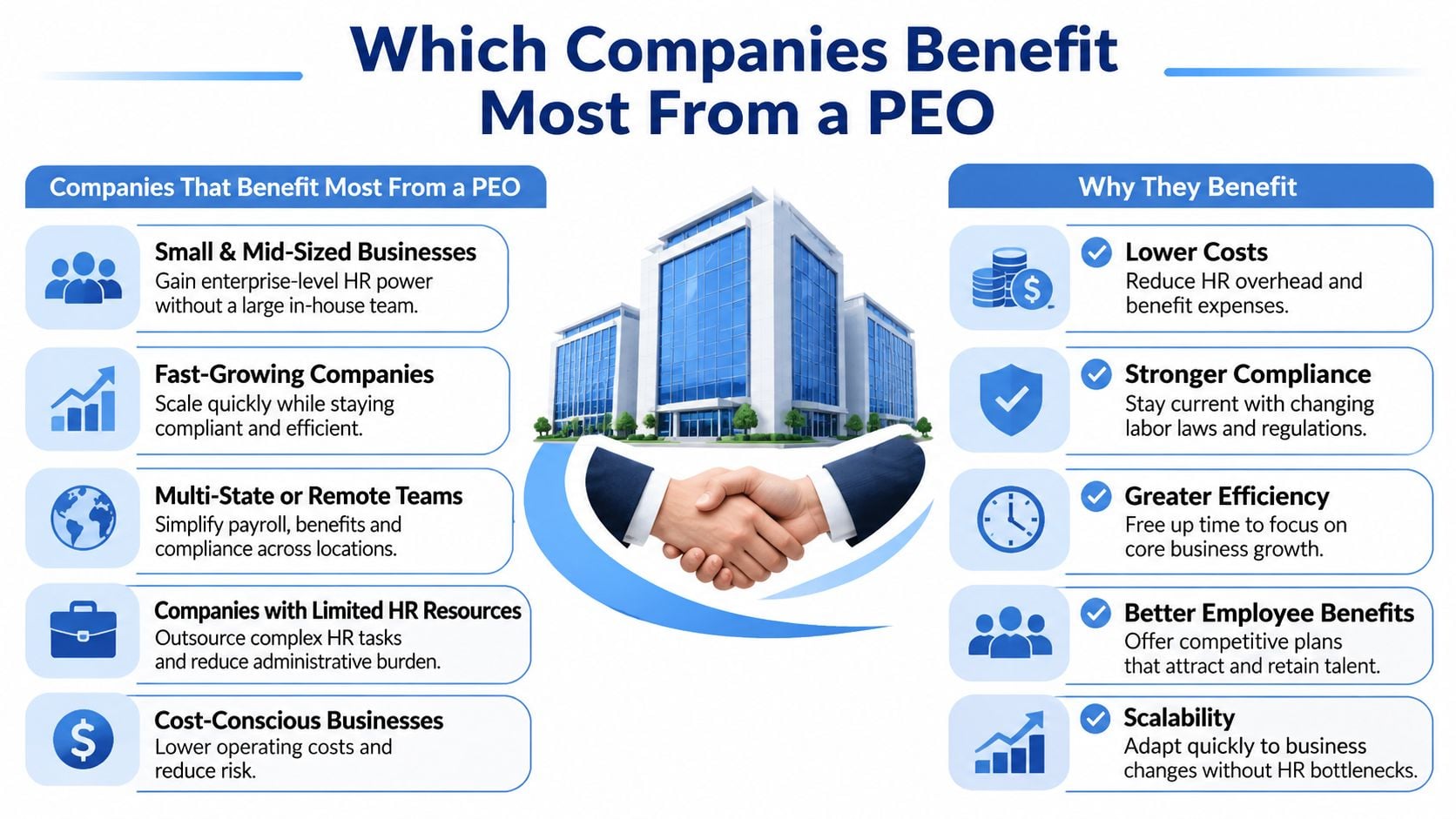
A practical fit comparison
| Company profile | Likely PEO value | Primary concern |
|---|---|---|
| Small employer without dedicated HR capacity | Payroll, benefits administration, and compliance support can replace several disconnected processes. | Standardized policies and service rules may limit flexibility. |
| Multi-state growth company | Centralized infrastructure can reduce the work required to coordinate employment administration across locations. | Define state coverage, service ownership, tax duties, and exit support. |
| Regulated employer | Healthcare, construction, and manufacturing companies may value structured compliance and risk support. | Review underwriting, workers' compensation requirements, and operational restrictions. |
| Specialized technology company | A PEO can provide a workable baseline for a growing workforce. | Standardized benefits may not meet specialized talent expectations. |
| Mature HR and finance organization | The PEO may fill narrow gaps or improve access to benefits purchasing. | The company may pay for capabilities it already performs well. |
The strongest fit occurs when a PEO addresses a capacity problem that internal hiring or separate vendors cannot handle efficiently. The weakest fit occurs when leadership requires highly customized benefits, rapid policy changes, or full control over carrier and administrative decisions.
Before signing, run an exit test. Identify who owns employee and claims data, how quickly records can be delivered, which services must continue during transition, and whether the company has enough internal capacity to take them back. A company comparing a PEO with payroll, HRIS, or other alternatives can compare top HR tools 2026 to determine whether it needs co-employment or a narrower technology and administration solution.
How to Negotiate Stronger PEO Terms
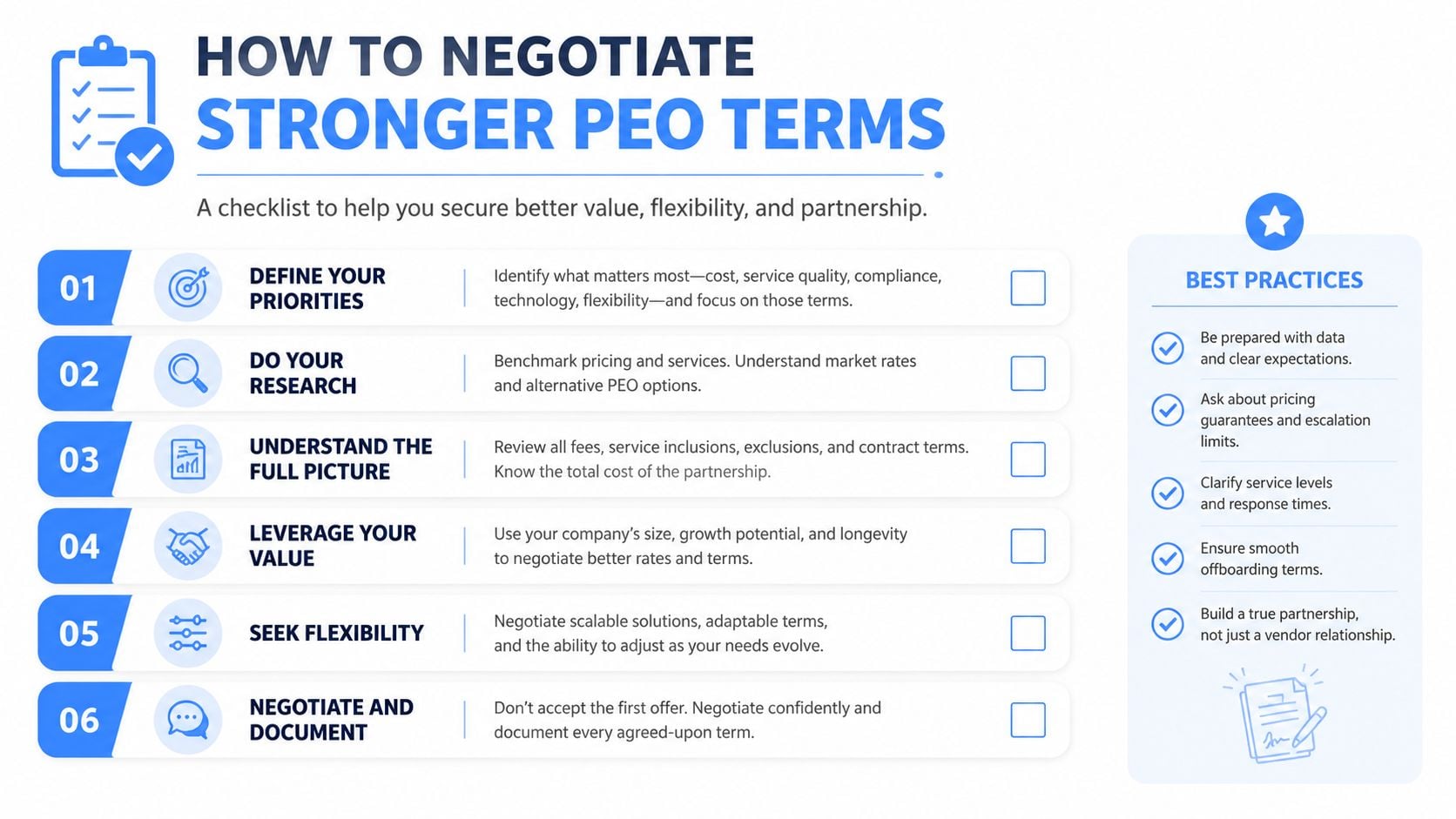
The first proposal rarely reflects the strongest available terms. Buyers gain strength by converting general preferences into specific contractual requests, then asking each provider to respond in writing. “Transparent pricing” isn't a sufficient commitment. The agreement should identify the fee base, pass-through charges, renewal mechanics, implementation costs, and circumstances that permit repricing.
Start with a documented baseline
Before negotiations, finance and HR should gather the current payroll cost, benefits spend, workers' compensation arrangements, internal administration time, compliance support costs, and known service failures. The baseline should distinguish costs the PEO would replace from costs that would remain after implementation.
The current contract also deserves a close review if the company already uses a provider. Important triggers include auto-renewal, minimum terms, notice periods, termination fees, underwriting changes, liability exclusions, and requirements for transferring employee or claims records.
Negotiation principle: A concession isn't valuable unless the company can measure it, use it, and enforce it.
Put these terms on the table
- Rate lock: Request protection against unexpected fee increases during the initial term and define which charges are excluded from the lock.
- Implementation credits: Ask the provider to offset documented conversion work, employee communications, data migration, or parallel payroll testing.
- Service-level commitments: Specify response times, escalation paths, payroll correction procedures, and remedies for recurring service failures.
- Data-exit provisions: Require ownership and timely delivery of payroll, benefits, claims, tax, and employee records in a usable format.
- Renewal protections: Set notice requirements for price changes and give the company enough time to evaluate alternatives before renewal.
- Liability language: Identify which party handles taxes, filings, claims, notices, penalties, and errors, rather than relying on broad co-employment wording.
The buyer should ask for sample reports and a transition plan before signing. A provider that promises easy conversion should be able to explain who supplies the data, how records are formatted, what employees experience, and which tasks the client must complete.
Negotiation style also affects the result. Some buyers lead with cost, while others emphasize implementation risk, service quality, or legal allocation. Reviewing PEO negotiation personality types can help a leadership team choose a negotiation approach that matches its priorities and influence.
PEO Metrics is one option for employers that need independent comparison support. It reviews provider pricing, benefits, service models, contract terms, compliance support, industry fit, and potential risks, then presents side-by-side options and negotiation considerations without charging the buyer.
Making a Confident PEO Decision
A PEO can be a strong operating partner or an expensive constraint. The benefits are clearest when the company needs broader benefits access, coordinated compliance support, and scalable HR administration. The drawbacks become more serious when leadership needs carrier flexibility, customized programs, direct administrative control, or a clean path back to an internal model.
Before signing or renewing, the decision team should document three things: what the PEO will improve, what control the company will surrender, and how the company will exit. It should verify CPEO status where relevant, negotiate rate and renewal protections, and require usable data-transfer terms. The right decision isn't unconditional acceptance or rejection. It's a contract-backed judgment that the operational value justifies the constraints.
PEO Metrics helps HR, finance, and leadership teams compare PEO providers, benchmark costs, identify contract risks, and negotiate terms such as rate locks, implementation credits, service guarantees, and renewal protections. Visit PEO Metrics to evaluate the options before signing a new agreement or renewing an existing one.
