
A professional employer organization (PEO) is a co-employment partner that shares employer responsibilities with your company, typically handling payroll, benefits administration, workers' compensation, HR support, and compliance while you retain day-to-day operational control. In the United States, PEOs support more than 200,000 small and mid-sized businesses and roughly 4.5 million jobs, according to NAPEO's industry materials.
A 50-person company often reaches the same breaking point. The founder spends hours each week fixing payroll errors, resolving benefits enrollment problems, and tracking employment paperwork instead of selling, hiring, or running the operation. A PEO can remove much of that administrative load, but it doesn't take the company's employer obligations off the table. The contract changes who handles specific tasks, not who controls the business or who must prevent workplace problems.
Table of Contents
- What a Professional Employer Organization Actually Is
- How Co-Employment Works in Practice
- Core Services a PEO Provides
- PEO vs ASO vs Payroll Provider vs Broker
- How PEO Pricing Models Work
- Real Pros and Cons of Using a PEO
- Who Should Use a PEO and Who Should Not
- How to Evaluate and Negotiate a PEO Contract
What a Professional Employer Organization Actually Is
A professional employer organization is a company that enters into a contractual co-employment relationship with another business. The PEO typically manages payroll, benefits administration, workers' compensation, HR support, and compliance services, while the client company continues to run its workforce and business.
Washington's regulatory definition describes a PEO as an organization that provides professional employer services to client employers in a co-employment relationship. Those services can include human resources, risk management, payroll administration, and unemployment insurance functions, as outlined in Washington's professional employer organization regulation.
The arrangement isn't staffing. A staffing agency recruits or supplies workers and generally controls the employment assignment. A PEO doesn't take over the company's operations, customer relationships, product decisions, or workforce strategy. It also isn't merely a software vendor that processes paychecks after the client has made every tax and compliance decision.
The basic operating arrangement
The PEO and client company divide employer responsibilities through a service agreement. The PEO commonly handles administrative and tax-related functions, while the client retains control over:
- Hiring decisions: The client decides whom to recruit, promote, discipline, and terminate.
- Daily management: Managers assign work, set schedules, supervise performance, and establish priorities.
- Business strategy: The client controls pricing, customers, products, locations, and operating methods.
- Workplace culture: The client remains responsible for how employees experience the workplace.
The PEO may become the employer for certain administrative or federal employment-tax purposes, but that status has limits. The client still needs competent managers, accurate time records, sound classification decisions, and enforceable workplace policies.
Practical rule: A PEO should reduce administrative friction, not become an excuse for managers to stop owning employment decisions.
Companies evaluating the model can use the HR Management 365 blog for broader HR management context, then review the operational responsibilities described in what a PEO does. The most important question isn't whether the PEO “handles HR.” It's which HR tasks the contract assigns to the PEO, which remain with the client, and what happens when either side misses a required action.
How Co-Employment Works in Practice
Co-employment creates two employers with different responsibilities over the same workforce. The PEO usually owns the administrative infrastructure, while the client employer owns the operating relationship with employees.
For a 100-employee technology company, the split might look like this:
| Responsibility | PEO typically handles | Client company retains |
|---|---|---|
| Payroll | Payroll processing, deductions, tax administration, and required filings covered by the agreement | Accurate hours, compensation data, approvals, and timely submission |
| Benefits | Plan administration, enrollment support, carrier coordination, and employee questions | Selecting desired plan options, communicating workplace expectations, and approving eligibility information |
| Workers' compensation | Policy administration, claims coordination, and safety support | Safe working conditions, incident reporting, and management follow-through |
| HR compliance | Guidance, policy templates, required administrative processes, and compliance support | Applying policies, managing employees, documenting decisions, and correcting workplace practices |
| Daily employment | Administrative employer functions | Hiring, supervision, scheduling, performance management, and termination decisions |
A PEO arrangement doesn't erase liability. Nebraska's labor guidance on PEOs explains the practical boundary: co-employment can divide responsibilities, but the client maintains operational control. Wage-and-hour violations, worker misclassification, inaccurate timekeeping, unsafe conditions, or poor disciplinary decisions can still create exposure for the client, the PEO, or both.
A realistic liability example
Suppose a supervisor classifies a group of field technicians as exempt even though their actual duties and pay practices don't support that classification. The PEO may provide classification guidance and payroll administration, but the client created the job structure and directed the work. A contract may allocate defense or indemnification responsibilities, yet that allocation won't automatically prevent a claim, investigation, or employee dispute.
The same principle applies to safety. A PEO may administer workers' compensation and offer safety resources, but the client controls the physical workplace. If managers ignore a known hazard, the client can't argue that outsourcing HR eliminated its duty to operate safely.
A buyer should read the service agreement as a responsibility map. The agreement should identify who files, who approves, who supplies the underlying data, who pays penalties caused by an error, and how the parties cooperate when an agency or employee raises a complaint. A detailed explanation of the legal structure appears in PEO co-employment.
Core Services a PEO Provides
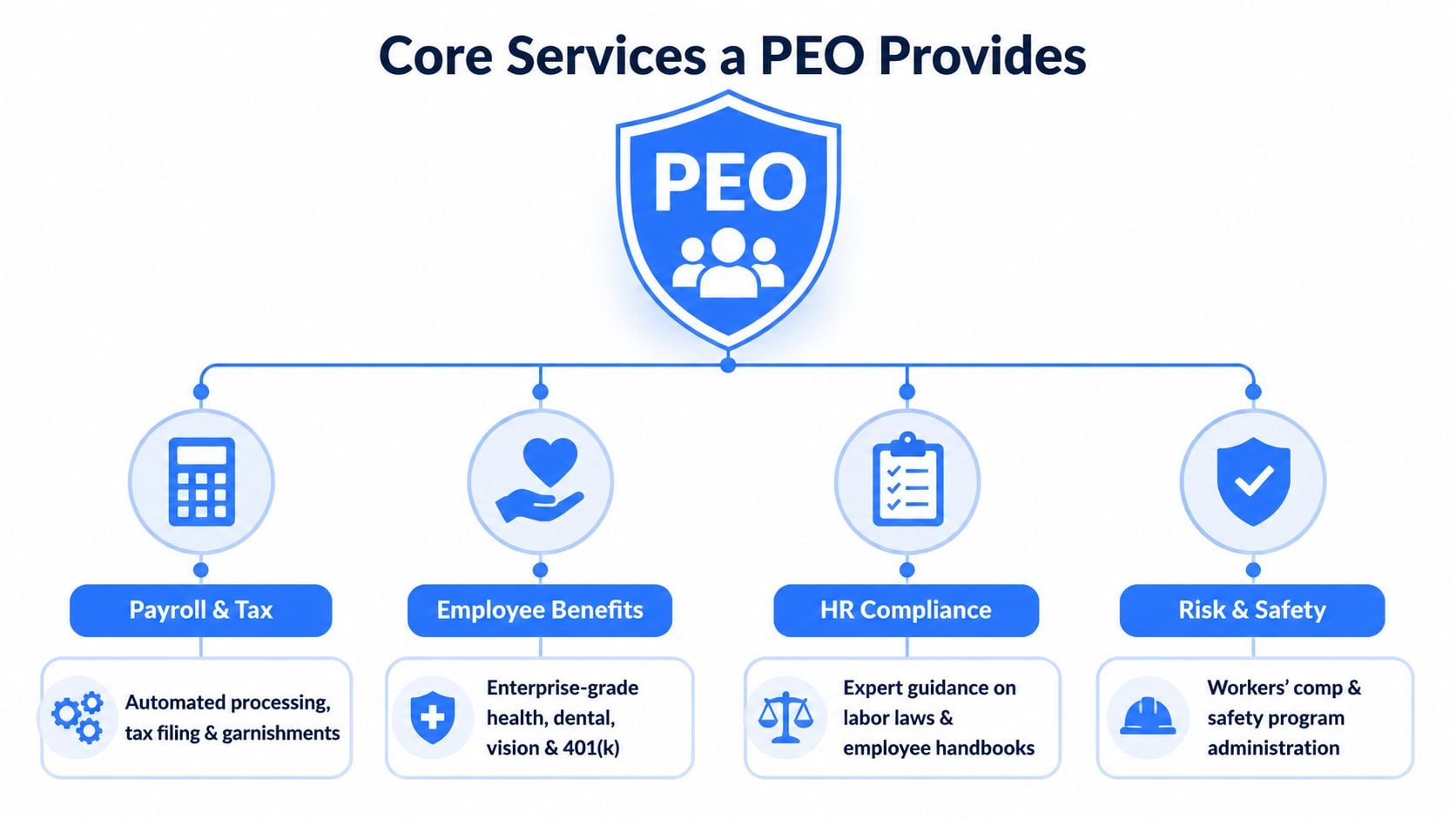
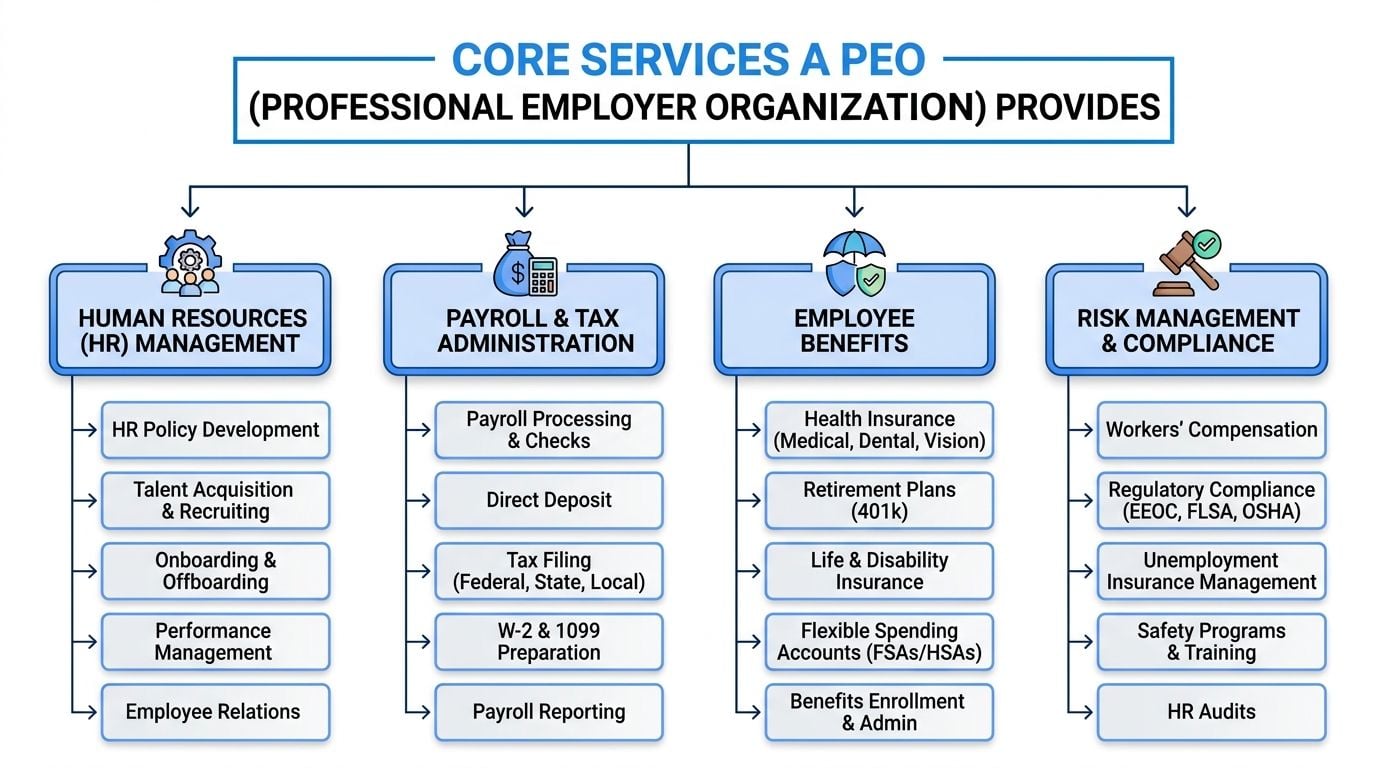
A PEO sells an operating system for employment administration, not just payroll software. The value depends on how well its specialists, processes, insurance arrangements, and technology work together.
Payroll and employment taxes
The PEO collects payroll information, calculates wages and deductions, processes payments, and handles tax filings covered by the agreement. The client still must submit accurate hours, bonuses, commissions, new-hire data, terminations, and compensation changes.
A certified professional employer organization, or CPEO, has applied for and received certification from the IRS. The IRS CPEO overview explains that a PEO agreement can cover some or all federal employment tax withholding, reporting, and payment functions. CPEO status matters because it changes federal employment tax consequences for the PEO and its customers. It doesn't certify the quality of every HR service in the contract.
Benefits administration
The PEO may provide access to health, dental, vision, retirement, and other benefit programs through its broader client base. A 30-person employer may gain access to benefit structures that would be difficult to arrange independently, but the trade-off is reduced freedom to choose every carrier, plan design, enrollment rule, and renewal strategy.
Benefits should be evaluated as a total package. The quote needs to show employee premiums, employer contributions, plan options, network limitations, renewal mechanics, and administrative fees. A lower administrative rate can be irrelevant if the available plans fit employees poorly or renew unpredictably.
Workers' compensation and risk
PEOs commonly administer workers' compensation coverage, claims coordination, safety programs, and risk-management support. The client still needs to report incidents promptly, enforce safety procedures, train managers, and correct hazards.
Risk transfer is never absolute. A contract can assign administrative duties and define indemnification, but it can't make unsafe conduct disappear. Buyers should check how claims affect pricing, whether the PEO can change program terms, and what the client owes after termination.
HR support and compliance
HR specialists may help with handbooks, employee relations, leave administration, onboarding, investigations, and employment-law questions. The quality of that support depends on response times, assigned personnel, escalation procedures, and the boundaries of the service package.
The PEO services overview provides a useful way to organize these service categories. Before signing, the buyer should convert every promised service into a written deliverable with an owner, timing expectation, and remedy for repeated failure.
For federal employment taxes, the IRS guidance for CPEO customers states that a CPEO is generally treated as the employer of covered employees for remuneration it pays and is generally solely liable for employment taxes, returns, deposits, and payments on those wages. That specific federal treatment should not be confused with a blanket transfer of all employment responsibility.
PEO vs ASO vs Payroll Provider vs Broker
The right choice depends on the problem the company is paying to solve. A finance team that needs cleaner payroll doesn't necessarily need co-employment. An employer facing multi-state compliance, benefits access, and workers' compensation administration may need more than a payroll platform.
| Feature | PEO | ASO | Payroll Provider | HR Broker |
|---|---|---|---|---|
| Employment relationship | Shared co-employment relationship | Client remains the sole employer | Client remains the employer | Client remains the employer |
| Payroll and tax work | Typically included under the agreement | Often included, with responsibilities retained by the client | Core service | Usually limited or referred out |
| Benefits | May provide access to broader plan options and administer enrollment | Client generally selects and sponsors its own plans | May offer integrations or limited administration | Sources and advises on benefits |
| Compliance support | HR guidance, policy support, risk services, and administrative help | HR support without co-employment | Narrower payroll-focused support | Benefits-focused guidance |
| Workers' compensation | Often administered through the PEO arrangement | Client typically arranges coverage separately | Usually outside the core service | May place coverage, but doesn't manage HR operations |
| Cost structure | Administrative fees plus pass-through employment costs | Service fees plus client-managed costs | Payroll fees and add-ons | Commissions, fees, or carrier compensation |
| Best fit | Employers seeking integrated HR, benefits, payroll, and risk support | Employers wanting HR help while retaining employment structure | Employers mainly needing payroll processing | Employers mainly needing benefits strategy |
An ASO can suit a company with an established benefits program and internal ownership of compliance. A payroll provider can be sufficient when the primary issue is processing accuracy and tax administration. A broker can help compare insurance products but won't usually manage the company's entire employment infrastructure.
The cheapest vendor is often the wrong comparison if the actual problem is fragmented ownership.
Decision-makers considering broader outsourced human resources should first document the current gaps. If managers need payroll software, buy payroll software. If the company needs benefits access, multi-state HR support, workers' compensation administration, and coordinated compliance ownership, a PEO deserves serious consideration.
How PEO Pricing Models Work
PEO pricing usually appears in one of two forms: a per-employee-per-month administrative fee or a percentage of payroll. The headline format matters less than the total cost after benefits, workers' compensation, retirement contributions, implementation charges, tax services, and optional HR support are included.
A per-employee fee makes budgeting easier when payroll varies. A percentage-of-payroll fee may rise with salary increases, bonuses, commissions, and overtime even when the PEO's administrative workload changes little.
What a proposal should separate
A useful proposal breaks costs into distinct lines:
- Administrative fee: Payroll, HR support, technology, compliance services, and stated account management.
- Benefits premiums: Health, dental, vision, life, disability, or other elected coverage.
- Workers' compensation: Premiums, fees, assessments, and any claims-related charges.
- Retirement costs: Employer contributions, recordkeeping charges, and plan expenses.
- Implementation charges: Setup, data conversion, onboarding, and training.
- Optional services: Recruiting, advanced reporting, investigations, consulting, or specialized compliance work.
A 20-person company and a 200-person company shouldn't evaluate proposals using the same assumptions. Small employers may value access to benefits and specialist support more heavily, while larger employers may focus on pricing tiers, service capacity, claims experience, data integrations, and the ability to retain strategic HR control.
The pricing traps that matter
Teaser rates can increase after the initial term. A contract may exclude compliance consulting, charge separately for implementation, or impose administrative fees on items the buyer assumed were included. Workers' compensation pricing can also introduce volatility through class codes, payroll changes, experience factors, claims treatment, and renewal adjustments.
The PEO cost guide can help frame the evaluation, but every quote should be normalized. CFOs should request a full-year comparison using actual payroll, workforce locations, benefits elections, workers' compensation classes, expected hiring, and historical claims information. A rate is useful only when the scope behind it is identical across proposals.
Real Pros and Cons of Using a PEO
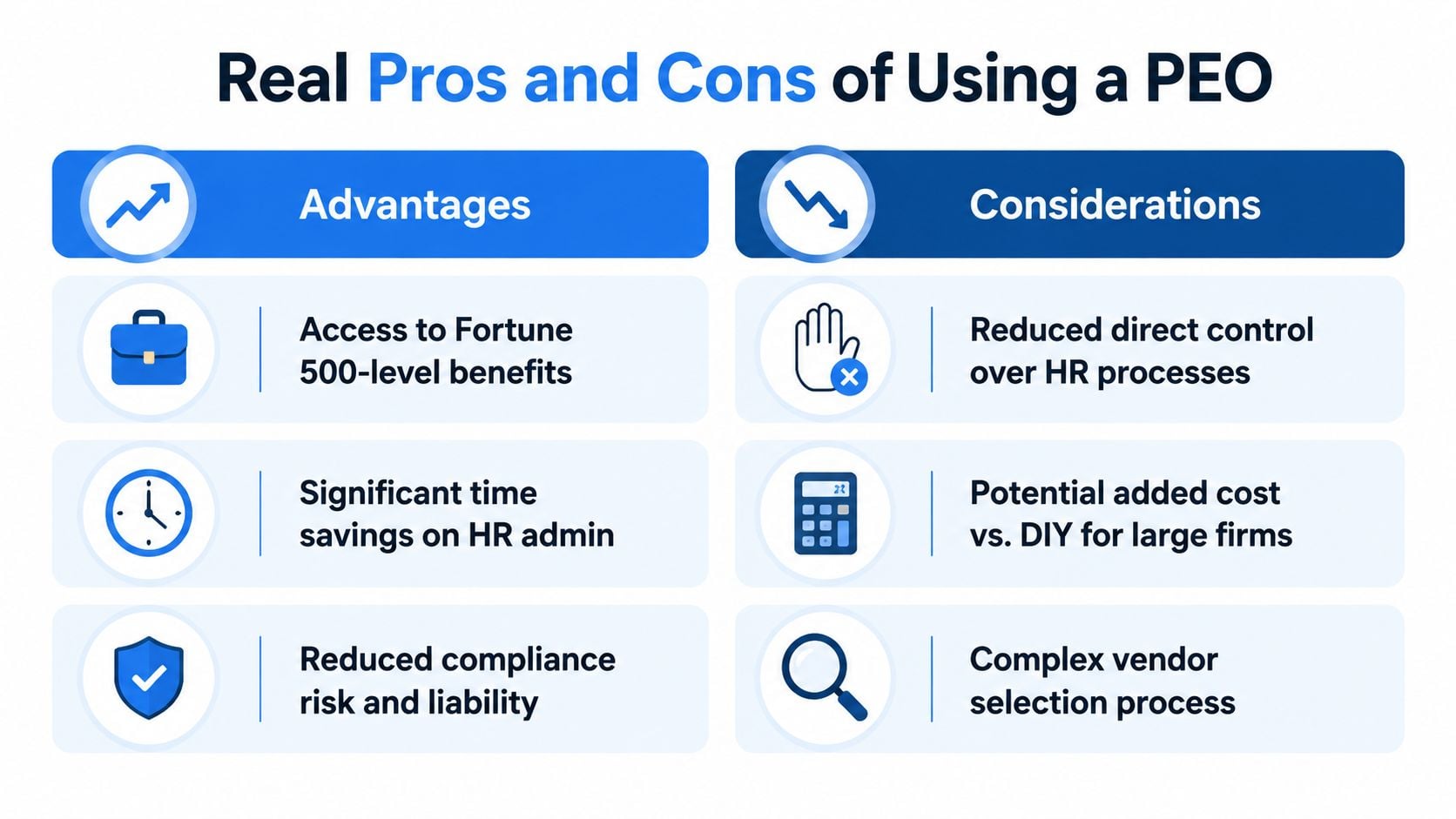
A PEO can be a strong operating decision, but it isn't automatically a cost-saving decision. The financial case depends on benefits pricing, administrative efficiency, workers' compensation terms, internal staffing, and the quality of the provider's service.
Where the model creates value
A PEO can give a smaller employer access to broader benefits infrastructure and experienced HR support. It can also reduce the number of separate vendors responsible for payroll, benefits administration, workers' compensation, and compliance workflows.
For an HR team handling employee questions, enrollment corrections, policy updates, and payroll escalations without dedicated specialists, outsourcing can release meaningful management capacity. The benefit isn't just fewer tasks. Better ownership can reduce missed deadlines, inconsistent processes, and reactive compliance work.
CPEO status can also provide a defined federal employment-tax framework. The IRS explanation of CPEO certification makes clear that certification is a technical designation with requirements and tax consequences, not a general endorsement of a provider's service quality.
Where the model causes friction
The client gives up some control over administrative processes. Employees may need to use the PEO's portal, follow its enrollment calendar, accept its benefit menu, or work through a service center rather than a familiar internal HR contact.
Contract lock-in is another concern. A company may face notice deadlines, implementation charges, data-transfer obligations, benefit disruption, or payroll transition work when it leaves. Renewal increases can undermine the original business case if the agreement doesn't provide pricing protection or a clear exit process.
A PEO relationship should be judged at renewal, not just at implementation.
Service quality can also vary by assigned team. A technically capable provider may still frustrate managers if payroll questions take too long, HR advice arrives without context, or the client repeatedly gets transferred between departments. Buyers should request service-level commitments, escalation paths, reporting access, and named responsibilities before treating a sales presentation as an operating plan.
Who Should Use a PEO and Who Should Not
A PEO generally fits employers that need more infrastructure than a payroll vendor provides but aren't ready to build every HR, benefits, compliance, and risk function internally. The strongest candidates often have a growing workforce, limited specialist coverage, or employees working across multiple jurisdictions.
Industry adoption confirms that PEOs aren't an edge-case solution. NAPEO reports 523 PEOs in the United States at the end of 2022, compared with 487 at the end of 2020, in its industry footprint report. The same source reports that worksite employment has grown at a compounded annual rate of about 7.5% since 2008, and that PEO clients represented 15.3% of U.S. employers with 10 to 99 employees in 2020. NAPEO's current overview also says about 14% of employers with 20 to 499 employees use a PEO.
A strong candidate
A company should seriously explore a PEO when several of these conditions apply:
- Limited HR depth: Managers are handling compliance questions without dedicated employment-law or HR operations expertise.
- Multi-state employment: The company needs consistent payroll, benefits, and HR administration across different jurisdictions.
- Benefits pressure: Recruiting depends on offering competitive coverage that the company struggles to source independently.
- Administrative overload: Payroll, onboarding, leave tracking, claims, and employee records consume leadership or HR capacity.
- Rapid change: Hiring, expansion, or distributed work is making the current process fragile.
The model can work for companies from small-business scale through the mid-market, but employee count alone shouldn't drive the decision.
A poor candidate
A mature HR organization may already have the systems, specialists, benefits negotiation power, and internal controls a PEO would provide. A larger employer may also negotiate directly with carriers and vendors, preserve more control, and avoid paying for bundled services it doesn't need.
A company with highly specialized workforce requirements may find a generalist PEO too restrictive. An employer preparing for an acquisition, divestiture, or complex ownership change should also examine whether co-employment records, benefits transitions, and exit obligations could complicate diligence or integration.
The latest NAPEO survey says 71.0% of PEO respondents expected moderate growth in worksite employees over the next 12 months, as reported in NAPEO's 2026 survey release. That growth signals an expanding category, not proof that every buyer should join it. The correct test is whether the PEO's bundled services solve expensive operational problems without weakening control the company still needs.
How to Evaluate and Negotiate a PEO Contract
A disciplined evaluation starts before a provider sends a proposal. The buyer should gather payroll registers, employee locations, benefit elections, workers' compensation classifications, claims information, current vendor invoices, and the existing agreement if the company is switching or renewing.
The contract review should answer five questions:
- Who owns each task? Look for explicit responsibility for filings, notices, claims, employee records, investigations, and compliance updates.
- What happens after an error? Review indemnification, defense obligations, penalties, correction costs, and cooperation requirements.
- How does pricing change? Request rate locks, renewal protections, pass-through definitions, and written limits on discretionary increases.
- How does the company leave? Check notice periods, implementation fees, data export rights, benefit transition responsibilities, and post-termination obligations.
- What service level is enforceable? Ask for response commitments, escalation procedures, reporting access, and remedies for repeated failures.
CPEO verification should be part of due diligence. The IRS CPEO public listings show which organizations hold certification, and the IRS states that certification remains in effect until revoked or voluntarily terminated. Buyers should still evaluate financial strength, service staffing, technology, benefits, workers' compensation structure, and contract language separately.
The IRS application requirements include an online application, a $1,000 user fee, a physical U.S. business location, CPA-prepared financial statements, and identity verification, as described in the CPEO application requirements. Applicants must also provide a surety bond equal to 5% of section 3511 liability, subject to a $50,000 minimum and $1,000,000 maximum, according to IRS CPEO guidance. Those requirements help explain why certification deserves verification, but they don't replace commercial diligence.
PEO Metrics helps HR, finance, and leadership teams compare PEOs, ASOs, payroll providers, and brokers using pricing, benefits, service quality, compliance support, and contract terms. Companies can visit PEO Metrics to benchmark proposals, identify exit and renewal risks, and negotiate protections such as rate locks, implementation credits, service guarantees, and renewal terms before signing.
