
The incumbent PEO's renewal notice just arrived. Payroll is stable enough to make a change feel dangerous, benefits costs are rising, and the sales team from a competing provider is promising a cleaner experience. Meanwhile, the current provider is asking for a signature before anyone has reviewed the termination clause, data-export language, or renewal deadline.
That's the trap. Switching service providers isn't primarily a payroll exercise. It's a strategic exercise that becomes an operational project once the decision is made. HR directors, CFOs, and owners at companies with 10 to 2,000 employees should negotiate the incumbent relationship and design the implementation plan as one integrated playbook.
Table of Contents
- Why Switching Service Providers Makes Strategic Sense
- When Switching Actually Beats Staying Put
- Contract Exit Flags That Decide Whether You Can Leave Cleanly
- Data Migration and Benefits Continuity Without a Payroll Disaster
- Should You Switch or Renegotiate
- Negotiation Levers That Capture Most of the Value
- A 90-Day Playbook From Decision to First Payroll
Why Switching Service Providers Makes Strategic Sense
An employer can spend weeks moving employee records, configuring deductions, and testing payroll, yet still miss the largest source of value. The strongest results usually come earlier. Once the incumbent sees a credible alternative, it must either improve the commercial terms or risk losing the account.
Treat the negotiation and implementation plan as one playbook. Before asking for better pricing, review auto-renewal language, notice deadlines, rate-reset provisions, and transition obligations. Those terms determine whether the employer can leave without avoidable fees or an inconvenient termination date. They also shape the realistic go-live schedule, data requirements, and support the new provider must deliver.
A Canadian broadband study shows why dissatisfaction does not automatically produce a provider change. Fifty-eight percent of Internet subscribers had considered switching providers in the previous two years, but only 17% switched during that period, according to the Canadian broadband switching report. The report also found that 91% of households still purchased service from major facilities-based providers, while 68% of switches stayed within that major-provider group. Friction limits action even when customers want something different.
Practical rule: Treat a provider change as one commercial and operational decision. The exit clause, negotiation position, data plan, testing schedule, and go-live date must support the same outcome.
A disciplined review should answer four questions:
- Should the employer switch at all? Renegotiation may capture much of the available value with less disruption.
- Can the employer leave cleanly? The contract may require specific notice, cooperation, conversion work, or data access.
- Can payroll and benefits move safely? Parallel testing, reconciliation, and carrier coordination protect continuity.
- What must the new provider concede? Price is only one lever. Exit flexibility, implementation support, audit rights, and service accountability may matter more.
For context on the broader PEO decision, review why companies use a PEO. Apply that same discipline when deciding whether an existing provider still deserves the account.
When Switching Actually Beats Staying Put
Switching earns its disruption when the incumbent has created a structural problem, not merely an irritating one. A one-off service mistake can be corrected. Persistent fee expansion, repeated payroll failures, weak escalation, or a contract that blocks reasonable flexibility should trigger a formal alternatives review.
The first screen is financial. An annual per-employee cost increase above 4% to 6% deserves an explanation, especially when headcount hasn't grown at the same pace. Benefits administration pass-through charges, separate reporting fees, tax filing fees, and administrative charges can expand the total bill. A 300-employee employer absorbing $80,000 a year in avoidable fees isn't facing a minor pricing dispute. It has a business case for replacement, provided the contract exit cost and implementation burden don't consume the savings.
Service quality is the second screen. Response times that regularly exceed 48 hours, recurring payroll errors, unresolved tax notices, or an account manager who changes every quarter point to an operating model problem. A benefits renewal that rises 18% without a competitive quote also warrants escalation. The employer should demand the underwriting basis, market alternatives, carrier options, and a written explanation of what the provider did to control the increase.
A decision tree for HR and finance
The decision process should be simple enough to run in a leadership meeting:
- Quantify the gap. Compare current invoices, benefits costs, implementation charges, and expected renewals against credible alternatives.
- Separate fixable issues from structural ones. A pricing error may be fixable. Missing data access, weak compliance ownership, and punitive termination terms are harder to repair.
- Test the contract clock. Identify the notice deadline, renewal date, termination mechanics, and any post-termination charges.
- Request a cure plan. Give the incumbent a defined list of commercial and service requirements.
- Run an alternative process in parallel. A credible competitor protects the employer from negotiating without a strong position.
- Choose based on net value. Savings must be reduced by exit costs, implementation effort, employee disruption, and ongoing risk.
| Trigger Category | Warning Sign | Recommended Action |
|---|---|---|
| Cost | Per-employee pricing rises faster than the business can justify | Build a full-cost benchmark and request a rate lock |
| Benefits | Renewal jumps without competitive carrier analysis | Demand underwriting detail and competing options |
| Service | Payroll errors or response times above 48 hours | Document incidents and issue a formal cure request |
| Contract | Broad auto-renewal or opaque benchmark language | Obtain legal review before the notice window closes |
| Relationship | Account ownership rotates constantly | Escalate to an executive sponsor and evaluate alternatives |
A detailed review of the employer's HR outsourcing and benefits options can help separate headline pricing from the service and benefits terms that drive risk.
Contract Exit Flags That Decide Whether You Can Leave Cleanly
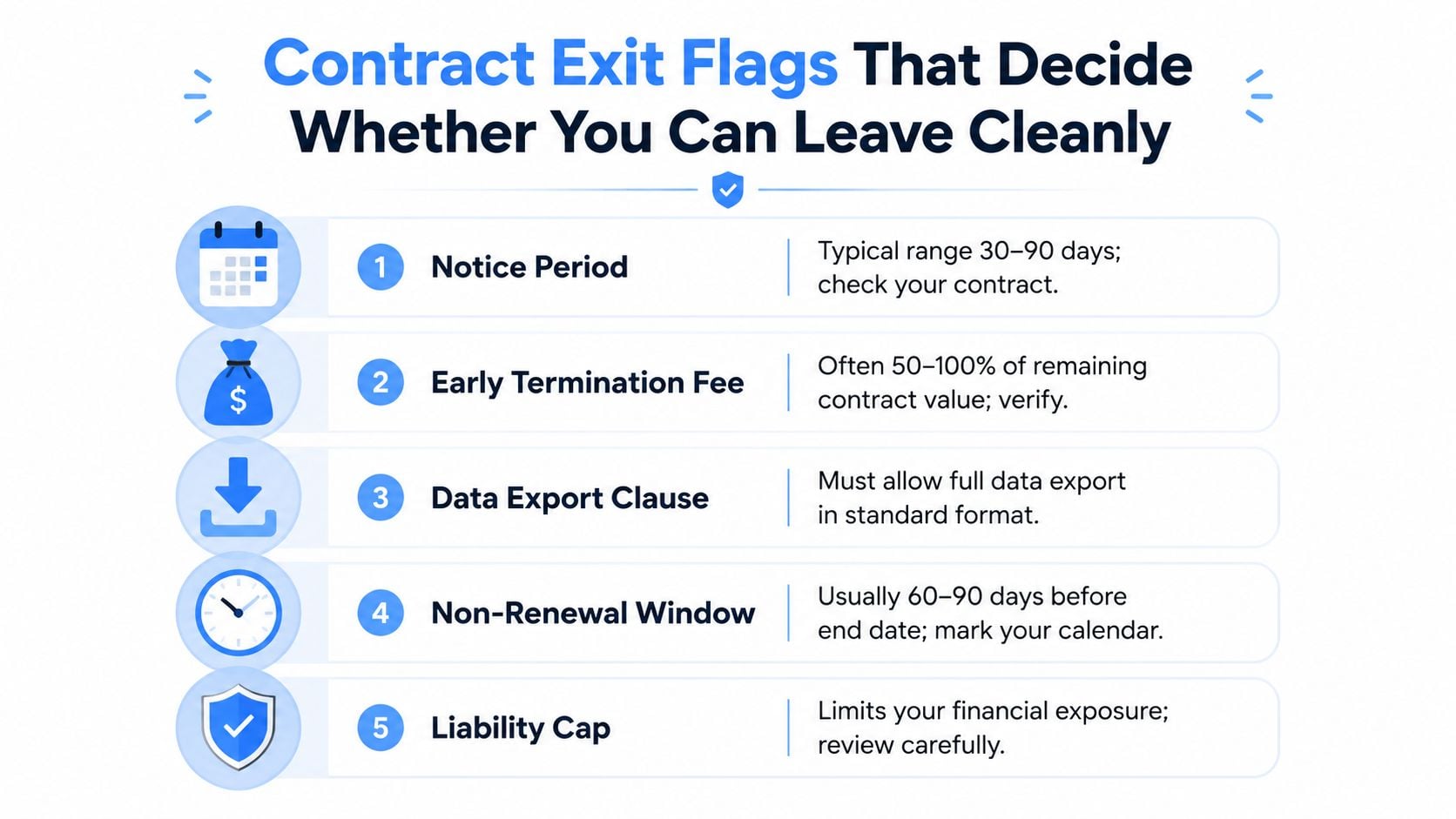
The contract decides whether switching is a controlled project or an expensive emergency. Before a provider is challenged or a competitor receives sensitive data, the employer should create a clause-by-clause exit schedule. The schedule should identify the relevant date, required notice, financial exposure, responsible owner, and evidence needed to support termination.
Independent PEO contract guidance commonly places notice requirements at 30 to 90 days, sometimes tied to a payroll cycle, as described in this PEO contract review guidance. Other agreements may require a longer non-renewal window. The plan notes often seen in the market, including 60 to 180 days before renewal, must never replace the actual contract language. The signed agreement controls.
Clauses that deserve an immediate review
Notice and renewal. Find the exact deadline and determine whether notice must arrive by a particular date, through a particular channel, or from a named executive. A late notice can trigger another term, continued fees, or a dispute over the effective termination date.
Termination for convenience. This clause permits exit without proving provider misconduct, but it may require advance notice or payment. Termination for cause is more powerful only when the contract defines cause clearly and the employer has documented failures.
Service-level commitments. A service promise without incident records has limited practical value. HR should retain payroll error logs, ticket histories, missed deadlines, tax correspondence, and escalation records. If the agreement requires a cure period, the employer must follow it precisely.
Data portability and transition assistance. The contract should require complete exports in usable formats, cooperation with the incoming provider, access to historical payroll and tax records, and named contacts during the handoff. Vague language gives the incumbent room to delay.
Conversion, non-solicit, and carrier provisions. Review employee conversion fees, benefit-carrier restrictions, non-solicitation terms, broker-of-record language, and obligations involving retirement or insurance relationships. These provisions can change the cost of moving even when the base termination clause looks manageable.
Liability and survival language. Indemnification, confidentiality, audit rights, tax responsibilities, and record-retention duties may survive termination. The employer should understand which obligations continue and for how long.
The financial model should show more than the new provider's quoted price. It should include remaining contract value, notice-period fees, conversion charges, data-transfer costs, legal review, internal project time, and any benefits disruption. Research on switching costs distinguishes procedural, financial, and relational costs, a framework discussed in the Ofcom technical report covering a switching tracker with 3,502 service decision-makers and related FCC findings that 36% of home Internet users had changed providers within the prior three years. The broader lesson is clear: switching costs include time and effort, not only termination fees. See the PEO exit strategy guidance before setting a target date.
Data Migration and Benefits Continuity Without a Payroll Disaster
A provider change becomes a payroll disaster when the team treats migration as a file handoff. Run it as a controlled reconciliation project instead. The incoming provider needs complete, clean, testable records, while the employer needs proof that payroll, tax, benefits, and employee balances will carry over correctly. The implementation plan should also strengthen the incumbent negotiation. A credible cutover schedule gives you a practical alternative if the current provider refuses needed concessions.
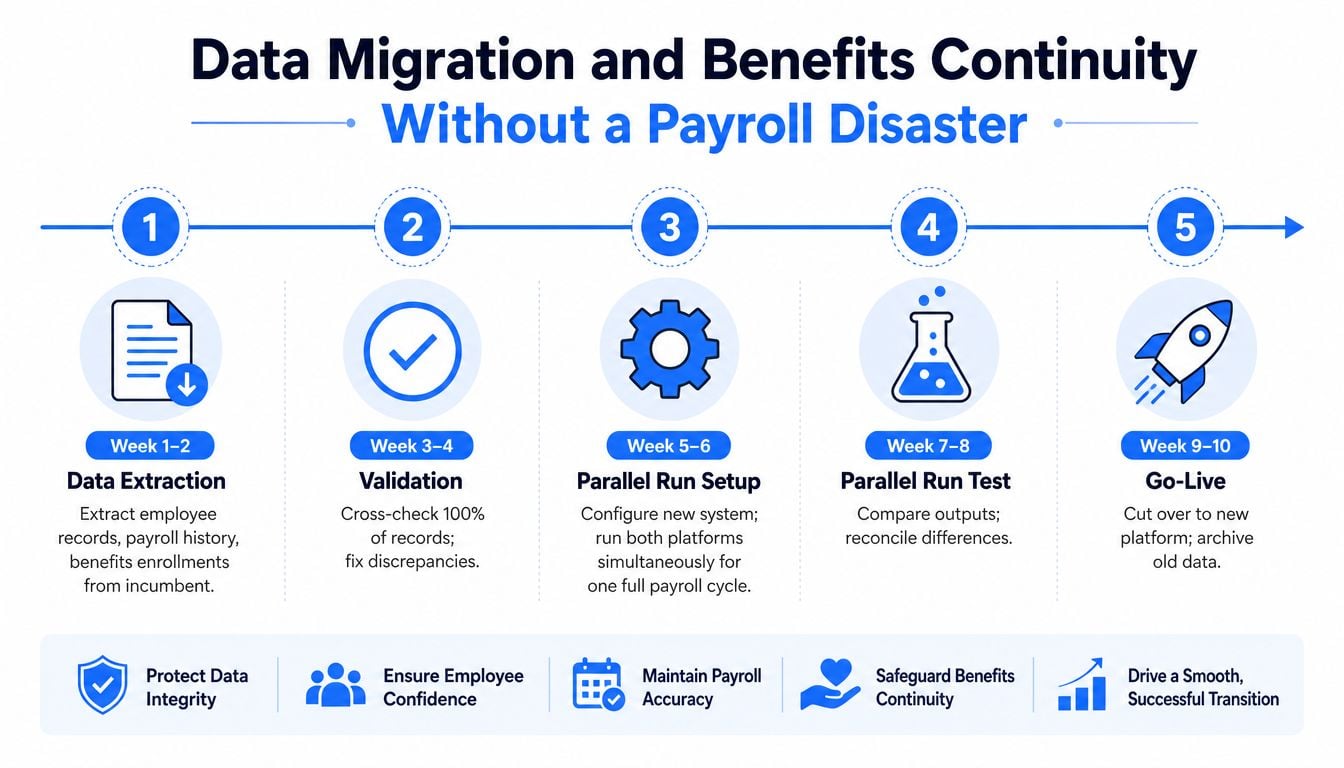
Extract the employee master file, pay rates, year-to-date earnings, deductions, direct-deposit details, tax records, benefits enrollments, accruals, garnishments, retirement data, and historical reports. Use this payroll vendor migration checklist to start three to four months before go-live, leaving time for cleanup, audit, testing, and parallel processing. A detailed data migration best practices guide can help structure the extraction and validation work.
The cutover schedule
- T-90: Complete the data audit. Reconcile the employee census, legal names, addresses, tax elections, pay rates, year-to-date totals, deductions, accrual balances, garnishment orders, retirement plan census, and prior-quarter tax filings.
- T-60: Configure the new platform and run test payrolls. Validate gross pay, deductions, employer taxes, tax jurisdictions, bank files, and reports.
- T-30: Give employees self-service access, verify elections, and review year-end W-2 responsibilities. Assign ownership for historical corrections and amended filings.
- T-7: Complete final reconciliation. Freeze approved data, confirm funding instructions, review carrier feeds, and obtain executive go-live approval.
- Day 1: Process the first live payroll on the new platform. Keep the project team available for same-day issue resolution.
Parallel payroll provides the clearest control. Run the old and new systems side by side for at least one payroll cycle, and extend the comparison when the data or payroll structure warrants it. Compare gross wages, deductions, tax filings, and bank files before retiring the old platform. The parallel payroll guidance provides a useful operating model.
Benefits continuity needs its own owner
Payroll and benefits may share a provider, but their failure points differ. Assign a benefits owner to confirm ERISA notices, Form 5500 responsibilities, FSA and HSA balances, COBRA administration handoff, carrier re-enrollment, eligibility files, effective dates, and employee communications. A late carrier feed can interrupt coverage even when payroll is accurate.
The employer should assign one accountable executive to payroll and another to benefits, even when one project manager coordinates both workstreams. For preparation, validation, and controlled handoffs, use our guide to calm data migration.
The project file should contain these artifacts:
- Employee census: Legal names, identifiers, addresses, work locations, tax elections, and employment status.
- Payroll history: Year-to-date earnings, tax withholdings, employer taxes, and prior payroll registers.
- Deduction register: Benefit deductions, loan repayments, garnishments, and recurring items.
- Accrual balances: Vacation, sick leave, paid time off, and policy-specific balances.
- Benefits records: Current elections, dependents, eligibility dates, FSA and HSA balances, and carrier identifiers.
- Retirement census: Participant data, contribution elections, loans, and plan contacts.
- Compliance records: Prior-quarter tax filings, notices, amended returns, and open cases.
Keep the old provider active until the first live payroll, benefit effective dates, and historical data access have all been verified. That control protects employees and preserves negotiating room if the cutover exposes a problem.
Should You Switch or Renegotiate
Switching and renegotiation aren't opposing philosophies. They're two outcomes of the same market test. An employer should build enough switching readiness to negotiate credibly, then switch only when the incumbent can't meet the required commercial and operational standard.
| Scenario | Switch | Renegotiate | Hybrid Lever |
|---|---|---|---|
| Service quality is persistently broken | Strong choice when failures affect payroll, tax, or employee trust | Useful only if the provider offers a specific cure plan | Present documented failures and a competing implementation schedule |
| Pricing is materially above market | Strong choice when savings remain after exit and implementation costs | Strong choice when service is sound and the gap is mainly price | Use competing proposals to demand rate relief and credits |
| Technology is obsolete | Usually preferable when integrations and reporting block growth | Viable if a funded upgrade has a firm delivery date | Require milestones, service guarantees, and an exit right |
| Contract terms are punitive | Consider switching after exposure is modeled | Seek amendments before renewal | Make revised exit terms a condition of staying |
| Acquisition or state expansion changes needs | Often necessary when the current model can't support the new footprint | Possible if the provider can demonstrate capability | Run both paths until compliance and implementation risks are proven |
| Institutional knowledge is valuable | Riskier if the provider is otherwise effective | Often preferable when the relationship works | Preserve the relationship only after securing commercial concessions |
A useful break-even test asks whether projected annual savings can recover switching friction, exit costs, implementation risk, and internal effort within an acceptable period. Independent research on service markets has found that switching costs can approach annual energy expenditure in some incumbent markets, while other service research identifies early-exit penalties and data-transfer fees as meaningful components of the total cost. The research on switching costs in service markets supports a disciplined view of the break-even threshold.
The credible alternative matters
Renegotiation works when the incumbent believes the employer can execute the alternative. A request for a discount without a timeline, data plan, or contract review sounds like a renewal tactic. A prepared transition plan changes the conversation.
The employer should put four variables into the decision model:
- Switching friction: Internal workload, employee communications, data complexity, and carrier coordination.
- Exit exposure: Notice obligations, remaining fees, conversion charges, and legal risk.
- Implementation risk: Payroll testing, benefits effective dates, tax setup, and escalation capacity.
- Projected value: Recurring savings, service improvement, reporting quality, and contract flexibility.
Technology and controls also deserve scrutiny. For employers reviewing security evidence during a provider comparison, a curated list of firms for SOC 2 audits can help explain what a credible assurance process should examine. The hybrid path remains the strongest default: negotiate with a real switch plan, and execute the switch if the incumbent's concessions fall short.
Negotiation Levers That Capture Most of the Value
Negotiation power is strongest before the letter of intent is signed. Once the provider has secured the account, implementation urgency can weaken the buyer's position. The commercial team should therefore negotiate the new agreement while the incumbent remains in play and the alternative remains executable.
Price matters, but buyers often focus too narrowly on the quoted rate. The agreement should address the total cost of ownership and the conditions that could expand it later.
Concessions worth putting in the term sheet
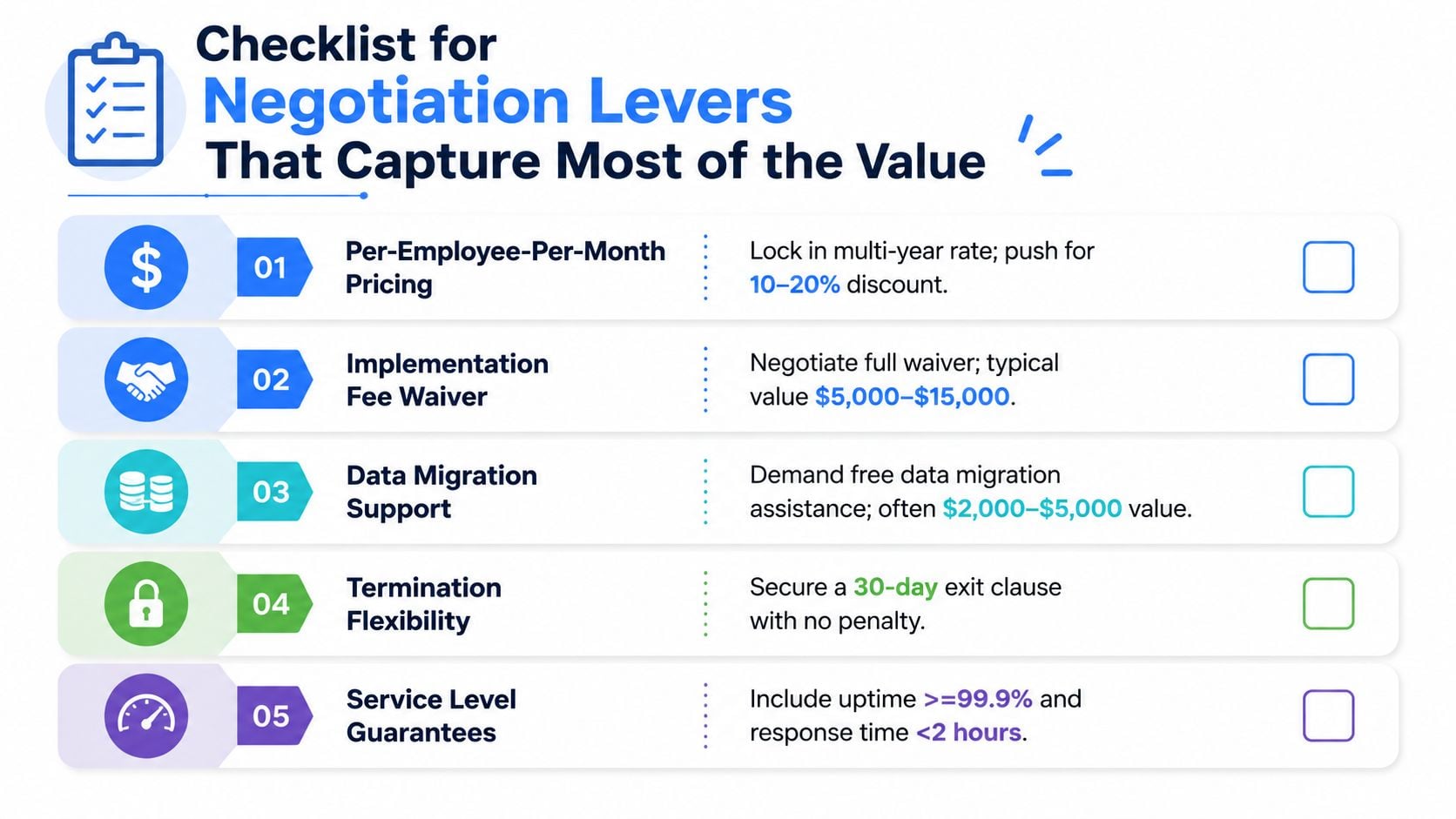
- Per-employee-per-month pricing: Request a multi-year rate lock, clear definitions for billable employees, and limits on unilateral fee changes.
- Implementation economics: Seek a full waiver or firm cap on implementation charges, along with credits if agreed milestones slip.
- Termination flexibility: Require termination for cause with defined service failures, cure periods, and a practical transition process.
- Audit rights: Secure access to tax filings, benefit billing, carrier reconciliations, and supporting records when the employer disputes a charge.
- Data portability: Require complete exports in standard, usable formats, with defined delivery deadlines and transition cooperation.
- Implementation ownership: Name a dedicated implementation manager and establish weekly status reporting during migration.
- Parallel-run protection: Ask for credits or included support for parallel payroll work, because the provider benefits from a controlled cutover too.
- Benefits stability: Address mid-year carrier rate changes, eligibility-file responsibilities, renewal transparency, and employee communication support.
Negotiation position: The new provider should share enough implementation risk to prove that the sales promise survives contact with payroll, benefits, and compliance data.
The final contract checklist should include price-lock duration, termination notice, transition assistance obligations, SOC 2 evidence, and a defined escalation path with named provider executives. A service-level promise should identify response expectations, ownership, remedies, and the evidence needed to invoke them. “Dedicated support” isn't a protection unless the agreement states who responds and what happens when the response fails.
The incumbent should receive a similarly specific proposal. That proposal can request fee reversals, rate protection, better escalation, expanded reporting, service credits, and revised exit terms. A useful framework for that conversation is PEO benefits negotiation leverage explained.
The buyer shouldn't accept a lower headline price in exchange for unlimited pass-through fees, weak data rights, or an automatic renewal mechanism that recreates the same problem. The best deal is the one that controls future exposure, not just the one that wins the first-year comparison.
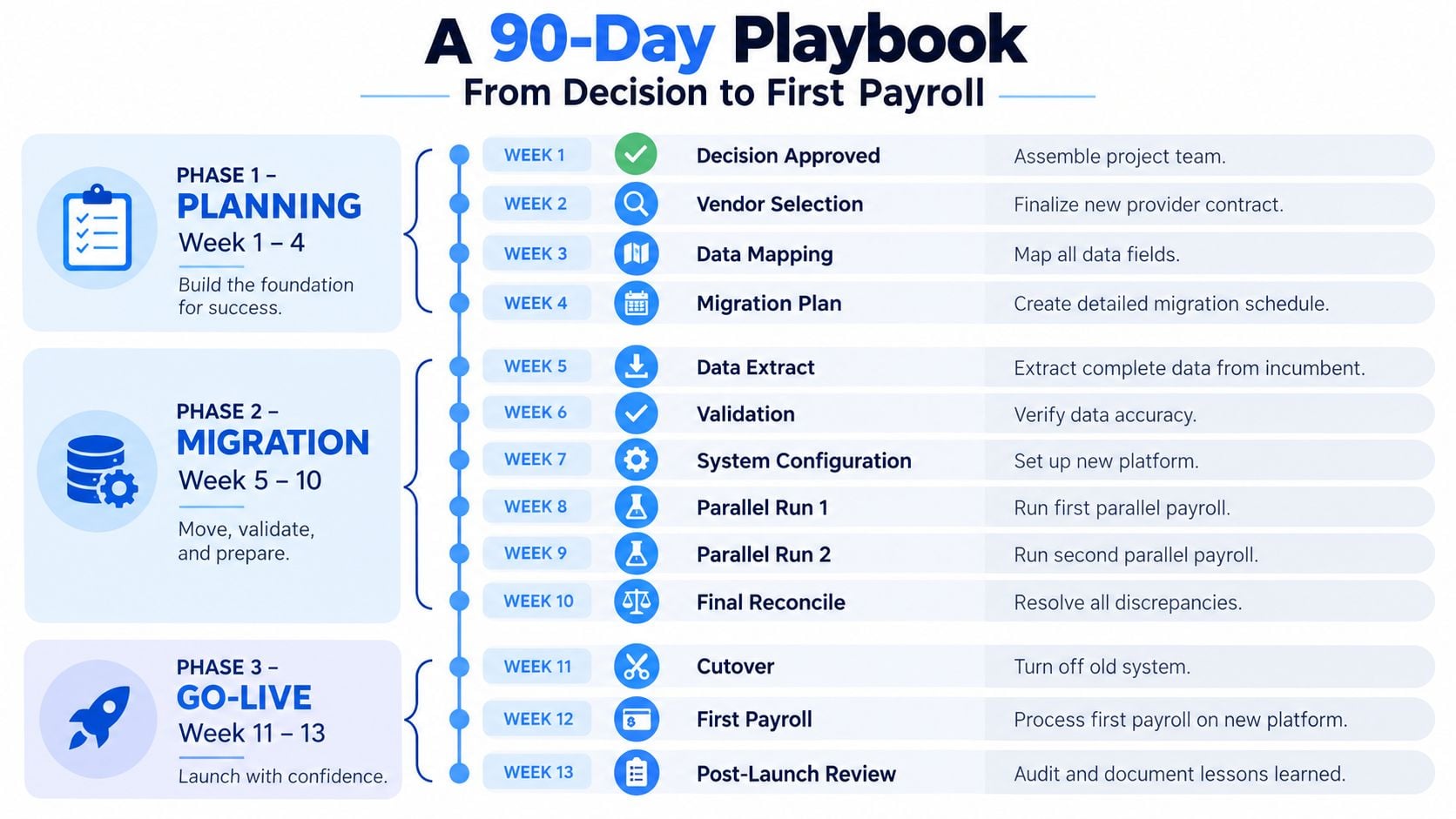
A 90-Day Playbook From Decision to First Payroll
A 90-day implementation works when each phase has one accountable owner and one tangible deliverable. The project manager can coordinate activity, but an executive must own the two checkpoints that create the most risk: the first parallel payroll and benefits effective-date alignment.
Weeks 1 through 2
The executive sponsor approves the switch, confirms the contract path, and appoints the project team. Procurement and legal finalize the vendor selection, review the agreement, send required notice to the incumbent, and secure written transition obligations.
The deliverable is a signed commercial package with a confirmed termination date, implementation plan, data request, escalation map, and decision log.
Weeks 3 through 6
HR and payroll lead the data audit. The incoming provider maps fields, validates employee records, configures payroll rules, and begins benefits carrier coordination. Finance should review funding, billing, tax jurisdictions, and reconciliation requirements rather than leaving those questions to the final week.
Employee communications should explain what changes, what remains the same, where employees will access information, and who handles questions. A payroll migration guide for replacing the current bookkeeper offers useful context for managing access, records, responsibilities, and handoff expectations during a provider change.
Weeks 7 through 10
The new platform runs test payrolls and then the first formal parallel payroll. The payroll executive owner must compare gross pay, deductions, taxes, net pay, bank files, reporting, and exception logs. Benefits leaders should verify enrollment files, effective dates, dependent records, COBRA responsibilities, and employee-facing confirmation.
No discrepancy should be waved through because the amount looks small. A small mismatch can reveal a faulty mapping rule that affects many employees.
Weeks 11 through 13
The team completes final reconciliation, confirms tax setup, freezes approved data, and conducts a go-live readiness review. Week 11 covers cutover, Week 12 covers the first live payroll, and Week 13 covers post-launch review, historical-data archiving, open-ticket ownership, and incumbent retirement.
Three conclusions should guide the next provider conversation:
- Treat the move as a key opportunity. A credible alternative improves the incumbent negotiation.
- Insist on parallel running. Payroll and benefits continuity require evidence, not assurances.
- Lock in exit concessions before signing. Data access, transition help, notice rights, and service remedies are difficult to win after implementation begins.
PEO Metrics helps HR, finance, and leadership teams compare PEOs, evaluate contract risks, and negotiate stronger pricing and transition terms without charging the buyer. Companies planning a provider change can visit PEO Metrics for an independent side-by-side review of costs, benefits, service models, and exit exposure before signing the next agreement.
