
The usual moment is painfully familiar. Renewal paperwork lands in the inbox, the admin fee looks worse than last year, service still feels generic, and nobody on the leadership team can answer a basic question with confidence: what would it cost to leave?
That’s where most companies get stuck. A PEO exit strategy sounds simple until someone starts tracing the operational chain. Payroll files have to move cleanly. Benefits can’t lapse for even a day. Workers’ comp has to be continuous. Employee records need to come over intact. The finance team needs a real budget, not a hand-wave. HR needs a timeline that matches contract notice periods and payroll calendars.
A poorly run exit doesn’t just create annoyance. It creates invoices, liability, duplicate tax reporting headaches, and employee distrust. A well-run exit gives the company control back. It also forces clearer decisions about what should stay bundled, what should be rebuilt internally, and what should be outsourced to more specialized partners.
For HR directors, CFOs, and owners managing a company somewhere between early growth and multi-state complexity, the right question isn’t whether leaving a PEO is possible. It’s whether the company is planning the exit like a legal, financial, and operational project instead of treating it like a vendor switch.
Table of Contents
- Why Your PEO Exit Strategy Matters Now More Than Ever
- Decoding Your PEO Contract Before You Give Notice
- Your 6-Month PEO Exit Project Plan
- The Real Financial Model for a PEO Exit
- Executing a Smooth Payroll and Benefits Migration
- Finalizing the Handover and Negotiating Exit Fees
Why Your PEO Exit Strategy Matters Now More Than Ever
A PEO exit strategy is no longer a niche concern for frustrated operators. It’s becoming a mainstream planning issue for growing employers that no longer fit a bundled model.
SHRM projects 2026 as the “Year of the PEO Exit” as rising costs, renewal fatigue, and limited flexibility push more employers to leave Professional Employer Organizations, especially companies with more than 50 employees where the cost-benefit balance often deteriorates, as noted in SHRM’s discussion of exiting a PEO. That projection lines up with what many finance and HR teams are already seeing in practice. The original value proposition starts to weaken as the business gets more complex.
The biggest mistake is treating the decision as a referendum on whether the PEO was “good” or “bad.” That’s not the useful framing. A lot of companies choose a PEO at the right stage, then outgrow the structure later. The issue is fit.
The signs usually show up in operations first
HR notices that benefits administration is too standardized for a workforce spread across multiple states. Finance sees bundled charges that are harder to benchmark. Leadership gets tired of building process around the provider’s constraints instead of the company’s needs.
Common triggers tend to look like this:
- Renewal fatigue. Every renewal becomes a defensive exercise instead of a strategic one.
- Loss of flexibility. The company wants different workflows for onboarding, payroll approvals, leave tracking, or performance management, and the model won’t bend.
- Scaling mismatch. Once the headcount grows, the one-size-fits-all service stack often feels expensive compared with unbundled alternatives.
- Control issues. Teams want direct ownership over vendors, plan design, reporting, and employee experience.
A good PEO can still be the wrong fit for the next stage of the business.
That matters because an exit affects more than HR administration. It changes who owns payroll processing, benefits administration, compliance coordination, employee records, and sometimes retirement plan structure. If leadership treats that as a side project, the company pays for it later in confusion and cleanup.
Leaving for the right reasons
A smart exit starts with an honest diagnosis. If the company only wants lower pricing, renegotiation may solve the problem. If the company needs different systems, more customization, better vendor visibility, or a direct operating model, a full exit may be the better move.
The practical takeaway is simple. Don’t start with a termination letter. Start with a business case. If leadership can’t clearly state why the current arrangement no longer works, the exit process will drift and the replacement model will probably disappoint too.
Decoding Your PEO Contract Before You Give Notice
Most bad PEO exits begin with an assumption that turns out to be false. The leadership team assumes it can leave at the end of a month. HR assumes the provider will send over clean data on request. Finance assumes the final invoice will be ordinary. The contract usually says otherwise.

Find the clauses that actually control your exit
The first pass through the agreement should focus on five areas, not the entire document.
- Termination notice window. Some agreements require notice well in advance of the effective termination date. If that date is missed, the company may lose its advantage or trigger another renewal cycle.
- Termination for convenience language. This tells the company whether it can leave without alleging breach and what procedural steps it must follow.
- Fees tied to exit. Businesses must send written notice as required by contract and confirm the final co-employment date to avoid early termination fees that can range from $5,000 to $25,000, depending on contract size, according to PEO Benefit Partners’ exit checklist.
- Data ownership and access rights. If the company waits until the final weeks to ask for files, it may learn too late that reports come in limited formats or require extra coordination.
- Benefit and payroll transition obligations. The contract may say very little about what support the outgoing provider owes once notice has been given.
This is also where legal review earns its keep. For companies trying to speed up issue spotting before counsel weighs in, tools that show clause patterns and obligations can help. A practical example is how LegesGPT streamlines legal review, especially when finance and HR need a faster read on notice language, fee triggers, and vague vendor protections.
Turn contract language into an exit budget
Contract review isn’t just legal housekeeping. It’s budget construction.
If the notice period is longer than expected, the company may be paying both the outgoing provider and implementation costs for the new stack during the overlap. If administrative charges survive termination, the final invoice may include items no one budgeted. If the PEO controls key records, the migration timeline may stretch while teams chase exports and reconciliations.
A useful working document is a two-column contract matrix. On the left, list each exit-related clause. On the right, translate it into action, owner, timing, and possible cost. That turns abstract legal language into an operating plan.
| Contract issue | What the team needs to know |
|---|---|
| Notice requirement | Exact deadline, delivery method, and effective date language |
| Fee exposure | Which charges stop, which survive, and what can still be billed |
| Data access | What reports are available and in what format |
| Benefit handoff | Who handles open claims, enrollments, and terminations |
| Final confirmation | What written acknowledgment proves co-employment ended |
For teams that want a more structured way to review exit language before giving notice, this PEO termination clause risk analysis is the kind of checklist worth using alongside counsel.
Practical rule: If a clause affects money, timing, data, or liability, it belongs in the exit workplan and not just in Legal’s marked-up PDF.
A contract that looks manageable in summary can still create a messy departure if those details aren’t pulled into the project plan early.
Your 6-Month PEO Exit Project Plan
A CFO approves a PEO exit on a Friday. By the second payroll in the new setup, deductions are off, the benefits file is rejected by a carrier, and the company is paying both vendors at once while HR spends nights reconciling employee records. I have seen that movie more than once. The price tag usually lands far above the original savings case.
Six months is the safer planning window because a PEO exit is not just a vendor swap. It is a payroll, benefits, tax, compliance, and data conversion project with real failure costs. Newfront notes that four months is possible and six months is generally the better timeline for a smooth transition in its guide to exiting a PEO. In practice, companies that try to force this into one quarter usually end up paying for rush implementation, duplicate service periods, or manual cleanup after go-live.
Months 1 and 2 build the operating map
Start with the workstream owners, not the announcement. Before anyone sends notice, the company needs one document that ties together timeline, responsibilities, system dependencies, and cost exposure.
The first 60 days should answer five practical questions. What is the target exit date? What payroll boundary makes sense? Which services are staying outsourced versus moving in-house? Which employee data sets live inside the PEO? What will overlap cost if the old and new providers both bill during implementation?
That last question gets ignored too often. A short overlap can still mean one extra month of PEO admin fees, an implementation invoice from the replacement provider, broker fees, internal overtime, and outside counsel review. If workers’ comp is moving out of the PEO master policy, the team also needs an early estimate on standalone pricing and classification impact. This guide to understanding workers’ comp rates is useful for framing that budget work before quotes arrive.
Owner assignments should be explicit:
- Finance builds the transition budget, approves overlap costs, and tracks final PEO invoices against contract terms.
- HR maps employee records, benefit elections, leave status, and communication timing.
- Payroll documents earning codes, deduction logic, tax registrations, quarter-to-date balances, and testing requirements.
- Legal or outside counsel reviews notice language, fee exposure, and any surviving obligations after termination.
- IT or systems support handles integrations, SSO, file feeds, permissions, and data retention.
- Broker or benefits adviser confirms carrier strategy, enrollment timing, and claim or COBRA handoff details.
Teams that want a stronger operating model should use a PEO integration project management framework rather than a generic spreadsheet. The difference shows up fast when testing slips or a carrier asks for a corrected eligibility file.
Months 3 and 4 lock the replacement and issue notice
By this stage, the company should be choosing a destination, not still debating the exit itself. Delays here create the most expensive version of the project because they compress testing and force payroll, HR, and finance to do exception work under deadline.
Pick the replacement model, confirm implementation dates, and send notice exactly as the contract requires. Delivery method matters. Effective date language matters. The named entity on the notice matters. A technically late or defective notice can buy you another month of fees whether you intended it or not.
During this window, request the full data package from the outgoing PEO and review it before cutover planning gets too far along. That package usually includes employee census data, payroll history, tax settings, deduction codes, PTO balances, benefit elections, COBRA status, and any open leave or workers’ comp items. If one of those files is incomplete, the cost is rarely theoretical. It shows up as manual reentry, delayed enrollments, correction payrolls, or employees calling HR because a paycheck or medical deduction looks wrong.
Use this period to lock decisions that are expensive to revisit later:
- The first payroll date in the new system.
- Mid-year versus year-end tax transition handling.
- Carrier effective dates and enrollment windows.
- Who owns COBRA, leave administration, and employee support on day one after exit.
- The reconciliation process for final PEO billing and any outstanding claims.
Months 5 and 6 move payroll benefits and employees
This is the execution window. Small errors become visible fast.
Employee communications should go out early enough for questions to surface before the first live payroll. Managers need a script. Employees need clear instructions on what changes, what stays the same, and where to go for help. If the health plan, pay stub format, HRIS login, or support contacts are changing, say that plainly.
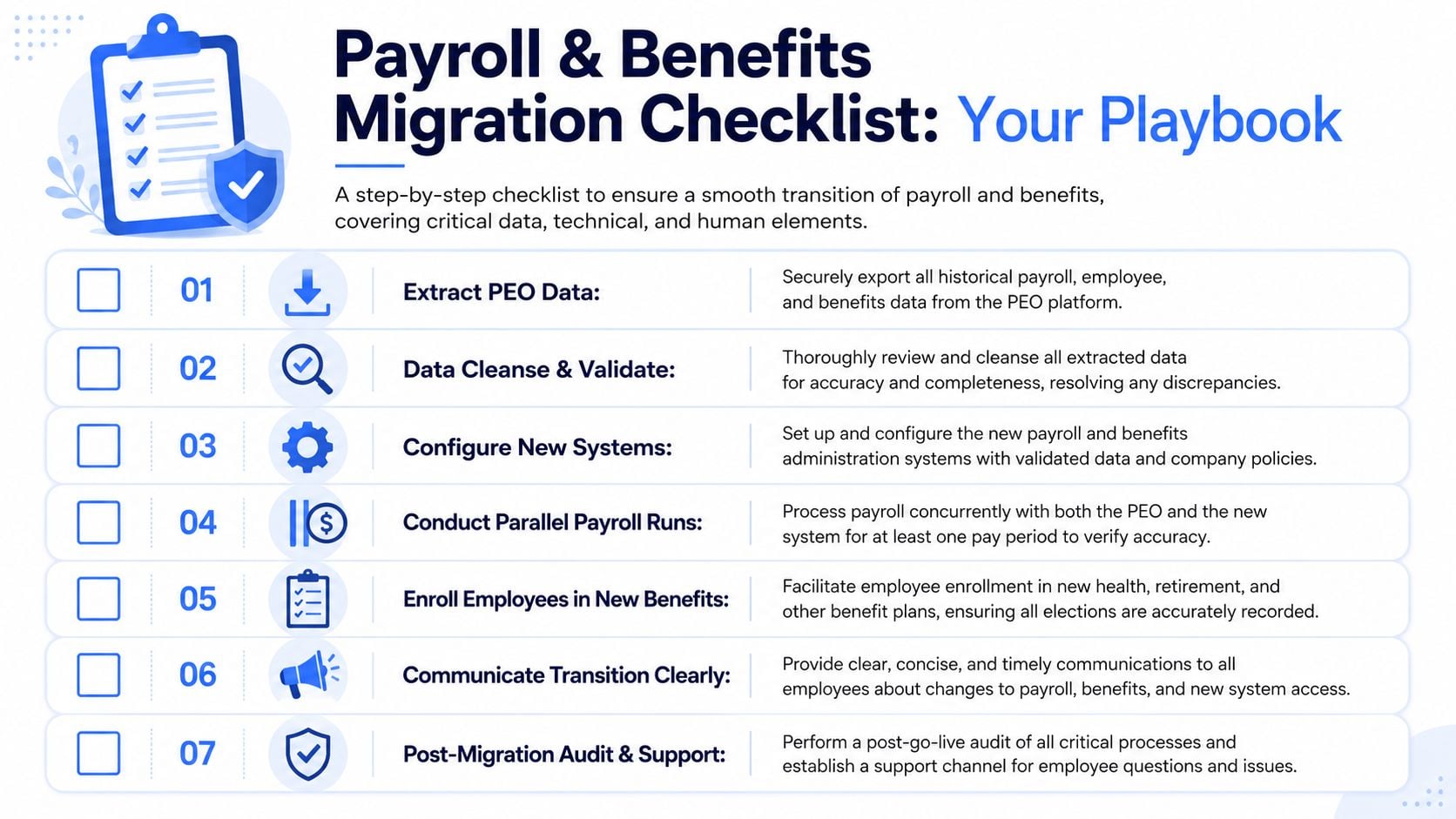
The core work in this final phase includes:
- Payroll parallel testing. Compare gross-to-net results, taxes, deductions, and employer contributions between old and new setups.
- Benefits file validation. Confirm carrier acceptance, coverage tiers, effective dates, and dependent data.
- Balance reconciliation. Check PTO, deduction arrears, garnishments, loans, and year-to-date amounts.
- Required notices and distributions. Send employee notices on time and confirm delivery records.
- Cutover control. Define who signs off on payroll, benefits, and data migration before the first live run.
- Final invoice review. Match the last PEO bill against contract terms, stop dates, and any agreed credits.
A clean payroll boundary reduces risk. End of quarter or end of year is often easier because tax reporting is cleaner and the chance of duplicate or mismatched reporting drops. Mid-year exits can still work, but they require tighter reconciliation discipline and more attention to quarter-to-date and year-to-date balances.
The companies that handle a PEO exit well treat it like a controlled financial event. They know the likely cash outlays before they give notice, they assign owners before tasks pile up, and they test every file that can create employee-facing errors. That is what keeps a planned exit from turning into an expensive cleanup project.
The Real Financial Model for a PEO Exit
A CFO approves a PEO exit because the replacement quote looks cheaper by $4,000 a month. Sixty days later, the savings are gone. The company pays a termination fee, a new platform setup fee, broker commissions, outside payroll help for quarter-end cleanup, and overtime for HR and finance staff who are now doing work the PEO used to absorb. That is a common miss, and it is why the financial model has to be built before notice goes out.
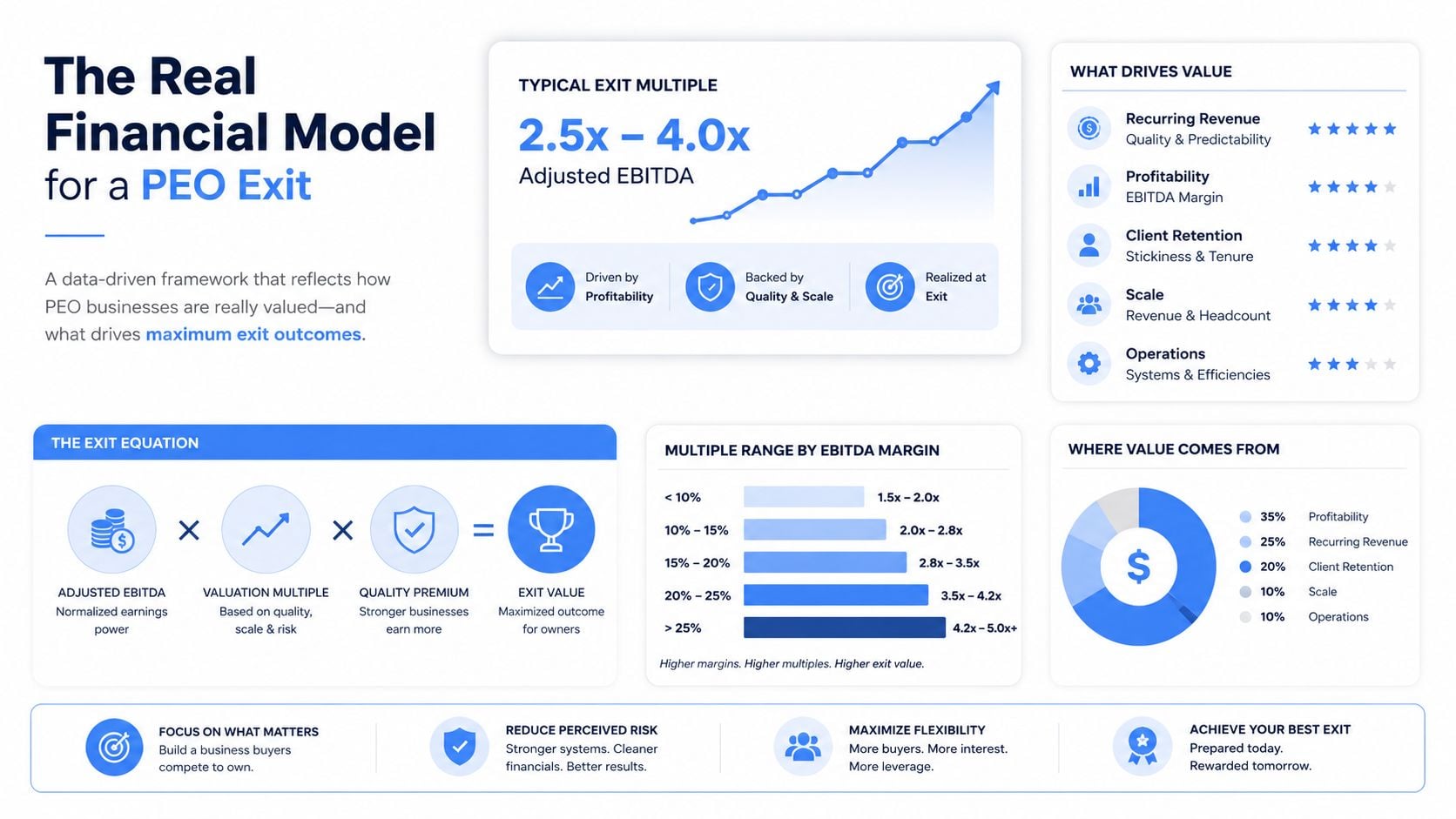
A useful exit model measures cash impact in three layers: one-time exit costs, temporary overlap costs, and risk-driven cleanup costs. If the model only compares the current admin fee to the future admin fee, leadership is approving an incomplete number.
What the budget usually misses
Bundled pricing hides a lot. Workers’ comp, COBRA administration, payroll tax amendment support, year-end W-2 handling, benefit eligibility file work, and HR support often move from one invoice line to several vendors and internal teams.
The expensive mistakes are rarely dramatic at the start. They show up as small approvals that pile up fast. A new payroll provider may charge an implementation fee. A broker may bill separately for open enrollment support. Legal counsel may need to review the separation language and responsibility for claims that surface after the exit date. Internal staff may spend 80 to 150 hours on reconciliations, carrier follow-up, employee communication, and issue resolution. For a lean HR and payroll team, that labor alone can add several thousand dollars of absorbed cost.
The continuity risks deserve their own line items, not a footnote. According to a 2025 claim report, 18% of mid-sized employers exiting a PEO faced temporary workers’ comp coverage gaps, averaging $42,000 in uncovered liability per incident, and COBRA administration costs often spike by 30% to 50% post-exit due to manual processing, as summarized in Nava Benefits’ PEO exit checklist. Those costs hit after the decision memo, which is exactly why they belong in the model up front.
For workers’ comp specifically, finance leaders should price the post-exit policy separately and review how payroll classifications and underwriting assumptions may change. This overview of understanding workers’ comp rates is useful for framing how classification, payroll, and underwriting assumptions can affect post-exit cost.
A practical cost structure
I usually build the model in three buckets and force owners to put a dollar range next to each one.
| Cost bucket | What belongs in it |
|---|---|
| Direct exit costs | Termination fees, implementation charges, legal review, broker fees, data extraction or cleanup |
| Overlap costs | Parallel vendor periods, duplicate benefit administration, outside payroll or HR support, internal project labor |
| Risk costs | Coverage gaps, COBRA processing errors, payroll corrections, tax notice response, employee claims caused by enrollment mistakes |
A mid-sized employer can test this structure with a simple example. Say the PEO charges a 30-day notice termination fee of $12,000. The replacement payroll and HRIS setup costs $8,000 to $20,000, depending on complexity. Internal labor adds another $6,000 to $15,000 if HR, payroll, finance, and IT collectively spend 120 hours to 200 hours on the migration. Add broker or benefits administration support, and the one-time spend can exceed a full quarter of projected fee savings before the first independent payroll is even stable.
That does not mean the exit is a bad decision. It means the board needs the full payback period, not the sales version.
A cleaner model follows a few rules:
- Separate one-time costs from steady-state operating costs so short-term disruption does not distort the long-term comparison.
- Run a base case and a downside case for workers’ comp, COBRA, and payroll tax cleanup.
- Price internal labor explicitly using loaded hourly rates for HR, payroll, finance, and IT.
- Assign a contingency amount for issues that tend to surface late, such as carrier file rejects or tax notice research.
- Write assumptions in plain English so leadership can see which savings are contracted and which depend on execution going well.
One sentence belongs in every model: cheap on paper can still be expensive in practice.
For teams that want a structured worksheet, this PEO financial modeling template for exit cost planning helps organize implementation fees, overlap costs, internal labor, and contingency assumptions before they turn into budget surprises.
Companies that exit well treat the move like a cash event with operational risk attached. They approve the savings case only after they price the messiest parts realistically.
Executing a Smooth Payroll and Benefits Migration
Payroll and benefits cutovers are where a good PEO exit can still go sideways. One wrong year-to-date tax figure, one missed medical enrollment, or one broken deduction code can turn a cost-saving decision into a cleanup project that burns weeks of HR and finance time. I have seen companies save on PEO fees and then give back a chunk of that savings through off-cycle payroll runs, carrier escalations, tax notice research, and employee concessions after a rough launch.
Start with a hard data audit
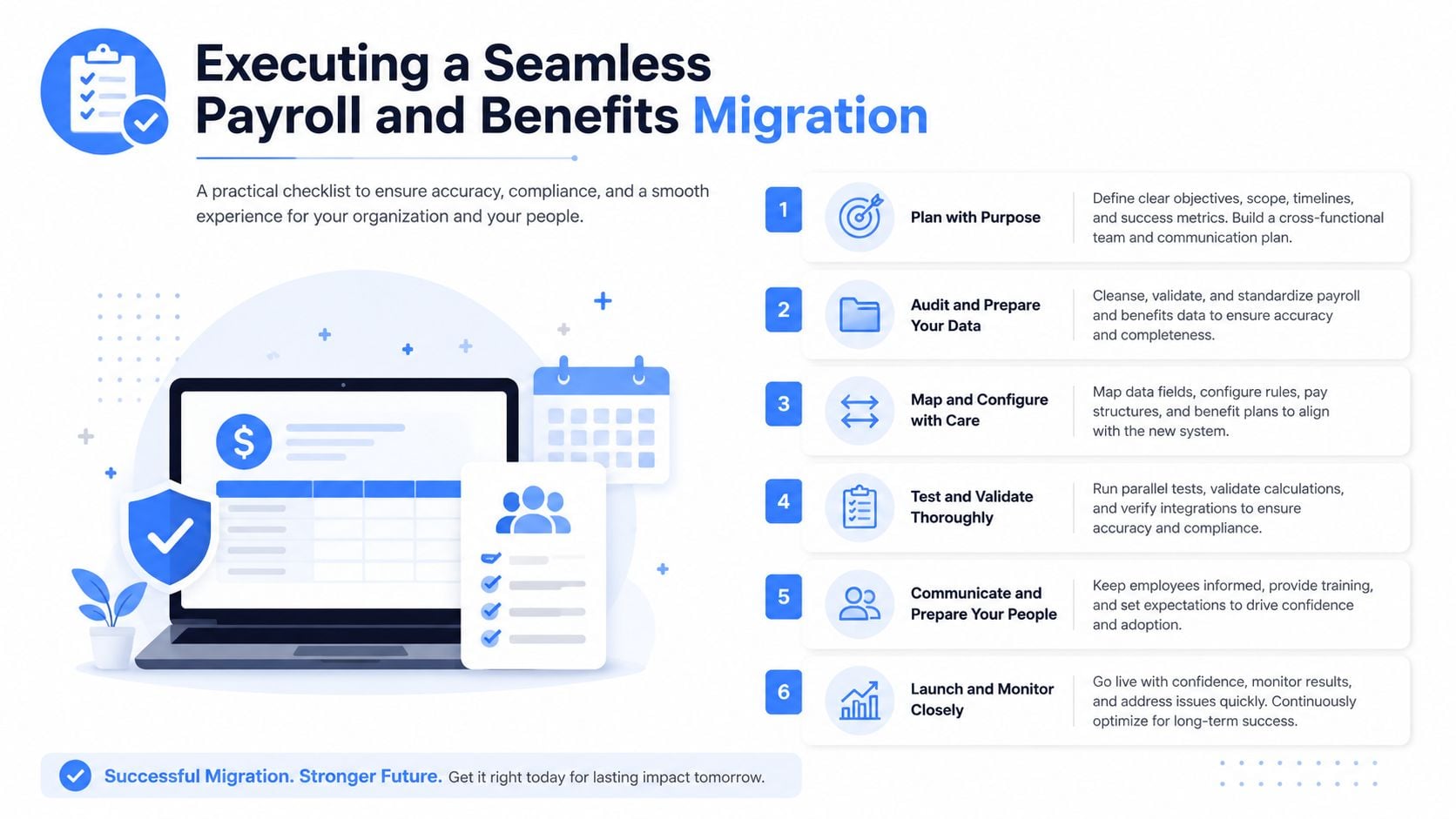
The cutover should start with record ownership and file accuracy. Before anyone builds the new system, get complete exports from the outgoing PEO and confirm the company can use them. That means employee demographics, compensation, deductions, tax elections, year-to-date payroll figures, PTO balances, benefits elections, dependent data, garnishments, direct deposit details, and historical reports needed for audits or employee disputes.
The highest-risk errors usually sit in ordinary fields. A bad Social Security number, an old salary amount, a deduction code mapped to the wrong benefit, or an incorrect benefit class can create real cost fast. The expensive part is not just fixing the record. It is the chain reaction. Payroll has to rerun, HR has to answer complaints, finance has to reconcile variances, and someone has to explain why the transition budget is already off plan.
A disciplined file review should cover:
- Year-to-date payroll validation. Match wages, taxes, deductions, and net pay against internal payroll records and general ledger totals.
- Benefits enrollment reconciliation. Confirm elections, waivers, dependent coverage, and carrier eligibility files line up.
- Time-off balance testing. Verify accrual rules and transferred balances before the legacy system is shut down.
- Deduction and earning code mapping. Check that medical, dental, HSA, FSA, 401(k), garnishments, bonuses, and taxable fringe items land in the right buckets.
- Workflow rebuilds. Recreate approvals, onboarding tasks, and manager actions in the new platform before the first live cycle.
Teams in the middle of file mapping usually benefit from a tighter operating checklist like these data migration best practices, especially when multiple vendors are touching payroll, HRIS, and benefits administration at the same time.
Mid-year exits need extra control. If year-to-date wages or tax filings do not transfer cleanly, the company can end up with W-2 correction work, duplicate tax payments, agency notices, or employees questioning their withholdings. Set one owner for each filing category, document the exact cutoff date, and get written confirmation on who is responsible for prior-quarter corrections if an issue appears after go-live.
Treat employee communication like an operating control
Employees judge the transition on two things. Did they get paid correctly, and did their coverage work when they needed it.
That is why communication needs structure, timing, and named owners. A single company-wide email is not enough. The better approach is a staged communication plan that starts with leadership, then moves to managers, then reaches employees with plain-language instructions on pay dates, benefit elections, logins, ID cards, and support contacts. People with complex situations need direct outreach, especially employees on leave, employees with dependent coverage, and employees with active claims or pending treatments.
If benefits are changing along with the PEO exit, explain the trade-offs directly. Higher deductibles, different provider networks, and new contribution levels will get more attention than any message about administrative efficiency. HR teams rebuilding plans outside the PEO can use this practical guide for small business health plans to frame those choices clearly for employees who are comparing unfamiliar options.
A good day-one standard is simple. Employees can log in, see accurate pay, confirm active coverage, and know exactly where to get help. If one of those breaks, the company pays for it somewhere, through off-cycle corrections, service credits, extra broker support, or lost trust that takes months to rebuild.
Finalizing the Handover and Negotiating Exit Fees
The final month is where too many teams relax early. That’s a mistake. Until the company has final records, final invoices, and written confirmation that co-employment has ended, the file is still open.
Push for leverage before the last invoice arrives
Some exit fees are contractual, and some are more flexible than they first appear. The team’s advantage usually comes from documentation, not from outrage. If the company has records of service failures, unresolved billing disputes, delayed support, or implementation promises that weren’t met, those facts can support a request for credits, fee reduction, or at least a cleaner final billing treatment.
Negotiation works better when it’s narrow and specific. Don’t ask the vendor to “be reasonable.” Ask for a waiver of a named fee, a shortened overlap period, no charge for certain reports, or written confirmation that no post-termination admin fees will be added without approval.
A practical review of likely charges and pressure points belongs in this kind of PEO cancellation penalties explained checklist before the final negotiation starts.
Close the file completely
The company should insist on a formal closing sequence. That means a post-exit meeting, confirmation that all requested records were delivered, a final invoice review, and written acknowledgment signed by an authorized representative showing the relationship has officially terminated.
A complete handover file should contain:
- Termination letter and proof of delivery
- Written acknowledgment from the PEO
- Final payroll and tax reporting documentation
- Final employee and benefits data exports
- Final invoice showing zero unresolved balance, if applicable
This is also the point to verify practical loose ends. Are any benefit claims still pending? Has COBRA administration been handed off cleanly? Are there any user accounts or system permissions that should be shut down? Has the company retained the records needed for future audits, employee questions, and tax reconciliation?
The strongest PEO exit strategy doesn’t end when the new system goes live. It ends when the old provider can’t create another surprise.
If a company is weighing whether to stay, renegotiate, or leave, PEO Metrics helps HR and finance teams compare options, pressure-test contract terms, and understand the trade-offs before a renewal or exit turns expensive.
