
A 150-employee professional services firm can look healthy on paper while its HR model fails under pressure. The head of HR spends nights checking multi-state payroll filings, managers wait for basic workforce reports, and the CFO still can't get a clean view of labor cost, benefits spend, or vacancy exposure. Leadership asks for predictive analytics, but the team is stuck correcting employee records and chasing missing approvals.
That situation is no longer an administrative inconvenience. Change in HR now affects compliance exposure, labor economics, employee retention, and the company's ability to grow without adding operational drag. A PEO, ASO, technology migration, reorganization, or internal role redesign can all solve the problem, but only if leaders compare the financial and contractual consequences before choosing a path.
Table of Contents
- Why Change in HR Is Now a Strategic Decision
- The Four Main Types of Change in HR
- Operational and People Impact of Each Change
- In-House HR vs PEO vs ASO Compared
- Signals That Your HR Model Needs to Change
- Planning and Executing the Transition
- Key Takeaways and Next Steps
Why Change in HR Is Now a Strategic Decision
The 150-employee firm in this example probably started with a sensible model. Payroll was handled internally, benefits were renewed annually, managers emailed HR when something went wrong, and a basic HRIS stored employee records. That setup worked while the company operated in one location and growth remained predictable.
The model becomes fragile when employees spread across states, new leave and pay requirements appear, and leadership expects HR to provide workforce intelligence. State and local rules now vary across leave, artificial intelligence, background screening, wage and hour requirements, pay transparency, employee notices, and workplace safety, as outlined in ADP's 2026 compliance overview. A spreadsheet and a capable generalist can't reliably replace a system designed to monitor jurisdictional obligations.
Technology has also moved from optional enhancement to operating infrastructure. In 2026, 39% of organizations had implemented AI in HR, another 7% planned to do so that year, and 62% were using AI somewhere in the business, according to SHRM's HR technology adoption summary. Recruiting represented 27% of HR AI use cases, HR technology 21%, and learning and development 17%, showing that AI is already appearing in ordinary HR workflows rather than remaining a laboratory project.
The cost of keeping a weak model
Turnover makes the decision more urgent. SHRM estimates replacement costs for many roles at 50% to 60% of annual salary, while total turnover costs can reach 90% to 200% of salary after recruiting, onboarding, and lost productivity are included, according to SHRM's talent retention guidance. A replaced $80,000 role can therefore create a total loss of $40,000 to $160,000, depending on complexity and ramp time.
That changes the CEO's question. The issue isn't whether HR can process payroll this month. The issue is whether the current model helps the business retain talent, manage risk, and scale, or whether it delays decisions and consumes capacity that should support growth. Leaders assessing current HR outsourcing trends should treat the review as an operating-model decision, not a vendor-shopping exercise.
Practical rule: If HR can't produce reliable data for labor cost, turnover, compliance status, and workforce capacity, the company doesn't have a reporting problem. It has a model problem.
The Four Main Types of Change in HR
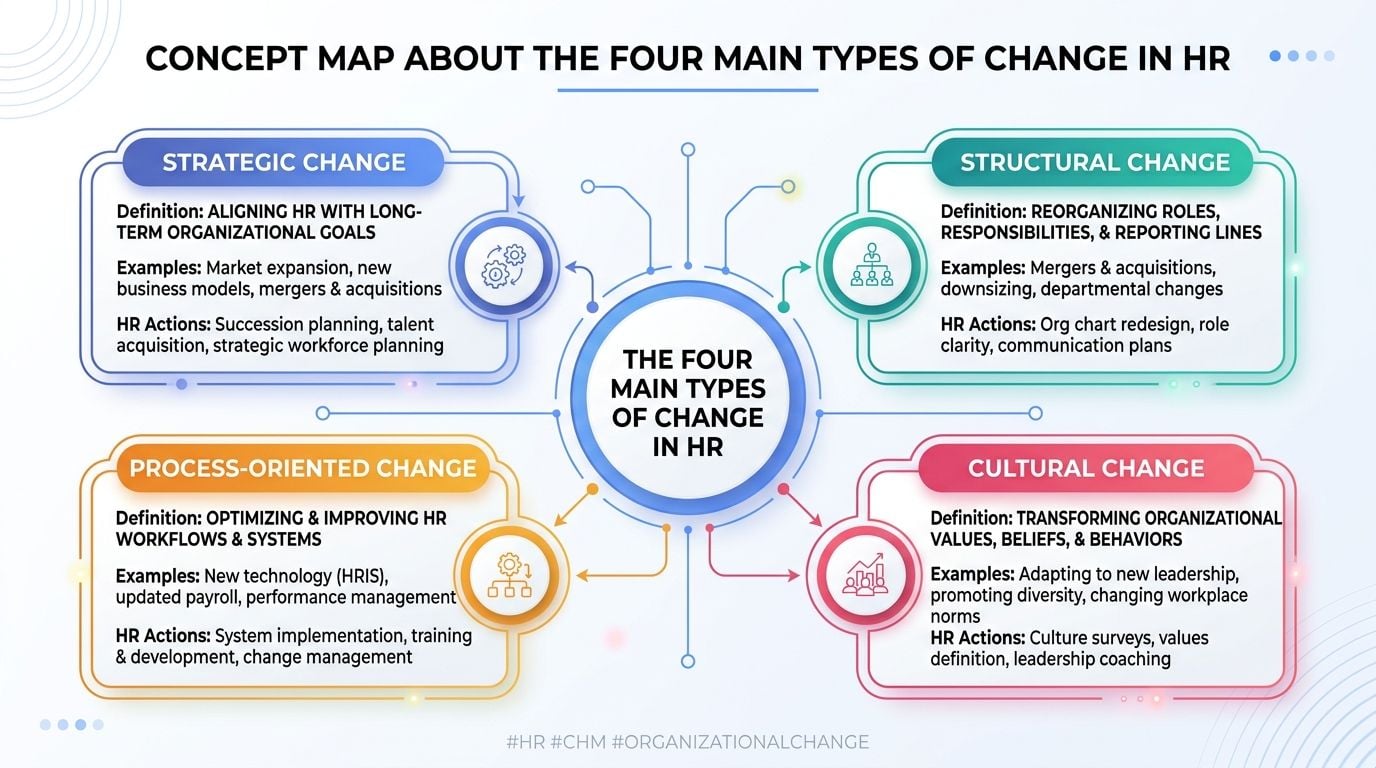
HR change usually develops in a sequence. A company changes its structure, then its processes, then its technology, and finally the roles and behaviors required to run the new model. Treating these as separate projects creates handoff failures. Treating them as a connected concept map gives leadership a clearer diagnosis.
Organizational change
Organizational change alters who owns decisions. It includes a reorganization, merger integration, new reporting lines, or the creation of a centralized people function. A professional services firm might move HR business partners into regional divisions while keeping payroll and benefits centralized. The trigger is usually growth, a merger, a leadership change, or a recognition that responsibilities have become unclear.
The first question is accountability. Someone must own employee data, compliance decisions, manager support, benefits strategy, and escalation paths. A new chart without clarified decision rights only moves confusion around.
Outsourcing change
Outsourcing change moves selected HR responsibilities outside the company. A PEO uses a co-employment model, typically combining payroll, benefits administration, workers' compensation support, and compliance services under a shared operating arrangement. An ASO provides administrative services without co-employment, so the employer keeps its own employment relationship, benefits structure, and policy authority.
That legal distinction affects risk, control, tax handling, and implementation. Companies that need benefits access and broader compliance infrastructure may evaluate a PEO, while companies that want to retain their own plans may prefer an ASO. A structured human resources outsourcing review helps separate service requirements from sales language.
Technology and automation change
Technology change replaces fragmented tools with connected workflows. Common examples include an HRIS migration, payroll-platform consolidation, AI-assisted recruiting, benefits integration, and employee self-service. The trigger is often duplicated data, manual approvals, poor reporting, or an inability to connect recruiting, payroll, and performance information.
Automation shouldn't be introduced merely because a vendor labels a feature “AI.” HR leaders need to test data governance, auditability, bias controls, and whether the tool improves a decision or only reduces keystrokes.
Role-shifting change
Role shifting changes what the internal HR team does. Transaction processors become people partners, HR analysts, talent specialists, or change leaders. A payroll coordinator might move into workforce reporting after payroll administration is outsourced, while an HR director takes ownership of manager capability and workforce planning.
This transition also affects employee experience. A company redesigning support channels should account for mental health and employee wellbeing resources, including Therapsy employee wellness, when the change increases uncertainty or manager workload.
Operational and People Impact of Each Change
Each HR change type carries a different cost profile. Leaders shouldn't compare them using a single vendor fee or project estimate. The relevant calculation includes direct spend, implementation time, internal capacity, payroll continuity, compliance exposure, and the employee disruption created during the transition.
The verified PEO benchmarks are more specific than many generic HR change estimates. Onboarding commonly includes a one-time setup fee of about $500 to $2,000 and takes 2 to 8 weeks from signed contract to live payroll, according to PEO onboarding fee guidance. A company with multiple states, complex benefits, or poor payroll records should assume the longer end of that range.
| Change Type | Typical Cost Range | Implementation Timeline | Primary Risk | Engagement Impact |
|---|---|---|---|---|
| Organizational restructure | Depends on severance, leadership coverage, and vacancy exposure | Project-specific | Unclear ownership and manager confusion | Morale can weaken if communication is poor |
| PEO or ASO transition | PEO fees may be quoted at $100 to $120 PEPM or 3% to 6% of gross payroll | PEO onboarding commonly takes 2 to 8 weeks | Payroll, benefits, data, and contract failures | Employees notice disruption quickly |
| Technology consolidation | Depends on platform scope and integrations | Project-specific | Bad data migration and weak adoption | Friction rises when self-service fails |
| Role shifting | Depends on hiring, training, and retained work | Project-specific | Internal capability gaps | Managers may receive less support during the handoff |
The PEO fee formula matters more than the headline rate. For a 100-employee company, a $20 PEPM difference equals about $24,000 annually, according to PEO service cost guidance. That difference can outweigh a modest benefit improvement, particularly when implementation, renewal, and termination charges sit outside the advertised rate.
People impact requires its own operating plan
Turnover cost is nonlinear because vacancy duration and ramp-up productivity can exceed the visible recruiting bill. SHRM's turnover cost calculation spreadsheet recommends combining separation, recruiting, onboarding, and unfilled-position costs rather than isolating one metric.
HR leaders should track:
- Vacancy duration: How long a role remains unfilled.
- Time to proficiency: How long the replacement takes to reach expected output.
- Manager capacity: How much leadership time the transition consumes.
- Employee support volume: Whether questions and escalations rise after go-live.
- Data accuracy: Whether payroll, benefits, and employee records reconcile.
Teams also need a clear recruiting workflow when role changes create new hiring demand. A practical review of the best place to hire appointment setters can help leaders distinguish recruiting-channel decisions from broader HR operating-model decisions.
In-House HR vs PEO vs ASO Compared
The right delivery model depends on control requirements, compliance complexity, benefits strategy, and the internal team's ability to operate core systems. Cost alone is a poor filter. A low-fee model that leaves payroll tax work, claims handling, or multi-state administration unresolved can cost more than a higher-fee model with dependable execution.
| Factor | In-House HR | PEO | ASO |
|---|---|---|---|
| Cost structure | Fixed internal payroll, benefits, systems, and staffing costs | Administrative fees may be quoted at $100 to $120 PEPM or 3% to 6% of gross payroll | Service fees vary by scope and may include separate technology or per-employee charges |
| Compliance liability | Employer retains responsibility | PEO assumes or shares defined responsibilities under the co-employment agreement | Employer generally retains employment and compliance responsibility |
| Benefits access | Employer selects and funds plans | PEO typically provides access to pooled benefits arrangements | Employer generally retains its own plans |
| Technology stack | Company buys and integrates tools | Provider supplies an integrated platform and service model | Provider adds administration and technology while employer retains more control |
| Implementation time | No transition if retained, but internal changes still require planning | Common onboarding is 2 to 8 weeks | Depends on scope, data, integrations, and service design |
| Day-to-day HRBP support | Internal team controls service level | Provider support varies by contract and staffing model | Support is usually administrative unless HR advisory work is purchased |
How the mechanics differ
An in-house model gives the employer direct control, but it also leaves the employer responsible for payroll filings, benefits administration, workers' compensation, employee records, and state unemployment work. The employer holds its own FEIN, owns its workers' compensation policy, and files state unemployment claims through its own accounts.
A PEO introduces co-employment. The contract should state who holds the relevant FEIN relationships, who controls payroll processing, how workers' compensation coverage operates, and how state unemployment accounts and claims are handled. Benefits may be broader, but the employer gives up some control and must understand the provider's risk and service model.
An ASO sits between the two. The employer keeps the employment relationship and usually retains its own FEIN, workers' compensation policy, benefits plans, and unemployment accounts. The ASO supplies administrative infrastructure, technology, and potentially advisory services, but it doesn't automatically transfer the underlying compliance responsibility.
Companies comparing these models should review the difference between PEO and ASO before requesting proposals.
A practical size-band recommendation
- 10 to 50 employees: Keep HR internal if the business has one state and low complexity. Consider an ASO when payroll, benefits, or compliance work is already consuming leadership time.
- 51 to 250 employees: Compare PEO and ASO formally. A PEO can provide structure during multi-state growth, while an ASO may fit a company with established benefits and strong internal compliance ownership.
- 251 to 500 employees: Use a documented financial and risk comparison. Larger employers often need a hybrid model, an ASO, or an internal team supported by specialized providers.
- 501 to 2,000 employees: Treat the decision as an operating architecture review. A PEO may fit a defined segment or growth unit, but the company should test data ownership, service scalability, and exit mechanics carefully.
Signals That Your HR Model Needs to Change
A quarterly diagnostic can reveal whether the cost of standing still now exceeds the cost of transition. The test should use payroll and HRIS exports, not impressions from the latest vendor presentation.
Six signals deserve immediate attention.
The operating triggers
1. The admin-to-headcount ratio exceeds 1:100.
If one HR administrator carries responsibility for more than 100 employees, routine processing can crowd out compliance review, manager support, and workforce planning. The ratio isn't a universal failure line, but it is a strong prompt to examine which work should be automated or outsourced.
2. Replacement cost exceeds 50% of annual salary.
SHRM identifies replacement costs of roughly 50% to 60% of annual salary for many roles, before the broader turnover impact is considered, as documented in its retention guidance. If a company repeatedly replaces roles at that exposure, leadership should examine manager quality, onboarding, benefits, workload, and the speed of HR support.
3. The workers' compensation modifier rises above 1.0.
A rising modifier can signal claims handling, safety, classification, or return-to-work weaknesses. The CFO should ask whether the current provider is actively managing claims or merely processing invoices.
4. Compliance deadlines are missed.
More than two late ACA filings or OSHA log errors in a 12-month window should trigger a formal control review. One mistake may be isolated. Repeated errors indicate that ownership, reminders, data validation, or vendor accountability isn't working.
5. Time to fill moves beyond 45 days.
Long vacancies affect revenue, manager capacity, and employee workload. The company should separate difficult labor-market conditions from process failures by reviewing approval time, sourcing volume, interview scheduling, offer acceptance, and onboarding readiness.
6. Employees work in three or more states without dedicated payroll-tax infrastructure.
Multi-state exposure becomes structural when the company relies on manual monitoring or informal knowledge. The PEO underperformance warning signs framework can help leaders assess whether the current partner is failing to deliver the infrastructure already being paid for.
Employment-law review should accompany the diagnostic, especially where policy changes, employee classification, AI-assisted decisions, or multi-state practices are involved. A resource on employment law can help frame the legal questions, but counsel should review the company's actual facts and contract language.
Planning and Executing the Transition
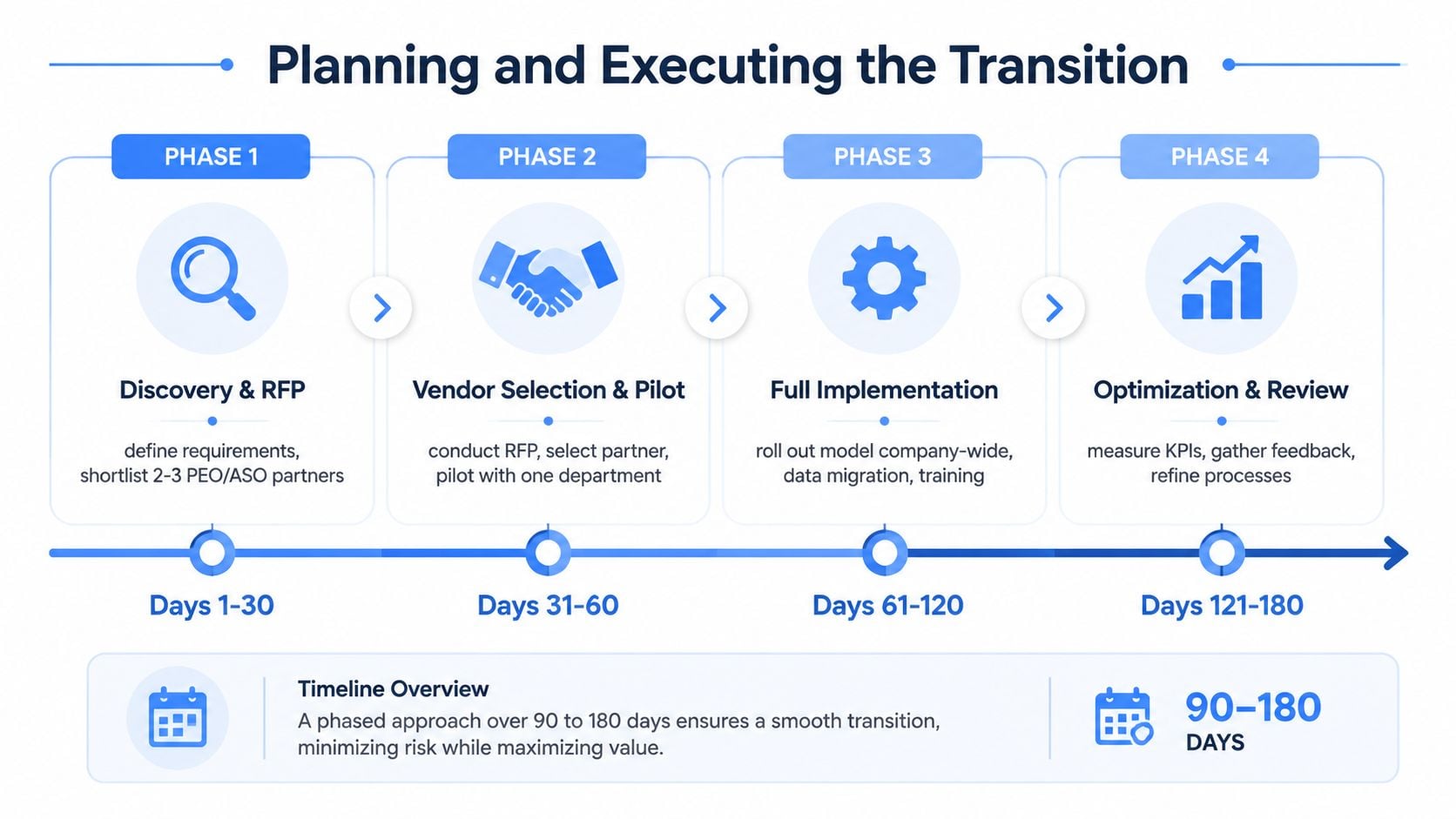
A workable transition usually follows four phases across roughly 90 to 180 days, depending on the number of states, benefit plans, data quality, and payroll complexity. The schedule should be owned by an executive sponsor, a day-to-day project lead, and named owners for payroll, benefits, compliance, technology, communications, and finance.
Phase one covers discovery and the RFP
During days 1 to 30, the company should document its current state. That includes payroll calendars, benefit plans, employee classes, PTO rules, workers' compensation policies, state registrations, tax accounts, HRIS integrations, reporting needs, and open employee issues.
The RFP should go to two to three PEO or ASO partners, with identical data and service requirements. Providers should demonstrate the actual employee and administrator workflows, not just present feature slides. Benefits and HRIS integrations should be tested in parallel where possible.
Phase two protects the contract and compliance position
During days 31 to 60, legal, finance, and HR should review the agreement together. The review must cover:
- Co-employment language: Define authority, responsibility, and employee communication rights.
- FEIN mechanics: Document how tax reporting, payroll records, and notices will work.
- Workers' compensation: Confirm coverage, claims handling, audits, and tail obligations.
- Unemployment accounts: Establish how state rates, claims, and account transfers will be handled.
- Price protection: Request a 24 to 36-month price hold where the provider will agree.
- Renewal terms: Review written notice periods, rate disclosure, and automatic renewal.
- Off-boarding: Require a workable data export, transition assistance, and defined termination fees.
- Data ownership: State that the employer owns its employee and payroll data and can retrieve it in a usable format.
PEO agreements may automatically renew unless notice arrives 30, 60, or 90 days before expiration, according to PEO contract marketplace guidance. Some guidance recommends renewal pricing disclosure at least 60 days before the deadline, while other recommendations call for 90 to 120 days. The contract should use a specific date and remedy, not a vague promise to provide notice.
Phase three and four make the change operational
During days 61 to 120, the team should migrate data, map policies, configure deductions, communicate with employees, and run payroll in parallel. Employees should know where to view pay statements, report issues, access benefits, and ask questions before the first live payroll.
During days 121 to 180, the company should review service levels, error logs, open tickets, benefits enrollments, claims activity, tax filings, and employee feedback. Quarterly business reviews and SLA checkpoints belong in the contract from day one, not in a post-launch wish list.
The most common transition mistakes are predictable. Companies skip the parallel payroll run, fail to map PTO accruals, overlook state unemployment transfers, and sign language that permits vague “market rate” increases. One PEO contract risk guide says those vague terms have historically translated into 12% to 22% increases, so negotiated caps and defined notice rights matter, as explained in PEO contract risk guidance.
For technical execution, the team should use documented data migration best practices and require reconciliation before approving go-live.
Key Takeaways and Next Steps
A CFO or HR director can run the decision framework this quarter with a focused review of payroll, HRIS, benefits, compliance, and turnover data.
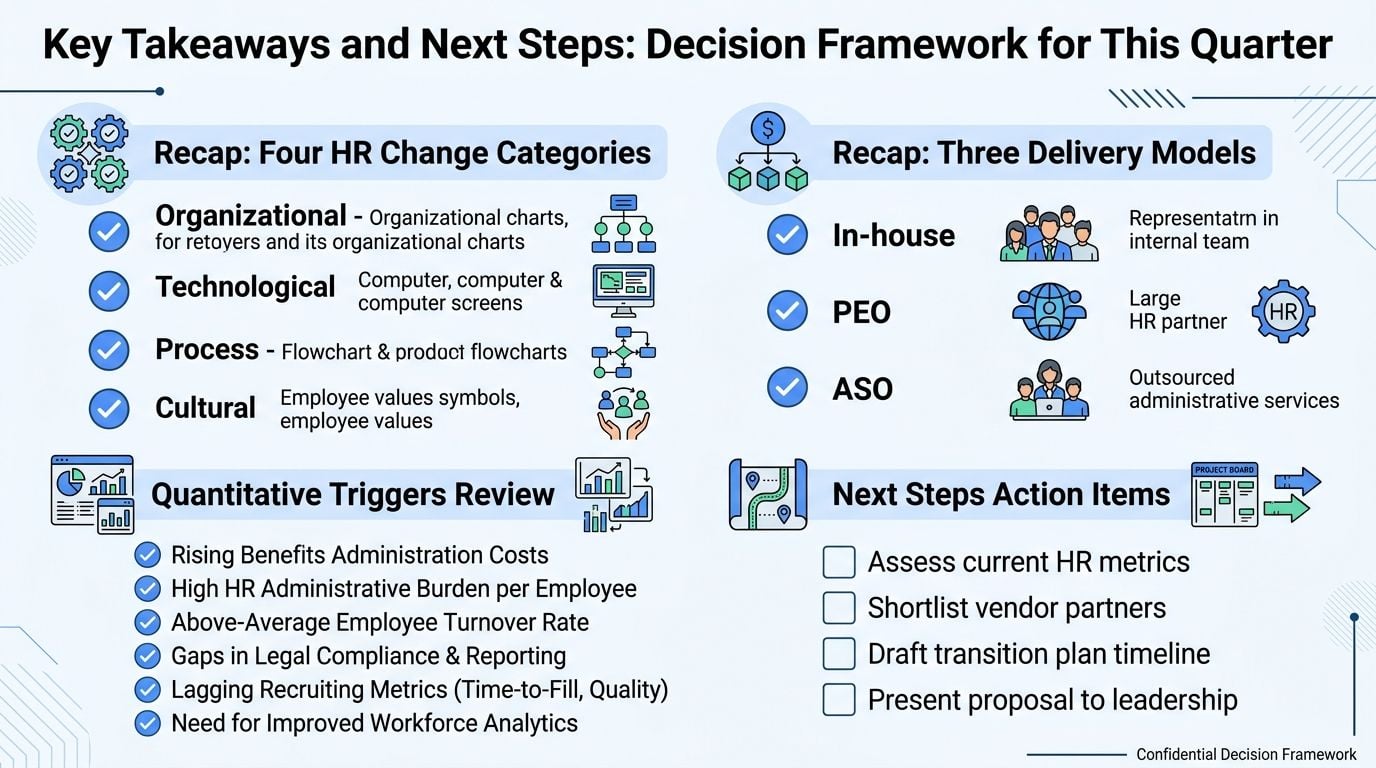
Start with the change category:
- Organizational: Reporting lines, ownership, merger integration, or workforce structure.
- Technological: HRIS, payroll, recruiting automation, analytics, and integrations.
- Process-oriented: Payroll, benefits, compliance, onboarding, and employee service workflows.
- Cultural and role-based: Manager capability, employee experience, and the shift from administration to partnership.
Then compare the delivery model:
- In-house: Maximum control, maximum responsibility.
- PEO: Co-employment, pooled benefits access, and broader outsourced infrastructure.
- ASO: Administrative scale while the employer retains more legal and operational control.
Run the quantitative review:
- Calculate administrative cost per employee.
- Calculate the HR admin-to-headcount ratio.
- Review turnover cost, time to fill, and time to proficiency together.
- Check multi-state payroll-tax infrastructure.
- Review compliance errors, workers' compensation performance, and contract renewal dates.
- Request proposals against a fixed scope, not a generic service bundle.
The five mistakes that cost mid-market employers the most are signing a multi-year PEO contract before a 90-day parallel run, underestimating payroll cutover risk, ignoring worksite employee co-employment language, skipping state-by-state unemployment account transfers, and choosing a partner on price instead of claims handling.
The 30-60-90 day action sequence
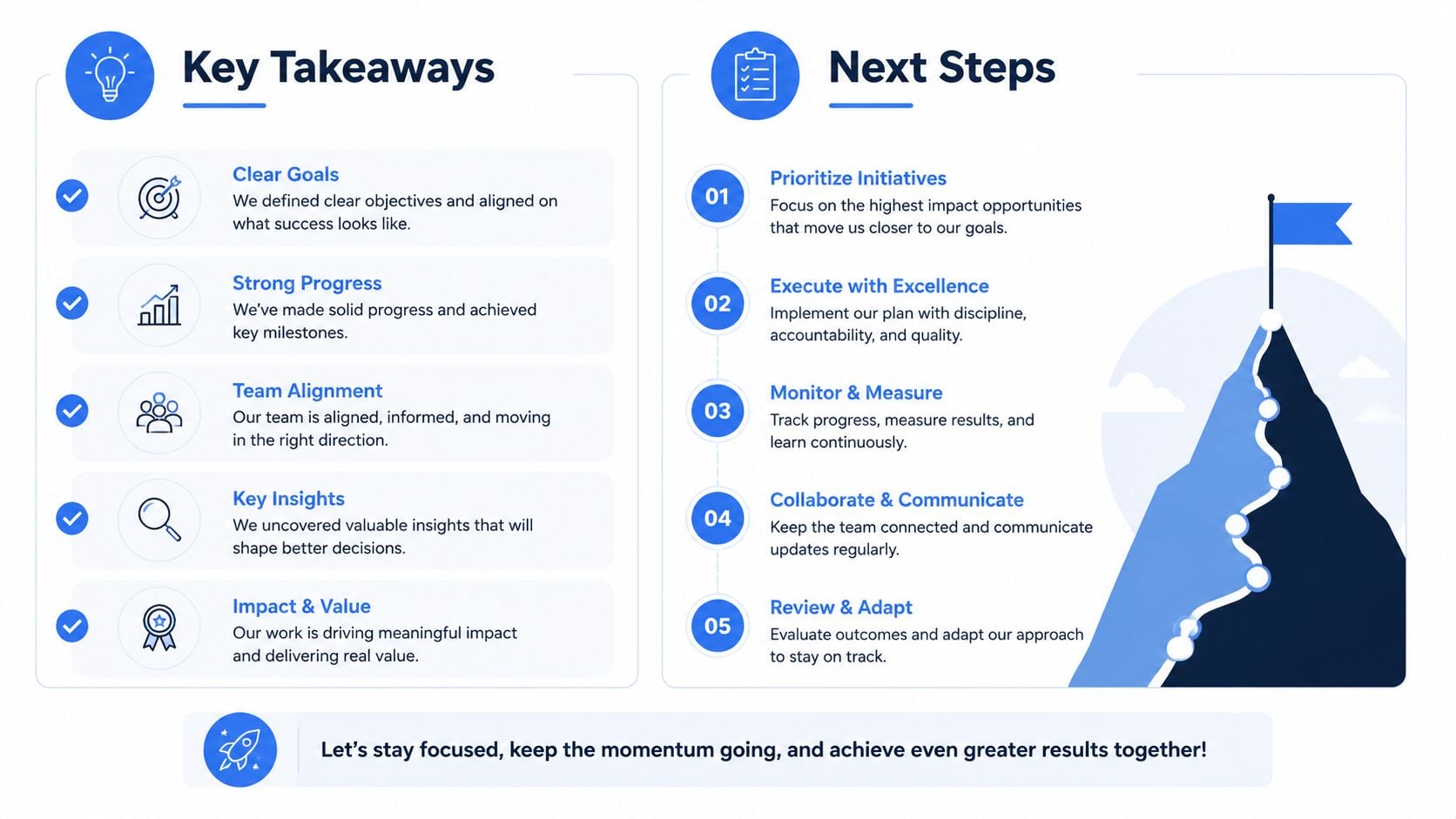
Within 30 days, export the data, document the current model, calculate administrative cost, and identify every contract deadline. By day 60, shortlist providers, validate PEO versus ASO requirements, and present a comparison that includes implementation, renewal, termination, data ownership, and claims handling. By day 90, approve a transition plan or formally document why the current model remains adequate, with named owners and measurable checkpoints.
PEO Metrics provides independent side-by-side analysis of PEO pricing, benefits, service models, compliance support, contract terms, and provider fit. HR and finance teams evaluating a change in HR can visit PEO Metrics to compare options, identify contract risks, and prepare for stronger negotiations at no cost to the buyer.
