
A CFO at a 60-person US SaaS company has just signed its first customer in Frankfurt. Two German engineers need to start within eight weeks. The leadership team has three choices: form a German GmbH, hire through an international professional employer organization, or classify the workers as contractors and hope the arrangement holds.
The decision looks administrative until a candidate asks about German payroll, statutory benefits, termination rules, and sick leave. A vague answer can cost the company the hire. A rushed contractor arrangement can create misclassification exposure. A poorly reviewed PEO contract can preserve the speed while shifting tax, employment, and benefits risk back to the buyer.
The model can work extremely well, but only when the buyer understands the gap between the provider's legal role and the company's operational control. The recurring problems aren't limited to pricing. They include hidden margin stacking, permanent establishment risk, and benefits gaps that become visible only when an employee needs support.
Table of Contents
- The Decision Most Growing Companies Face Too Late
- What an International Professional Employer Organization Actually Does
- International PEO Compared to Domestic PEO and Local Entity Setup
- Legal, Tax, and Benefits Implications Across Borders
- Three Real Scenarios Where the Model Pays Off or Breaks Down
- Selection Criteria and Negotiation Moves That Change Outcomes
- When an International PEO Makes Sense and When to Walk Away
The Decision Most Growing Companies Face Too Late
The first international hire usually arrives as a commercial deadline, not an HR project. A customer wants local support, a sales leader has identified candidates, and the business needs people productive before the opportunity cools. A company hiring its first five employees in Germany or Mexico must decide whether to create an entity, use an employer of record, or rely on contractor agreements.
Delaying that choice is a false economy. Contractor status may look inexpensive, but the company still needs to assess whether the worker operates like an employee, receives ongoing direction, and performs an integral role. A dispute can expose unpaid employment obligations, local payroll taxes, benefits, and termination liabilities. A German engineer who can't get a clear answer about payroll may accept another offer before the company finishes its internal debate.
Three risks appear before the invoice
Revenue delay is the most visible risk. A customer contract may require regional coverage, but the company can't deliver that coverage without compliant employment infrastructure. A provider that can onboard workers in five to fourteen business days can materially change the launch plan, according to this international hiring guide.
Permanent establishment exposure is less visible. A foreign employee who negotiates or habitually supports contracts may create questions about whether the company has taxable business activity in that country. An international PEO doesn't automatically eliminate that analysis. The client still needs tax advice based on the employee's authority, activities, and reporting structure.
Benefits failure tends to surface at the worst time. A candidate may receive a compliant contract but discover that the offered health coverage, pension arrangements, parental leave administration, or sick-pay process doesn't match local expectations. The legal employer may have enrolled the employee correctly, yet the client remains responsible for communicating the offer accurately.
Practical rule: Treat the first international hire as a legal and financial design decision, not a payroll purchase.
The modern PEO model developed from US employee leasing in the late 1960s and 1970s. Practitioners formed the National Staff Leasing Association in 1984, and the organization later became NAPEO in 1993. The IRS created the certified PEO framework in 2014, allowing a certified PEO to be treated as the employer for employment tax purposes when it meets federal requirements, as described by the Journal of Accountancy's history of certified PEOs. International arrangements build on the administrative logic of that model, but the legal mechanics differ by country.
What an International Professional Employer Organization Actually Does
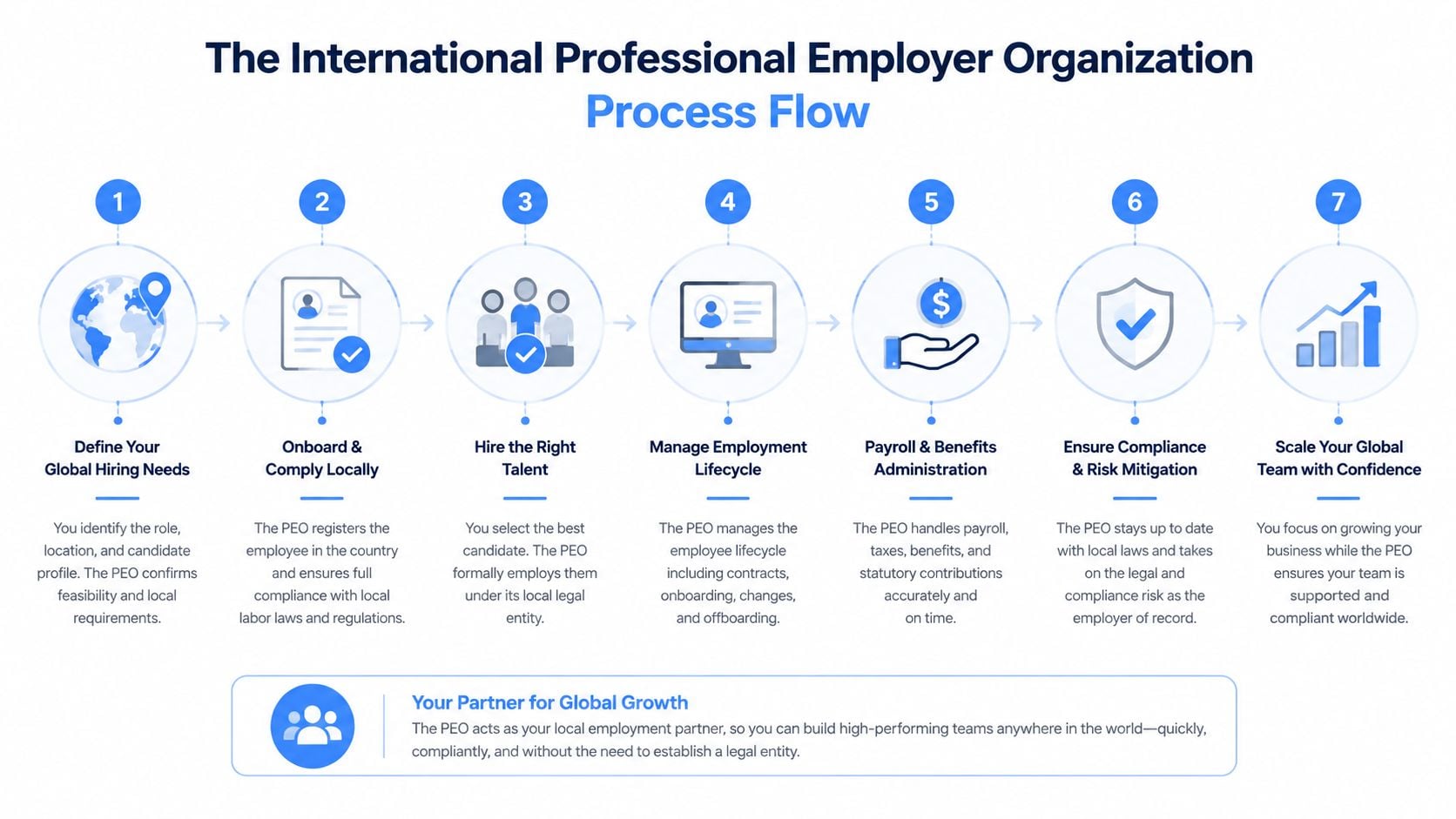
An international professional employer organization, often called an international PEO or EOR, provides an employment infrastructure in a country where the client may not have its own entity. The provider becomes the worker's legal employer of record for statutory purposes, while the client directs the worker's daily activities, objectives, compensation decisions, and performance management. International EOR guidance describes this arrangement as a way to centralize payroll, tax withholding, benefits administration, and labor-law compliance across jurisdictions.
That division of responsibility matters. The provider signs or administers the local employment contract, runs payroll, withholds taxes, manages statutory contributions, and supports compliant termination. The client still decides what work gets done, evaluates performance, protects confidential information, and investigates workplace conduct. A provider can be the legal employer without becoming the employee's operational manager.
The service stack behind the label
A serious international PEO arrangement usually includes:
- Localized contracts: The provider prepares employment terms that reflect local rules on pay, leave, notice, probation, confidentiality, and termination.
- Payroll and withholding: The provider calculates payroll, deducts applicable taxes and social contributions, and pays the employee in the local currency.
- Benefits administration: The provider enrolls workers in statutory programs and may offer supplemental benefits through local carriers or its own plans.
- Immigration coordination: Where applicable, the provider coordinates work permits, visa sponsorship, and supporting documentation.
- Offboarding support: The provider manages notice, severance calculations, consultation requirements, and final payroll according to local law.
For example, a US software company hiring its first employee in the United Kingdom may choose an EOR instead of immediately creating a UK subsidiary. The employee works for the US company's product team, but the EOR issues the local contract, processes payroll, administers benefits, and handles statutory employment steps. The US company remains accountable for the employee's role, supervision, goals, and workplace conduct.
The distinction between a PEO and EOR is easy to blur in sales conversations. Buyers comparing domestic co-employment arrangements with international employment models should review the PEO and EOR distinction before treating the terms as interchangeable. For regional hiring decisions, the LatoJobs playbook for Latin America can also help teams identify country-specific employment questions before provider demos begin.
International PEO Compared to Domestic PEO and Local Entity Setup
A finance director choosing between an international PEO and a local entity is not comparing two versions of payroll. The decision determines who carries employment administration, how quickly the company can hire, how much control managers retain, and how difficult it will be to leave the arrangement. Duration, headcount, country complexity, and required control should drive the choice.
A domestic PEO normally supports workers within its home jurisdiction through co-employment. A local entity gives the company direct control over employment, payroll, policies, and operating infrastructure, while also making the company responsible for maintaining each part. An international PEO occupies the middle position by supplying a legal employer in the worker's country while the client directs the employee's daily work.
| Dimension | International PEO / EOR | Domestic PEO | Local Entity Setup |
|---|---|---|---|
| Hiring speed | Often supports onboarding in five to fourteen business days, depending on country and worker documentation, according to international PEO hiring guidance | Fast for workers within the provider's domestic coverage | Entity formation, registrations, banking, payroll, and local setup can take substantially longer |
| Cost structure | Commonly priced at $300 to $800 per employee per month, or 5% to 15% of gross salary | Service fees and benefits costs follow the domestic arrangement | Formation, professional services, payroll, accounting, local staff, and ongoing administration |
| Compliance burden | Provider manages local employment administration, but the client retains operational and tax questions | Shared administrative responsibilities under domestic rules | Client owns the compliance system and local employer obligations |
| Control | Client directs daily work, while the provider controls the legal employment framework | Client and PEO share employer functions | Client controls the employment relationship directly |
| Exit flexibility | Relatively simple if the contract includes transition assistance and data portability | Depends on benefit and payroll migration terms | Closing or retaining the entity requires a deliberate corporate process |
| Best fit | Small or exploratory teams spread across countries | Established domestic workforce needing outsourced HR infrastructure | A durable local operation with enough scale to justify ownership |
The table hides the main contract risk: the legal employer and the day-to-day manager are different parties. The provider may sign the employment agreement and process formal employment actions, but the client still sets goals, assigns work, evaluates performance, and shapes workplace conduct. The agreement should therefore specify approval rights, investigation duties, termination steps, indemnities, data access, and transition support. A low monthly fee offers little value if an unclear exit clause delays hiring through a new structure.
A local entity can become more economical when a country will support a substantial, long-term team, but the threshold varies by operation. Finance leaders should model total cost across the expected operating period, not compare a PEO fee only with the incorporation invoice. Entity accounting, local counsel, payroll, benefits, tax filings, banking, audit support, and internal management time belong in the calculation.
Domestic alternatives require the same discipline. A company with a US workforce may need a domestic PEO, an ASO, or payroll support rather than an international EOR. The practical distinction is explained in this guide to the difference between PEO and ASO.
The cheapest monthly quote is rarely the cheapest expansion strategy. Compare total cost, hiring speed, control, contract risk, and exit friction.
Legal, Tax, and Benefits Implications Across Borders
International PEO risk has three separate layers. Buyers get into trouble when a provider's promise to “handle compliance” causes the client to stop asking which obligations move to the provider and which remain with the business.
Legal responsibility is shared in practice
The provider becomes the legal employer or employer of record for local employment administration. That usually covers the contract, payroll, statutory filings, benefits enrollment, and formal termination process. The client still controls the worker's daily environment, so it can remain exposed to allegations involving harassment, discrimination, retaliation, unsafe management, or wrongful instructions.
The contract should identify who investigates a complaint, who communicates with the employee, who approves a termination, and who pays legal fees. A provider's legal-employer status doesn't turn workplace misconduct into someone else's problem.
Tax exposure doesn't disappear
Payroll withholding generally follows the country where the employee performs the work. The provider should explain who calculates and remits withholding, who responds to an audit, and what happens if local authorities challenge the arrangement. The client also needs separate advice on permanent establishment, dependent-agent activity, transfer pricing, and management fees.
A PEO may reduce the need to form an entity, but it can't provide a universal shield against corporate tax exposure. The employee's authority, customer contact, contract activity, and reporting lines can still matter.
Benefits require local precision
Statutory vacation, parental leave, mandatory social contributions, pension requirements, sick pay, and country-specific compensation rules can materially change the employment cost. Works council or employee-representation obligations may also affect hiring and termination processes. In Germany, a buyer should ask specifically whether a proposed structure could trigger Betriebsrat involvement and how the provider handles consultation.
Country-specific examples deserve direct questions. In China, the provider should explain withholding and local registration ownership. In Mexico, the buyer should verify IMSS registration and social security administration. In Germany, the buyer should ask how the provider handles Betriebsrat-related processes under the Works Constitution Act.
| Layer | Common Failure Point | Typical Consequence |
|---|---|---|
| Legal | Client assumes the provider bears every employment claim | Disputed liability, delayed investigation, and unexpected legal costs |
| Tax | Payroll compliance is confused with corporate tax compliance | Audit exposure, penalties, or permanent establishment questions |
| Benefits | Provider's bundled plan doesn't match local expectations or the offer letter | Employee dissatisfaction, corrective payments, or retention problems |
| Employee representation | Works council or consultation requirements are discovered after hiring | Delayed decisions and constrained termination processes |
| Data and records | Contract and payroll data cannot be exported cleanly | Costly transition and weak audit readiness |
For organizations operating in the Gulf, a focused resource on how to navigate DIFC employment compliance can help separate local employment rules from the broader EOR service promise. Buyers should also review the tax liability and legal implications of a PEO before approving a global rollout.
Three Real Scenarios Where the Model Pays Off or Breaks Down
An international PEO is neither a permanent substitute for an entity nor a reckless shortcut. Its value changes with headcount, country rules, and the company's operating model.
A 25-person SaaS enters Mexico
A US SaaS company with 25 employees identifies five engineers in Mexico. The business needs peso-denominated payroll, local employment contracts, and benefits without delaying the customer launch. An EOR is a sensible first move because it can absorb onboarding and payroll administration while the leadership team tests demand.
The problem appears when the company assumes the provider's infrastructure answers every expansion question. Management later learns that a sustained local presence, branch activity, and registration obligations require additional analysis. The team also needs to confirm IMSS administration, employee classifications, and whether the provider's contract covers regulatory changes.
The PEO stops working when the company treats a temporary market-entry tool as the permanent operating model without reviewing local tax and corporate exposure.
A manufacturer builds a German team
A US manufacturer with 400 employees hires a production supervisor and two engineers in Germany. The provider promises compliant contracts and a straightforward termination process. The manufacturer then discovers that employee-representation considerations affect workplace decisions earlier than the commercial proposal suggested.
The issue isn't that the EOR failed to process payroll. The issue is that the company bought payroll administration while assuming it had bought unrestricted employment flexibility. Once the German operation requires a stable production structure, direct local control and a dedicated entity may make more sense. The model breaks down when operational complexity exceeds the provider's standardized process.

A PE-backed rollup hires across five countries
A private equity-backed group acquires targets while recruiting teams across five countries. An international PEO helps the group move through diligence and transition without waiting for every entity, payroll process, and employment file to be rebuilt. That flexibility has real value during an acquisition.
The limits emerge when portfolio HR teams continue paying for overlapping administration and the provider can't deliver one management-information pack across countries. Finance receives separate invoices, inconsistent cost categories, and country-specific reporting that requires manual reconciliation. The model stops working when the buyer needs integrated workforce governance rather than separate employment transactions.
The broader lesson appears in these international PEO examples. Provider coverage matters, but operating visibility matters just as much.
Selection Criteria and Negotiation Moves That Change Outcomes
A provider comparison should produce a scorecard, not a collection of polished demos. HR and finance leaders should score each candidate against the actual countries, roles, benefits, reporting needs, and exit scenarios.
Score the operating model first
- Country depth: Confirm whether the provider operates through its own entity or a partner network. Ask who employs the worker, who holds the local registrations, and who appears on the contract.
- Service ownership: Identify which team handles payroll corrections, employee relations, immigration, benefits claims, and termination approvals. A global brand doesn't guarantee local execution.
- Systems and reporting: Require a sample invoice, payroll register, management-information pack, and HRIS integration map before signing.
- Financial protection: Review liability caps, insurance, segregation of client funds, audit rights, and the provider's obligation to correct filing errors.
- Commercial structure: Separate setup fees, monthly charges, FX spreads, payment fees, benefits markups, immigration costs, and one-off employment actions.
PEO Metrics can provide an independent comparison of provider pricing, benefits, contract terms, service quality, compliance support, and industry fit for a company's profile. It belongs in the evaluation alongside legal and tax counsel, not as a replacement for either.
Redline the terms that control the downside
Indemnification deserves more attention than the headline fee. The buyer should distinguish losses caused by the provider's payroll error or statutory filing failure from losses caused by the client's management decisions. Broad exclusions can leave the company paying for a problem it assumed the provider had accepted.
Termination liability needs a process, not a promise. The agreement should state who approves termination, who calculates severance, who attends employee meetings, and how disputed claims are handled. It should also define whether the provider can charge extra for routine offboarding.
Exit assistance determines whether employees can move to a subsidiary or replacement provider without disruption. The clause should cover transition timing, employee records, payroll history, benefits data, tax documents, and cooperation with the incoming provider.
Other negotiation points include IP assignment, confidentiality, data residency, change-of-control rights, service levels, fee increases, FX treatment, and the identity of the governing employment contract. Before signature, the three clauses to redline are indemnification, termination liability, and exit assistance.
For the negotiation process itself, teams can use a structured approach informed by different negotiation personality types. The useful output isn't a clever tactic. It's a written record of the concessions, assumptions, and obligations the provider has agreed to honor.
When an International PEO Makes Sense and When to Walk Away
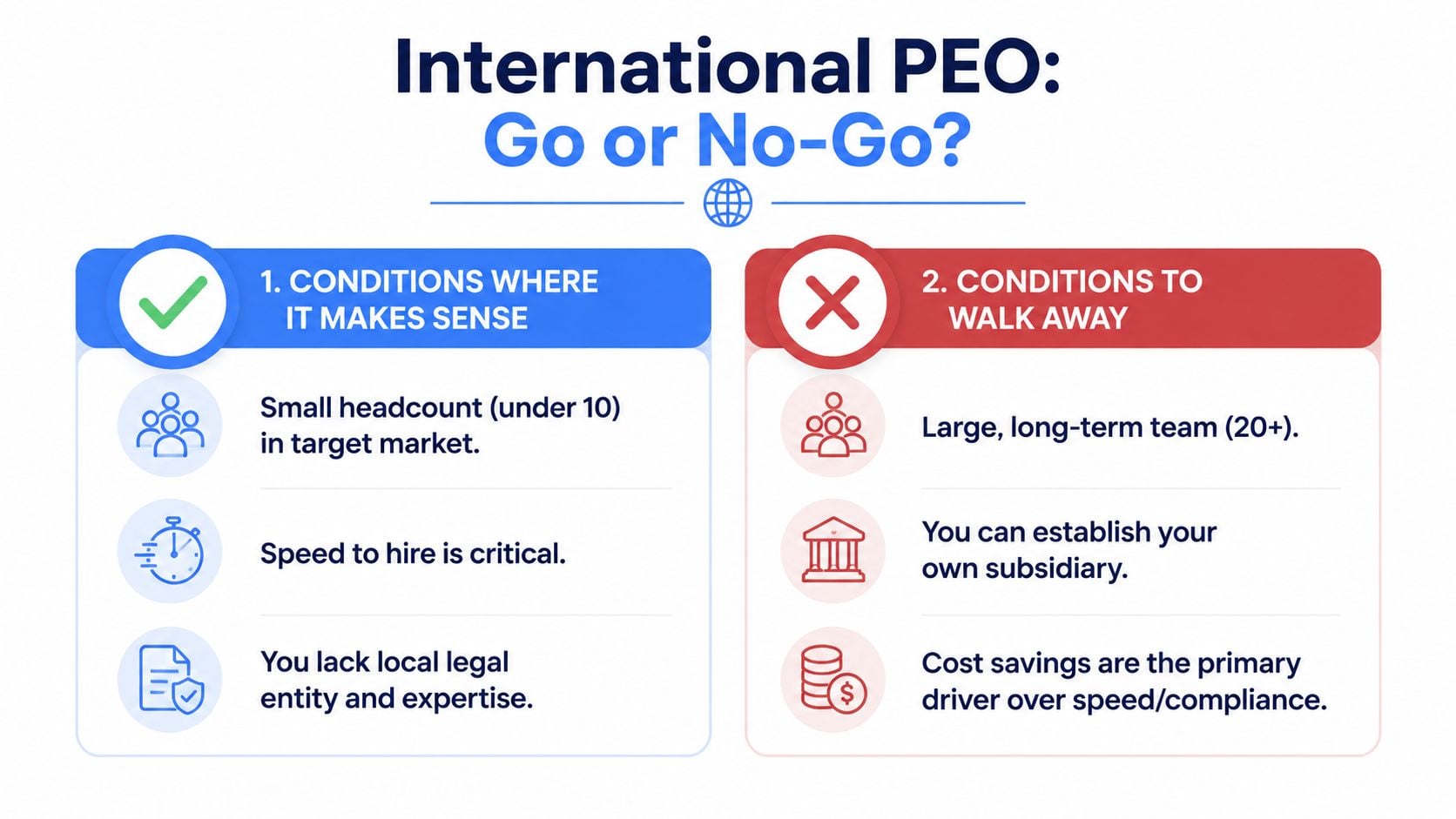
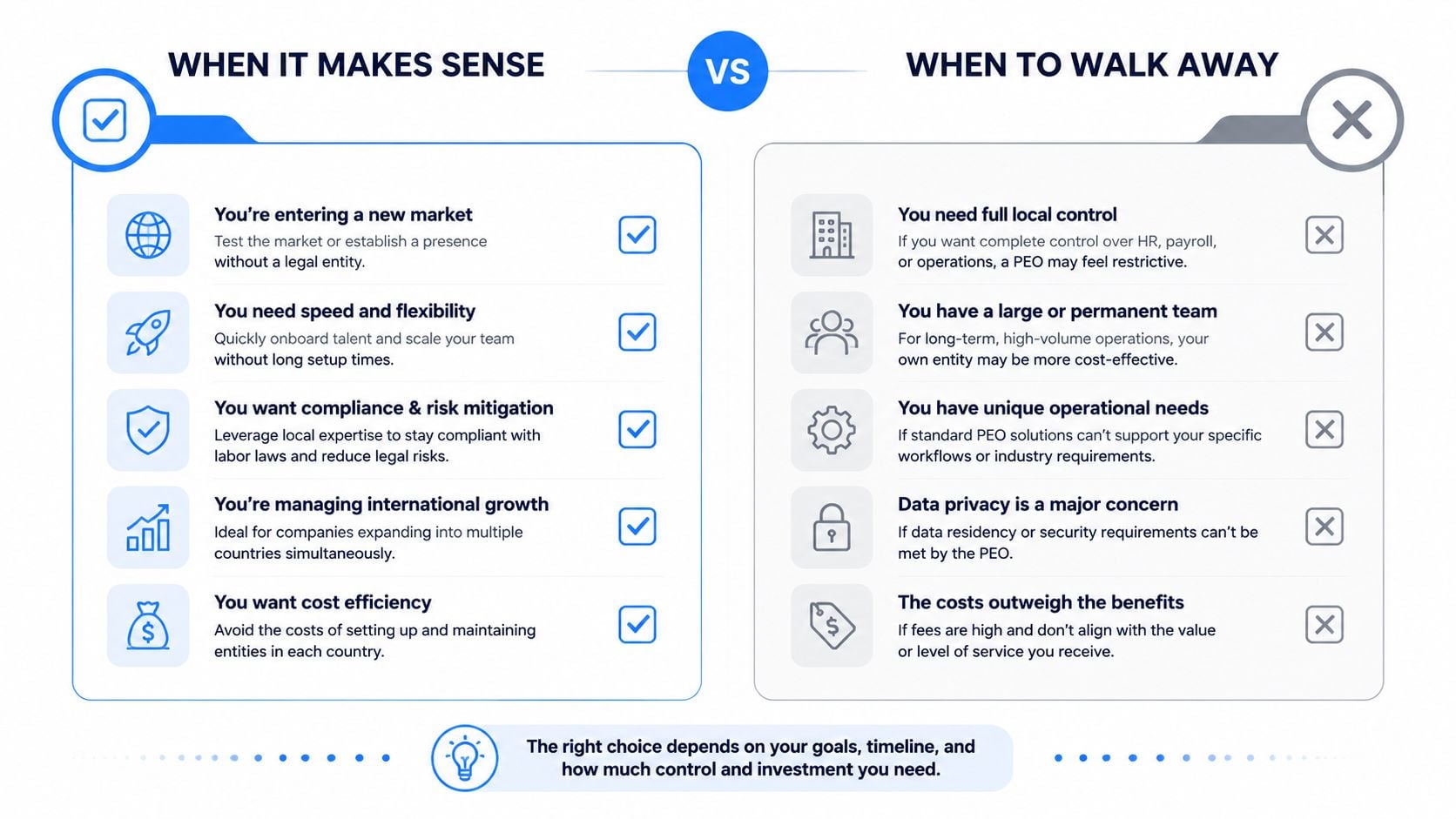
An international PEO makes sense when the company has a small headcount, needs to hire quickly, and is testing a market without a guaranteed long-term volume. It also fits countries where entity formation would consume disproportionate legal and administrative effort compared with the immediate hiring need. In those cases, the provider's local employment infrastructure can let the business validate demand before committing to a permanent structure.
The model is less attractive when a company expects sustained headcount above 50 employees in one country. At that point, management should model an entity, direct benefits strategy, local HR capability, and the tax consequences of continuing through an intermediary. A PEO also deserves skepticism when the company needs highly customized compensation, complex equity tax structuring, or licenses that the provider can't legally hold.
Regulated industries require particular caution. A PEO can employ a worker, but it may not be able to satisfy licensing, supervision, capital, or regulated-activity requirements for the client's business. Permanent establishment risk can also outweigh payroll convenience if the company maintains a long-term local operation through an EOR without revisiting its corporate structure.
The protective move is straightforward: negotiate a clean exit clause with a defined transition period and data-portability rights. The agreement should require delivery of employment records, payroll history, benefits data, tax documents, and employee communications in usable formats. It should also prevent the provider from making transition cooperation contingent on an undefined extra charge.
The decision rule is simple. Use an international PEO to buy speed, local administration, and flexibility during an uncertain expansion. Walk away when the company needs permanent control, deep customization, regulated capability, or a local workforce large enough to justify its own infrastructure.
PEO Metrics helps HR, finance, and leadership teams compare international PEO providers on pricing, benefits, service coverage, compliance support, and contract risk. Visit PEO Metrics to benchmark the total arrangement, identify negotiation priorities, and build a clearer shortlist before signing or renewing an international PEO agreement.
