
The meeting usually starts the same way. The HR director has a turnover report open, the CFO has a spreadsheet open, and both know the company is spending too much time replacing people it already worked hard to hire. The problem isn't awareness. It's that most retention plans still collapse into vague fixes like better culture, more recognition, or another engagement initiative no one can tie to results.
That approach doesn't hold up when the business has 10 employees, and it definitely doesn't hold up when it has 2,000. Leaders need a way to decide where retention is breaking, which intervention deserves budget first, how to measure whether it worked, and how the PEO relationship can either help or get in the way. That's where most companies miss out on significant advantages.
A practical retention strategy works better when it's run like an operating plan. Diagnose the problem. Match the fix to the problem. Measure the financial impact. Then use that evidence when selecting, renewing, or renegotiating a PEO arrangement.
Table of Contents
- Stop Guessing About Turnover and Start Leading with Data
- Diagnose Your Real Retention Problem in Two Steps
- Design High-Impact Retention Programs Not Pizza Parties
- Measure and Report the ROI of Your Retention Efforts
- Use Retention Data to Leverage Your PEO Relationship
- Conclusion Building a Virtuous Cycle of Retention
Stop Guessing About Turnover and Start Leading with Data
A company can feel busy addressing turnover and still make no progress. HR launches recognition campaigns. Managers order lunches. Leadership talks about culture. Meanwhile, recruiting stays overloaded, new hires keep leaving, and finance keeps absorbing the cost in backfills, overtime, training time, and lost output.
The better approach is more operational. Retention needs an owner, a dashboard, and a small set of decisions tied to evidence. That sounds obvious, but many companies still run retention as a collection of disconnected gestures instead of a business process.

What leadership teams usually miss
The CFO sees vacancies, agency spend, and slower execution. The HR team sees managers burning out and candidate quality slipping because the company is always hiring under pressure. Both are looking at the same problem from different sides.
The mistake is treating turnover like one company-wide number. A single headline rate obscures the true problem. In many businesses, the actual problem sits in one tenure band, one department, one location, or under one manager.
Practical rule: If a company can't identify where turnover is concentrated, it isn't ready to fund a retention program. It's only ready to guess.
That is why the strongest retention plans start with diagnosis, move into targeted design, then get reviewed through financial outcomes. Leaders who want a more concrete framework can compare that thinking against this employee turnover reduction model, especially when retention needs to be tied to a PEO-supported HR operating model.
What useful retention work looks like
A disciplined approach to how to improve employee retention usually includes four moves:
- Diagnose the pattern: Break turnover down by department, manager, role type, and tenure.
- Identify the likely cause: Use exit comments, stay interviews, compensation reviews, and onboarding feedback.
- Deploy one targeted fix first: Don't launch five initiatives at once.
- Track business impact: Measure what changed in turnover, recruiting load, manager strain, and replacement cost.
That doesn't mean softer issues don't matter. They do. But they only become useful when they show up in a pattern leaders can act on.
For teams that want more tactical ideas beyond internal dashboards, these actionable tips for workforce retention from Acheloa Wellness, Inc. are a useful supplement because they push leaders away from generic morale talk and toward practical intervention.
Diagnose Your Real Retention Problem in Two Steps
A CFO sees turnover at 24% and approves a retention budget. Six months later, nothing meaningful changes because the company solved the wrong problem. The underlying issue was not culture in the broad sense. It was first-year exits in two frontline teams, both reporting to inexperienced managers, with pay falling behind the local market.
That pattern is common. Companies waste retention dollars when they diagnose at the company level and intervene at the slogan level. The practical fix is simpler. Find where turnover is concentrated. Then confirm why those exits are happening.
Step one starts with segmentation
Start with the last 12 months of exits and cut the data by department, tenure band, manager, location, and role type. The goal is not a perfect theory. The goal is a usable pattern.
A useful first pass answers five questions:
- Where are exits concentrated: customer support, field operations, sales, plant staff, or corporate functions
- When do people leave: first 90 days, first year, after a promotion miss, or after a compensation cycle
- Which managers have outlier turnover: even solid companies often have one or two supervisors driving avoidable loss
- Which exits hurt the business most: high performers, licensed staff, quota carriers, and hard-to-fill roles should be separated from general attrition
- Which PEO-supported populations show the highest churn: if the PEO handles payroll, benefits enrollment, onboarding workflows, or HRIS reporting, use those records to isolate friction points faster
Early tenure deserves close review because it usually points to expensive operational failures: poor role fit, weak onboarding, inaccurate job previews, or manager neglect. Compensation deserves the same scrutiny. Benepass retention statistics note that 35% of employees will actively begin looking for a new job if they do not receive a pay raise within the next 12 months. That does not mean every retention problem is solved with salary increases. It does mean pay pressure should be tested early instead of treated as a taboo topic.
Keep the dashboard plain and decision-ready. If a report looks polished but does not tell a leader where to act first, it is decoration.
| KPI | Metric | Benchmark/Target | What It Tells You |
|---|---|---|---|
| Early-tenure attrition | Exits in first six months | Lower than current baseline | Whether onboarding and role fit are failing |
| Manager-level turnover concentration | Exits grouped by supervisor | Reduce concentration under highest-loss managers | Whether turnover is a leadership issue |
| Department turnover trend | Exits by function over time | Stabilize high-loss teams first | Where interventions should start |
| Compensation-triggered exit themes | Exit and stay interview references to pay | Declining frequency over time | Whether pay is a primary risk factor |
| Regrettable turnover | Loss of strong performers in key roles | Lower than current baseline | Whether the company is losing people it cannot easily replace |
If your PEO provides reporting support, push for segmented turnover files rather than summary headcount reports. That request matters in contract discussions. A PEO that can only produce generic dashboards is harder to justify at renewal than one that helps isolate retention risk by manager, tenure, and benefit plan enrollment.
Step two finds the reason behind the pattern
Once you know where turnover sits, examine why people in those groups leave. Exit interviews can help, but only if someone codes the answers into repeat themes and separates noise from signal. Review 12 months of exits, tag the comments, and rank the top causes by frequency and business impact. In practice, the recurring buckets are usually familiar: manager quality, compensation, schedule strain, role mismatch, limited advancement, or a hiring process that sold the job badly.
Stay interviews are often more useful because they catch risk before the resignation email arrives. Managers should ask direct questions. HR should review the themes centrally so one manager's blind spots do not stay hidden.
Ask employees what could cause them to leave in the next year, what part of the role feels unsustainable, and what next step inside the company would make staying credible.
Policy clarity also affects retention more than many leadership teams admit. If pay practices, attendance rules, promotion criteria, or conduct standards are inconsistent, employees read that inconsistency as favoritism. A stronger foundation often starts with cleaner onboarding documentation and a clearer explanation of employee handbook purpose, especially in companies that grew faster than their management systems.
For teams that want to put numbers around experience-related improvements before they spend money, the HubEngage ROI calculator is a useful planning tool. It helps estimate whether a communication or engagement fix is likely to pay for itself, which is the right question before adding another platform or program.
A good diagnosis ends with two or three prioritized causes, each tied to a specific employee group and a measurable cost. If leaders walk out with ten priorities, they still do not know what is driving turnover.
Design High-Impact Retention Programs Not Pizza Parties
Once leaders know why people leave, the job shifts from diagnosis to capital allocation. During this allocation, many companies waste money. They spread budget across low-friction perks because perks are easy to approve and hard to challenge in a meeting. Turnover does not improve because the root cause was never addressed.
A better approach is to fund the smallest set of programs that can change the loss pattern you found. If early attrition is concentrated in one role family, build onboarding there first. If regrettable exits cluster around underpaid supervisors or licensed specialists, fix those pay bands before launching another recognition campaign. Good retention design is specific, uneven, and sometimes politically uncomfortable.
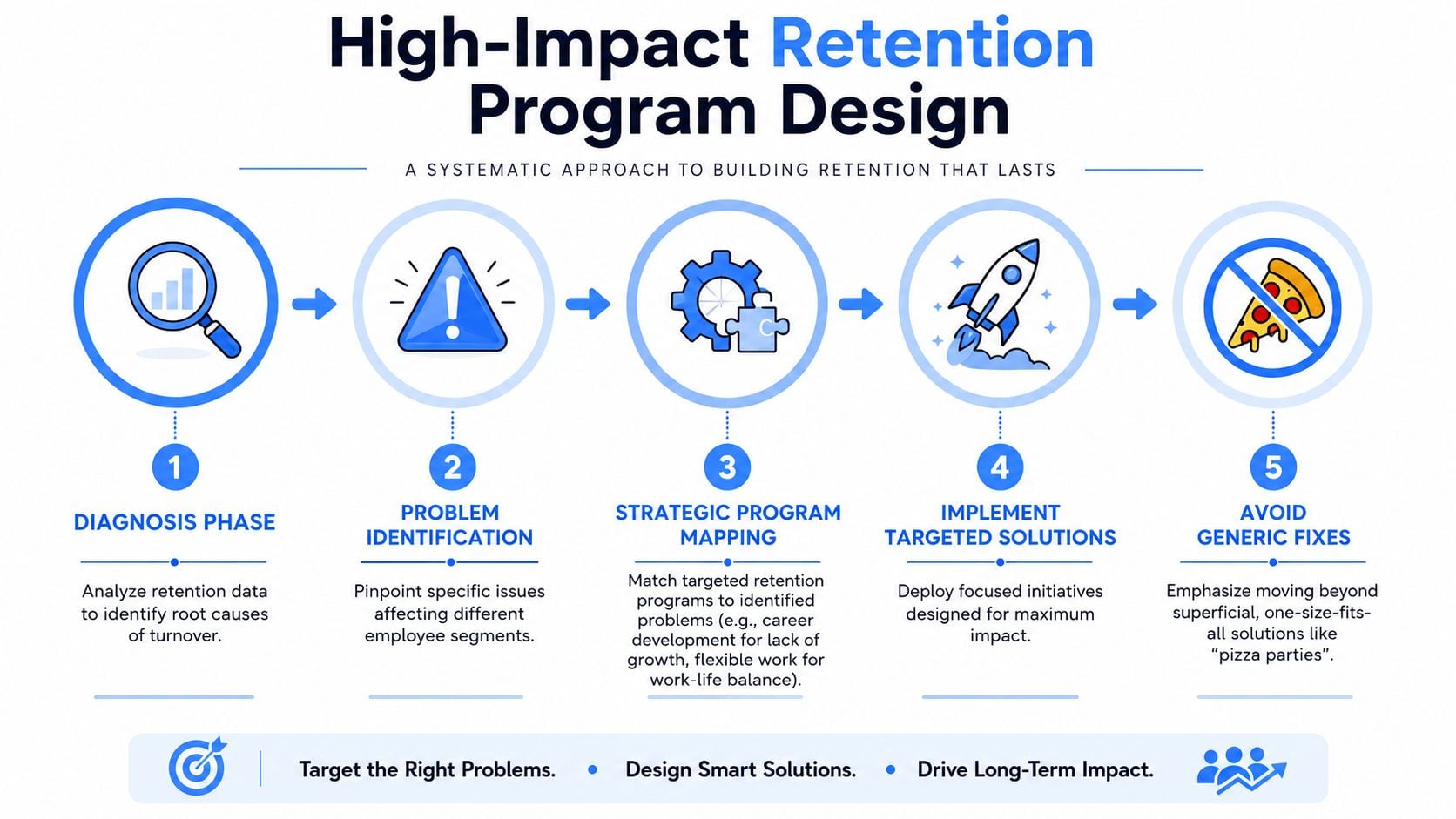
A PEO can help execute these programs, but only if the employer treats the PEO as an operating partner instead of a benefits vendor. The company still owns the retention strategy. The PEO can support rollout through onboarding workflows, benefits communication, policy administration, manager training support, and reporting that shows whether the fix is reaching the intended employee group.
If the problem is early turnover
Employees who leave in the first three months usually are not making a statement about culture. They are reacting to a job that feels unclear, unsupported, or different from what they were sold in recruiting.
A structured first ninety days should include:
- Pre-start preparation: Equipment, systems access, schedule, and a named point of contact before day one.
- Role clarity: Written success metrics for days 30, 60, and 90.
- Manager cadence: Weekly one-on-ones during the ramp period, focused on obstacles and confidence, not just task updates.
- Cross-functional exposure: Introductions to the people new hires will depend on, not only the immediate team.
- New-hire feedback: A formal check-in on surprises, confusion points, and whether the role matches the hiring process.
I have seen companies spend heavily on signing bonuses while skipping basic ramp structure. The result is predictable. New hires get through orientation, hit ambiguity in week three, and start returning recruiter calls by week six.
If the problem is pay pressure
Pay issues show up in two forms. Compensation may be behind the market. Or the package may be fair on paper and badly explained in practice.
A targeted compensation response usually includes three moves:
- Benchmark critical roles first. Focus on jobs with repeat turnover, poaching pressure, or long time-to-fill.
- Review compression and internal equity. Long-tenured employees notice when new hires land too close to their pay.
- Translate total rewards into plain language. Employees compare what they understand, not what sits in a plan document.
This is one place where the PEO relationship can either help or hurt retention. A strong benefits package can retain people, especially when the employer explains the employer contribution, plan quality, leave structure, and retirement support in terms employees can use. A weak explanation turns a decent package into a source of frustration. Leadership teams that need to assess that part of the offer should understand what PEO benefits mean for employees and employers.
If the problem sits under a specific manager or department
Some turnover patterns are local. One supervisor burns through analysts. One plant manager creates scheduling chaos. One department head hoards information and calls it high standards.
Company-wide programming will not fix that.
Targeted manager intervention should focus on observable behaviors and a short review window:
- One-on-one quality: Whether managers ask useful questions and remove blockers.
- Feedback discipline: Whether performance issues are raised early and clearly.
- Career visibility: Whether employees can see a realistic next step inside the team or company.
- Work allocation: Whether strong performers are carrying an unfair share of difficult work.
- Consistency: Whether rules, flexibility, and recognition are applied evenly.
Generic leadership training often makes executives feel productive without changing retention. A narrower intervention works better. Pick the managers or departments with the highest regrettable loss, define the few behaviors that must change, and use the PEO's HR support team to document expectations, coach managers, and track whether exits in that group decline.
The standard for a retention program is simple. It should solve a specific loss problem, reach the employees at risk, and be operational enough for the PEO and internal managers to run without improvising every step.
Measure and Report the ROI of Your Retention Efforts
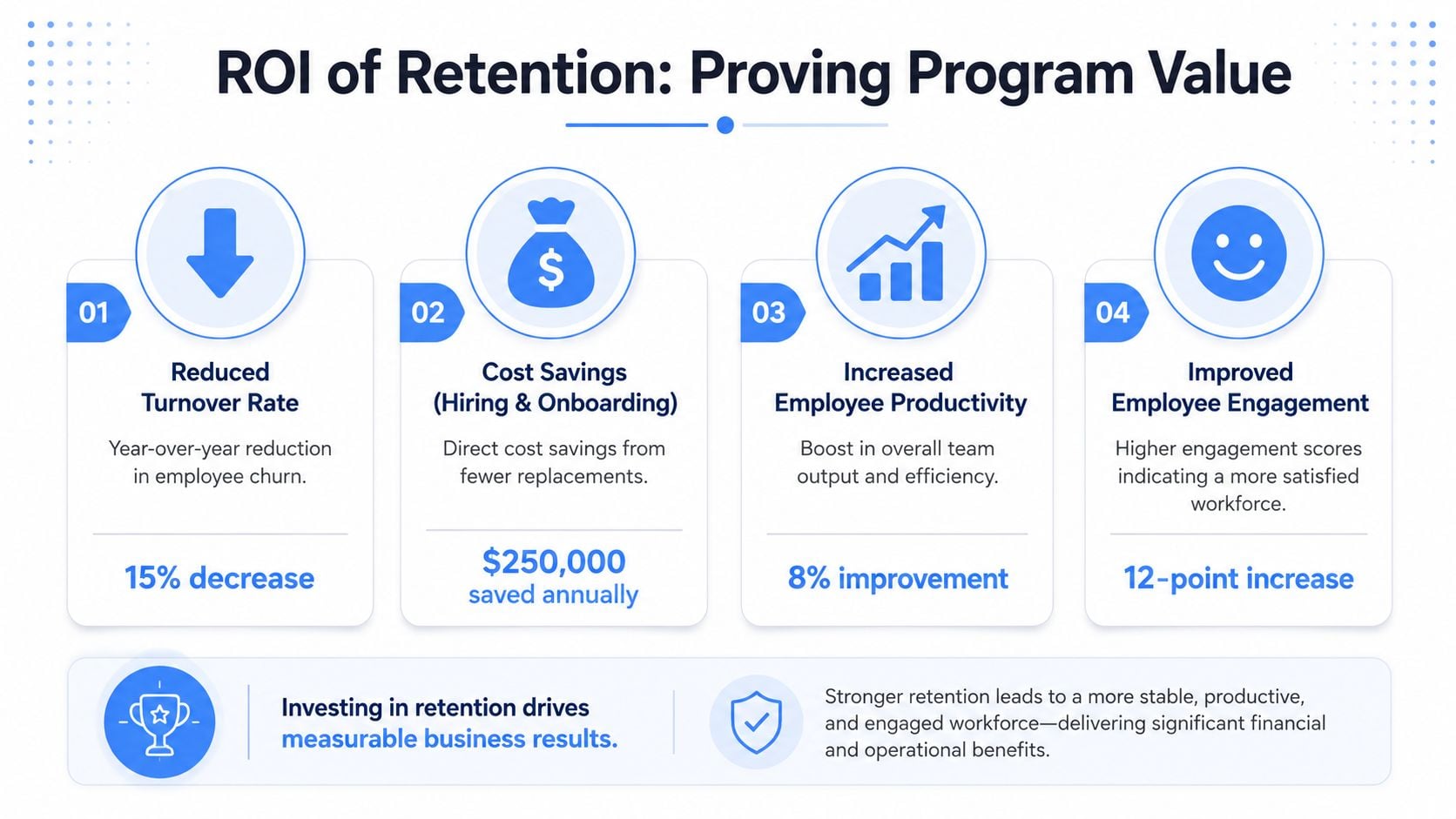
Retention work loses support when it sounds important but stays financially vague. CFOs don't need a lecture on why turnover is disruptive. They need a defensible view of what the company spent, what changed, and whether the intervention earned another round of budget.
That means every retention initiative needs an operating baseline, a post-intervention review window, and a simple cost model.
Build a finance-ready turnover cost model
A practical turnover cost formula doesn't need to be academic. It needs to capture the categories leadership already understands:
- Recruiting cost: Job ads, recruiter fees, agency support, interview time.
- Onboarding and training cost: HR time, manager time, training materials, systems setup.
- Lost productivity: The gap between a vacant role, a ramping replacement, and a fully effective employee.
- Team disruption: Overtime, project delay, customer friction, or rework carried by others.
A company can assign its own dollar values to those buckets by role. For example, if replacing a mid-level employee costs $50,000 in recruiting, training, and lost productivity, preventing three such exits preserves $150,000. That example isn't a universal benchmark. It's a planning model. Its value is that it forces HR and finance to use the same math.
For teams that want a separate planning tool to pressure-test broader workforce experience investments, the HubEngage ROI calculator can be a useful reference point.
Use a one-page reporting format
The best retention reporting fits on one page. It should show the before state, the intervention, the after state, and the financial implication. If the summary needs fifteen slides, it probably isn't decision-ready.
A strong one-page summary includes:
| Reporting element | What to show |
|---|---|
| Problem statement | The turnover issue identified in the diagnostic stage |
| Target group | Which department, manager group, or tenure band was addressed |
| Intervention | What changed, such as structured onboarding or compensation review |
| Time window | When the company measured before and after |
| Financial impact | Replacement cost avoided, reduced recruiting load, or lower overtime burden |
Finance lens: If a retention program can't show which cost category it is expected to reduce, it is still an idea, not an operating decision.
This reporting discipline also strengthens broader outsourcing decisions. Leaders comparing service models often benefit from reviewing the wider benefits of HR outsourcing because retention gains often depend on whether internal HR has the bandwidth to execute consistently.
Use Retention Data to Leverage Your PEO Relationship
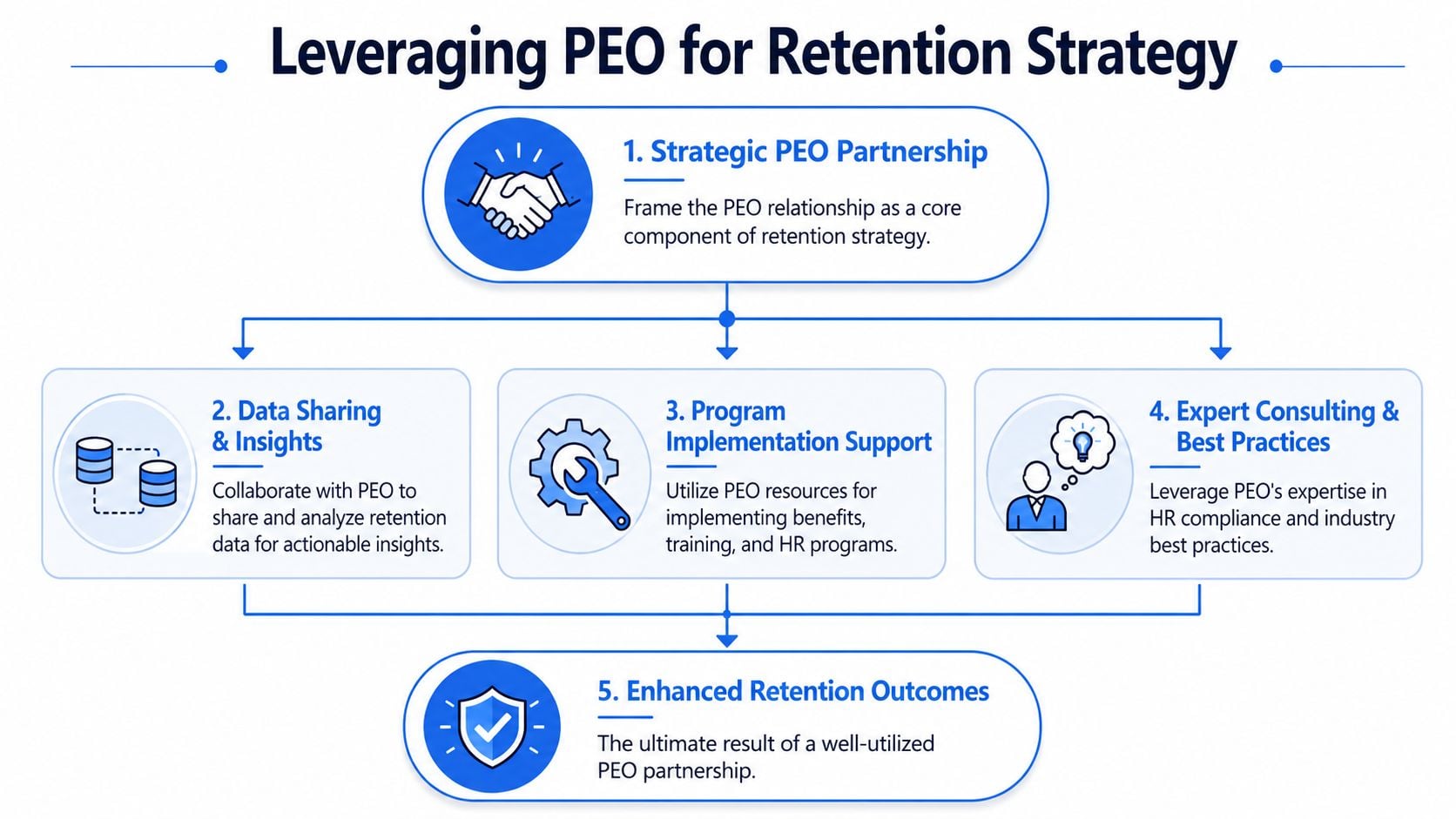
Many employers underuse their PEO because they treat it as payroll infrastructure with better benefits. That leaves value on the table. A strong PEO can support onboarding workflows, compensation benchmarking, benefits communication, manager training resources, and HR process consistency. A weak one can slow all of that down.
Retention data makes the difference visible. Once a company knows where people are leaving and why, it can judge the PEO relationship based on whether the provider is helping solve those problems or processing transactions around them.
Use the PEO as an execution layer
A PEO should be evaluated against the company's actual retention priorities.
If early attrition is the issue, ask whether the provider's platform supports structured onboarding tasks, manager check-ins, policy acknowledgments, and clean reporting on new-hire completion. If compensation pressure keeps appearing in exits, ask what salary benchmarking support is available and how current that market data is. If employees question benefits quality, compare not just premiums but plan design, network strength, employee contribution structure, and how clearly the provider helps communicate the offering.
The same applies to manager enablement. Some PEOs offer practical learning modules, compliance training, and advisory support that managers use. Others offer libraries that look good in a demo and sit untouched.
A smart buyer also asks how well the PEO can segment reporting. A provider that can't help leadership view turnover, enrollment patterns, and workforce trends by location, department, or employee class is harder to use as a strategic partner.
Bring retention evidence into the renewal conversation
Retention data becomes a negotiating advantage when it is specific. General dissatisfaction won't move contract terms. Evidence sometimes will.
Use direct questions like these in PEO selection or renewal discussions:
- Benefits fit: Our exit themes point to benefits dissatisfaction. How do your health plan options compare for employers in our size range and labor market?
- Compensation support: We need stronger pay benchmarking in several roles. What data sources and advisory support do you provide?
- Onboarding execution: We are addressing early-tenure exits. Show how your system supports a structured first ninety days.
- Manager support: We have turnover concentrated in specific teams. What training or advisory resources help front-line managers improve retention?
- Reporting quality: Can your platform help us isolate turnover and workforce trends by manager, location, and tenure band?
Those questions change the conversation. They force the provider to respond to business outcomes, not just feature lists.
A company can also use improved workforce stability as part of the commercial discussion. If retention is improving and operational risk is lower, that should inform how the employer thinks about administrative fees, renewal protections, service expectations, and contract concessions. The point isn't to demand arbitrary discounts. The point is to negotiate from a more informed position. This is especially relevant when reviewing PEO benefits negotiation leverage because retention outcomes often strengthen the employer's case for better terms.
The best PEO conversations start with internal evidence, not provider promises.
Conclusion Building a Virtuous Cycle of Retention
Turnover usually behaves like a loop. People leave, managers absorb more work, onboarding gets rushed, morale slips, and the next round of exits gets easier. Companies that want to break that cycle need more than good intentions. They need a repeatable method.
The strongest approach to how to improve employee retention is straightforward. Audit turnover in a way that shows where the problem sits. Pair the intervention to the cause instead of launching broad morale campaigns. Measure the cost impact in terms finance can defend. Then use that evidence to make the PEO relationship more useful and more accountable.
That last step matters more than many employers expect. A PEO can either reinforce retention strategy or undermine it through weak onboarding support, thin reporting, poor benefits fit, or limited advisory depth. Leaders who bring retention data into the provider discussion make better decisions than leaders who buy based on demos and sales language.
For additional perspective on how labor mobility and retention pressures are showing up in practice, these Australian job mobility insights from Corporate Challenge Events add useful context. Companies that are revisiting the broader operating model behind retention may also benefit from a PEO workforce governance playbook, especially when HR, finance, and operations need shared accountability.
The first move doesn't need to be dramatic. Pick one metric from the dashboard. Track it for the next ninety days. If leadership can get honest about one retention problem, it can usually solve the second one faster.
PEO decisions get easier when the numbers are clear. PEO Metrics helps employers compare providers, benchmark pricing and benefits, and negotiate stronger contract terms with less guesswork.
