
Most advice about an employee leasing company starts with a neat definition and a list of benefits. That's backwards. Buyers rarely get into trouble because they misunderstood the dictionary meaning. They get into trouble because they signed a contract without understanding who controls benefits, how workers' compensation is structured, what fees can change at renewal, and how expensive the exit can be.
That's the core decision. An employee leasing company can solve painful HR, payroll, benefits, and compliance problems. It can also create a new layer of cost and dependency if the deal is poorly scoped. For HR directors, CFOs, and owners, the useful question isn't “What is a PEO?” It's “What will this relationship cost over time, and which terms matter enough to negotiate before signature?”
Table of Contents
- Untangling the Terminology Employee Leasing PEO and ASO
- The Business Case When to Consider an Employee Leasing Model
- The Real Trade-Offs Weighing the Pros and Cons
- The True Cost How Employee Leasing Companies Are Priced
- Your Due Diligence Checklist Before Signing a Contract
- Frequently Asked Questions About Employee Leasing
Untangling the Terminology Employee Leasing PEO and ASO
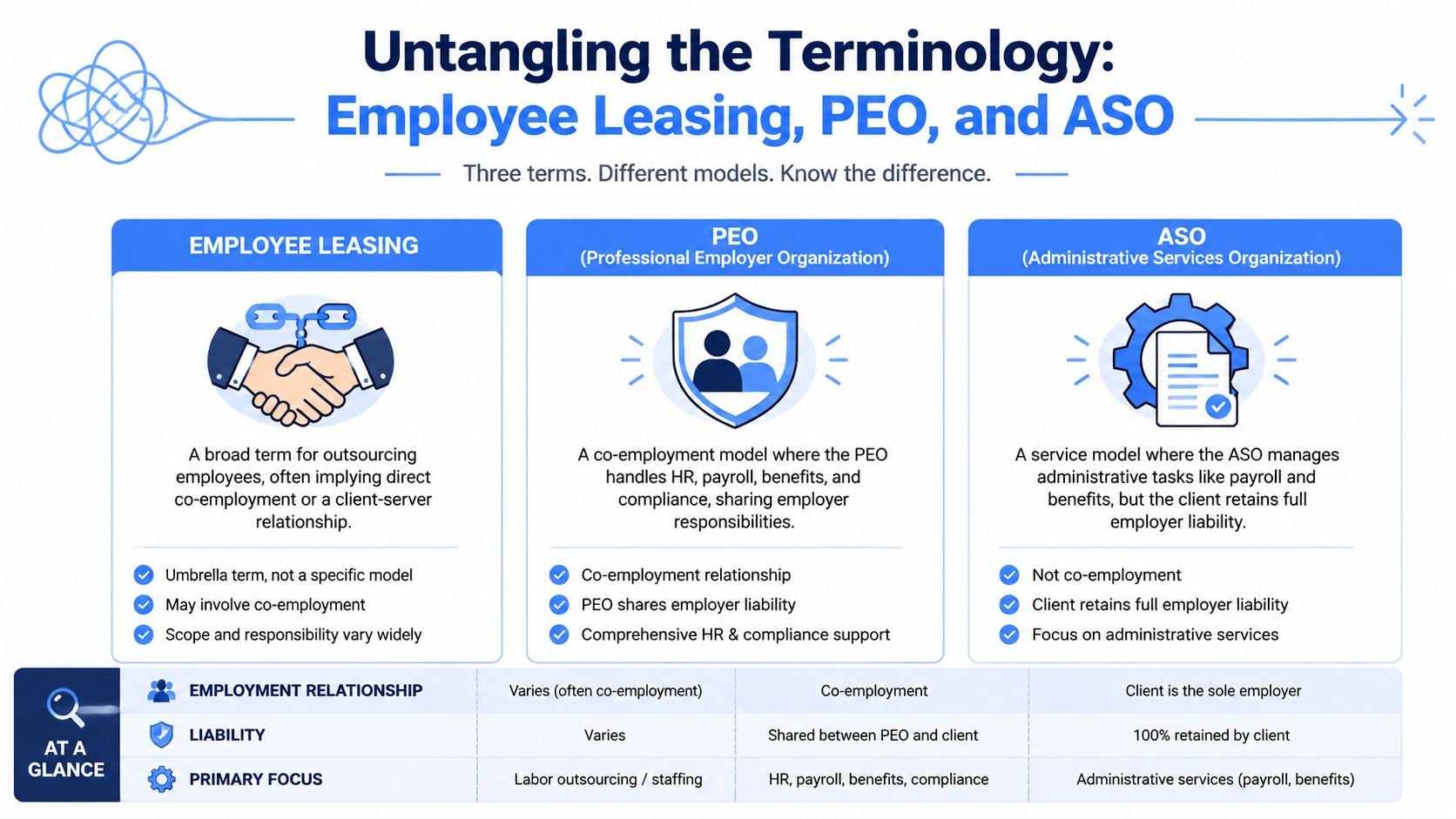
The term employee leasing company confuses buyers because it sounds like a separate category. In practice, it often points to the same operating model buyers see labeled as a PEO. The National Council on Compensation Insurance notes that a PEO may also be referred to as a labor contractor or employee leasing company, and that workers' compensation is often written under a master policy, which shows how tightly the terms overlap in actual insurance and regulatory use through NCCI's PEO and employee leasing guidance.
A cleaner way to think about it is this. The client company still runs the business. The provider runs much of the employment infrastructure. Managers direct daily work, set priorities, and handle performance. The leasing provider or PEO handles payroll, employment taxes, benefits administration, and often workers' compensation administration under a co-employment structure.
Why the terms blur together
For many buyers, “employee leasing” is the search term, but the actual vendors under review are PEOs. That matters because the legal and service model is more specific than the phrase suggests. The relationship is usually co-employment, not a simple outsourcing handoff.
A useful analogy is a building lease. The client occupies and operates the space. The infrastructure owner maintains major systems, sets certain rules, and handles functions the occupant doesn't want to build alone. The comparison isn't perfect, but it helps buyers understand why control is shared rather than transferred.
A provider can remove administrative burden without removing management responsibility. If the client wants day-to-day control, that won't disappear in a PEO model.
For a deeper primer on the terminology itself, this overview of what employee leasing means is a useful companion.
A practical way to separate PEO from ASO
The distinction that matters most is usually liability and policy structure.
A PEO typically works inside a co-employment model. The provider may sponsor benefits, process payroll under its framework, and coordinate workers' compensation through a shared policy structure. That can offer advantages and efficiency, but it also means the client has to live within the provider's operating system.
An ASO usually handles administrative tasks without becoming a co-employer in the same way. The client retains more direct responsibility and often more control.
A simple comparison helps:
| Model | Day-to-day supervision | Payroll and HR admin | Benefits structure | Employer liability posture |
|---|---|---|---|---|
| Employee leasing / PEO | Client | Provider handles much of it | Often through provider-sponsored framework | Shared or coordinated |
| ASO | Client | Provider supports admin | More client-directed | More retained by client |
That's why an employee leasing company shouldn't be evaluated as a label. It should be evaluated as an operating and contract model.
The Business Case When to Consider an Employee Leasing Model
The buyer who gets the most value from an employee leasing company usually isn't shopping for HR theory. That company has hit an operating threshold. Internal staff are stretched, compliance complexity has increased, or the current benefits setup no longer supports hiring and retention.
This isn't niche anymore. The U.S. Census Bureau reported that the employee-leasing industry included 3,769 businesses, covered 2.7 million workers, and generated $177.8 billion in revenue in 2017, according to the Census Bureau's review of worker leasing as a major business category. That scale signals a mainstream labor-services market, not a fringe workaround.
A smaller employer that needs infrastructure fast
A smaller company often reaches the same moment. Hiring is up. Payroll errors create employee friction. Leadership is still approving every benefit decision because nobody owns the process. The office manager became the accidental HR department.
At that point, the appeal of a PEO-style employee leasing company is straightforward:
- Benefits access: The company may gain access to a stronger benefits framework than it can build alone.
- Administrative relief: Payroll, tax filings, onboarding workflows, and routine HR support move out of the founder's or controller's inbox.
- Manager capacity: Supervisors spend less time chasing forms and more time running teams.
A practical summary of these HR outsourcing benefits helps frame when that shift makes sense.
A larger employer that needs focus not more headcount
A mid-sized or larger company usually comes to the model for a different reason. It already has HR capability. What it lacks is bandwidth. Multi-state payroll, leave rules, workers' compensation coordination, and benefit administration begin to consume the team's calendar.
A common pattern looks like this:
| Company situation | What pushes the decision |
|---|---|
| Growing across states | Payroll tax and compliance administration become harder to manage manually |
| High claims sensitivity | Workers' compensation oversight needs more structure |
| HR team buried in transactions | Leadership wants HR focused on recruiting, performance, and retention |
Practical rule: If internal HR spends most of its time fixing payroll, answering routine benefits questions, and chasing compliance paperwork, the company is already paying for fragmentation. It just isn't paying one vendor invoice for it.
For some employers, the move is temporary. For others, it becomes a long-term operating model. The trigger is rarely size alone. It's whether the company still wants to build the infrastructure itself.
The Real Trade-Offs Weighing the Pros and Cons
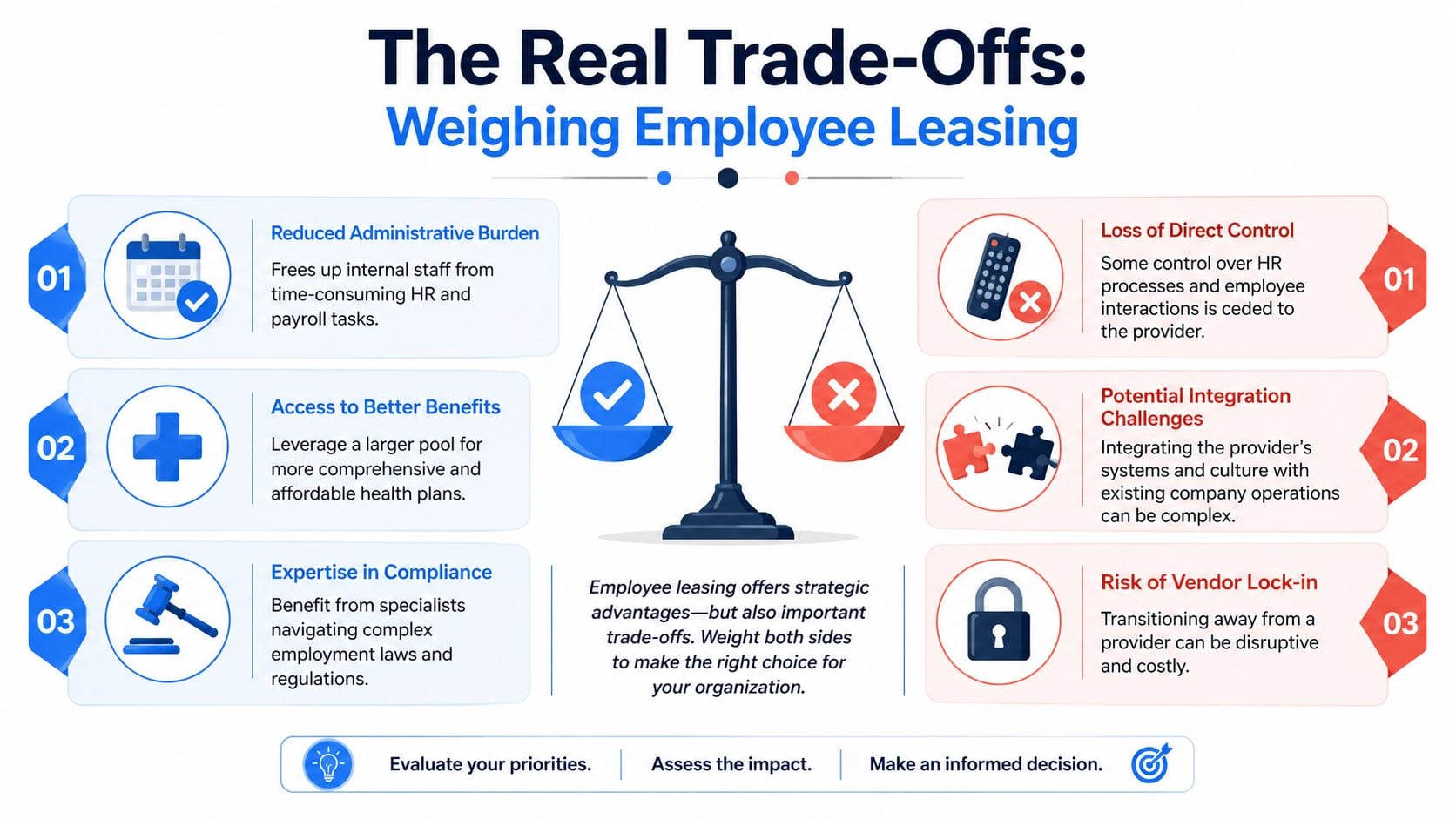
Employee leasing works best when leadership accepts that this is a trade, not a magic trick. The company gains scale, process, and outside infrastructure. In return, it gives up a degree of autonomy. Buyers who treat the arrangement like a pure cost-saving tool usually miss the operational consequences.
Where the model works well
The strongest advantage is concentration of expertise. Payroll tax filings, onboarding workflows, handbook support, benefits administration, and workers' compensation coordination sit in one operating system instead of being split across a broker, payroll platform, internal HR, and outside counsel.
That consolidation often improves response time and accountability. Employees know where to submit payroll or benefits questions. Managers have a process. Finance gets cleaner billing and fewer stray vendor relationships.
Another major benefit is access. A smaller employer may not have the resources or internal team to build a competitive benefits package on its own. A larger employer may prefer not to spend internal resources negotiating every detail when a provider already has the infrastructure.
Where the friction usually shows up
The same structure creates the first real downside. Standardization helps the provider operate efficiently, but clients often discover that “flexibility” has limits. If the company wants a highly customized enrollment process, a unique leave administration approach, or a nonstandard reporting format, the answer may be no or yes with added cost and delay.
Control also changes in subtle ways. Employees may still identify with the client company, but payroll documents, benefit materials, and support channels often carry the provider's systems and processes. If implementation is sloppy, employees feel like they've been moved into someone else's machine.
A short contrast captures the trade-offs better than a generic pros-and-cons list:
| Gain | What comes with it |
|---|---|
| Centralized HR administration | Less freedom to run one-off processes |
| Better benefits infrastructure | Less direct control over plan design and renewal strategy |
| Compliance support | Need to follow the provider's workflows and timelines |
| Outsourced transactions | Dependence on vendor service quality |
Buyers should assume that any convenience gained through standardization will reduce customization somewhere else.
A more detailed review of PEO pros and cons is useful when a team needs to pressure-test its essential criteria.
The final trade-off is exit risk. An employer that lets all HR operations, benefit administration, and payroll knowledge live inside the vendor relationship may later find that unwinding the arrangement is harder than expected. That doesn't make the model bad. It means the transition plan matters on day one, not just on the day the contract ends.
The True Cost How Employee Leasing Companies Are Priced
The cheapest quote often becomes the most expensive deal.
That happens because employee leasing is rarely priced on one clean line item. Buyers see an administrative fee in the proposal, then discover that benefit premiums, workers' compensation treatment, payroll taxes, implementation work, and contract-driven increases matter more over a two or three year term. The essential task is not comparing sticker prices. It is tracing how money moves through the arrangement and which terms let that cost drift later.
Start with the pricing model, then audit what sits outside it
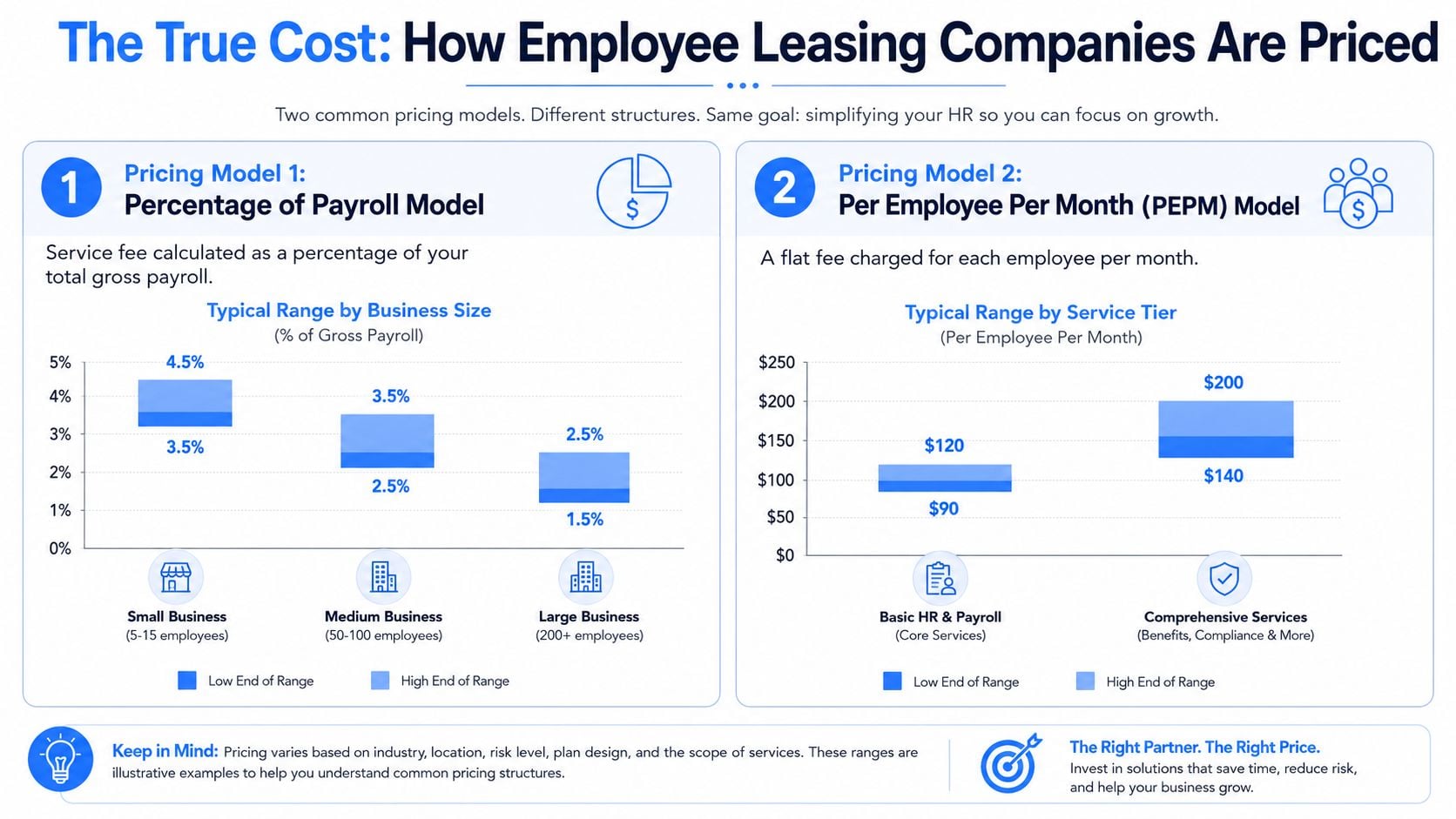
Two fee structures show up again and again.
- Percentage of payroll: The provider charges a fee tied to gross payroll. This can look reasonable at signing, then climb fast when wages rise, overtime increases, or the company adds higher-paid roles. The service effort may stay flat while the fee grows anyway.
- Per-employee pricing: The provider charges a fixed amount per worker each month. Finance teams usually prefer this because forecasting is cleaner and invoice review is simpler. The trade-off is that companies can end up paying for a broad bundle of services they only partly use.
Neither structure is a problem by itself. Problems start when buyers compare one vendor's percentage fee to another vendor's per-head fee without normalizing the rest of the proposal.
The biggest dollars often sit outside the base charge. Benefit premiums can move at renewal. Workers' compensation can be billed through different rating methods. Implementation may be quoted separately. Off-cycle payrolls, year-end processing, compliance projects, and custom reporting may trigger extra fees that never made it into the headline number.
In practice, I tell clients to model employee leasing as a total labor administration cost, not as an HR subscription.
That point hits harder in labor-sensitive operations. A restaurant group already focused on hitting restaurant labor targets can see a payroll-based fee rise with overtime and premium pay, even if the underlying HR service has not changed. For those operators, pricing method affects margins, not just administrative overhead.
The contract terms that change cost over time
The fee page matters. The boilerplate often matters more.
Review these clauses line by line:
- Renewal mechanics: Check when rates can change, how much notice the provider must give, and whether pricing resets automatically at renewal.
- Pass-through cost definitions: The contract should say which expenses are billed at cost, which include markup, and which can be repriced during the term.
- Benefit renewal authority: Confirm who controls plan changes, contribution changes, and carrier substitutions, and how those decisions flow through to your invoice.
- Workers' compensation methodology: Ask whether pricing is based on pooled rates, class codes, loss history, audits, or midyear adjustments.
- Implementation fees: Sales teams sometimes describe onboarding as included when data conversion, payroll setup, or parallel runs are separate charges.
- Termination and runout fees: Early termination charges, notice periods, COBRA administration, and final payroll support can turn exit into an unplanned expense.
A low admin fee with loose pass-through language is not a low-cost deal. It is a hard-to-forecast deal.
How to compare proposals without fooling yourself
The cleanest comparison is an all-in model built from your current state. Include internal payroll labor, HR staff time, broker fees, benefit administration costs, workers' compensation structure, software subscriptions, implementation cost, and likely renewal exposure. Then price each employee leasing proposal against that baseline under the same assumptions.
Use more than one scenario. A flat-growth year may favor one pricing model. A year with wage inflation, hiring, overtime spikes, or richer benefits may favor another. Buyers usually find the gap between vendors widens once those variables are tested.
For a grounded benchmark, this guide on how much a PEO costs is a useful starting point. The contract still decides whether the quoted price stays close to that starting point after month six, after renewal, and during exit.
Your Due Diligence Checklist Before Signing a Contract
A polished demo won't answer the questions that matter. Due diligence should focus on what breaks in live operation. Payroll timing. Benefit issue escalation. multi-state compliance ownership. Renewal mechanics. Offboarding support. If the provider can't answer those clearly, the contract risk is already visible.
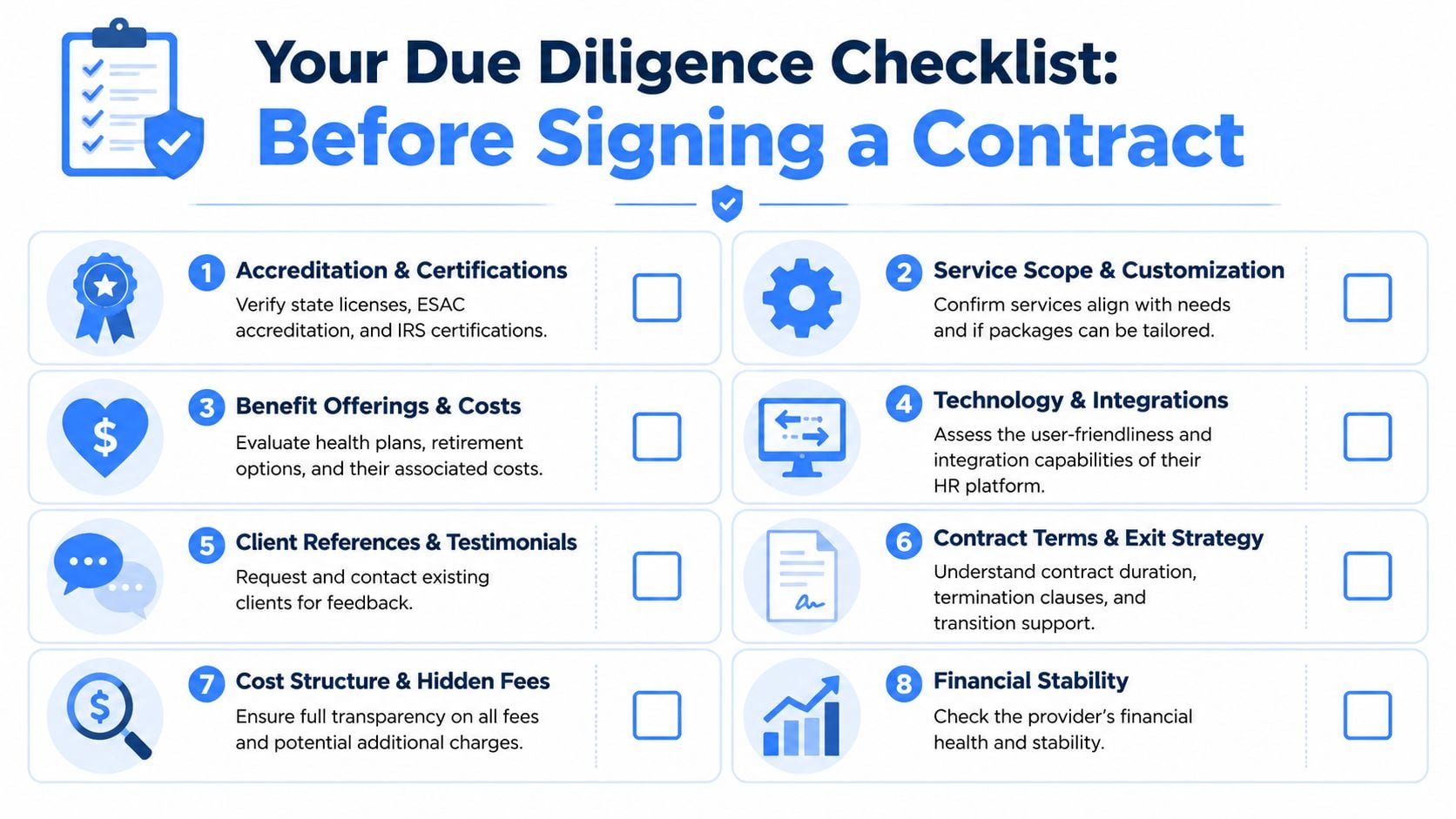
Questions that uncover service risk
Start with the day-to-day model. Buyers don't need broad promises. They need names, workflows, and escalation paths.
- Who handles the account: Ask whether the company gets a dedicated team, a named specialist by function, or a general service queue. A good answer identifies roles, not just departments.
- How employees get help: Ask what happens when an employee has a payroll problem the day before a holiday weekend. A good answer describes channels, response ownership, and escalation timing.
- What the platform does: Request a live walkthrough for onboarding, payroll approvals, time reporting, benefits enrollment, and reporting exports. A good answer shows the exact workflow your managers and employees will use.
- How implementation is managed: Ask who owns data migration, payroll mapping, benefits setup, and testing. A good answer includes a project plan, responsibilities, and handoff structure.
A buyer-side framework like this PEO due diligence checklist can help organize vendor meetings and keep every provider answering the same questions.
Questions that uncover compliance and contract risk
The compliance review has to go beyond general assurances. One issue that deserves direct attention is leased employee treatment under IRS rules. Under Section 414(n), a leased employee may be treated as a common-law employee for benefit plan purposes if the worker provides more than 1,500 hours in a year, according to this summary of employee leasing and IRS treatment. That makes benefit eligibility handling, plan administration, and classification processes worth reviewing in detail.
Ask direct questions such as:
| Ask this | Good answer sounds like |
|---|---|
| How are benefit eligibility and leased employee rules handled? | The provider can explain process, exceptions, and who reviews edge cases |
| How is workers' compensation structured? | The provider can explain policy structure, client reporting, and audit handling clearly |
| What can change during the term? | The contract identifies rate changes, pass-through adjustments, and notice requirements |
| What happens on exit? | The provider can describe termination notice, transition support, and data return |
The contract review should also test the less glamorous items that create real pain later:
- Data ownership: The client should know how employee records, payroll history, and reports will be delivered at termination.
- Runout support: COBRA, tax filings, and claims issues don't disappear the day the relationship ends.
- Subcontracting: Buyers should ask whether any core service is delivered by another party the client never met during the sales cycle.
Ask every vendor the same hard questions in the same order. That's how weak answers become obvious.
One practical option for companies that want outside help structuring those comparisons is PEO Metrics, which provides side-by-side analysis of PEO pricing, benefits, contract terms, service model, and risk flags.
Frequently Asked Questions About Employee Leasing
Will employees feel like they work for someone else
They can, especially if the rollout is treated as a back-office change instead of a management communication job.
Employees usually do not care who processes payroll nearly as much as they care about whether pay stays accurate, benefits are explained clearly, and someone can answer questions on day one. When those basics are handled well, the provider stays largely invisible. When they are handled poorly, employees start wondering who their employer really is.
The company should stay front and center. Managers should explain the reason for the change, what will change for employees, what will not change, and where to go for help. Culture, performance management, and day-to-day supervision should still come from the client company.
How hard is it to leave an employee leasing arrangement
Leaving is rarely a technical problem first. It is usually a contract problem, then an execution problem.
The hard parts show up in the details. Payroll history has to move cleanly. Open benefit issues still need owners. Tax filings, claims questions, and workers' compensation matters can continue after the relationship ends. If the agreement is vague on transition support, a simple exit gets expensive fast.
The best time to negotiate an exit is before the relationship starts. Buyers should know the notice period, any termination fee, how data will be returned, who handles runout items, and how long the provider will support the transition after termination.
Is this only for small businesses
No.
Smaller employers often use employee leasing because they need HR and payroll infrastructure without building a full internal team. Mid-sized and larger employers use it for different reasons. Common drivers include multi-state payroll complexity, uneven HR processes across locations, benefits administration that has outgrown the internal staff, or a decision to shift transactional work outside the company.
Headcount matters less than operating complexity.
How should buyers compare quotes from different providers
Put every quote into the same cost buckets before comparing anything. If one proposal bundles administration into a single percentage and another breaks it into fees, benefit charges, workers' compensation, setup costs, and pass-through expenses, the cheaper quote may only look cheaper on page one.
A useful comparison shows at least five things: fixed admin fees, variable payroll-based charges, benefit costs, workers' compensation structure, and contract terms that can change the price later. Renewal language matters. Minimums matter. Off-cycle payroll fees, year-end charges, and implementation costs matter. So do fee floors that stay in place after headcount drops.
I have seen buyers focus on the starting rate and miss the clauses that changed the economics six months later.
What is the clearest sign that a buyer should keep looking
A provider that cannot answer direct pricing and contract questions in plain language.
If the sales team avoids specifics on what is included, what is passed through, what can increase during the term, or what support continues after termination, the buyer does not have a usable proposal. A good provider can explain those points clearly without hiding behind a generic spreadsheet or a polished demo.
If a company wants outside help comparing fee structures, benefits, service models, and contract risk across providers, PEO Metrics is one option for independent evaluation and quote review before signing.
