
A finance lead usually starts the search for PEO services near me after something breaks. Payroll questions pile up. Health plan renewals get harder to compare. A manager hires one remote employee in another state, and suddenly the company needs wage-and-hour guidance, tax registration help, and a support team that answers quickly when a deadline is close.
That search feels practical. It also points many companies in the wrong direction. The closest PEO isn’t always the safest fit, the most cost-effective option, or the easiest partner to scale with if the workforce expands across state lines. For companies with 10 to 2,000 employees, the better approach is to treat PEO selection like a vendor-risk decision, not a local directory search.
Table of Contents
- Why ‘PEO Services Near Me’ Is the Wrong First Question
- How to Identify Potential PEO Partners
- Creating Your PEO Request for Proposal RFP
- Beyond the Price Tag Analyzing PEO Contracts for Hidden Risks
- How to Negotiate a Stronger PEO Agreement
- Your Next Steps After Signing the PEO Agreement
Why ‘PEO Services Near Me’ Is the Wrong First Question
The phrase PEO services near me sounds harmless. It isn’t. It assumes geography should drive vendor selection before the company has defined its actual risk profile.
A local provider can absolutely be the right choice. Fast callbacks, face-to-face meetings, and a more personal service model matter. But those advantages only help if the provider can support the company’s hiring footprint, benefits strategy, reporting needs, and compliance exposure.
The broader market makes that point clear. The U.S. Professional Employer Organization Services Market nearly doubled from USD 88.14 million in 2018 to USD 174.70 million in 2024, with between 780 and 980 PEOs operating nationwide, according to Credence Research’s U.S. PEO market analysis. A buyer isn’t choosing between a few firms in driving distance. The buyer is choosing among hundreds of models, service structures, and risk tolerances.
Fit matters more than ZIP code
A company with one office and a stable local workforce may value in-person service above all else. A company with remote hires, field staff, or plans to expand doesn’t have that luxury. Once employees spread across jurisdictions, the search stops being local procurement and turns into an operating model decision.
A better first question is this: What problem is the PEO expected to solve?
That answer usually falls into a handful of categories:
- Compliance coverage: Multi-state tax filings, handbook support, wage-and-hour guidance, leave administration, and workers’ compensation coordination.
- Benefits advantage: Access to stronger plan options, enrollment support, and cleaner administration.
- Payroll reliability: Fewer manual steps, clearer reporting, and a faster path to issue resolution.
- HR capacity: Support for onboarding, policy administration, and employee relations processes.
Practical rule: If the business risk sits in compliance, benefits, or multi-state operations, distance should rank below capability.
Define the operating reality first
An HR director and CFO should map the current state before contacting providers. Count active states. Identify pain points from the last two payroll cycles. List open compliance questions. Flag upcoming events like renewals, acquisitions, or remote expansion.
That internal inventory does more for vendor selection than another local search page. It also prevents a common mistake. Buyers often confuse familiar with safe. A nearby provider may feel easier to manage, but a poor fit creates more work after implementation, not less.
For companies weighing broader HR outsourcing options, this comparison of HR outsourcing providers near you is a better starting point than a map pack. It shifts the conversation from proximity to service model.
How to Identify Potential PEO Partners
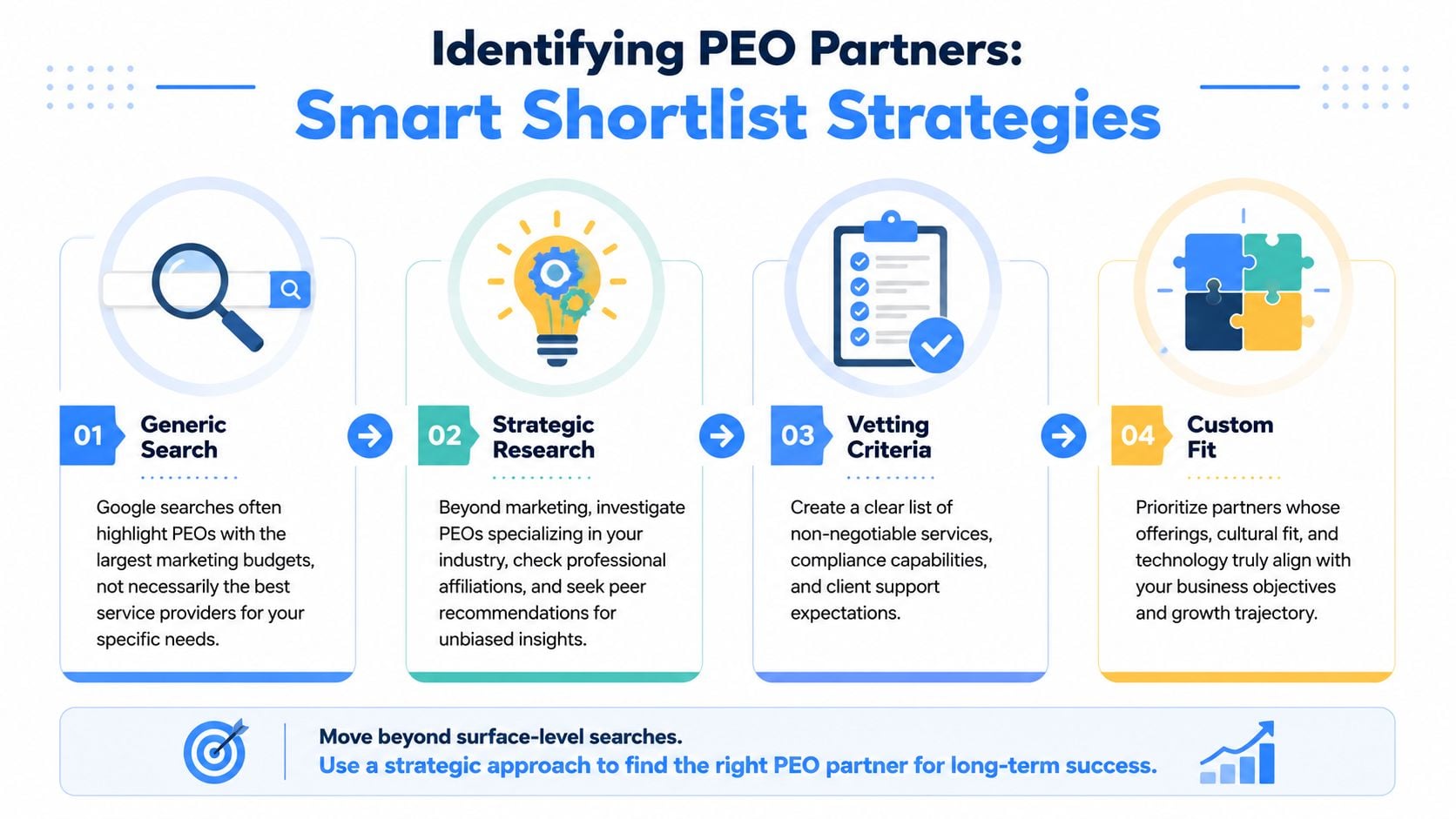
Search results favor marketing budgets. That doesn’t tell a CFO who answers urgent payroll questions, who can support a four-state workforce, or who can deliver a clean implementation without surprise work on the client side.
A smarter shortlist starts with the business model, then the provider list.
Start with a shortlist, not a search result
The best candidate list usually comes from four places:
Trusted professional referrals
Ask the company’s CPA, benefits consultant, outside employment counsel, or portfolio operating partner which PEOs they’ve seen perform well for similar employers.Industry fit checks
A construction firm, a medical practice, and a software company won’t value the same service model. Workers’ compensation handling, EPLI support, and onboarding complexity differ by employer.Independent provider directories
A broad list of professional employer organizations helps buyers see beyond the handful of brands that dominate paid search.Current-state constraints
Existing payroll tools, time systems, broker relationships, and benefits expectations should narrow the field quickly.
Use a local versus national scorecard
Regarding this, most buyer guides remain vague. The trade-off is real.
While 68% of SMBs search locally, multi-state employers increasingly prioritize compliance consistency. Local PEO response times can be as low as 4 hours versus 48 hours for some national providers, but national PEOs handle 50+ states versus a local’s 1 to 3, according to ProResources’ discussion of common PEO questions.
That doesn’t mean local is better or worse. It means the company needs a scorecard.
| Evaluation factor | Local PEO | National PEO | What the buyer should ask |
|---|---|---|---|
| Service responsiveness | Often stronger | Often more layered | Who responds to payroll errors and by when |
| Multi-state compliance | Usually limited | Usually broader | Which states are actively supported today |
| Benefits breadth | Can be narrower | Can be broader | Which medical, dental, and retirement options are standard |
| Technology depth | Varies widely | Often more standardized | What integrations exist for payroll, time, and HRIS |
| Relationship model | More personal | More process-driven | Will there be one service team or rotating contacts |
A practical example makes the choice clearer. Consider a 75-employee technology company with staff in four states. The local PEO may win on response time and executive access. The national PEO may win on state registrations, leave compliance consistency, and employee self-service tools. If the company expects to keep hiring remotely, compliance reach probably outweighs local convenience. If headcount will stay concentrated and management wants high-touch support, the local provider may still be the better pick.
A PEO that answers quickly but can’t support the company’s operating footprint creates a different kind of delay. The issue just shows up later, during a state filing, claim, or audit question.
When building a shortlist, buyers should score each provider on service model, state coverage, benefits structure, implementation readiness, and contract flexibility. Proximity can be one line on the sheet. It shouldn’t be the top one.
Creating Your PEO Request for Proposal RFP
Most PEO quote requests fail because they ask broad questions and receive polished answers. That doesn’t help when finance needs side-by-side numbers and legal needs to compare actual obligations.
A usable RFP forces specificity.

What a usable RFP has to force into the open
For companies evaluating PEOs, pricing needs to be separated into components. Administrative fees should never be blended into benefits assumptions or buried inside broad “platform” language.
The minimum standard is clear. An RFP should demand unbundled quotes that itemize one-time onboarding or implementation fees ranging from $500 to $2,000, and annual compliance fees that can start at $2,500, based on Native Teams’ breakdown of PEO pricing structures.
That matters because two providers can look similar in a sales meeting and produce very different first-year costs once implementation, compliance, and pass-through fees are added.
A useful RFP packet usually includes:
- Employee census: Headcount by state, compensation bands, class codes where relevant, and current benefit enrollment.
- Payroll profile: Pay frequency, current payroll system, timekeeping setup, and filing complexity.
- Benefits expectations: Medical plan richness, contribution philosophy, renewal timing, and broker involvement.
- Service requirements: Dedicated rep, support hours, onboarding help, and issue-escalation expectations.
- Contract preferences: Desired term length, renewal treatment, and exit notice expectations.
For plan comparison work, this guide to how to compare health plans is useful because benefits are often the hardest line item to normalize across PEO proposals.
Questions that produce comparable proposals
A strong RFP doesn’t ask, “What do you charge?” It asks for numbers in a format that can be audited.
Use questions like these:
- Pricing structure: State the administrative fee as a flat per-employee-per-month amount, a percentage of payroll, or both if offered.
- Implementation costs: Identify all onboarding, setup, migration, and training charges. Note whether any are waived and under what contract terms.
- Pass-through costs: Specify which costs are billed separately, including benefit premiums, payroll tax items, claims handling, and optional HR services.
- Service team design: Name the roles assigned after implementation. Clarify whether payroll, benefits, and HR support come from one pod or separate queues.
- Timeline: Provide an implementation schedule with milestones for data transfer, payroll setup, benefit enrollment, and first live payroll.
Buyer note: If a provider won’t supply a sample invoice, the proposal still isn’t specific enough.
An RFP should also ask for sample agreements, sample invoices, and a redlined explanation of anything the provider considers standard and unchangeable. That separates firms that are ready for enterprise-style review from firms that rely on verbal reassurance.
Beyond the Price Tag Analyzing PEO Contracts for Hidden Risks
The monthly admin fee gets attention because it’s easy to compare. The contract language matters more because that’s where cost creep and exit friction usually live.
Many companies don’t discover this until they try to renegotiate, leave, or challenge an invoice increase.
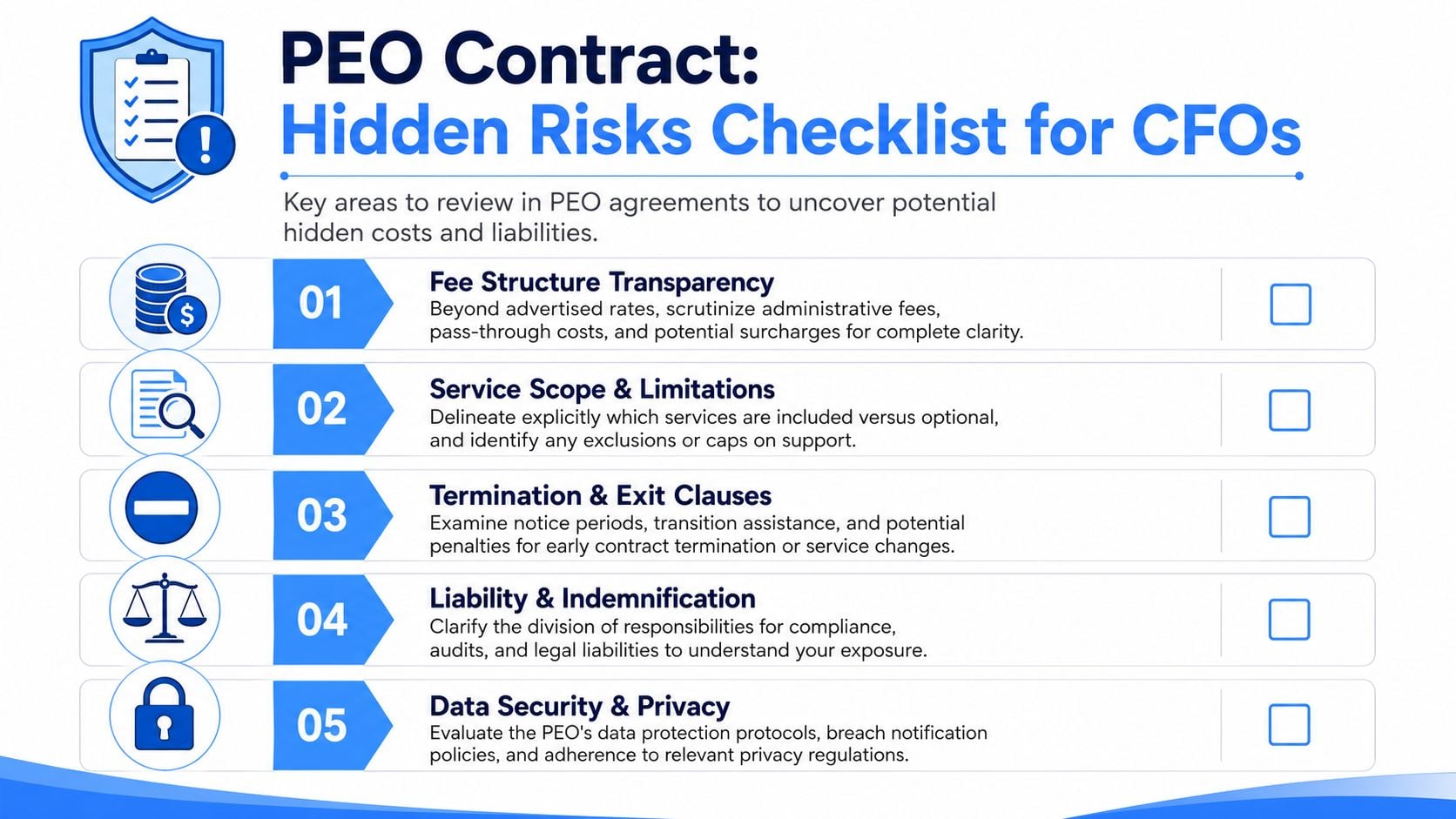
Three clauses that deserve CFO-level review
The warning signs aren’t obscure. They’re often sitting in ordinary service agreements under headings that sound routine.
First, fee escalation. A 2025 Napeo survey found 72% of buyers renegotiated PEO contracts due to surprise fee hikes, and 41% of PEOs increased fees by 5 to 8% annually after signing, according to Foothold America’s guidance on selecting a PEO partner. If the agreement doesn’t define the increase process clearly, finance should assume the provider kept flexibility for itself.
Second, exit terms. The same source notes that exit terms can cost SMBs 15 to 22% more than projected. That extra cost may come from transition support charges, short notice windows, residual benefit obligations, or implementation costs that have to be repaid if the contract ends early.
Third, liability language. Co-employment doesn’t mean the PEO absorbs every employment risk. Buyers need plain-English language on who handles tax issues, claims administration, unemployment disputes, workers’ compensation coordination, and employment-practices defense support.
What contract review should look like in practice
A finance team should review the PEO agreement like any other material vendor contract. Legal, HR, payroll, and operations all need to read the same document because each function sees different risk.
A useful checklist includes:
- Renewal mechanics: Does the contract auto-renew. Is there a rate cap. Is notice required to dispute changes.
- Termination rights: What notice period applies. Are there transition charges. Does the provider commit to data handoff support.
- Fee definitions: Are administrative charges fixed, adjustable, or tied to payroll changes. What counts as an out-of-scope service.
- Insurance and claims support: What coverage is included. What is only coordinated. What remains fully with the employer.
- Data access: How quickly can payroll and employee records be exported if the relationship ends.
Contract review works better when the company applies the same discipline it uses in other vendor categories. This resource on protecting your business with vendors is useful because PEO risk isn’t only HR risk. It’s also procurement, legal, privacy, and operational risk.
Contract reality: The cheapest proposal on the pricing sheet can become the most expensive agreement when the exit language is weak.
For buyers that want a structured review process, a PEO contract risk audit guide can help organize red flags before signature instead of after a dispute starts.
How to Negotiate a Stronger PEO Agreement
Once proposals are comparable and the contract issues are visible, the advantage shifts. Negotiation stops being a generic pricing discussion and becomes a risk-allocation exercise.
That is where many buyers leave money and protection on the table.
Use market benchmarks carefully
For companies with 10 to 2,000 employees, the average PEO administrative cost is approximately $100 to $120 per employee per month, according to People Managing People’s PEO cost benchmark. That benchmark isn’t a universal price cap. It is a reference point.
If a provider quotes well above that range, the buyer should ask why. Sometimes the answer is legitimate. The quote may include a broader service package, a higher-touch support model, or a more expensive risk profile. But the provider should be able to explain the premium in writing.
Negotiation works better when finance responds with direct language:
“This quote sits above the market benchmark for employers in our size band. Please break out what is driving the difference between the administrative fee, bundled services, and any pass-through costs.”
That one sentence forces specificity. It also makes it harder for a sales team to defend a high price with broad value claims.
Terms worth pushing on before signature
A stronger PEO agreement usually comes from five pressure points, not one.
Rate stability
Ask for a defined rate-lock period or a written cap on annual increases. If the provider won’t cap increases, ask for a narrower review standard and more notice before renewal.Implementation relief
Request a waiver or credit for onboarding costs, especially if the company is moving on a provider-driven timeline or bringing meaningful headcount.Clear indemnification language
If responsibility is shared, the contract should say exactly where the PEO’s obligations start and stop. Buyers can use this guide to PEO indemnification negotiation tips to sharpen those redlines.Service accountability
Ask for named support roles, response expectations, and an escalation path. A “dedicated team” should mean more than a sales promise.Exit predictability
Push for cleaner termination rights, practical transition support, and a defined process for returning payroll and employee data.
Some concessions won’t show up unless the buyer asks twice. Providers often have flexibility on implementation credits, contractual cleanup, renewal language, and service commitments, even when they present the first draft as standard.
The key is to negotiate the relationship the company will live with, not just the launch price.
Your Next Steps After Signing the PEO Agreement
A signed agreement doesn’t solve anything by itself. The return comes from implementation discipline, internal ownership, and early issue resolution.
The companies that struggle after signing usually don’t have a weak PEO alone. They also don’t have a clean internal process.
The first month sets the tone
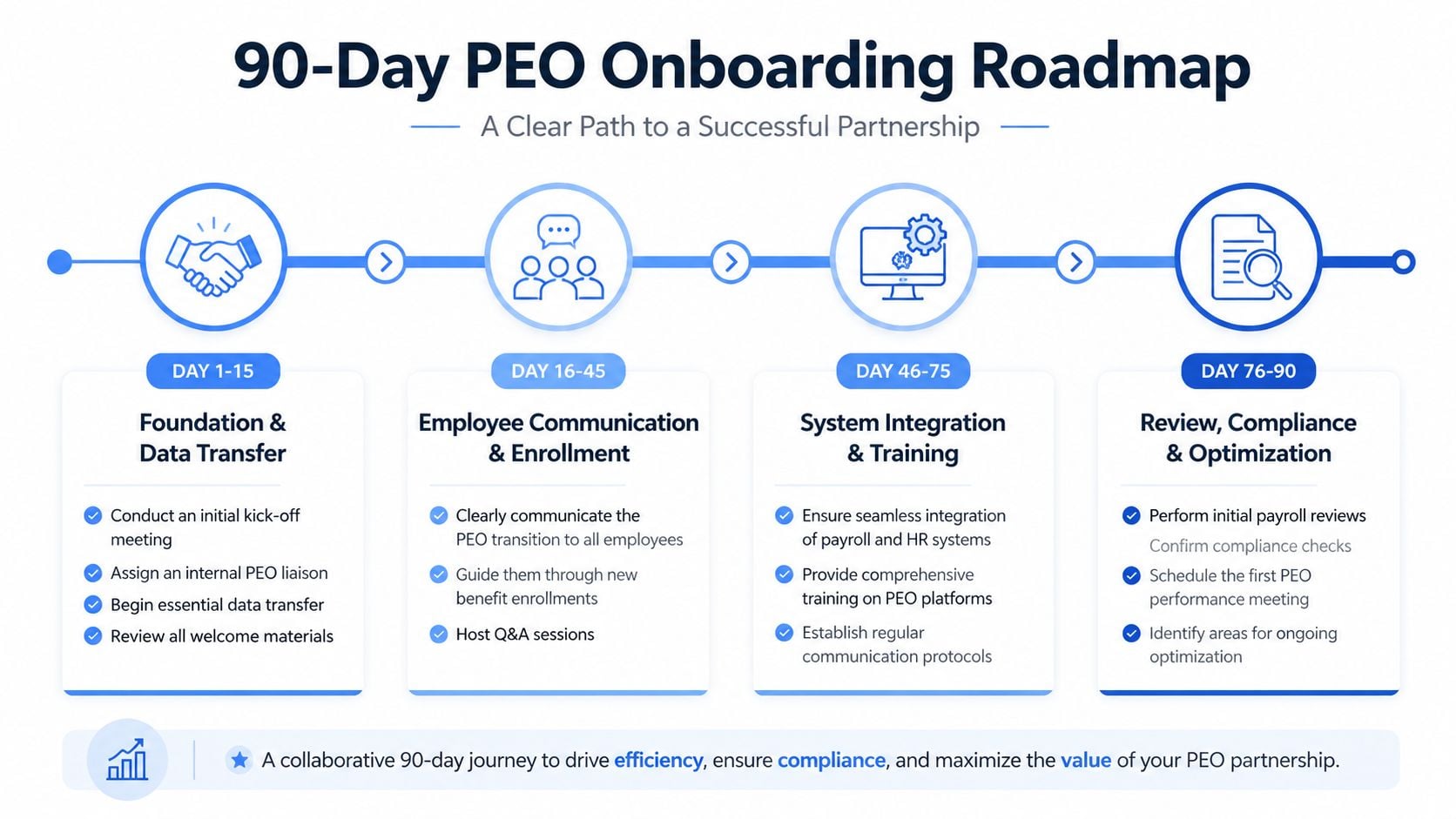
A structured implementation process matters. A vetted selection and rollout process uses six steps, from internal assessment to onboarding, and following that structure correlates with a 92% service-quality retention rate among SMB clients, based on Paychex’s explanation of the PEO implementation process.
During the first phase, leadership should assign one internal owner. That person coordinates payroll data, employee census files, benefits elections, tax information, and access to existing systems. Without one decision-maker on the client side, implementation drifts.
The company should also communicate the change clearly to employees. Staff don’t care about co-employment theory. They care about pay dates, benefit enrollment, who to contact, and whether anything is changing on forms or portals.
What leadership should review before the first quarter ends
A practical first-quarter checklist looks like this:
- Payroll accuracy: Review the first live payroll closely and reconcile tax treatment, deductions, and reporting outputs.
- Benefits administration: Confirm enrollment files, carrier feeds, and employee elections match what was promised during selection.
- Support quality: Track whether service requests are routed correctly and answered by the assigned team.
- Compliance follow-through: Verify state registrations, notices, handbook updates, and required workflows are complete.
- Renewal readiness: Save implementation documents and pricing schedules now. They become essential at the first renewal.
The best time to prepare for a future renegotiation is during onboarding, when the company still remembers what the provider promised.
A stable PEO relationship needs quarterly review, not just annual renewal attention. If service slips, fees drift, or business complexity changes, leadership should address that before the next contract cycle locks in.
Companies comparing PEOs or trying to improve terms on an existing relationship can use PEO Metrics to get an independent view of pricing, benefits, service trade-offs, and contract risk before making a final decision.
