

Most businesses walk into PEO sales calls at a structural disadvantage. The rep across the table has fielded these conversations hundreds of times. You’re doing it for the first, maybe second time. That gap doesn’t stay abstract; it shows up later as a fee you didn’t know was variable, a contract exit that costs more than you budgeted, or a benefits renewal increase that wasn’t in the sales deck.
The questions below are organized by the categories that actually matter: how pricing behaves, what exit looks like, which liabilities transfer under co-employment, what the benefits really are, how the service runs day to day, and what happens to your data. Work through these before any vendor demo and you’ll know exactly what to listen for, and what a vague answer is telling you.
1. PEO Metrics
Best for: Buyers who want to compare provider data before entering sales conversations
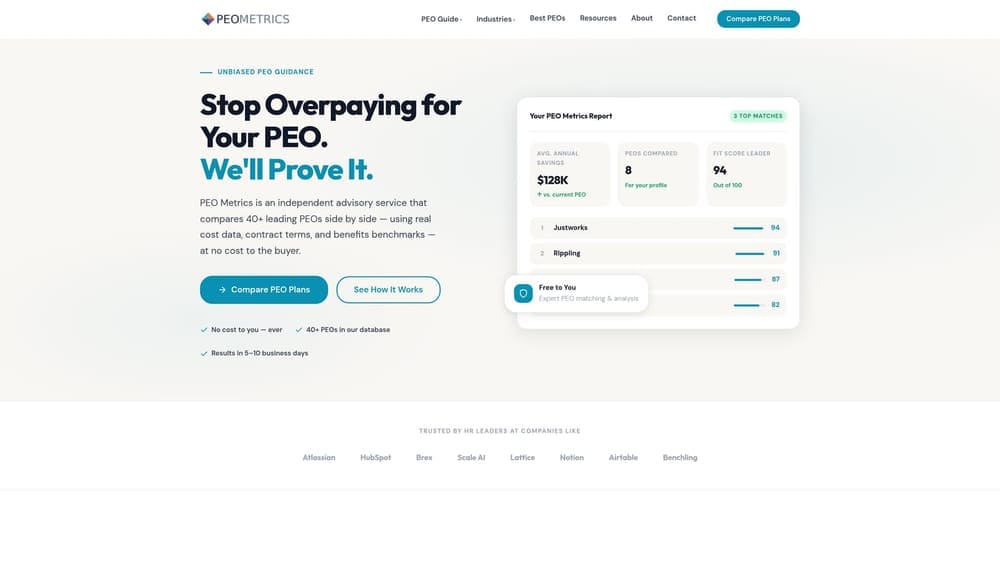
PEO Metrics is a comparison resource that organizes PEO provider data into structured, side-by-side views so you can evaluate vendors on pricing model, contract terms, compliance credentials, and service structure before a rep ever calls you back.
Where This Tool Shines
The typical PEO evaluation starts with a demo, which means you’re learning the vocabulary while the vendor is already in pitch mode. PEO Metrics reverses that sequence. You can see how providers differ on PEPM versus percentage-of-payroll pricing, which ones hold CPEO or ESAC credentials, and how their service models are structured, all before you’ve agreed to a single follow-up call.
That upfront context changes the quality of every conversation you have afterward. Instead of asking a rep to explain what ESAC accreditation means, you’re asking why their renewal rate history isn’t disclosed in the comparison view. Those are very different conversations.
Key Features
Side-by-side provider comparisons: Structured views that put pricing model, contract terms, and compliance credentials in the same frame across multiple vendors.
Pricing model breakdowns: Distinguishes PEPM from percentage-of-payroll pricing across providers so you can see how costs will scale with your headcount and payroll.
Compliance credential tracking: Flags which providers hold CPEO certification from the IRS and ESAC accreditation, both verifiable trust signals that many buyers don’t know to ask about.
Answer interpretation guidance: Helps you understand what a provider’s response to a specific question actually signals, not just whether they answered it.
Pre-signing mismatch identification: Surfaces structural differences between providers that are easy to miss during a sales call but significant once you’re under contract.
Best For
HR leaders, CFOs, and business owners who are in active evaluation mode and want to walk into vendor conversations with a clear picture of how providers differ. Particularly useful if you’re comparing more than two vendors at once or if this is your first time buying PEO services.
Pricing
[CONFIRM: pricing or access model for PEO Metrics comparison service]
2. Pricing and Fee Structure Questions
Best for: Exposing how a PEO’s fee model actually behaves across payroll changes, headcount shifts, and annual renewals
Fee structure is where the gap between the sales presentation and the actual invoice tends to open up. The questions in this category are designed to make that gap visible before you sign.
Where This Category Matters Most
The PEPM versus percentage-of-payroll distinction sounds technical, but it has a real dollar effect. A percentage-of-payroll model scales with every raise, bonus, and commission you pay. If your payroll grows, your PEO fee grows with it, even if your headcount stays flat. A PEPM model doesn’t work that way. Knowing which structure you’re being quoted, and why the vendor prefers it, is the first question to get on the table.
Workers’ comp is another area where buyers get surprised. Some PEOs bundle workers’ comp premiums into the quoted fee; others bill them separately and conduct annual audits that can result in additional charges. Asking who bears the audit risk, and how any audit adjustments are calculated, is not a detail question. It’s a budget question.
Key Questions to Ask
Is your fee a flat PEPM rate or a percentage of gross payroll? If it’s percentage-based, ask how bonuses, commissions, and overtime are treated in that calculation.
What triggers a mid-contract rate adjustment? Some contracts allow the PEO to adjust rates if your headcount drops below a threshold or if your industry classification changes. Know the triggers before you’re subject to them.
Are workers’ comp premiums included in the quoted fee or billed separately? If separately, ask for the rate basis and how audits are conducted at year end.
How are workers’ comp audits handled, and who bears the audit risk? An audit that results in additional premiums owed is a cost your budget needs to account for.
Are there setup fees, and are they refundable if we don’t proceed? Some providers charge implementation fees upfront. Know whether those are at risk before you write the check.
Best For
Any buyer receiving a first quote, and especially buyers comparing multiple quotes where the fee structures are different. These questions make apples-to-apples comparison possible.
Pricing
N/A. This is a question category, not a paid service.
3. Contract Terms and Exit Questions
Best for: Understanding how difficult and costly it will be to leave if the relationship doesn’t work out
Exit terms are the questions most buyers skip because leaving feels hypothetical during a sales conversation. They stop feeling hypothetical when the relationship isn’t working and you realize the notice window is 90 days and the early termination fee is substantial.
Why These Questions Matter More Than They Seem
Notice requirements and termination fees are often buried in the contract rather than surfaced in the pitch. A vendor who is confident in their service quality should be willing to discuss these terms plainly. One who deflects or minimizes them is telling you something about how they expect the relationship to go.
Benefits continuity at exit is a separate issue and one that catches buyers off guard. Employees on group health coverage through the PEO may face a gap if the relationship ends mid-year outside of a qualifying life event window. That’s not a hypothetical risk for your employees; it’s a real one that affects your decision about when and how to transition.
Key Questions to Ask
What is the minimum contract length? Annual contracts are common, but multi-year agreements exist. Know what you’re committing to.
How much notice is required to terminate, and when does the clock start? Some notice windows are longer than they appear because the clock starts at the next billing cycle, not the day you send the notice.
Are there early termination fees, and how are they calculated? Ask for the formula, not just a yes or no. Flat fees and prorated fees have very different financial implications.
What happens to employee health coverage if we exit mid-year? Ask specifically about the gap between leaving the PEO’s group plan and getting employees onto a new plan, and what COBRA rights apply.
Can we take our workers’ comp loss history with us when we leave? Your loss run history affects your future workers’ comp rates. Some PEOs make this portable; others don’t. Know before you sign.
Best For
Every buyer, regardless of how confident they feel about the vendor. The time to understand exit terms is before you’re bound by them.
4. Compliance and Liability Questions
Best for: Clarifying which employer obligations transfer to the PEO under co-employment and which remain with your company
Co-employment is the legal structure that makes PEO services work, and it’s also the structure that buyers most often misunderstand. Under a PEO arrangement, the PEO becomes the employer of record for tax and benefits purposes while you retain control over day-to-day work direction. That’s different from an EOR arrangement, where the provider is the legal employer and the client has less operational control. It’s also different from an ASO, which handles HR administration without co-employment at all.
What You’re Actually Asking About Here
The compliance questions in this category are designed to make the liability split concrete. Which tax obligations transfer? Which stay with you? What happens when a regulation changes mid-contract? These aren’t abstract questions. They determine your actual exposure if something goes wrong.
IRS Certified PEO (CPEO) status and ESAC accreditation are two credentials worth asking about directly. CPEO status, granted by the IRS under the Small Business Efficiency Act, affects how certain federal employment tax liabilities are treated in the co-employment relationship. ESAC accreditation involves independent financial audits and bonding requirements. Neither is required to operate as a PEO, which is exactly why asking about both is a meaningful differentiator question. (Source: IRS.gov, Certified Professional Employer Organization program documentation.)
Key Questions to Ask
Are you an IRS-certified PEO (CPEO)? If yes, ask what that means for how federal employment tax liabilities are allocated between your company and the PEO.
Are you ESAC-accredited? If yes, ask what the accreditation covers and when it was last renewed. If no, ask what financial assurances the provider offers instead.
Which employer tax liabilities transfer to you, and which stay with us? Get a written summary, not a verbal overview.
How do you handle compliance when we have employees in multiple states? State employment law varies significantly. Ask whether the PEO has experience in your specific states and how multi-state compliance is managed operationally.
What is your process when a state or federal regulation changes mid-contract? Ask who is responsible for identifying the change, who communicates it to your team, and what the timeline looks like.
Best For
Companies with employees in more than one state, businesses in regulated industries, and any buyer who hasn’t previously operated under a co-employment arrangement and needs the liability structure clearly explained.
5. Benefits Questions
Best for: Getting past the benefits brochure to understand the actual carrier relationships, plan quality, and renewal mechanics behind a PEO’s health offerings
The benefits pitch is often the most polished part of a PEO sales conversation, and the part that deserves the most scrutiny. A PEO’s ability to offer competitive health coverage is one of its primary value propositions. But the brochure and the actual plan document are not the same thing.
What the Sales Presentation Often Leaves Out
Many buyers don’t ask which insurance carriers actually underwrite the health plans. The PEO’s name is on the enrollment materials, but the carrier behind the plan determines network quality, claims handling, and out-of-network costs. Knowing whether you’re getting a major national carrier or a regional plan matters to your employees and to your ability to recruit.
Renewal rate history is the other question most buyers skip. A PEO that has delivered consistently modest renewal increases year over year is a different product than one with volatile history. A provider that can’t or won’t share that history is worth noting.
Key Questions to Ask
Which insurance carriers underwrite your health plans? Ask for carrier names, not just plan tier names. If the answer is vague, ask again.
Can we see the actual plan documents before we sign? Summary plan descriptions are not the same as plan documents. Request the full documents and review them before committing.
How are renewal rate increases determined each year? Ask whether increases are based on your company’s claims experience, the broader PEO pool, or some combination. The answer affects your predictability.
What has your average renewal increase looked like over the past three years? Ask for the number. A provider who hedges or refuses to answer is giving you information whether they intend to or not.
Can employees continue coverage through COBRA if we leave the PEO? COBRA rights at exit are not automatic in every PEO structure. Understand what your employees’ options are before you need to use them.
Best For
Any company where health benefits are a meaningful part of the compensation package or a recruiting tool. If your employees care about their coverage, you need to understand it before you sign.
6. Service Model and Day-to-Day Operations Questions
Best for: Understanding how the relationship actually functions once the contract is signed, not how it’s described in the sales presentation
The service model questions are where the gap between the pitch and the reality tends to be widest. Every PEO describes itself as responsive and proactive during the sales process. The questions below are designed to get past the description and into the structure.
The Dedicated Manager Question Is Not a Small One
The difference between a dedicated account manager and a shared service queue is operational, not cosmetic. With a dedicated manager, there’s a person who knows your account, your industry, and your history when something goes wrong. With a shared queue, you’re explaining context every time you call. Neither model is inherently wrong, but you need to know which one you’re buying.
Client-to-account-manager ratio is a follow-up worth asking. A dedicated manager who is managing 200 accounts is functionally a shared queue with a name attached. Ask the ratio and compare it across vendors.
Key Questions to Ask
Will we have a dedicated account manager or access to a shared service queue? If dedicated, ask what happens when that person is out or leaves the company.
What is your committed response time for payroll errors? Ask for the SLA in writing. A verbal commitment during a sales call is not the same as a contractual one.
Which HR functions do you handle versus what our team retains? Get a clear division of responsibilities. Ambiguity here creates gaps that become your problem later.
How do you handle employee relations issues or terminations? Ask for a specific example of how a termination is managed, who is involved, and what documentation the PEO provides.
What is your client-to-account-manager ratio? This number tells you more about actual service capacity than any description of the service model will.
Best For
Companies with active HR needs, frequent headcount changes, or any history of service issues with a previous PEO or HR provider. Also relevant for lean HR teams that will depend on the PEO for operational support.
7. Technology and Reporting Questions
Best for: Determining whether the PEO’s HR platform will fit your existing workflows and what happens to your data if you leave
HR technology questions are often treated as a secondary concern, something to sort out during implementation. That’s the wrong sequence. Platform fit affects your team’s daily experience, your ability to pull the data you need, and your cost and timeline if you ever switch providers.
Data Portability Is the Question Most Buyers Forget
Most buyers ask about what the platform can do. Fewer ask what happens to their data when the relationship ends. Employee records, payroll history, benefits enrollment data, and compliance documentation don’t automatically follow you out the door in a usable format. Asking about data export format, timeline, and cost before you sign is the kind of question that feels unnecessary until it isn’t.
Integration compatibility is the other area worth pressing on. If your team already uses specific tools for time tracking, expense management, or applicant tracking, find out whether the PEO’s platform connects to them natively or whether you’re looking at manual workarounds.
Key Questions to Ask
What HR functions does your platform include natively? Ask specifically about payroll processing, time and attendance, benefits enrollment, onboarding, and document management. Not every platform covers all of these.
Which third-party tools does your platform integrate with? Name the tools your team currently uses and ask directly whether integrations exist or whether workarounds are required.
Can we pull our own reports, or do we have to request them from your team? Self-service reporting is a meaningful operational capability. If you need to submit a ticket every time you want a headcount or payroll summary, that affects your team’s efficiency.
What format is our employee data exported in if we terminate the relationship? Ask whether data comes out in a standard format your next provider or internal system can use without manual cleanup.
Is there a cost or timeline associated with data retrieval at offboarding? Some providers charge for data exports or have multi-week timelines. Know this before you sign, not when you’re trying to transition.
Best For
Companies with existing HR tech stacks, teams that rely on self-service reporting, and any buyer who has experienced a difficult technology transition in the past and wants to avoid repeating it.
Which Questions Should You Prioritize?
Use this list as a working document across every vendor conversation, not a checklist you run through once and file away. Record the answers. Compare them side by side. The differences between providers often show up not in what they say but in how willing they are to say it clearly.
The pricing structure and contract exit questions tend to be the most revealing. A PEO that hedges on whether workers’ comp audit risk transfers to you, or that won’t name its insurance carriers, or that describes early termination terms in vague language, is communicating something before you’ve signed anything. That’s valuable information.
Compliance questions matter differently depending on your situation. If you have employees in multiple states or operate in a regulated industry, the CPEO and ESAC questions aren’t optional. If you’re a single-state employer with a straightforward workforce, the liability split questions are still worth asking, just with different urgency.
The technology and data portability questions are the ones buyers most consistently wish they had asked earlier. They feel like implementation details during the sales process. They feel like deal-breakers during offboarding.
PEO Metrics helps businesses run exactly this kind of structured comparison, with provider data organized so the differences between vendors are visible before you commit. You can see how pricing models compare, which providers hold verifiable compliance credentials, and how service structures differ, all before you’ve agreed to a demo. Don’t auto-renew. Make an informed, confident decision.
Before you sign that PEO renewal, make sure you’re not leaving money on the table.
Many businesses unknowingly overpay because of bundled fees, hidden administrative markups, and contracts designed to limit flexibility. We give you a clear, side-by-side breakdown of pricing, services, and contract terms, so you can see exactly what you’re paying for and choose the option that truly fits your business.
