
An Arizona company can do everything “right” on paper and still end up frustrated with its PEO relationship. The contract looked clean, the benefits deck looked polished, and the per-employee quote looked lower than the alternatives. Then the renewal letter arrives, the workers' comp piece gets adjusted, and payroll or compliance tasks still need more hand-holding than anyone expected.
That's the national PEO AZ decision point. Buyers usually aren't choosing between “good” and “bad” providers, they're choosing between a structure that fits their workforce and one that shifts cost, risk, or admin burden back onto the employer.
Table of Contents
- Why Most PEO Evaluations Miss the Mark
- Assessing Whether a National PEO Fits Your Arizona Operations
- Benchmarking PEO Pricing Structures in Arizona
- Navigating Arizona PEO Compliance and Workers' Comp Rules
- Contract Terms That Create Hidden Risk
- Building a Vendor Scoring Framework
- Negotiation Tactics That Actually Work
Why Most PEO Evaluations Miss the Mark
A Scottsdale company with 75 employees can easily get seduced by the lowest admin fee on the first quote. The sales deck may show simpler payroll, better benefits access, and a faster path to HR relief, but the actual cost often shows up later in the contract details, especially if the pricing model leaves room for escalators, pass-throughs, or workers' comp surprises. That's why a surface comparison almost always misses the mark.
The wrong question is usually the first one asked
Most teams start with, “What's the fee?” That question matters, but it's incomplete because PEO pricing can be built as a flat PMPE fee or as a percentage of payroll, and the quoted number rarely tells the whole story. Industry guidance on Arizona pricing commonly points to ranges around $100–$200 PMPE or 2%–12% of gross payroll depending on services and risk profile, so comparison has to start with the same payroll base and the same service assumptions. PEO pricing transparency guide
A better first pass is to ask whether the PEO matches the company's operating reality. A multi-state employer with frequent hiring changes needs a different service model than a single-site office with stable headcount, and a company with seasonal turnover cares about different contract triggers than a firm with long-tenured staff. For leadership teams comparing providers, it also helps to use neutral references like compare PEO leadership resources to understand who is accountable for service delivery, not just who is best at selling it.
Practical rule: if the evaluation starts and ends with the admin fee, the buyer is probably comparing marketing, not contracts.
The better benchmark is business fit. National PEOs can be a strong match when the company wants broader service coverage, multi-state consistency, and a more standardized HR infrastructure, but that same scale can be a poor fit if the employer needs customized workflows and a highly responsive local account team.
Use the contract, not the brochure, as the source of truth
The contract should answer the questions the brochure avoids. Who owns E-Verify? Who manages Arizona sick-time accruals? What happens when workers' comp gets audited? What does exit look like if the relationship doesn't work?
A smart evaluation also compares service accountability. If a vendor's sales process is smooth but implementation language is vague, the employer is buying hope, not service. For a deeper read on why some buyers regret the relationship after signing, see why companies regret using PEO arrangements.
Assessing Whether a National PEO Fits Your Arizona Operations
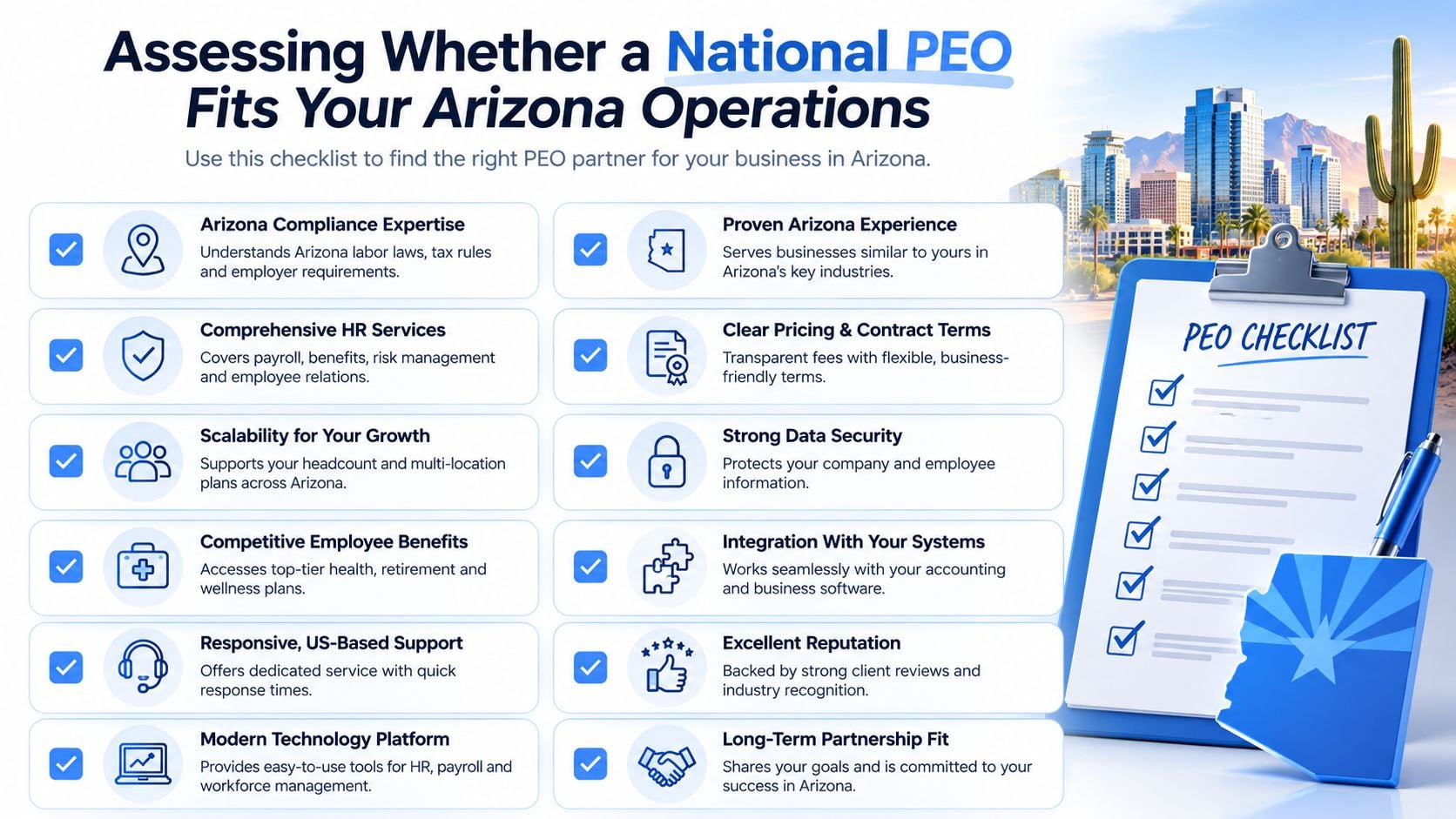
Before comparing names on a spreadsheet, leadership should decide whether a national PEO is solving the right problem. That decision is less about brand recognition and more about workforce complexity, benefits expectations, and where the company operates. A firm with scattered employees, shifting locations, or compliance exposure across states tends to feel the value of scale much faster than a narrow single-site operation.
Start with workforce shape, not vendor names
The right screening questions are blunt. How many people are in Arizona versus outside the state? Which locations have the most hiring churn? Are managers asking for centralized payroll support, better benefits access, or stronger compliance help? If the team can't answer those clearly, the vendor conversations will drift toward vague promises.
Arizona employers should also account for local care access and workforce geography. Arizona's 2024 medically underserved areas report shows that 83 of 126 primary care areas are designated as medically underserved, with multiple counties and communities affected, so benefits design and network access matter more in some markets than in others. In those areas, a national brand alone doesn't guarantee that the plan design, provider network, or employee support experience will match local needs. National PEO services
A useful self-check looks like this:
- Multi-state payroll complexity. If employees work across states, a national PEO may reduce internal friction.
- Benefits expectations. If recruiting depends on stronger benefit options, scale can matter.
- Compliance pressure. If HR staff is thin, the company may need tighter administrative support.
- Local healthcare fit. If employees sit in underserved areas, network quality matters as much as pricing.
- Internal bandwidth. If managers still want to own most HR decisions, a PEO may be overkill.
A PEO is a fit problem first, a pricing problem second.
The most common mistake is assuming a national provider automatically beats a regional specialist. That isn't always true. The better question is whether the company needs broad reach and standardized administration, or whether it needs a provider that understands a narrower industry or county-level operating reality.
For employers comparing candidates in the state, top PEO providers in Arizona can be a useful starting point, but only after the company has defined its workforce profile and service priorities.
Benchmarking PEO Pricing Structures in Arizona
PEO pricing looks simple until the quote arrives with multiple layers attached. Arizona employers usually see one of two models, a flat PMPE fee or a percentage of payroll, but the headline rate can hide very different economics once workers' comp, benefits, taxes, and add-ons enter the picture. The job is to compare the same payroll base, not two different packaging styles.
PMPE and percentage pricing do not tell the same story
A flat PMPE model is easier to budget because the fee is tied to headcount. A percentage-of-payroll model can look attractive for lower-wage teams, but it becomes harder to predict as compensation rises or headcount shifts. Independent Arizona pricing guides commonly cite roughly $100–$200 PMPE or 2%–12% of gross payroll, depending on services and risk profile, so a quote that sits inside those ranges still needs context. PEO pricing transparency guide
Here's a simple comparison framework for a 50-employee company with $3M in payroll:
| Pricing Model | Typical Range | 50-Employee Example | Best For | Risk Factors |
|---|---|---|---|---|
| Flat PMPE | Roughly $100–$200 PMPE | Around $5,000–$10,000 per month before pass-throughs | Stable headcount and easier budgeting | Hidden escalators, service add-ons |
| Percentage of Payroll | Roughly 2%–12% of gross payroll | Around $60,000–$360,000 annually before pass-throughs | Payroll-heavy models where the rate aligns with pay structure | Cost drift as payroll changes, unclear included services |
The table is only useful if pass-throughs are modeled separately. Workers' comp can change the economics fast, and so can medical plan selection, tax administration scope, implementation charges, and technology fees. A quote that looks lower upfront can become more expensive once the employer discovers that the “full service” bundle still leaves key workflows on its own team.
Read the renewal language before you compare the rate
The most common traps are not exotic. They're the quiet ones. Hidden escalators, renewal timing mismatches, and unclear ownership of E-Verify or sick-time accrual can turn a clean-looking quote into an administrative headache six months later. The practical test is whether the vendor will show each cost line item using the same assumptions as the other bids.
A finance team should also ask for the timing of rate locks, audit adjustments, and implementation credits. If a vendor won't clarify when the fee can change, the buyer doesn't really know the cost of the relationship. For a more detailed lens on how vendors present pricing, PEO pricing transparency guide is the right internal reference point.
Navigating Arizona PEO Compliance and Workers' Comp Rules
Arizona doesn't use a special PEO licensing regime the way some buyers expect. The state operates under a registration framework, and Arizona's PEO statute, A.R.S. 23-901.08, tracks whether all or a majority of the client employer's workforce is covered under the professional employer agreement. That matters because a provider can look legitimate on a sales call while still leaving the buyer exposed if the filing structure and coverage split are not correct.
Registration is the first check, not the last
Arizona buyers should verify that the PEO is properly registered and that the client agreement matches how the workforce is covered. The workers' comp piece is just as important, because Arizona's state guide tracks whether the PEO policy or the client policy carries the experience rating modification. That assignment directly affects quoted rates, audit exposure, and how volatile renewals can become.
A compliance review should ask for documentation, not assurances. Ask which entity is listed for workers' comp, how claims are reported, and who gets the modification if the account changes mid-cycle. When a vendor answers vaguely, the employer is likely to inherit the mess later. For multi-state teams, the internal reference multi-state workers' comp compliance under PEO is especially relevant.
A practical diligence packet should include:
- Arizona registration proof. Confirm the PEO is properly registered in the state.
- Workers' comp assignment. Verify whether the modifier sits on the PEO or client policy.
- Coverage mapping. Confirm how covered employees are counted under the agreement.
- Audit responsibility. Identify who handles audit prep and responses.
- Workflow ownership. Get written clarity on compliance tasks such as onboarding files and local notices.
If the vendor can't explain the workers' comp structure in plain English, the contract probably isn't ready to sign.
For employers with lean HR teams, a straightforward compliance checklist from compliance rules for small companies can help frame the right questions before the agreement goes to counsel.
Ask for the operating documents, not the sales summary
A serious buyer asks for the actual service map. That means the PEO's Arizona registration details, the workers' comp allocation language, the implementation timeline, and any document showing who owns updates when state rules change. If the vendor hesitates, that hesitation is part of the answer.
Contract Terms That Create Hidden Risk
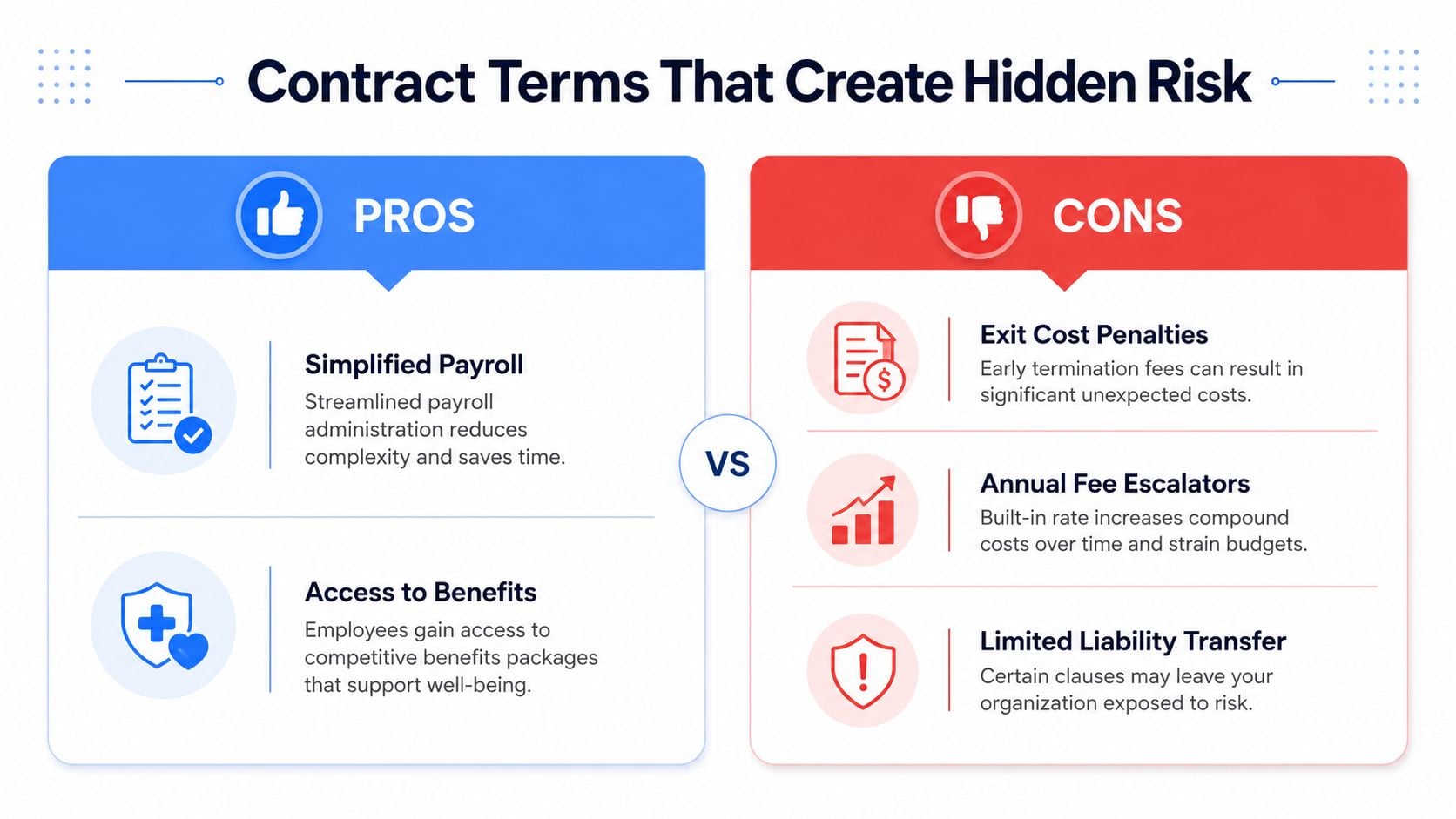
Most PEO agreements are written to reduce the vendor's uncertainty, not the buyer's. That doesn't make them bad contracts, but it does mean Arizona employers should read them like risk documents, not just service agreements. The biggest problems usually come from five places, and none of them are obvious on the first page.
The five clauses that deserve the most scrutiny
Implementation cost recovery sounds harmless until the company realizes it's on the hook for early termination or transition work it never expected to pay for. Renewal rate caps matter because a low first-year rate can become a very different second-year number if the contract gives the provider broad discretion. Exit notice periods are another trap, especially when the notice window is long enough to miss a clean switch date.
Data ownership is easy to ignore until the company wants payroll records, benefits data, or employee files during a transition. Co-employment liability boundaries are the final piece, because the agreement should make clear what the PEO is taking on and what still belongs to the employer. A good contract doesn't erase employer responsibility, it defines it.
The hard questions are straightforward:
- What changes the fee mid-contract?
- How much notice is required to exit cleanly?
- Who owns the data if the relationship ends?
- What support continues during offboarding?
- Where does the PEO's liability stop and the employer's begin?
For a plain-language list of loopholes that show up in real agreements, PEO contract loopholes to watch is worth keeping nearby while redlining.
Push for clarity, not promises
Good negotiators don't ask for “better terms” in the abstract. They ask for specific revisions. A buyer can request a cap on renewal increases, written language on transition support, and a defined export process for employee and payroll records. Those changes don't remove all risk, but they stop the contract from drifting later.
A useful rule is to reject any clause that sounds flexible only because it's vague. If the agreement says the vendor can adjust pricing “as needed” or terminate support “at its discretion,” that language should be cleaned up before signature. For a structured way to score vendors on these points, building a vendor scoring framework works best when contract terms carry real weight in the review.
Building a Vendor Scoring Framework
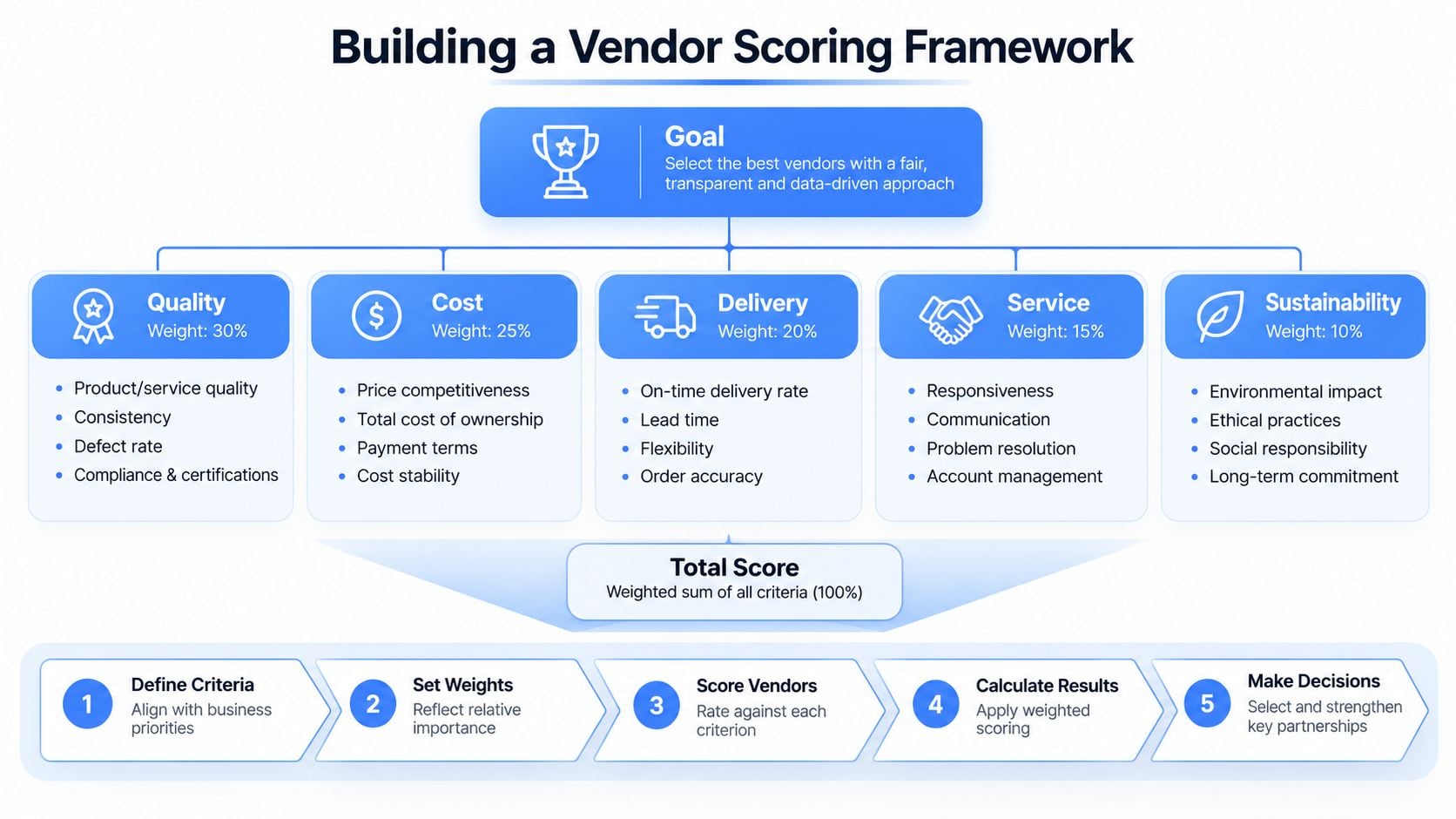
Once the shortlist is down to a few providers, the conversation needs a scoring sheet, not another sales call. A good framework keeps the team from overvaluing polished demos and underweighting contract discipline. That matters because two vendors can look equally strong in a meeting and behave very differently once implementation starts.
Weight the score around the company's real pain points
A 200-employee tech company and a 50-employee construction firm should not use the same scorecard. The tech buyer may care most about benefits access, service responsiveness, and contract flexibility. The construction firm may care more about claims handling, onboarding speed, and how the provider deals with field employees across locations.
A practical framework often weights the decision like this:
- Pricing transparency. Are all charges visible, and are pass-throughs easy to trace?
- Benefits quality. Does the package support recruiting and retention?
- Compliance support. Does the vendor handle Arizona-specific and multi-state complexity cleanly?
- Service model fit. Is the account team responsive and structured in a useful way?
- Contract flexibility. Can the employer exit, renegotiate, or scale without pain?
That framework should also include a check on vendor diligence. A third-party risk lens, such as the guide by Nolana AI, can help teams think beyond the demo and ask who is accountable for controls, escalation, and continuity.
A vendor that avoids detailed questions during the RFP usually avoids them after the contract is signed too.
Ask every vendor for the same evidence
The scoring sheet only works if each provider answers the same questions in the same format. Ask for a proposal that separates base fees from pass-throughs, a written implementation timeline, a named service model, and the specific contract terms that govern renewal and exit. If one provider won't provide a clean apples-to-apples answer, that evasiveness belongs in the score.
A useful template can be as simple as a one-page grid with weighted categories and a notes column. The notes matter because they capture what the number misses, such as whether the account manager answered direct questions or only redirected to marketing language. That qualitative detail often predicts the post-signature experience better than the brochure ever will.
Negotiation Tactics That Actually Work
PEO contracts are more negotiable than many buyers assume, but bargaining power has to be used carefully. A vendor responds differently when it knows the employer is comparing multiple options, understands the fee structure, and is prepared to walk away from vague language. That's especially true in national PEO AZ searches, where buyers are often balancing scale against service accountability.
Ask for terms, not favors
The cleanest requests are the ones tied to a business reason. If the vendor wants a multi-year commitment, ask for a rate lock or a clearly defined cap on renewal increases. If implementation will require heavy internal lift, ask for implementation credits or reduced onboarding charges. If service quality is a major concern, ask for measurable support commitments in writing.
When a company has competing quotes, the negotiation becomes much easier. The strongest move is to compare not just price, but what each provider includes, what gets passed through, and what changes at renewal. That is where the buyer gains an advantage, because vendors hate being compared on terms they didn't fully disclose.
The most common concessions are practical, not dramatic:
- Rate protections. Helpful when the employer wants predictability.
- Implementation credits. Useful if the migration will eat staff time.
- Service guarantees. Worth pushing for when the team needs faster response times.
- Exit support language. Important if a future switch is likely.
- Clear data export rights. Non-negotiable for smoother transitions.
Bring counsel in before the signature, not after the problem
A legal review is most useful when the business team has already identified its red lines. That means the employer knows which items are must-have, which are negotiable, and which are deal-breakers. If counsel gets the contract after the team has emotionally committed to a provider, the review often turns into damage control.
A good negotiation also avoids overreaching. Asking for every possible concession can stall the deal, but asking for the wrong concession wastes time. The smarter approach is to focus on the terms that affect actual cost, exit risk, and service accountability, then leave the rest alone.
For companies that want an independent comparison of cost, benefits, and contract language before entering those conversations, PEO Metrics reviews providers side by side and helps buyers benchmark the terms that matter most.
The right PEO choice in Arizona isn't the one with the slickest brochure or the lowest first-year fee. It's the one whose registration, workers' comp setup, pricing structure, and exit language all hold up under scrutiny. Companies ready to pressure-test those details should visit PEO Metrics and use an independent comparison to narrow the field before they sign anything.
