
In 2024, employer-sponsored coverage averaged $25,572 for family coverage and $8,951 for single coverage, with family premiums rising 7% and single premiums 6% in one year, according to the KFF 2024 Employer Health Benefits Survey. Those figures describe the premium, not the full financial burden employees experience after deductibles, copays, coinsurance, and paycheck deductions change.
That distinction matters during a PEO renewal. A quoted increase may reflect genuine medical trend, but it may also reflect a carrier changing the plan design, an employer reducing its contribution, or a PEO bundling administrative charges into a benefits rate that's difficult to audit. The practical question for HR and finance leaders isn't why premiums are rising. It's which portion represents unavoidable claims pressure, which portion can be negotiated, and which portion merely moves cost from the company to employees.
Table of Contents
- The Cost Trajectory Employers Face in 2026
- Structural Drivers Behind Persistent Premium Growth
- Headline Premiums Versus True Employee Burden
- Mitigation Tactics That Actually Move the Needle
- Short-Term Fixes Versus Long-Term Cost Trajectory Changes
- Translating Mitigation Strategy Into PEO Negotiation Leverage
- Building Your Renewal Preparation Playbook
The Cost Trajectory Employers Face in 2026
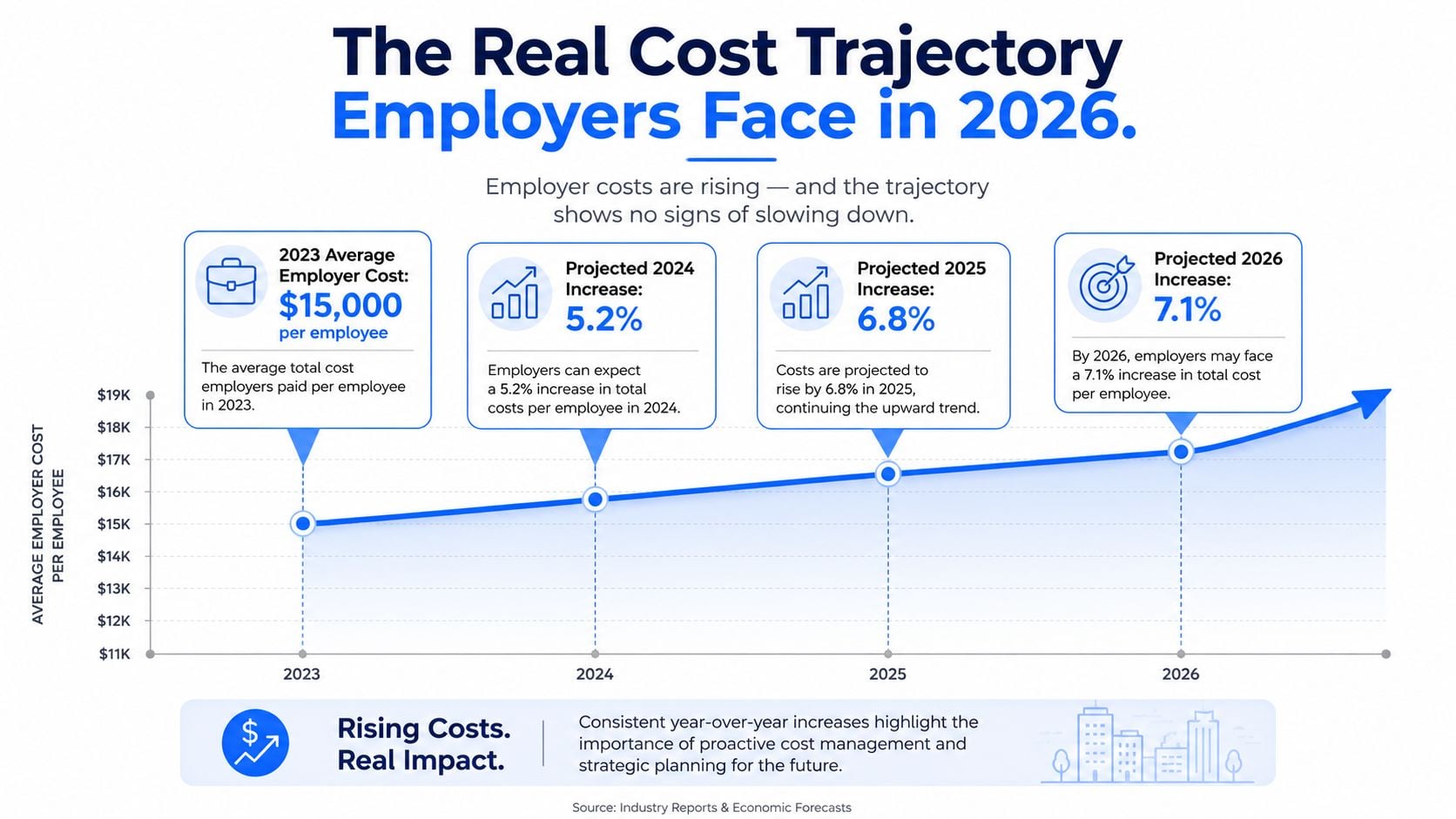
Mercer projects U.S. employer-sponsored health insurance costs will rise 6.7% in 2026, taking average spending above $18,500 per employee. Higher medical utilization, an aging workforce, and expensive therapies such as GLP-1 drugs are contributing factors. The projection is summarized in Mercer's 2026 employer healthcare cost outlook.
That percentage is a budget signal, not an explanation of what employees or employers will pay. Employer reporting places expected total health benefit cost growth between 6.5% and 9% for 2026, while plan-design changes may reduce the increase shown in the headline premium. A lower renewal can still come with a larger deductible, higher copays, or a greater payroll contribution.
The budget number needs a composition analysis
In a renewal meeting, separate the quoted increase into four parts:
- Medical trend: Provider prices, service use, prescription spending, and changes in the covered population's health.
- Plan design: Deductibles, copays, coinsurance, out-of-pocket maximums, and network changes that alter claims exposure.
- Contribution strategy: The premium share paid by the employer and employees across coverage tiers.
- Administrative load: Broker compensation, PEO fees, carrier expenses, and other charges included in the rate.
This breakdown shows whether the increase reflects actual claims pressure or cost shifting. A carrier or PEO can hold down the employer's quoted premium by raising point-of-care costs for employees. The company may improve its immediate budget line, while recruiting, retention, and affordability worsen.
Use employee benefit trend data to compare the renewal with broader market movement, then test the quote against plan-level evidence. Request claims detail, contribution comparisons, network-change documentation, and a clear account of what changed from the current plan. Those documents create negotiation points. They also expose whether a proposed savings measure reduces spending or just relocates it.
Practical rule: Treat the renewal quote as a starting point for forensic review, not as a final explanation of cost.
Structural Drivers Behind Persistent Premium Growth
Premium growth reflects several different forces, and employers need to separate them before accepting a renewal as unavoidable. A peer-reviewed analysis found that from 1999 to 2024, total health insurance premiums rose 342%, while mean worker contributions toward family premiums rose 308%. Worker earnings increased 119%, and inflation increased 64%, leaving premium growth at roughly three times the pace of wage growth. The historical comparison appears in the peer-reviewed analysis of long-run health insurance cost growth.
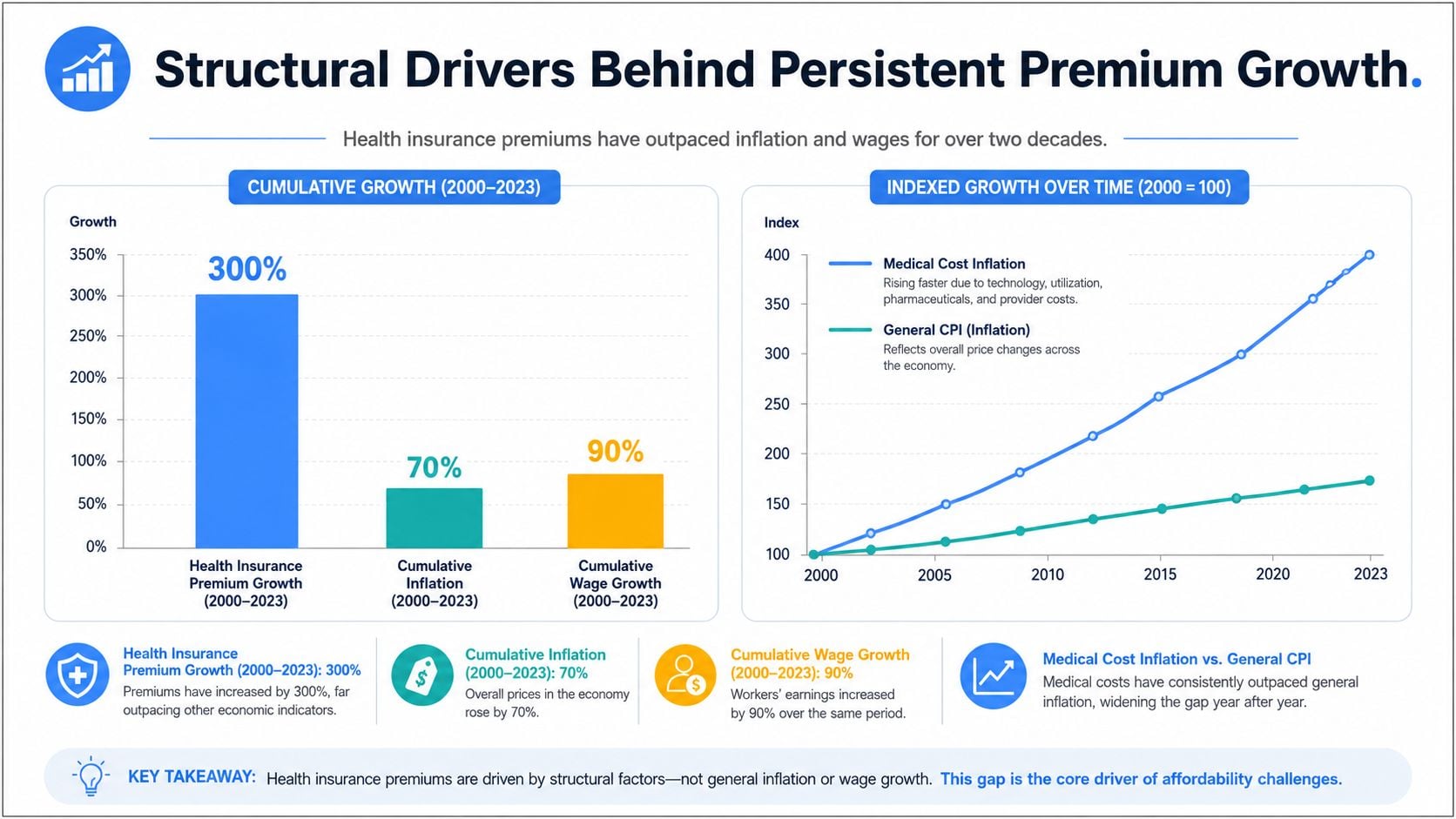
The recent figures reinforce the same pressure. Family coverage premiums were $15,022 in 2011, up 62% since 2003, and earlier research warned that they could approach $25,000 in later years. KFF's employer survey reported average family premiums of $23,968 in 2023 and $25,572 in 2024, with the latter representing a 7% year-over-year increase. Waiting for the market to normalize leaves employers reacting after the renewal is already priced.
Actual medical trend is only one part of the increase. Specialty medications can create substantial claims exposure even when few members use them. Employers and carriers are also weighing the clinical value and budget effect of GLP-1 therapies for diabetes and weight management. Mercer includes expensive therapies such as GLP-1 drugs among the factors affecting projected 2026 costs.
Utilization can rise when members return to care after delayed treatment, use more services, or access technologies that increase total spending. An aging workforce generally requires more medical services. Provider pricing varies by market and network, while a group priced too aggressively in prior years may face a sharp correction when claims experience catches up.
The quoted premium can also reflect plan design, contribution strategy, and administrative charges. Higher deductibles, copays, or employee contributions may reduce the employer's immediate increase while transferring more cost to employees. Review calculating insurance costs in Spain for a useful illustration of the broader pricing principle: premiums reflect risk, coverage scope, utilization assumptions, and operating costs.
A PEO master plan changes the purchasing context, not the underlying medical trend. Employers should review what PEO insurance includes and request claims detail, contribution comparisons, network-change documentation, and a clear account of every change from the current plan. Those records show whether a proposed saving reduces total spending or merely shifts it to employees.
Headline Premiums Versus True Employee Burden
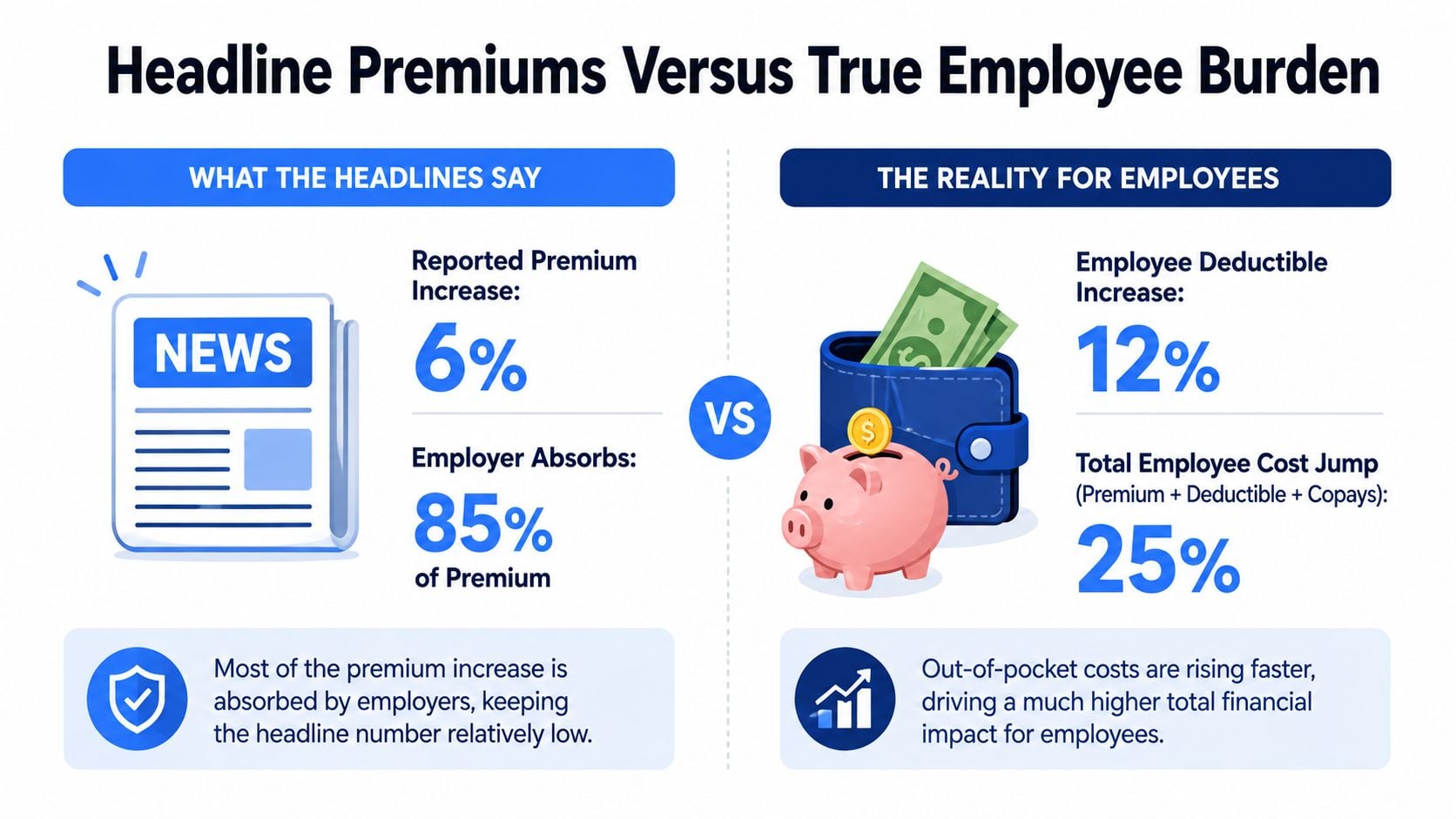
A 7% premium increase does not describe the full employee cost. If the employer reduces its contribution percentage while raising the deductible or copays, employees can pay more through payroll deductions and at the point of care.
Consider a hypothetical 100-employee company reviewing family coverage. The family premium rises 7%, the employer contribution falls from 80% to 75%, and the deductible increases from $2,000 to $3,000. The renewal quote shows the premium increase, while the employee also faces a larger premium share and an additional $1,000 in potential deductible responsibility. The example demonstrates how cost can move between the employer and employees. It does not establish a universal percentage increase in total employee costs, because the result depends on enrollment, coverage tier, utilization, and whether employees reach the deductible.
Four questions expose the transfer
During renewal, HR should ask:
- Did the premium change because the carrier expects higher claims, or because the plan was redesigned?
- Did the employer contribution percentage change by coverage tier?
- How did deductibles, copays, coinsurance, and out-of-pocket maximums change?
- What would a typical employee pay under low, moderate, and high utilization?
The third question separates a lower premium from a lower total cost. A higher deductible may reduce the quoted premium without changing provider prices or utilization. It places more financial risk on members and may lead some employees to delay care.
The guide from Refresh Psychiatry & Therapy illustrates why employees judge coverage through actual care encounters, not the renewal percentage alone. Behavioral health visits, specialist appointments, prescriptions, and diagnostic services can produce very different out-of-pocket costs under plans with similar premiums.
A useful renewal comparison places employer spending beside employee exposure. Use this guide to comparing health plans to structure the review, then apply the company's enrollment and claims experience where available. For PEO evaluations, request the same side-by-side view from each option. A lower headline increase deserves scrutiny if it comes from reduced employer contributions or less favorable benefits.
Employee communication should show both sides of the equation: paycheck deductions and likely point-of-care costs. Presenting only the premium change invites distrust.
Mitigation Tactics That Actually Move the Needle
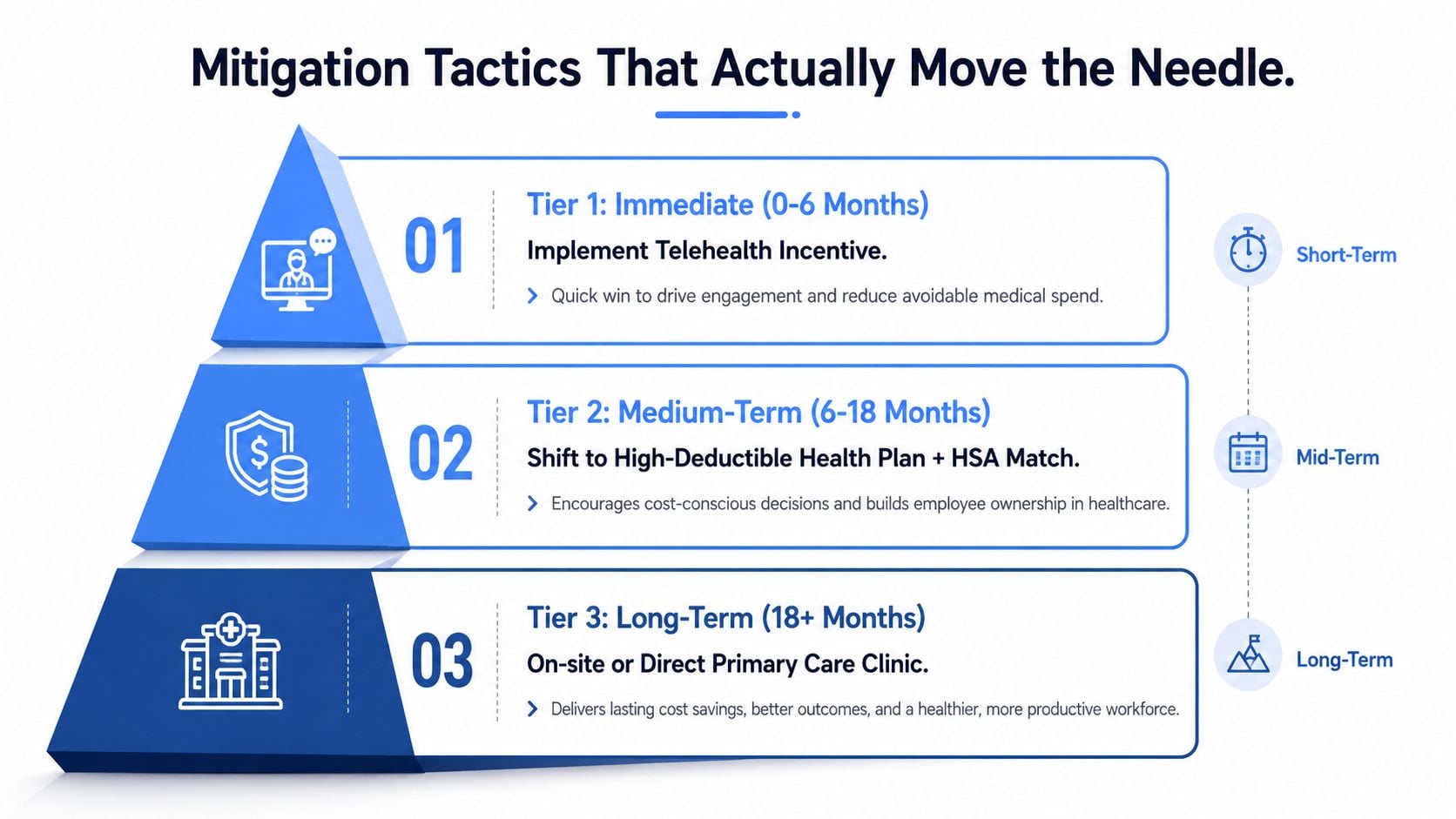
The strongest response combines immediate budget controls with interventions that can influence claims over time. Each tactic carries a different trade-off, so the renewal team should identify whether the tactic reduces total cost, changes timing, or reallocates responsibility.
Immediate controls
Telehealth and navigation programs can be implemented relatively quickly, especially when the carrier or PEO already has a contracted vendor. The expected financial effect depends on employee adoption and whether the program replaces higher-cost settings, so the buyer should request utilization reporting rather than accept a promised savings figure.
Contribution redesign creates a fast budget effect. An employer might preserve a richer plan for employees by changing the employer share across employee-only, employee-plus-one, and family tiers, but that decision changes compensation value and can make family coverage less affordable. The negotiation should include an employee impact analysis before approval.
Network changes can reduce the quoted premium, particularly when a narrower network removes expensive providers. The trade-off is access, employee disruption, and potential dissatisfaction in markets where a dominant health system controls care.
Medium-term levers
A high-deductible health plan paired with an HSA can align contributions with a lower-premium design, but the employer should consider an HSA contribution or match so the arrangement doesn't expose employees to more risk. The decision should compare the employer's premium savings against the HSA funding obligation and projected employee utilization.
Pharmacy management deserves its own review. Employers can ask about specialty-drug management, formulary controls, prior authorization, site-of-care policies, and whether a pharmacy carve-out would produce better transparency. A carve-out may improve visibility and negotiating flexibility, but it can also create vendor coordination work and a less integrated member experience.
Self-funded employers should examine stop-loss terms, including specific and aggregate attachment points, contract basis, renewal methodology, and exclusions. A lower stop-loss premium may come with less favorable protection, so the apparent savings should be tested against the company's risk tolerance and cash reserves.
Longer-term investments
Chronic-condition management, centers of excellence, direct contracting with health systems, and primary care access can address avoidable utilization and care fragmentation. These programs require data, employee engagement, and sufficient time to evaluate results. They're more credible when the vendor defines the target population, intervention, measurement method, and reporting schedule before implementation.
PEO buyers can use PEO options for lowering health insurance costs to build a diligence checklist. The relevant question isn't whether a PEO advertises lower rates. It's whether the PEO offers meaningful access to pharmacy strategy, care navigation, population health programs, and plan alternatives that fit the workforce.
Short-Term Fixes Versus Long-Term Cost Trajectory Changes
A renewal plan benefits from separating quick budget protections from interventions that may reshape future claims. The distinction matters because a lower employer invoice can result from shifting more expense or access limits to employees, without changing the medical cost trend.
| Approach | Timing | What it can change | Main risk |
|---|---|---|---|
| Higher employee contributions | Next renewal | Employer cash expense and payroll allocation | Employees absorb more cost |
| Higher deductibles or copays | Next renewal | Headline premium and point-of-care allocation | Delayed care and weaker perceived benefit value |
| Narrower networks | Next renewal or following cycle | Provider pricing and network expense | Access disruption and employee dissatisfaction |
| Pharmacy management | Medium term | Specialty-drug utilization and pricing controls | Vendor complexity and member friction |
| Chronic-condition programs | Longer term | Avoidable utilization and care coordination | Results require engagement and measurement |
| Centers of excellence | Longer term | Site-of-care decisions for complex procedures | Limited relevance for smaller populations |
| Direct primary care or onsite care | Longer term | Primary care access and potentially avoidable urgent care | Fixed operating commitment and participation risk |
The table does not provide a universal savings range. Results depend on the workforce, geography, plan structure, vendor terms, and whether the tactic changes medical spending or only reallocates payment. Build the business case from the employer's enrollment, claims, pharmacy, and network data.
A decision test for every proposal
A proposal merits long-term attention when it answers three practical questions:
- Whose cost changes? Employer, employee, carrier, or provider.
- When does the effect appear? At the next renewal, after implementation, or after sustained utilization change.
- What evidence will confirm success? Premium, claims per member, specialty-drug spend, emergency department use, employee access, or another agreed measure.
This test also clarifies the composition of a quoted increase. A contribution change may lower the employer's share while leaving the underlying carrier premium untouched. A deductible change may reduce the headline premium but increase the employee's payment when care is used. A network change may affect provider prices, yet create access disruption that reduces the plan's practical value.
Raising a deductible can provide immediate budget relief, but it does not necessarily bend the medical cost curve. A care program may require more effort and show less visible relief at the first renewal, while addressing utilization and access over time. PEO buyers should ask vendors to identify which part of the increase each proposal changes, what employees will pay, and which measure will be reviewed at the next renewal.
Translating Mitigation Strategy Into PEO Negotiation Leverage
PEO negotiations become stronger when the buyer can identify the exact source of the increase. A PEO may present a single benefits rate, but the employer should request a component-level explanation covering carrier premium, administrative fees, broker or service compensation, plan design, contribution assumptions, and any change in the underlying risk pool.
Terms worth putting on the table
A buyer can request:
- Renewal caps or rate locks: Define the maximum annual increase or the conditions that allow an exception.
- Benchmarking provisions: Tie renewal discussions to credible published market data and require an explanation when the proposed increase exceeds the benchmark.
- Pass-through protections: Prevent the PEO from adding an above-market increase without documented carrier support.
- Transparency language: Require disclosure of administrative charges, commissions, fees, and plan-level assumptions.
- Alternative-plan access: Require multiple plan designs, contribution scenarios, and network options before renewal approval.
- Performance reporting: Establish reporting for claims, pharmacy, utilization, care management, and employee participation where legally and operationally available.
A 200-employee company receiving an 8% renewal quote could propose a 2% rate cap as a negotiation position, subject to the final contract language, carrier terms, and documented exceptions. The buyer shouldn't assume the cap will be accepted. The advantage comes from showing alternatives, benchmarking the proposed increase, and demonstrating that the employer is prepared to evaluate another PEO, broker, ASO, or self-funded structure.
Questions that separate substance from sales language
Ask the PEO:
- What portion of the increase reflects medical trend?
- What portion reflects plan design or contribution assumptions?
- Which pharmacy and specialty-drug controls are available?
- Can the PEO provide centers of excellence, direct contracting, or chronic-condition support?
- What happens if the group leaves before the next renewal?
- Are administrative fees fixed, percentage-based, or subject to annual increases?
- What renewal data will the employer receive, and when?
PEO benefits negotiation leverage depends on contract detail, not just the quoted rate. PEO Metrics is one option employers can use to compare PEO pricing, benefits, service models, contract terms, and negotiation opportunities before accepting a renewal.
Negotiation language should describe a remedy, not just a complaint: “Provide the medical trend calculation, separate administrative charges, and show the plan changes required to reach the proposed rate.”
Building Your Renewal Preparation Playbook
A disciplined renewal process starts before the quote arrives. The following timeline gives HR, finance, and ownership a shared operating plan.
90 days before renewal
Gather the current plan documents, enrollment by tier, employer and employee contributions, deductible and out-of-pocket limits, claims reporting, pharmacy information, network changes, administrative fees, and termination provisions. Ask the PEO or broker for the carrier's renewal rationale and a side-by-side comparison against the current plan.
Benchmark the proposed direction against published employer trends, then identify two or three mitigation candidates. Each candidate should include its effect on employer cost, employee exposure, implementation effort, and expected measurement method.
60 days before renewal
Set negotiation priorities in writing. Rate caps, contribution protections, fee transparency, alternative plan designs, pharmacy controls, and service guarantees should be ranked rather than presented as an unstructured list of demands.
Prepare employee communications at this stage, not after the decision. Employees need clear examples showing payroll deductions, deductible changes, copays, network differences, and available decision support. For broader context on health insurance resources from Wealth Collective, benefits teams can compare how coverage decisions affect household affordability beyond the employer's premium line.
30 days before renewal
Choose the arrangement using a defined threshold. Stay with the current PEO when the renewal is transparent, the benefits remain competitive, the contract protects the employer, and the PEO can support the chosen cost strategy. Explore alternatives when the PEO won't disclose cost composition, offers no meaningful plan or vendor options, imposes unfavorable renewal terms, or repeatedly solves increases by shifting burden to employees.
The final approval package should show the current and proposed employer cost, employee exposure, contract changes, implementation dates, communication owners, and unresolved risks. That record gives leadership a defensible decision and gives HR a stronger starting position at the next renewal.
PEO Metrics helps employers compare PEOs, benefits, pricing, service quality, and contract terms while identifying renewal protections and negotiation opportunities. Visit PEO Metrics to benchmark the current arrangement and prepare a more informed response to the next health insurance premium increase.
