
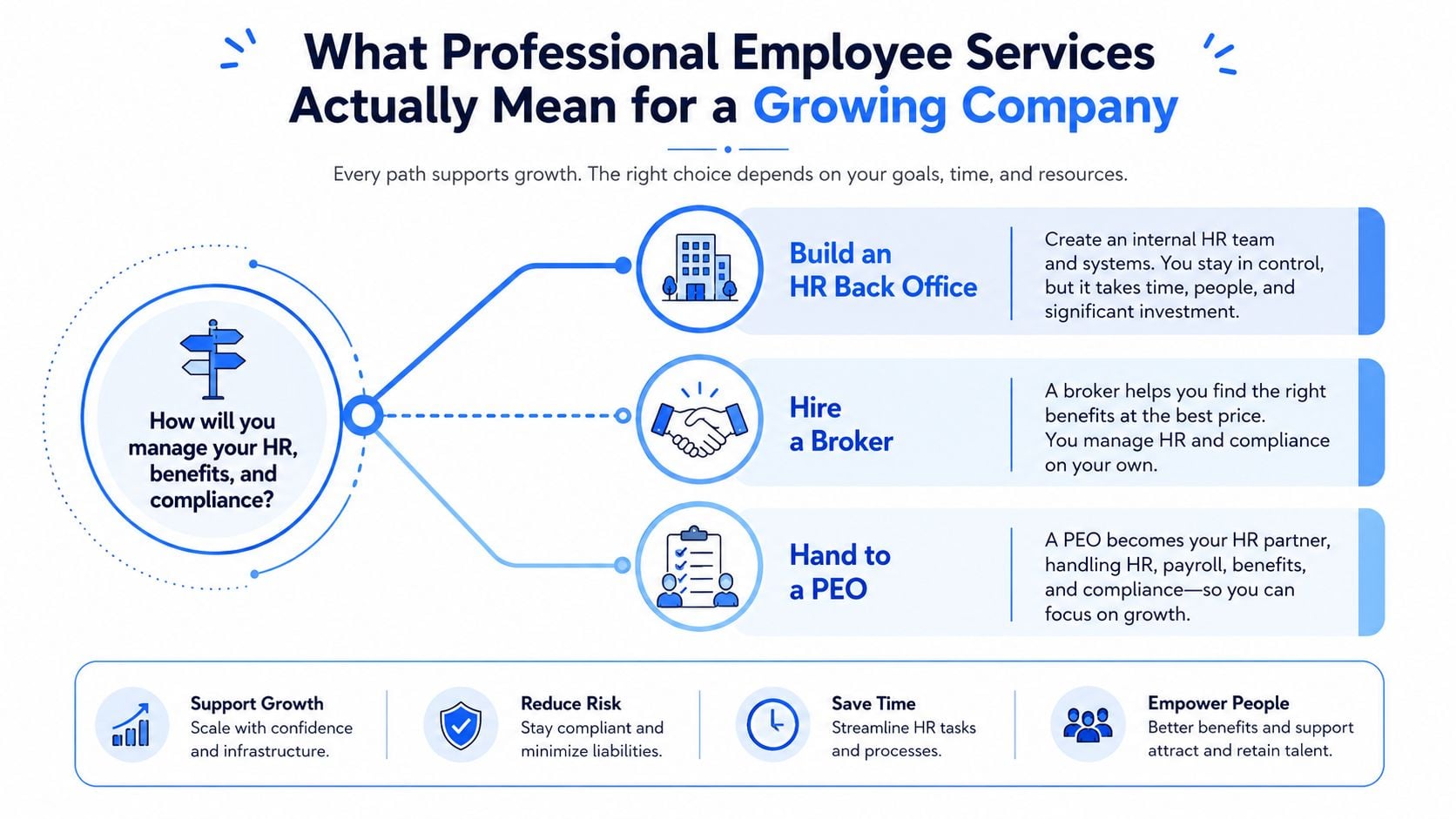
A 60-person company can reach the point where payroll errors, benefits renewals, workers' compensation questions, and multi-state filings consume more management time than the leadership team expected. The usual options appear simple: build an HR back office, hire a broker, or hand the employment administration to a PEO. The expensive mistake is treating that choice as a universal recommendation rather than a business decision tied to headcount, complexity, control, and contract terms.
Professional employee services can remove substantial administrative work, but a PEO isn't automatically cheaper or better. The right question is which responsibilities should be shared with a co-employer, which should stay inside the company, and whether the resulting risk transfer justifies the total cost.
Table of Contents
- What Professional Employee Services Actually Mean for a Growing Company
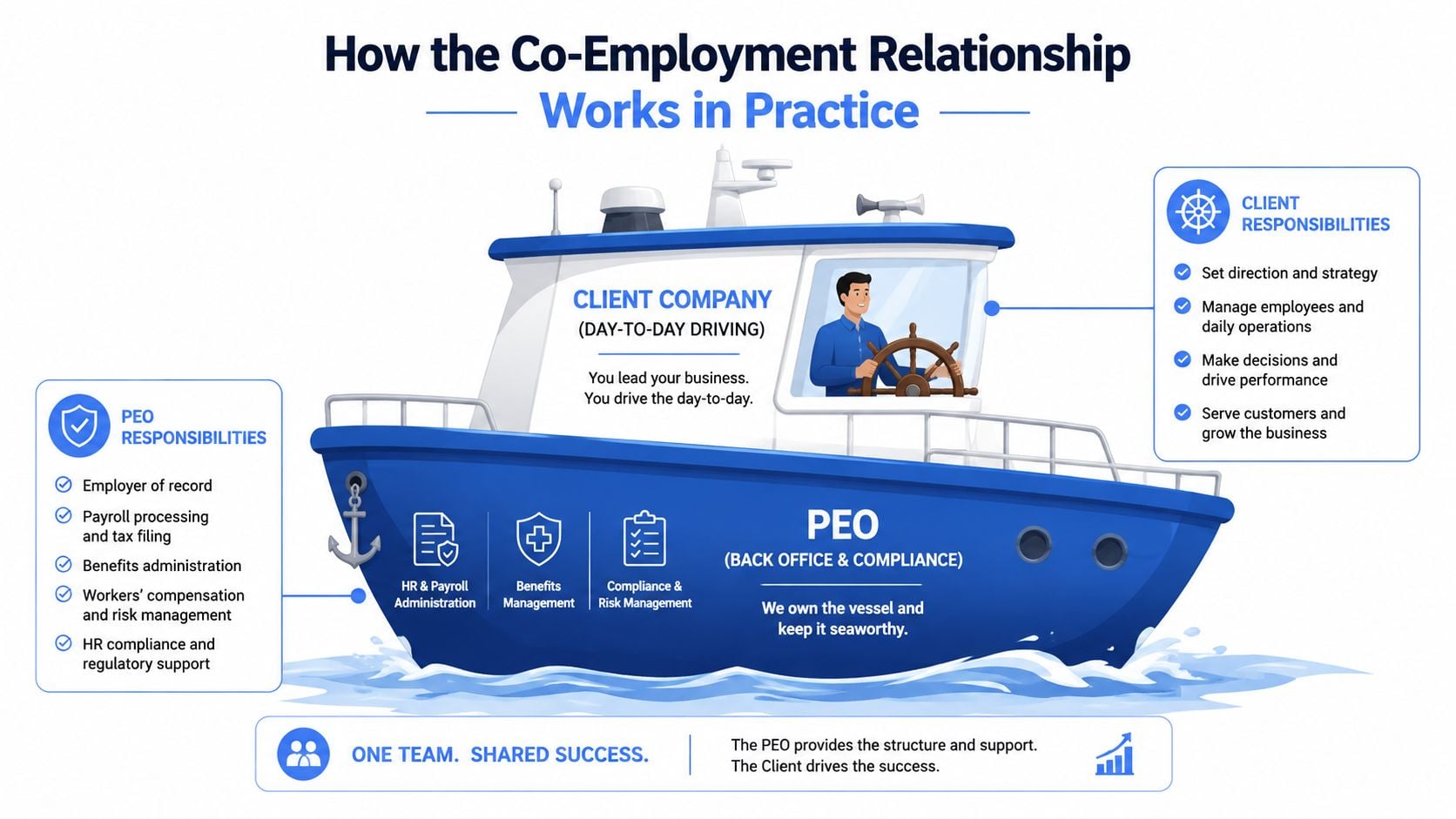
- How the Co-Employment Relationship Works in Practice
- What Services Come Inside a Typical PEO Bundle
- How PEO Pricing Works and What Drives the Bill
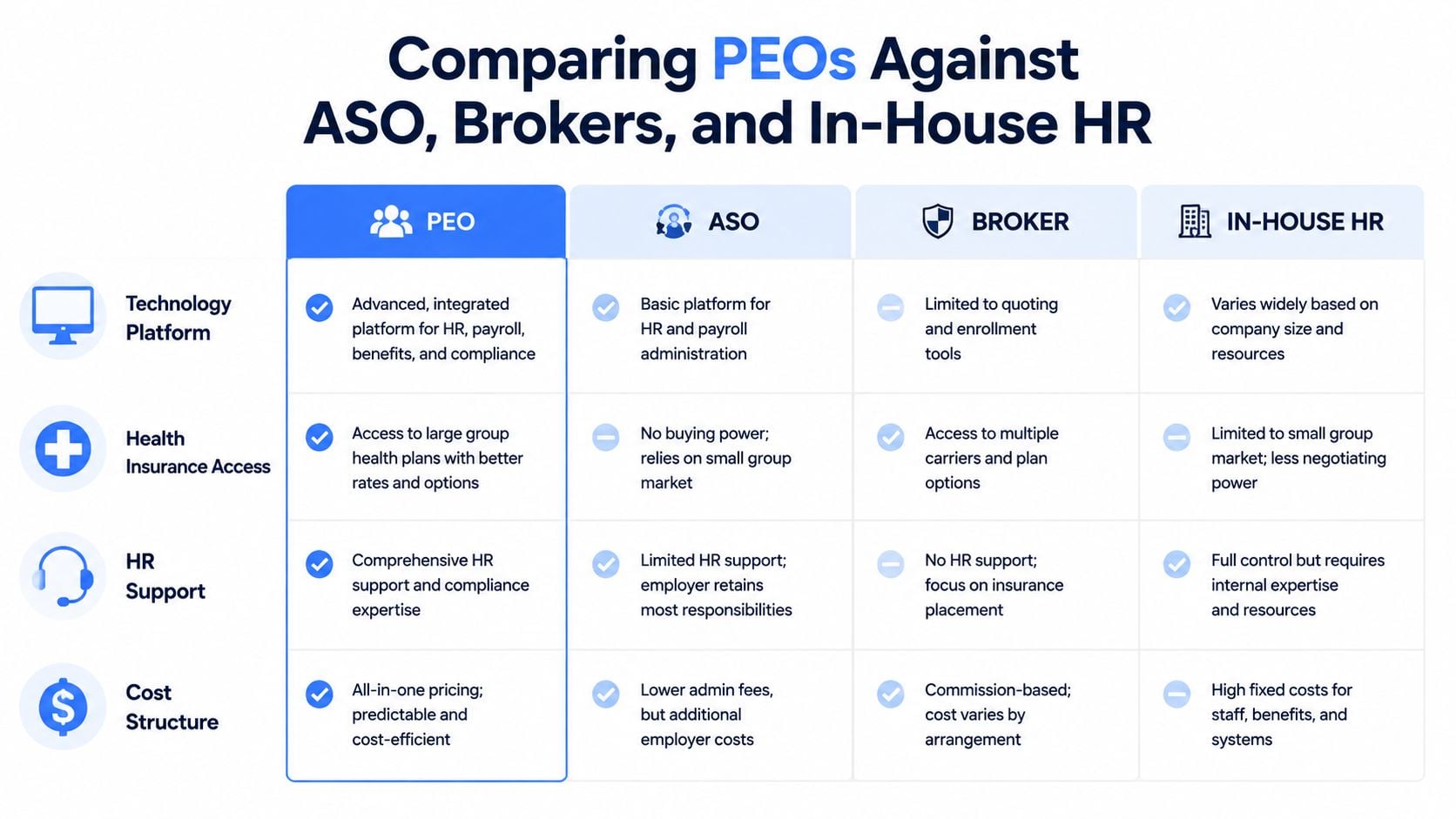
- Comparing PEOs Against ASO, Brokers, and In-House HR
- Benefits and Risks That Change Your Real Numbers
- Contract and Compliance Considerations That Decide the Outcome
- How to Evaluate PEOs and Negotiate Better Terms
What Professional Employee Services Actually Mean for a Growing Company
Most PEO discussions start with an all-or-nothing question: should the company use a PEO? That framing is too crude. A growing employer may want the PEO to handle payroll taxes, benefits administration, workers' compensation, and employment paperwork while retaining internal control over recruiting, culture, compensation, supervision, and performance management.
A PEO becomes a co-employer for defined administrative and employment responsibilities. It generally processes payroll, files payroll taxes, sponsors or provides access to benefits, and supports workers' compensation administration. The client still runs the business. Managers hire employees, assign work, set schedules, make compensation decisions, and address performance issues.
The model has existed in the United States since the 1980s and has developed into a substantial market. By the end of 2022, 523 PEOs served more than 200,000 small and mid-sized businesses, employed 4.5 million worksite employees, and paid $305 billion in wages during the year, according to IBISWorld's professional employer organizations industry profile. NAPEO reported that 208,000 clients represented 17 percent of U.S. employers with between 10 and 99 employees, which shows why PEOs have moved beyond niche outsourcing.
Practical rule: A PEO should take administrative ownership, not managerial ownership.
A consultant gives advice. Payroll software automates transactions. A broker helps source insurance. A PEO combines those functions with a formal co-employment arrangement and contractual responsibility for specific employer obligations. Buyers evaluating the structure can use this explanation of what a PEO is before comparing providers.
How the Co-Employment Relationship Works in Practice
A growing company can hand payroll administration to a PEO without handing over control of the business. The PEO manages defined employment administration, while the client's managers continue directing the people and work that produce revenue.
The client typically retains responsibility for:
- Hiring decisions: Managers choose employees, define roles, and approve staffing needs.
- Daily supervision: The client assigns work, sets schedules, monitors output, and manages attendance.
- Compensation decisions: Leadership sets pay practices, promotions, bonuses, and organizational design.
- Performance management: Client managers give feedback, document problems, and decide whether termination is appropriate.
The PEO generally takes responsibility for the administrative side:
- Payroll and tax filings, including wage payments and required reporting.
- Benefits administration, such as access to health plans and retirement programs.
- Workers' compensation administration, usually through the PEO's program.
- Employment documentation, onboarding workflows, and basic HR support.
- Certain employment-tax obligations, based on the agreement and the PEO's legal status.
For a detailed explanation of the co-employment relationship, review how co-employment responsibilities are divided.
The IRS treats PEO third-party payer arrangements differently from ordinary payroll software or consulting services. Federal tax law does not define “co-employer,” but a PEO may perform employer acts when it represents itself as the employer or co-employer of workers. That distinction can affect responsibility for wage-related filings and tax handling, as explained in the IRS guidance on PEO third-party payer arrangements.
The credentials that deserve attention
A Certified PEO, or CPEO, receives IRS recognition after meeting background, financial, and reporting requirements. The IRS application includes a $1,000 user fee. An agreement with a CPEO also changes employment-tax liability treatment for the PEO and its customers, according to ADP's explanation of CPEO status.
ESAC accreditation is separate and voluntary. ESAC requires quarterly and annual CPA-prepared financial statements, along with CPA verification that withholding taxes, employee and employer benefit contributions, workers' compensation premiums, and group life and health insurance premiums are paid on time. ESAC lists a $5,000 application fee for accreditation in its standards and procedures.
Co-employment is a legal and operational allocation of duties. The contract determines which party carries each responsibility, so review the service agreement more carefully than the sales presentation. If that allocation does not match your operating model, choose an ASO, broker, or in-house arrangement instead.
What Services Come Inside a Typical PEO Bundle
A typical PEO proposal combines functions that a company might otherwise buy separately. The base bundle often includes payroll processing, payroll tax filing, W-2 and year-end reporting, multi-state tax registration, health benefits access, retirement plans, workers' compensation coverage, HR policy templates, basic compliance support, and employee onboarding paperwork.
That list describes the headline package, not necessarily the complete operating cost. Providers frequently separate higher-touch services from the base fee, so the request for proposal must distinguish included services from optional features.
Services that often sit outside the base fee
A buyer should ask for separate pricing and service descriptions for:
- Dedicated HR consulting, especially manager coaching and employee-relations support.
- Time and attendance, including scheduling, time capture, and integrations.
- Learning platforms, compliance training, and course administration.
- Advanced analytics, dashboards, and workforce reporting.
- State unemployment management, claims, hearings, and rate administration.
- Leave administration, accommodation support, and case tracking.
- Recruiting support, applicant tracking, sourcing, and screening.
A 75-person software company may receive payroll, benefits, and workers' compensation inside the standard proposal, then discover that dedicated HR support, time tracking, and multi-state unemployment claim management carry additional charges. That isn't necessarily unreasonable. It becomes a problem when the buyer compares only the advertised administrative fee instead of the full operating package.
The professional employee services overview can help buyers create a more complete comparison list. Each finalist should receive the same employee census, state footprint, payroll frequency, contractor details, benefit requirements, and service expectations.
The practical output should be an apples-to-apples pricing schedule. It should show the base fee, pass-through costs, optional services, implementation charges, renewal mechanics, and every item that could appear on an invoice after implementation.
How PEO Pricing Works and What Drives the Bill
A 60-person company with $4.5 million in annual payroll could receive an administrative bill of roughly $45,000 to $90,000 per year, before benefits pass-through and workers' compensation costs. The final number depends on how the PEO charges and which services the contract includes. This illustration uses the pricing structures below, not a guaranteed quote.
PEO pricing generally follows three models. A percentage model ties the administrative fee to payroll. A per-employee model makes the fee easier to forecast. A bundled or tiered model combines a base charge with usage-based or service-specific costs. Review the PEO pricing and cost structure before comparing proposals.
| Pricing Model | Typical Range | Best Fit Profile | Watch Out For |
|---|---|---|---|
| Percentage of payroll | 2% to 4% of payroll | Employers with relatively stable payroll and variable wages | The fee rises with payroll even when service volume stays flat |
| Per employee per month | $50 to $200 PEPM | Employers that want predictable administration costs | Minimums, employee definitions, and exclusions can distort the headline rate |
| Bundled or tiered | Base fee plus usage-based charges | Employers needing a mix of standard and specialized support | Add-ons, renewal escalators, and service tiers can make comparison difficult |
The percentage model can suit a company whose wages fluctuate, while PEPM pricing gives a clearer administrative budget. Neither model is automatically cheaper. A low percentage can cost more than a higher PEPM fee when payroll is large, and a low PEPM rate can conceal minimums or excluded services.
Invoice items that change the result
Check these charges before signing:
- Minimum monthly fees may remain in place after headcount declines.
- Implementation charges may sit outside ongoing administration.
- Year-end W-2 fees can be billed per employee or as a project charge.
- Off-cycle payroll delivery may carry a separate surcharge.
- Employee definitions may count W-2 employees and certain 1099 contractors differently.
- Renewal escalators can raise the fee without adding service.
Use effective annual cost per worksite employee as the comparison metric. Add administrative fees, mandatory service charges, benefits-related costs, workers' compensation, and implementation expenses. Divide that total by worksite employees. This calculation prevents an attractive percentage or PEPM figure from hiding an expensive bundle.
A PEO pays off when internal administration, separate benefits purchasing, compliance support, and management time cost more than the effective PEO price. Choose an ASO, broker, or in-house setup when the company would pay for bundled infrastructure it does not use. The contract should make that trade-off visible before implementation.
Comparing PEOs Against ASO, Brokers, and In-House HR
The strongest alternative to a PEO is often an ASO, not a fully independent HR department. An ASO can provide a technology platform and core back-office services while the client remains the employer of record. That preserves control and avoids the co-employment structure, but the client retains more employment and tax responsibility.
A benefits broker occupies a narrower role. The broker may source health insurance and sometimes coordinate payroll or technology, but the broker doesn't assume the company's employment risk or take responsibility for multi-state filings. In-house HR provides the highest control, but the company must recruit, manage, and fund the entire operating capability.
| Option | Employment Risk | Benefits Access | Cost Predictability | Control | Implementation Speed |
|---|---|---|---|---|---|
| PEO | Shared by contract for defined responsibilities | Often broad, bundled access | Medium | Medium | Fast |
| ASO | Client retains responsibility | Depends on the company's own plans and broker | Medium to high | High | Moderate |
| Broker-led | Client retains responsibility | Broker sources available plans | High for broker fees, variable for benefits | High | Fast |
| In-house HR | Client retains responsibility | Directly controlled by employer | Variable fixed staffing cost | Highest | Slowest |
Headcount is a useful starting point
Under 10 employees, a broker and payroll software often win because the company has limited administrative volume and may not need a bundled employment platform. From 10 to 75 employees, a PEO is usually the most efficient option when the company lacks internal HR capacity or needs benefits and compliance support.
From 75 to 200 employees, the answer depends on geography, benefits complexity, payroll variation, and the quality of the existing HR team. Above 200 employees, an in-house team or ASO often starts to pull ahead because the employer can spread dedicated HR capability across a larger workforce while retaining more control.
These are decision bands, not laws. A 30-person company operating across many states may be a stronger PEO candidate than a 100-person company operating in one state with a capable HR leader.
Benefits and Risks That Change Your Real Numbers
A PEO benefit should always be paired with its matching exposure. Large-group health insurance access can improve plan choice or pricing, but the company may accept less flexibility in plan design and a tighter renewal process. Workers' compensation through a PEO master program can simplify administration, yet coverage doesn't automatically extend to every person performing work for the company.
NAPEO reports that the U.S. PEO industry includes about 500 PEOs serving more than 200,000 primarily small and mid-size businesses and employing about 4.5 million people, creating a large but finite provider market for benchmarking, as described in Mordor Intelligence's North America PEO market overview.
| Potential benefit | Matching risk |
|---|---|
| Access to large-group health insurance | Less flexibility in plan design and carrier selection |
| Workers' compensation through a master policy | Coverage may exclude subcontractors, 1099 labor, or other non-enrolled workers |
| Potentially lower unemployment tax rates through pooling | The client may have limited control over how claims and rates are managed |
| Reduced administration for multi-state payroll | The company depends on the PEO's processes, platform, and compliance execution |
| Less internal HR administration | Contract lock-in and transition costs can make switching difficult |
For example, a 90-person home services company operating in three states might estimate $40,000 to $80,000 in annual savings on benefits and workers' compensation through a PEO. That savings case can weaken quickly if the agreement permits a 12% to 18% renewal fee increase without a rate cap. Those figures are scenario assumptions for evaluating a contract, not a reported case study or guaranteed outcome.
The contract should answer four questions before the company signs:
- What is locked? A true rate lock differs from a cap that still permits increases.
- What happens at renewal? The agreement should identify notice periods and permitted adjustments.
- Who carries the liability? Tax, workers' compensation, benefits, and employment claims need separate treatment.
- Who is covered? Workers' compensation terms should address employees, subcontractors, and non-enrolled labor distinctly.
Contract insight: A PEO's operational return is usually real, but the size of that return is determined by the agreement, not the brochure.
Contract and Compliance Considerations That Decide the Outcome
A PEO contract often runs for two to three years, according to common market practice described in buyer materials, but the important issue is not the stated term alone. Auto-renewal language, notice deadlines, early termination fees, and transition obligations determine whether the company can leave without operational disruption.
The agreement should specify how the employer receives payroll records, W-2 history, benefits data, employee files, and tax documentation after termination. It should also define implementation fees, credit-back guarantees, service failures, rate escalation, and whether a multi-year cap is a genuine ceiling or merely a formula with exceptions.
A pre-signature risk checklist
- Exit terms: Can the company terminate for cause, convenience, or service failure?
- Transition window: Does the PEO provide enough time to move payroll and benefits?
- Rate language: Are increases capped, and do benefits, workers' compensation, and add-ons follow separate rules?
- Liability allocation: Does the contract match the IRS treatment and explain each party's filing obligations?
- Record access: Are historical payroll, tax, and benefits records available in a usable format?
- Service remedies: Does the agreement provide credits or other remedies for missed obligations?
- Coverage limits: Are subcontractors and 1099 labor excluded from workers' compensation coverage?
- Financial credentials: Does the provider hold CPEO status, ESAC accreditation, both, or neither?
CPEO status matters because the IRS recognizes the certification only after background, financial, and reporting requirements are met, and the arrangement changes employment-tax liability treatment. ESAC accreditation provides a separate financial-discipline signal because accredited PEOs submit CPA-prepared financial statements and verification of timely payments, as detailed in the earlier credential discussion.
The contract should pass the CFO's review before implementation begins. A persuasive demonstration can't compensate for vague exit rights or uncapped renewal economics.
How to Evaluate PEOs and Negotiate Better Terms
A practical scorecard should rate each finalist from one to five across five criteria:
- Total cost, including every mandatory and optional charge.
- Benefits strength, including plan fit, employee affordability, and renewal treatment.
- Service model, including dedicated HR support and response expectations.
- Compliance credentials, including CPEO status, ESAC accreditation, and liability language.
- Contract terms, especially rate protection, exit rights, records, and transition support.
The buyer should gather at least three quotes and request at least two references from each finalist in the same industry and headcount band. Negotiation should focus on a multi-year rate cap, implementation credits, measurable service response times, defined exit terms, and a price walk-back if headcount grows above an agreed threshold. The questions to ask PEO providers can turn a sales conversation into a comparable evaluation.
PEO Metrics offers independent analysis for employers comparing PEOs, ASOs, brokers, and payroll providers, including side-by-side reviews of pricing, benefits, service quality, compliance support, and contract risks. HR and finance teams can visit PEO Metrics to request a no-cost comparison before entering provider negotiations.
