

If you run a marketing agency or an in-house marketing team and you’ve outgrown spreadsheets and basic payroll, the choice between a PEO and a payroll company will come up quickly. A PEO shares employer duties with you through co-employment. A payroll company processes pay and taxes, and you stay the sole employer. This list is for owners and ops leads at small, often remote, lower-risk creative teams. The tools were chosen for fit with that profile, for how clearly each vendor explains what it is and is not, and for how open its pricing is.
Vendor details change often. Confirm current pricing, minimums, state availability, and plan names on each official site before you decide. PEO Metrics may receive vendor placement fees.
Quick Comparison of the Eight Options
- PEO Metrics: best for agencies still deciding between a PEO and payroll; pricing on request via its website; the only item here that compares providers for you instead of being one.
- Justworks: best for small agencies wanting an all-in-one PEO; see website for current per-employee pricing; published pricing you can estimate before a sales call.
- TriNet: best for growing agencies wanting plan design for a services business; quote-based; industry-specific plan packaging.
- Insperity: best for agencies with no in-house HR; quote-based; an assigned HR representative for day-to-day people issues.
- ADP TotalSource: best for larger or multi-state agencies; quote-based; backing of a large payroll vendor with a path across its wider products.
- Paychex: best for agencies that want to start with payroll and maybe move to a PEO; quote-based; both payroll and PEO under one brand.
- Gusto: best for small agencies with an existing broker; see website for tiered pricing; payroll-only with no co-employment, so benefits stay under your control.
- Rippling: best for remote or hybrid creative teams; quote-based and modular; payroll-only or PEO plus IT device management in one platform.
1. PEO Metrics
PEO Metrics is a PEO comparison and consulting service. It is not a PEO, a payroll processor, or an employer of record. It helps businesses compare PEO providers side by side using detailed metrics and pricing analysis, which makes it the odd one out on this list and the sensible first stop for an agency that hasn’t settled the PEO versus payroll question.
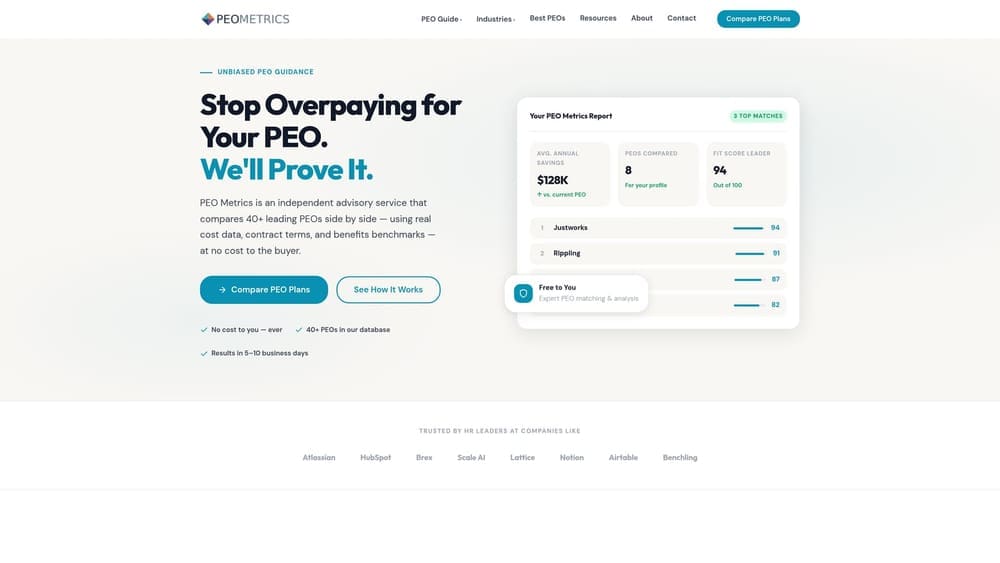
Its distinctive strength is that it looks at several providers on your behalf. Headline per-employee fees rarely tell the full story, so the service focuses on the detail behind them: bundled fees, administrative markups, and contract terms. That is useful when vendors quote in different formats and you can’t line them up yourself.
- Side-by-side provider comparisons, so you see services and costs in one frame instead of eight PDFs.
- Pricing analysis aimed at spotting where you might be overpaying.
- Guidance oriented toward unbiased provider selection rather than pushing one vendor.
- Metrics that go beyond headline fees, including contract flexibility.
Integrations don’t apply, since this is an advisory service. Setup is a conversation and a review of the quotes or renewal terms you already hold, and it’s typically run by the owner or ops lead making the decision.
The limitation is plain: PEO Metrics doesn’t run payroll or act as your employer of record, so you still need a provider afterward. It also isn’t the right fit if you’ve already decided on payroll-only and simply want to pick a tool. PEO Metrics may receive vendor placement fees, which you should factor in when weighing any recommendation. Starting price and pricing details are listed on its website.
Best for: Agencies still deciding between PEO and payroll that want quotes compared before committing.
2. Justworks
Justworks is a PEO built around small businesses. It bundles payroll, benefits, and compliance support under a co-employment arrangement, so a 10-person agency can hand off much of the HR administration without hiring someone to own it.
What sets it apart on this list is pricing that’s published and aimed at small teams. You can estimate cost before talking to sales, which most PEOs on this list don’t allow. Per-employee pricing is shown on its website; confirm current tiers there, as they can change.
- Payroll and tax filing handled in the same system as benefits, so pay changes flow through without double entry.
- Benefits administration that removes the need to manage carriers yourself.
- Workers’ comp coverage through the PEO arrangement, rather than a separate policy you shop for.
- HR and compliance support for questions a small team can’t answer in-house.
- An employee self-service app for pay stubs, time off, and benefits enrollment.
It connects with accounting and time-tracking tools, though you should confirm the current list on the site. Setup means moving payroll, benefits, and coverage into the PEO, which takes planning around open enrollment. Day to day, an office manager or ops lead can usually run it.
The main limitation is control. If you want to keep your own broker or existing benefit carriers, a PEO model like this is a poor match, because benefits come through the PEO’s plans. Agencies that value that independence may be better served by a payroll-only platform.
Best for: Small agencies that want an all-in-one PEO without a dedicated HR hire.
3. TriNet
TriNet is a PEO offering HR, payroll, benefits, and compliance services, with packages tailored to particular industries, professional services among them. For an agency, the appeal is plan design that reflects how a services business actually operates rather than a one-size bundle.
That industry-specific packaging is what it does distinctively on this list. Most other PEOs here present a single general offer, so if you want your plan to be built around a professional-services profile, TriNet is worth a look.
- Industry-tailored plans, so benefits and services line up with a services firm’s workforce.
- Payroll and benefits administration in one place, cutting the number of vendors you manage.
- Workers’ comp under the PEO arrangement, so coverage isn’t a separate procurement task.
- Compliance support to help with employment rules as you add staff or states.
- HR advisory for policy, hiring, and employee questions.
It works with accounting and HR-related software; confirm specifics on its site. Implementation is a formal onboarding process, and someone in operations or finance typically owns the relationship afterward.
The limitation is pricing visibility. TriNet is quote-based, so early cost comparison is harder than with a vendor that publishes rates. You’ll need to request a quote and compare fees and terms carefully, ideally against at least one other proposal.
Best for: Growing agencies wanting plan design tuned to a services business.
4. Insperity
Insperity is a PEO that pairs payroll and benefits administration with a dedicated HR representative and employee-relations support. The pitch is human help: a named person who knows your company and can handle the difficult people questions.
Hands-on assigned HR support is what it does best compared with the rest of this list. If your agency has no HR staff and a manager is currently fielding performance problems, leave requests, and disputes, that support has real value.
- A dedicated HR representative, giving you one contact for day-to-day people issues.
- Payroll and tax administration handled inside the same relationship.
- Benefits administration so enrollment and carrier questions don’t land on you.
- Employee relations support for conflicts, discipline, and terminations.
- Compliance guidance as rules change across the states where you have staff.
Confirm current integrations on the site. Setup involves onboarding into the PEO, and after that, the assigned representative does much of the running, with an owner or ops lead as the internal contact.
It may be more service than a very small studio needs. A five-person team with straightforward needs could pay for support it rarely uses. Pricing is quote-based, so you’ll need to request proposals to see how fees compare.
Best for: Agencies with no in-house HR that expect employee-relations issues.
5. ADP TotalSource
ADP TotalSource is ADP’s PEO offering. It is separate from ADP’s non-PEO payroll products, and that distinction matters: TotalSource involves co-employment, while ADP’s payroll-only products do not. It provides benefits, payroll, workers’ comp coverage, and HR support.
Its differentiator is the backing of a large payroll vendor. If you expect to grow into multiple states or need a path across a wider set of HR and payroll products, an established ecosystem can reduce the chance of outgrowing your provider.
- A co-employment PEO model, with employer responsibilities shared under the contract.
- Payroll and tax processing under the same arrangement as your benefits.
- Benefits access that a small agency may struggle to match on its own.
- Workers’ comp coverage included in the PEO structure.
- HR and compliance support for multi-state employment questions.
It integrates with ADP’s broader HR and payroll ecosystem; confirm details with ADP. Setup is a structured implementation, and finance or HR operations usually run it after launch.
It typically suits firms with enough headcount, so minimums and eligibility should be verified before you invest time in a proposal. Very small agencies may find another option fits better. Pricing is quote-based.
Best for: Larger or multi-state agencies wanting an established vendor ecosystem.
6. Paychex
Paychex sells both payroll (Paychex Flex) and a PEO, so a business can pick either model from one vendor. That makes it a natural fit for an agency that isn’t sure where it lands on the PEO versus payroll question.
The distinct advantage is the upgrade path. You can start payroll-first and consider the PEO later without changing brands, which no PEO-only vendor on this list offers.
Keep the two products separate
Payroll and PEO contracts with the same company differ in liability and in who acts as employer. A payroll agreement leaves you as sole employer. A PEO agreement creates co-employment. Read each contract on its own terms and never assume the protections of one carry into the other.
What you get
- Payroll and tax filing through the payroll product, for teams that want to stay the sole employer.
- A PEO option when you want shared HR and benefits administration.
- Benefits administration to reduce carrier and enrollment work.
- HR support for common employment questions.
- Time and attendance tools for hourly or project-tracked staff.
It connects with accounting and time tools; confirm on the site. Setup effort depends on which model you choose, and an ops or finance lead typically runs it. Pricing for both is quote-based, so the cost comparison takes a request. That’s the main limitation, alongside the need to compare the two contract types carefully.
Best for: Agencies that want to start with payroll and possibly move to a PEO later.
7. Gusto
Gusto is a payroll and HR platform for small businesses. It is not a PEO, so your agency stays the employer of record and holds responsibility for compliance, benefits, and workers’ comp arrangements. That’s a real tradeoff, and for some agencies it’s the appeal.
Its standout trait here is the simple payroll-only model with no co-employment. Benefits and insurance stay under your control, which suits teams that already work with a broker and want to keep choosing carriers.
- Payroll and tax filing so pay runs and filings don’t sit in spreadsheets.
- Contractor payments, useful for agencies that use freelancers (classification is still your responsibility).
- Employee onboarding that collects paperwork and sets people up without manual forms.
- Benefits via brokerage, letting you offer plans while keeping the broker relationship.
- Time tracking for hourly staff and project reporting.
It connects with accounting, time tracking, and other business apps; confirm the list on the site. Setup is comparatively light, and an owner, office manager, or ops lead can run it without specialist HR knowledge.
The limitation is what a PEO would otherwise supply: no shared employer liability and no pooled large-group benefits buying power. If you lack HR capacity or a good broker, the work stays with you. Pricing is tiered, combining a per-company fee with per-person charges, published on its website; confirm current rates there.
Best for: Small agencies with an existing broker and modest HR needs.
8. Rippling
Rippling is a workforce platform that combines payroll, HR, IT management, and a PEO option in one system. For a distributed creative team, having people data and device management connected is a distinctive draw.
What it does differently from the rest of this list is let you run payroll-only or a PEO inside the same platform, alongside IT tools for remote staff. You could begin without co-employment and change the arrangement later without changing systems, though you should confirm how that transition works.
- Payroll and HR in one system, so a new hire record drives pay, benefits, and access.
- A PEO option for teams that want shared employer duties.
- Device and app management so laptops and software for remote staff are set up and controlled centrally.
- Benefits administration to manage enrollment and changes.
- Multi-state and global payroll tools for teams spread across locations.
It offers a large app integration library; confirm the current list on its site. Setup is broader than with a payroll-only tool because you may configure HR, IT, and payroll modules together. It’s often run by an ops or people lead, sometimes with IT involvement.
The limitation is cost structure. Pricing is modular and quote-based, and it can add up for a team that only needs payroll. If you don’t need the IT or wider HR modules, a simpler payroll tool may be more economical.
Best for: Remote or hybrid creative teams wanting HR and IT in one system.
Matching the Model to Your Agency
The two models solve different problems, so start there. If you aren’t sure which one fits, a comparison step comes first: PEO Metrics can put provider quotes side by side so you’re weighing real terms instead of sales pitches. [LINK CHECK: PEO vs payroll guide] covers the model differences in more depth.
- Choose a PEO (Justworks, TriNet, Insperity, ADP TotalSource, or the PEO options at Paychex and Rippling) if you want shared HR and benefits administration and have no one to run it in-house.
- Choose a payroll company (Gusto, or the payroll products at Paychex and Rippling) if you already have a broker and HR capacity and want to remain in control as sole employer.
Desk-based marketing roles generally fall into lower-risk workers’ comp classes, but verify that per carrier and state. Freelancer classification and multi-state remote staff deserve attention under either model.
Before you sign that PEO renewal, make sure you’re not leaving money on the table. Many businesses unknowingly overpay because of bundled fees, hidden administrative markups, and contracts designed to limit flexibility. We give you a clear, side-by-side breakdown of pricing, services, and contract terms, so you can see exactly what you’re paying for and choose the option that truly fits your business.
