

If you run an ecommerce business with seasonal warehouse hiring, remote customer support, and a handful of employees in different states, you are choosing between two models: a PEO that shares employer responsibilities with you, or a payroll company that leaves you as the sole employer. The tools below were picked for fit with those realities: workers’ comp for fulfillment staff, multi-state payroll, contractor and international needs, accounting integrations, and how transparent each vendor is about pricing and contracts.
Each entry says which model the product actually uses, because the labels get blurred. A PEO enters a co-employment relationship with you. A payroll-only provider does not. An employer of record (EOR) becomes the legal employer of workers, typically abroad. An ASO administers HR tasks without co-employment. A CPEO is a PEO certified by the IRS, so check the IRS CPEO list for any vendor you consider. Pricing and availability change often, so confirm every figure directly with the vendor.
Quick Comparison of the Nine Options
- PEO Metrics: best for teams choosing between several PEOs; pricing on request via its website; the only entry here that compares multiple PEOs side by side instead of selling one.
- Justworks: best for small ecommerce teams wanting a simple PEO package; see its website for pricing; largely published per-employee pricing that makes budgeting easier.
- Gusto: best for founder-led stores with a modest US team; see its website for pricing; the clearest payroll-only route with no co-employment.
- Rippling: best for growing brands with remote staff; quote-based; ties employee records to device and app provisioning.
- TriNet: best for established brands wanting a long-running PEO; quote-based; industry-oriented PEO packaging.
- Insperity: best for mid-sized brands with a fulfillment center; quote-based; assigned, hands-on HR support.
- ADP TotalSource: best for scaling brands or existing ADP payroll users; quote-based; a path from ADP payroll to a PEO within one provider family.
- Paychex: best for stores starting with payroll and hourly time tracking; quote-based; time and attendance tools with a ladder from payroll to PEO.
- Deel: best for brands hiring overseas talent; see its website for pricing; employer-of-record hiring and payment in other countries.
1. PEO Metrics
PEO Metrics is a comparison and guidance service, not a PEO and not a payroll provider. It is built for owners and HR leads who already suspect a PEO might fit but don’t want to evaluate providers one sales call at a time.
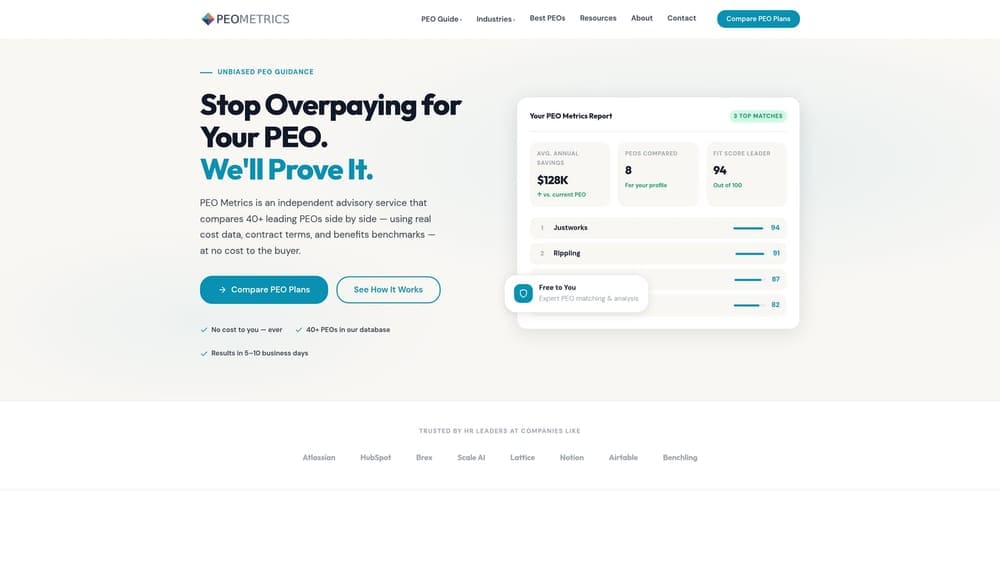
What sets it apart on this list is independence from any single vendor’s process. You can see several PEOs next to each other on metrics and pricing before you commit to one provider’s pitch. That matters for ecommerce because the cost drivers, such as workers’ comp for warehouse roles, seasonal headcount swings, and contract exit terms, are exactly where quotes diverge and where bundled fees can hide.
- Side-by-side provider comparisons, so you can weigh services and terms in one view.
- Pricing analysis, which helps you see what you would actually pay rather than a headline rate.
- Detailed provider metrics that go beyond brochure language.
- Guidance on selecting a PEO, useful if you are still deciding whether co-employment is right at all.
There are no integrations to evaluate because it is an advisory service. Setup is a conversation and a review of your needs, and whoever owns HR or finance at your company would typically run it.
The limits are plain. It does not run payroll, administer benefits, or act as your employer, so it does nothing for a business that needs payroll only. It also may receive vendor placement fees, so you should treat it as one input and verify quotes directly with providers. Pricing details are on its website.
Best for: Teams choosing between several PEOs who want comparison data before requesting quotes.
2. Justworks
Justworks is a PEO aimed at small businesses, bundling payroll, benefits access, workers’ comp, and HR support under a co-employment arrangement. It is designed for a store with a small team that wants one vendor handling compliance paperwork.
Its distinguishing strength on this list is pricing that is largely published on a per-employee basis. Most other PEOs here are quote-based, so Justworks makes it easier to model what a seasonal bump in headcount would do to your monthly cost before you talk to a salesperson.
- Payroll that runs inside the same system as benefits, so enrollment changes flow to pay automatically.
- Access to benefits plans that a small team may not be able to buy on its own.
- Workers’ comp coverage included under the PEO arrangement, which matters once you hire packers or pickers.
- HR support for questions on policies and employment issues.
- Employee self-service for pay stubs, time off, and benefits elections.
It connects with accounting tools such as QuickBooks and Xero, though you should verify the current list. Setup is typically handled by whoever runs finance or operations, and the self-service design keeps day-to-day admin light.
The trade-off is scale. A larger fulfillment-heavy operation that needs deep customization or on-site HR support may outgrow the simple package. Because co-employment is part of the model, you also give up some control over how benefits and workers’ comp are structured compared with a payroll-only setup. Check the website for current rates and what drives them, which usually includes headcount and the plan you pick.
Best for: Small ecommerce teams wanting PEO benefits and compliance in one simple package.
3. Gusto
Start with the model: Gusto is a payroll and HR platform, not a PEO. You remain the sole employer of record, with optional benefits administration layered on top. That makes it the cleanest example here of the payroll-only route.
What the payroll-only route means for a store
You keep your own benefits carriers and your own workers’ comp policy, and you avoid co-employment. The flip side is that compliance and workers’ comp remain your responsibility. If you hire warehouse staff, you or your broker must secure the policy and make sure roles are classified correctly. Gusto will not pool your purchasing power with other businesses.
Features and fit
- Full-service payroll that files and pays payroll taxes on your behalf, cutting out manual filings.
- Contractor payments, handy for freelance designers, photographers, and ad managers.
- Multi-state payroll for the remote support rep living two states over.
- Benefits administration so enrollment lives in the same system, even though you choose the carriers.
- Onboarding tools that collect new-hire paperwork before day one.
It integrates with QuickBooks, Xero, and time tracking apps, though the current list should be verified. A founder or office manager can run it without dedicated HR staff.
It suits a modest US team poorly if you need pooled benefits buying, or if you would rather hand off compliance risk. Pricing is on the Gusto website and generally depends on the plan and the number of people paid.
Best for: Founder-led stores with a modest US team that want payroll without co-employment.
4. Rippling
Rippling combines HR, IT, and payroll in one platform and offers a PEO option next to its non-PEO payroll products. So you can ask which model applies before you buy, rather than assume.
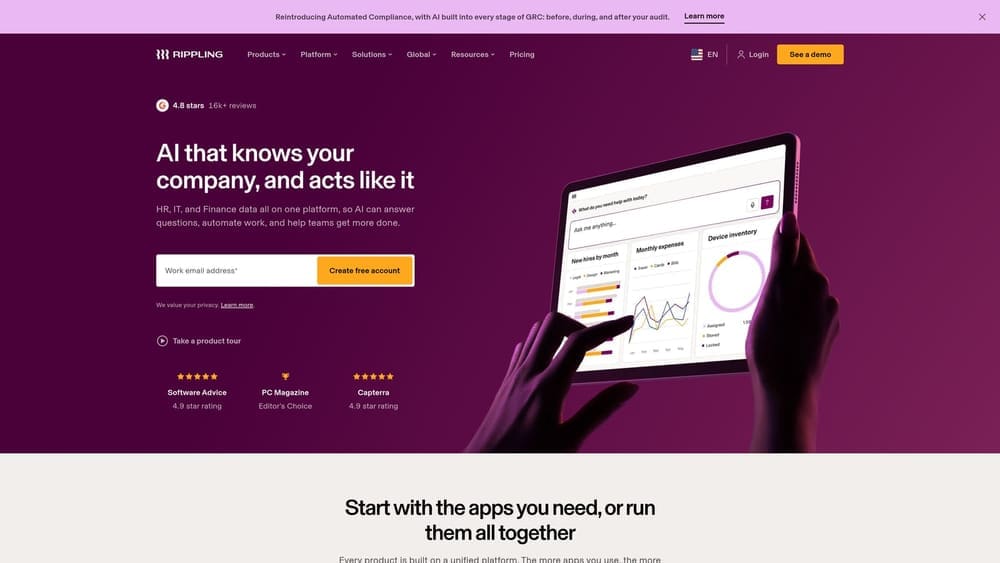
Its differentiator is the link between employee records and equipment. When a remote support agent or developer is hired, their data can drive device management and app provisioning so they get the right tools and access. For an ecommerce company with distributed staff using helpdesk, storefront, and ad tools, that cuts onboarding and offboarding gaps.
- Payroll tied to the same employee record used for everything else.
- A PEO offering for businesses that want co-employment benefits and compliance.
- Device management to ship, secure, and recover laptops for remote workers.
- App provisioning that grants and revokes access as roles change.
- Workflow automation to route approvals and onboarding steps.
It has a large app marketplace, so check that the ecommerce and accounting connectors you rely on are available. Setup effort is higher than a payroll-only tool, since the value comes from configuring several modules, and an HR or IT lead usually owns it.
Pricing is quote-based and modular, so the total can climb as you add modules. If all you need is payroll for a few people, it is likely more than you need.
Best for: Growing brands with remote support, marketing, and engineering staff.
5. TriNet
TriNet is an established PEO offering co-employment, benefits, payroll, HR advisory, and workers’ comp administration. It packages services by industry, so it is worth asking whether a retail or ecommerce configuration is currently offered and what it includes.
- Co-employment structure that moves much employment compliance administration to the PEO.
- Benefits plans for staff, which can help with recruiting hourly and salaried workers.
- Payroll processed in the same relationship as benefits and compliance.
- HR advisory for questions like handling terminations or leave requests.
- Workers’ comp administration for warehouse and fulfillment roles.
TriNet integrates with accounting and HR tools; confirm which ones before you sign. Implementation is more involved than a self-serve payroll app, since benefits, workers’ comp, and payroll move together. Expect an HR lead or owner to work with an assigned implementation team.
The limitations are commercial. Pricing is quote-based and may come with minimums, so it is a poor fit for an owner-only shop or a very small team. Ask about contract length and exit terms, because leaving a PEO mid-year can mean re-enrolling benefits. What moves your price typically includes headcount, benefits selection, and the risk profile of your roles.
Best for: Established brands wanting a long-running PEO with industry-aware guidance.
6. Insperity
Insperity is a PEO with a high-touch service model. Instead of leaving you in a self-service portal, it assigns HR support to your account, alongside payroll, benefits, and risk management.
That distinction is useful for hourly operations. A fulfillment center with shift supervisors dealing with attendance, injuries, discipline, and peak-season onboarding benefits from a person to call, more than a help center article. It is the most hands-on approach among the PEOs here.
- Co-employment that places many compliance tasks with the PEO.
- Dedicated HR support so your managers have a named contact.
- Payroll integrated with benefits and HR records.
- Benefits access for hourly and salaried employees.
- Risk and safety guidance relevant to warehouse injury exposure.
Check the website for current integrations, and verify them against your accounting and time tracking tools. Setup is a managed implementation, and day-to-day ownership usually sits with an HR or operations leader who works with the assigned representative.
Pricing is quote-based, and the service typically targets larger small-business headcounts, so confirm minimum employee requirements early. A tiny store may find it more than it needs. Headcount, benefits, and your workers’ comp profile will shape the quote.
Best for: Mid-sized brands with a fulfillment center wanting hands-on HR help.
7. ADP TotalSource
ADP TotalSource is ADP’s PEO offering. It is distinct from ADP’s payroll-only products, so be careful when you hear “ADP” in a sales conversation: ask which product and which employment model is being quoted.
Its advantage is the provider family. A business already running ADP payroll has a route to a PEO without switching to an unfamiliar vendor, and the reverse is possible if co-employment stops fitting. Few vendors here offer that range under one brand.
- Co-employment structure that shifts employer administration to the PEO.
- Payroll handled in the same system as HR records.
- Benefits access for employees across roles.
- Workers’ comp, important for warehouse and fulfillment staff.
- HR compliance support for policy and employment-law questions.
ADP Marketplace connectors cover many tools; verify the list for your accounting and ecommerce stack. Implementation typically involves a dedicated team and a defined timeline, and an HR lead would own it afterward.
Pricing is quote-based, with eligibility requirements to verify, including any minimums and state availability. It may exceed what a tiny store needs. Headcount, benefits choices, and your industry risk profile are the likely price drivers.
Best for: Scaling brands or existing ADP payroll users considering a move to a PEO.
8. Paychex
Before comparing anything, note that Paychex sells payroll (Paychex Flex) and a separate PEO offering. Which product you buy determines whether co-employment applies. Compare the payroll plan with the PEO plan, not brand to brand, because they differ in cost and in who carries compliance.
Why hourly and seasonal staff are the draw
Paychex offers time and attendance tools aimed at hourly workforces. For a warehouse that adds dozens of temporary packers in Q4, accurate timekeeping feeds directly into payroll, which reduces errors in overtime and hours worked. The ladder from payroll to PEO means you can start light and move up if risk grows.
- Payroll that processes pay and tax filings for employees.
- A PEO option for businesses that later want co-employment.
- Time and attendance for hourly and seasonal workers.
- Benefits administration to manage enrollment.
- Retirement plans so you can offer savings options as you grow.
It works with QuickBooks and other accounting tools; verify the current list. Setup varies with the product mix, and a finance or HR lead typically manages it.
Pricing is quote-based and add-on heavy, so ask for line items. A shop that only needs simple payroll for a few people may find the modular menu more than necessary.
Best for: Stores starting with payroll and hourly time tracking that may add a PEO later.
9. Deel
Deel is a global payroll, employer of record, and contractor payment platform. It is an EOR, not a US PEO, and that difference defines where it belongs: hiring and paying people outside your home country.
Its distinguishing ability is something domestic PEOs and payroll vendors cannot do: hire and pay workers in other countries through one platform. For an ecommerce brand with overseas customer support, designers, or developers, an EOR can employ them locally without you setting up a foreign entity.
- Employer of record services so a local entity employs the worker legally.
- Global payroll across countries in one place.
- Contractor payments for freelancers outside the US.
- Compliance documents such as locally appropriate contracts.
- Multi-currency payouts so workers are paid in their own currency.
It integrates with QuickBooks, Xero, and NetSuite; verify the current list. Setup is usually light for contractors and more involved for EOR hires, and it is often run by finance or an operations lead.
It does not replace what a US PEO does for domestic staff, such as benefits pooling or workers’ comp for a warehouse team. Many brands pair it with a US payroll or PEO provider. Pricing is on the website and typically depends on the service type and the number of workers.
Best for: Brands hiring overseas support, design, or development talent.
Matching Each Option to Your Situation
The right pick depends on your warehouse risk, headcount swings, and where your people live, so match by use case:
- Comparing PEO options: PEO Metrics, before you sit through several sales processes.
- Small US team, payroll only: Gusto, if you are content to manage your own benefits carriers and workers’ comp.
- Benefits and compliance in one bundle: Justworks for small teams, or TriNet and ADP TotalSource for larger or established ones.
- Hands-on HR for warehouse staff: Insperity.
- Remote, tech-heavy teams: Rippling.
- Hourly time tracking first: Paychex, with a PEO option later.
- Hiring abroad: Deel, alongside a US provider.
Whichever you favor, verify quotes, minimums, state availability, and CPEO status directly with each vendor, and read exit terms before you sign. Warehouse workers’ comp classification and seasonal hiring assumptions can change a quote materially. For background on the model differences, see our [LINK CHECK: PEO vs payroll guide], and our [LINK CHECK: PEO comparison hub] for provider comparisons.
Before you sign that PEO renewal, make sure you’re not leaving money on the table.
Many businesses unknowingly overpay because of bundled fees, hidden administrative markups, and contracts designed to limit flexibility. PEO Metrics gives you a clear, side-by-side breakdown of pricing, services, and contract terms, so you can see exactly what you’re paying for and choose the option that truly fits your business. PEO Metrics may receive vendor placement fees.
