

If you own one or more franchise units, the PEO versus payroll question comes down to how much HR, benefits administration and employment risk you want to hand off, and how much you want to keep, while still operating inside your franchisor’s brand standards. This list is for franchisees at every stage, from a single unit with a handful of hourly staff to a multi-unit operator across several states.
The options were chosen for franchise-relevant fit: multi-location payroll, benefits access, workers’ comp handling, compliance support, and compatibility with franchisor systems. Each is clearly a PEO, a payroll platform, or a comparison resource, and the labels matter because they carry different legal responsibilities. Details such as pricing, minimums, state availability and integrations change, so confirm them with each vendor before you decide. This article is informational, not legal, tax or benefits advice.
Quick Comparison of the Options
- PEO Metrics: franchisees who want to compare PEO quotes before buying; see website for pricing; the only item here that compares multiple PEOs side by side rather than selling payroll or a PEO.
- Insperity: multi-unit franchisees without HR staff; quote-based; advisor-led, high-touch service model.
- ADP TotalSource: growing franchisees across several states; quote-based; connects to the wider ADP ecosystem.
- TriNet: franchisees in a vertical TriNet serves; quote-based; industry-oriented PEO packaging.
- Justworks: small franchisees who want a PEO without a long sales process; see website; the lightest, most self-serve PEO experience here.
- Paychex: owners who may start payroll-only and grow into a PEO; quote-based; both payroll and PEO paths under one vendor.
- Gusto: owners with confident HR practices; see website; a payroll platform where you stay sole employer, with publicly listed plans.
- Rippling: multi-location owners wanting one console; see website; links HR, payroll and IT workflows in one system.
- Paycor: hourly-heavy franchisees; quote-based; scheduling and per-location reporting inside the payroll platform.
1. PEO Metrics
PEO Metrics is our own comparison service, and it sits first because it answers the question that comes before vendor selection: is a PEO worth it for your locations at all? It is not a PEO and not a payroll platform. It helps you put several PEO providers side by side, with detailed metrics and pricing analysis, so you can see what each one costs and what you get for it.
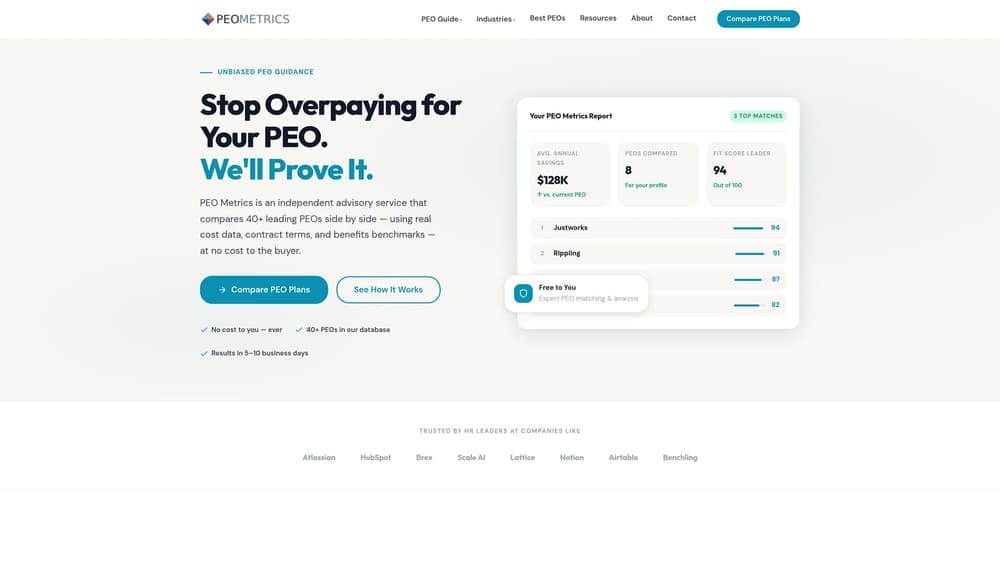
That matters for franchisees because PEO economics vary with headcount, state mix, workers’ comp class codes and benefit choices. A PEO does not automatically save money, and a side-by-side view lets you test that assumption before you sign anything.
- Side-by-side PEO comparisons, so you can weigh providers against each other instead of one sales pitch at a time.
- Pricing analysis that shows what bundled fees and administrative charges look like in practice.
- Detailed provider metrics for judging services, not just headline rates.
- An unbiased-guidance approach aimed at helping you avoid overpaying, though no comparison can promise perfect neutrality.
Integrations are not applicable, since this is an advisory service. Setup is simply a conversation and a review of your headcount, locations and current setup, and the owner or HR lead can run it without any system changes.
The limits are plain. PEO Metrics does not run payroll or act as your employer, and it covers PEOs rather than payroll-only vendors, so a franchisee leaning toward Gusto or Paycor will need other resources for that side. PEO Metrics may also receive placement fees from vendors, which you should factor in when weighing any recommendation. Pricing details are on the website.
Best for: Franchisees who want to compare PEO quotes and see whether a PEO is worth it before buying.
2. Insperity
Insperity is a full-service PEO that bundles HR advisory support, benefits, payroll and workers’ comp under a co-employment model. Its distinguishing trait on this list is the advisor-led approach: you get a named HR contact, which suits owners who have no HR department and would otherwise handle hiring, discipline and policy questions alone.
What you get
- Co-employment, so Insperity shares certain employer responsibilities with you.
- Dedicated HR support for day-to-day people questions across locations.
- Benefits and workers’ comp administration handled inside one contract.
- Payroll and time tools that cover the basics of hourly staffing.
Setup, fit and limits
Onboarding is sales-led and involves moving payroll, benefits and workers’ comp under the PEO, so plan for a real implementation rather than a quick switch. Your franchisor may require specific POS or payroll integrations, so verify current integrations on Insperity’s site and ask how it works with your system.
It is likely too heavy for a very small single-unit owner, and minimums should be verified. Pricing is quote-based, and what moves it is typically headcount, location mix, benefit selections and workers’ comp exposure.
Best for: Multi-unit franchisees wanting hands-on HR support.
3. ADP TotalSource
ADP TotalSource is ADP’s PEO, combining payroll, benefits, compliance and risk services under co-employment. Its edge is scale and the surrounding ADP ecosystem, which can appeal if your units already run ADP products or your franchisor works with ADP.
Keep one distinction straight: TotalSource is a PEO, which is different from ADP’s payroll-only products. With payroll-only, you remain the sole employer. With TotalSource, employer duties are shared, and the contract terms reflect that.
- Co-employment that shifts part of the compliance and administrative load off you.
- Benefits programs, which can matter if you struggle to offer competitive coverage to hourly staff.
- Multi-state payroll and compliance support for operators with units across state lines.
- Workers’ comp coverage folded into the arrangement rather than purchased separately.
Integrations run through the ADP Marketplace, but verify the current list against your franchisor’s required systems. Setup is a full onboarding with ADP’s team, and an owner or office manager will typically run payroll while ADP handles the compliance layers.
Pricing is quote-based, and headcount requirements should be verified before you go far into the process. Expect cost to move with employee count, states, benefit plans and workers’ comp class codes. It may not suit a tiny single-unit shop.
Best for: Growing franchisees operating across several states.
4. TriNet
TriNet is a PEO that provides HR, benefits, payroll and compliance services, with packages oriented toward particular industries. If your franchise falls in a category it specifically serves, that tailoring can mean benefits and compliance guidance closer to how your business actually operates.
The catch is the reverse of the strength: the fit depends on your vertical. Before investing time, confirm whether your franchise category is covered and which verticals TriNet currently supports.
- Co-employment, which shares employer administration and some compliance duties.
- Industry-specific plans that can align benefits and risk services with your category.
- Benefits access that a single small unit could struggle to buy alone.
- Payroll and compliance support to keep filings and registrations on track.
Verify current integrations on TriNet’s site, especially if your franchisor mandates a POS or scheduling tool. Setup is sales-led, with implementation handled alongside TriNet’s team, and day-to-day administration usually sits with an owner or general manager.
Pricing is sales-led and quote-based, and minimums should be verified. Headcount, benefit design, location and risk class tend to drive the quote. Franchisees outside a served vertical may find a broader provider a better match.
Best for: Franchisees in a vertical TriNet specifically serves.
5. Justworks
Justworks is the lightest PEO on this list. It offers a self-serve online platform for small businesses and bundles payroll, benefits and compliance support under co-employment, with a more transparent pricing approach than many sales-led competitors.
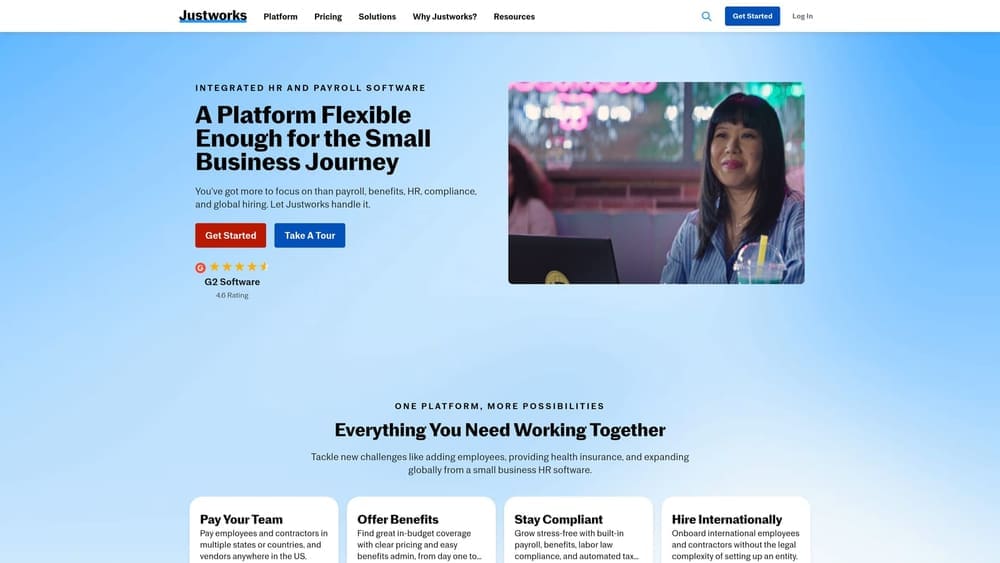
Its practical advantage is speed. A small franchisee can evaluate it without sitting through a long sales cycle, which suits owners who want to see what they would pay before talking to anyone.
The trade-off is customization. Larger PEOs generally offer more tailored advisory service and plan design, so a multi-state operator with complex benefit needs may outgrow the self-serve model. Verify state availability and the benefit options on offer for your locations.
- Co-employment with a bundled payroll, benefits and compliance package.
- A self-serve platform where owners and managers handle most tasks themselves.
- Payroll that runs inside the same system as benefits and onboarding.
- Compliance support so a small team isn’t tracking every rule alone.
Accounting and other integrations are available, but verify the current list against what your franchisor requires. Setup is lighter than with high-touch PEOs, and the owner or a manager typically runs it. Starting price and plan details are on the website, and costs generally move with headcount and benefit selections.
Best for: Small franchisees wanting a PEO without a long sales process.
6. Paychex
Paychex offers both payroll (Paychex Flex) and PEO services, which gives franchisees a path that can change as the business changes. You might start with payroll while you have one or two units, then move to a PEO as headcount and benefits needs grow, without changing vendors entirely.
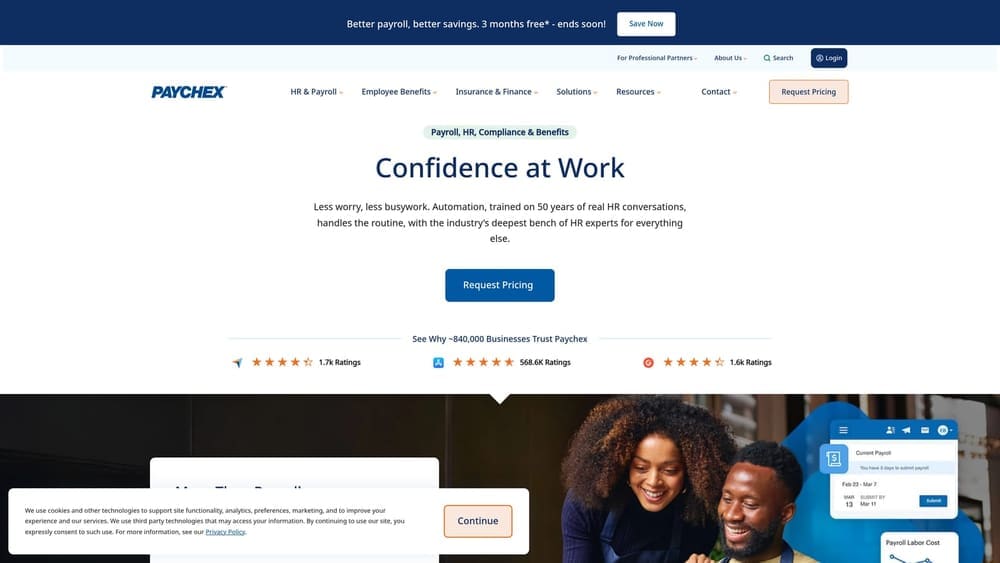
The caution is contractual. Payroll and PEO products carry different responsibilities. On payroll-only, you remain the sole employer and keep the compliance liability. On the PEO side, duties are shared. Read exactly which product you are signing and what each party handles.
- A payroll platform for pay runs and tax filings when you want to stay the sole employer.
- PEO services for owners ready to share employer duties and bundle benefits.
- Time and attendance tools that help with hourly scheduling and hours tracking.
- Benefits administration to manage enrollment without a dedicated HR person.
Accounting and time-tracking integrations are available, but verify the current list against franchisor requirements. Setup varies by product, from a simple payroll migration to a full PEO onboarding. Pricing is quote-based for both, and it typically moves with employee count, modules selected and benefit complexity.
Best for: Franchisees who may start payroll-only and grow into a PEO.
7. Gusto
Gusto is a payroll and HR platform for small businesses, and it is not a PEO. That distinction defines it: you remain the sole employer, there is no co-employment, and the compliance liability stays with you. In exchange, you get a simple platform with publicly listed plan pricing.
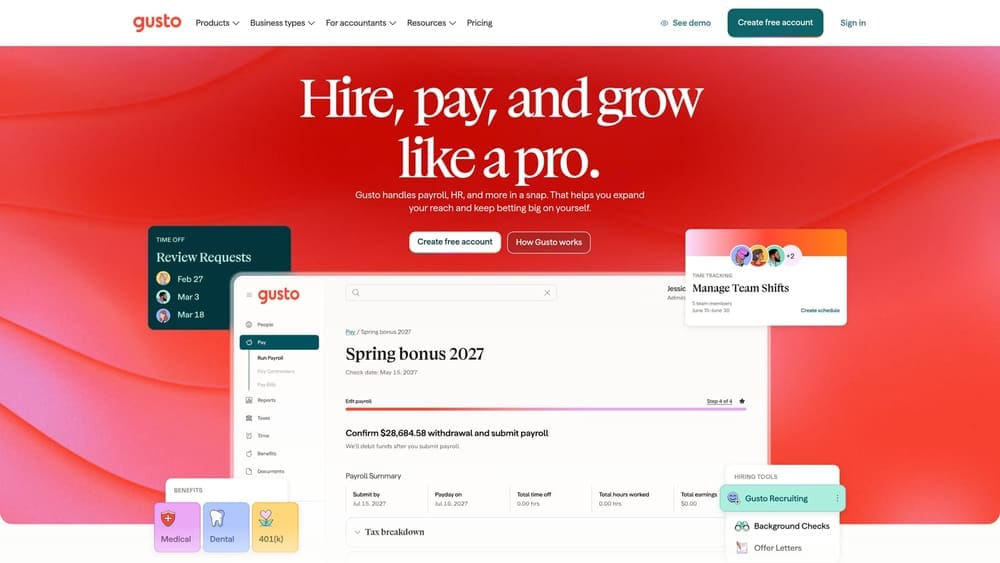
For a franchisee with confident HR practices, such as a clear handbook, solid hiring and a manager who knows wage-and-hour rules, that can be the cheaper and simpler path. For an owner hoping a vendor will absorb employment risk, it will disappoint.
- Payroll and tax filing that cuts manual work on each pay run.
- Benefits administration, though without PEO-style pooled purchasing power.
- Onboarding and HR tools for new-hire paperwork and basic records.
- Time tracking to support hourly pay across shifts.
Accounting integrations such as QuickBooks and Xero are available, but verify the current list and your franchisor’s required systems. Setup is quick and self-serve, and the owner or a manager typically runs it. Plans are publicly listed on the website (verify as of publication), and price generally moves with plan tier and employee count.
Best for: Owners with confident HR practices who want a simple, lower-cost payroll platform.
8. Rippling
Rippling is a modular platform that combines payroll, HR and IT management, with a PEO option (verify what is currently offered). Its distinctive angle is connecting people and systems: when a hire is made, payroll, benefits, and device and app access can be handled from one console.
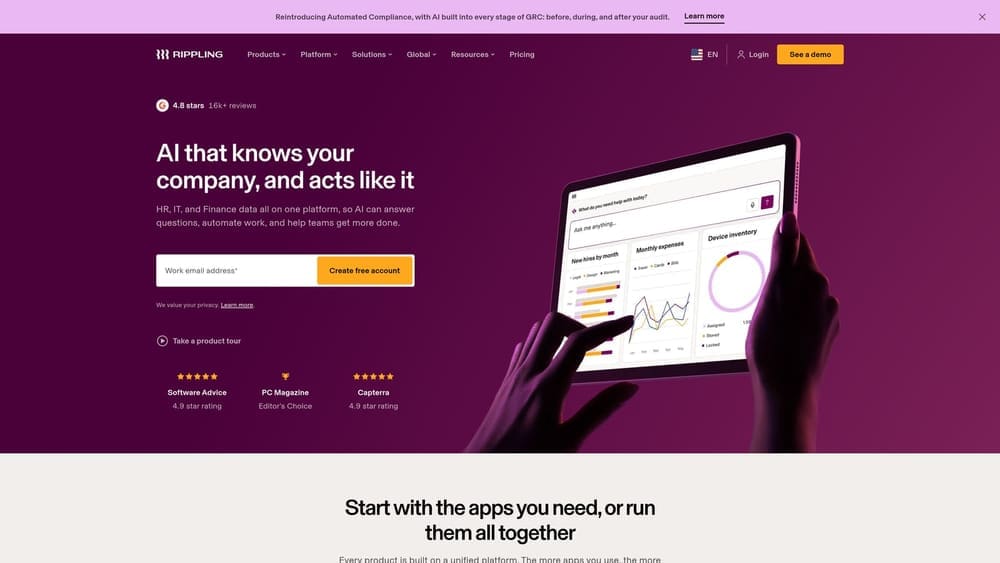
That appeals to a multi-location owner who is tired of stitching together separate tools for each unit. It is less compelling for a single-unit owner whose needs are narrow, since breadth is what you pay for.
- Payroll that connects to employee records across all locations.
- An HRIS that keeps people data in one place instead of spreadsheets per unit.
- Device and app management that ties provisioning to hiring and departures.
- Benefits administration inside the same system.
- A PEO option for owners who want shared employer duties (verify current availability).
Rippling advertises a wide app integration catalog, so check that it covers your franchisor’s required POS or scheduling tools. Setup scales with the modules you adopt, and a manager or operations lead usually owns it. Pricing details are on the website and may be quote-based or per-employee by module (verify). Each added module raises cost, so scope carefully.
Best for: Multi-location owners wanting one console for HR and systems.
9. Paycor
Paycor is a payroll and human capital management platform with scheduling and time tools built for hourly workforces. It is not a PEO, so there is no co-employment, no pooled benefits purchasing and no shared liability. You stay the employer.
What it does well is the daily reality of a shift-based franchise: scheduling, time capture and payroll in one place, plus reporting broken out by location so you can compare labor across units.
- Payroll that pulls hours straight from time records to reduce manual entry.
- Time and scheduling tools for managing shifts across hourly staff.
- Reporting by location so you can see labor patterns unit by unit.
- Talent and HR tools for hiring, onboarding and basic people management.
Verify current integrations on Paycor’s site against your franchisor’s POS and system requirements. Setup involves migrating payroll and configuring time and scheduling, typically run by an owner, ops manager or office administrator. Pricing is quote-based and generally moves with employee count and the modules you choose.
It is a weaker fit if what you want is bundled workers’ comp, pooled benefits or HR liability sharing, since those are PEO features. Owners who need them should look at the PEOs above.
Best for: Hourly-heavy franchisees who want payroll depth without co-employment.
Matching the Option to Your Franchise Situation
For a single-unit owner, the realistic choices are usually Justworks if you want a PEO with little friction, or Gusto if you are comfortable carrying HR compliance yourself. For a multi-unit growth operator, Insperity or ADP TotalSource fit best when you want hands-on support or multi-state reach, and Paychex suits those who want a path from payroll into a PEO. A franchisee with strong in-house HR can often skip co-employment and look at Gusto, Paycor or Rippling. An owner who is unsure whether a PEO pays off should compare first, which is the job PEO Metrics does.
Before any signature, check two things. Your franchisor may require specific payroll, POS or scheduling integrations, so confirm compatibility in writing. And joint-employer exposure, meaning how much control a franchisor is seen to have over your workers, is a separate issue from PEO co-employment, and the legal standard has shifted over recent years. Verify the current status with qualified counsel. If you are weighing a PEO, also confirm any vendor’s CPEO status on the IRS list rather than assuming it.
Before you sign that PEO renewal, make sure you’re not leaving money on the table.
Many businesses unknowingly overpay because of bundled fees, hidden administrative markups, and contracts designed to limit flexibility. We give you a clear, side-by-side breakdown of pricing, services, and contract terms, so you can see exactly what you’re paying for and choose the option that truly fits your business. PEO Metrics may receive placement fees from vendors, and we tell you so up front.
