

If you run a hotel, resort, or inn with tipped staff, seasonal swings, and a housekeeping team that turns over faster than you’d like, the question of PEO versus payroll company is really a question about who carries risk. This list is for owners and HR leads weighing co-employment against payroll software plus separately bought benefits and workers’ comp.
The options were chosen for hospitality fit (tips, hourly scheduling, workers’ comp, multi-state staff), how clearly each provider sits on the PEO or payroll side of the line, and how much you can verify before talking to sales. Details like pricing, minimums, and state availability change, so confirm them on each vendor’s site before you decide. For background on the two models, see [LINK CHECK: PEO vs payroll guide] and [LINK CHECK: hospitality PEO hub].
Quick Comparison of PEO and Payroll Options for Hospitality
- PEO Metrics: best for operators comparing PEO options and costs before committing; pricing on its website; the only entry here that is a vendor-neutral comparison service rather than a PEO or payroll provider.
- Insperity: best for mid-sized hotels wanting hands-on HR support; quote-based; a hands-on HR advisory model for large hourly teams.
- ADP TotalSource: best for multi-property groups across several states; quote-based; scale and multi-state reach.
- Paychex (PEO and Paychex Flex): best for operators unsure whether they need a PEO; quote-based; a payroll-to-PEO path under one vendor.
- Justworks: best for small and boutique properties modeling PEO cost; see website; pricing transparency for small employers.
- Gusto: best for small properties with stable teams that keep their own carriers; see website; payroll without co-employment.
- Toast Payroll and Team Management: best for restaurants and bars inside hotels already on Toast; see website; tip and sales data flowing from the POS into payroll.
- Homebase: best for small hourly teams needing scheduling more than HR outsourcing; see website; scheduling and time tracking as the core product.
- Paycor: best for mid-sized hotel groups wanting analytics without co-employment; quote-based; workforce analytics for turnover and labor cost.
1. PEO Metrics
PEO Metrics is a PEO comparison and consulting service, and it sits first because the PEO-versus-payroll decision should be made before you pick a vendor. It is not a PEO or a payroll provider. It does not run payroll or employ your staff. PEO Metrics may receive vendor placement fees, so weigh its guidance with that in mind and check any figures it gives you against vendor documents.
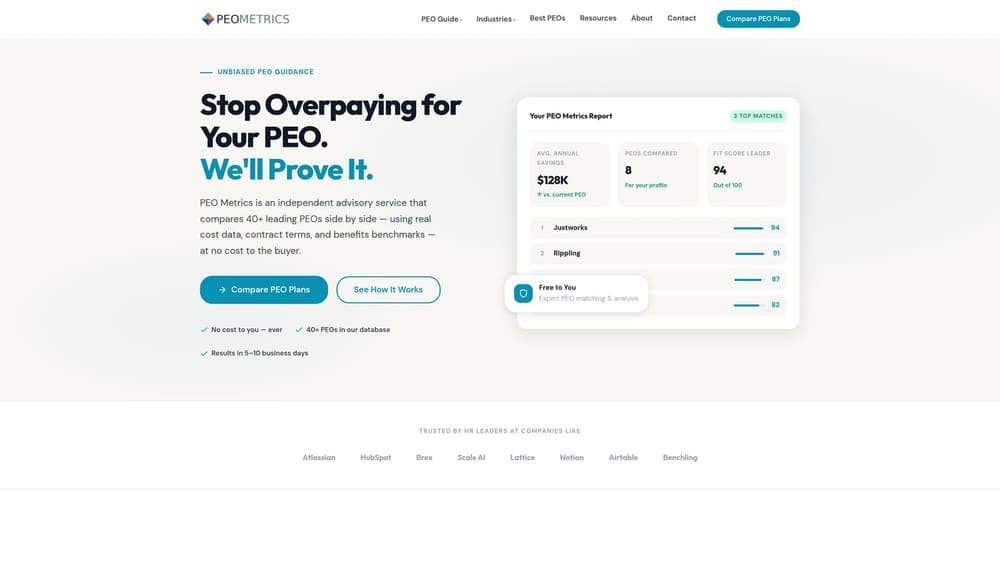
Its distinctive value on this list is vendor neutrality across both paths. Every other entry is selling you its own model; PEO Metrics helps you test whether co-employment is worth it for your property at all.
- Side-by-side PEO provider comparison, so you can see how options differ on services and terms rather than reading separate sales decks.
- Pricing analysis that shows what you would pay and what is bundled into that number.
- Detailed provider metrics that give you something concrete to compare before you request quotes.
- Guidance on PEO versus alternatives, including payroll-only setups where you buy benefits and workers’ comp separately.
There are no integrations to set up because it is an advisory service. You or your HR lead would use it as a research step, not as a daily system. The tradeoff is exactly that: it adds a step before purchase and it cannot process a single paycheck. If you already know you want a specific provider, it may be more than you need.
Pricing details are on the PEO Metrics website; check there for current terms.
Best for: Operators who want to compare PEO options and costs before committing.
2. Insperity
Insperity is a full-service PEO offering HR advisory, benefits, payroll, and risk management, aimed at mid-sized employers. What sets it apart here is the hands-on advisory model. For a hotel with a large hourly workforce, having a named HR contact for employee relations issues is a different product from self-service software.
- Dedicated HR support, so a manager with a disciplinary or leave question has a person to call.
- Payroll and benefits administration handled under one co-employment arrangement.
- Workers’ comp and risk management, which matters for housekeeping and maintenance injury exposure.
- Employee relations guidance for the documentation and process side of high-turnover hiring and termination.
Integrations are not specified in the research for this list, so ask which time, scheduling, and property management systems it connects to. Setup for a PEO is a real onboarding project, since employees move onto the PEO’s payroll and benefits plans. Someone in HR or finance will own that process and the ongoing relationship.
It may not suit very small operators, or businesses that want to keep their own benefits broker. Confirm minimums and contract terms in writing. Pricing is quote-based and typically moves with headcount and the benefits and risk profile of your workforce.
Best for: Mid-sized hotels wanting hands-on HR support.
3. ADP TotalSource
ADP TotalSource is ADP’s PEO offering, and it is a separate product from ADP’s payroll-only lines. That distinction matters: buying ADP payroll does not put you in a co-employment arrangement, while TotalSource does. Its standout trait for this list is scale and multi-state reach, which helps hotel groups with properties in several states.
What you get
- PEO co-employment, which shifts a share of employer administration and liability to the PEO.
- Benefits access through pooled plans, useful if your own group is too small for good rates.
- Payroll and HR technology in one system across properties.
- Compliance support for the patchwork of state rules a multi-state operator faces.
What to check
Ask which integrations it supports and how time and scheduling data reaches payroll; the research notes call for verifying this on the vendor site. A single independent property may find it heavy, and you should verify minimums and contract terms before engaging. Rollout across several locations takes coordination, usually led by corporate HR or finance rather than a general manager.
Pricing is quote-based and generally depends on headcount, benefits selections, and the states you operate in.
Best for: Multi-property hotel groups across several states.
4. Paychex (PEO and Paychex Flex)
Paychex sells both a PEO and payroll-first software (Paychex Flex), so you can price both paths from one vendor. If you honestly don’t know whether co-employment pays off for your property, that is a useful position to be in: the same sales team has to show you both numbers.
- Payroll software for hourly and salaried staff, usable on its own without co-employment.
- A PEO option if you decide pooled benefits and shared liability are worth it.
- Benefits administration, whether you bring your own carriers or use PEO plans.
- Time and attendance tools for tracking hourly shifts.
The caution is hospitality fit. Tip handling and scheduling needs may require add-ons, so get the included modules listed in the quote rather than assuming them. Ask about integrations with your property systems; the details need verification on the vendor site. Setup effort differs by path: payroll-only is lighter, while moving to the PEO is a fuller onboarding.
Pricing is quote-based and moves with headcount, modules selected, and which path you take.
Best for: Operators unsure whether they need a PEO and wanting to price both.
5. Justworks
Justworks is a PEO known for published per-employee pricing and a simple employee experience. For a small or boutique property trying to model what co-employment would cost, being able to see plan pricing on the website before a sales call is a real advantage over the quote-only vendors here.
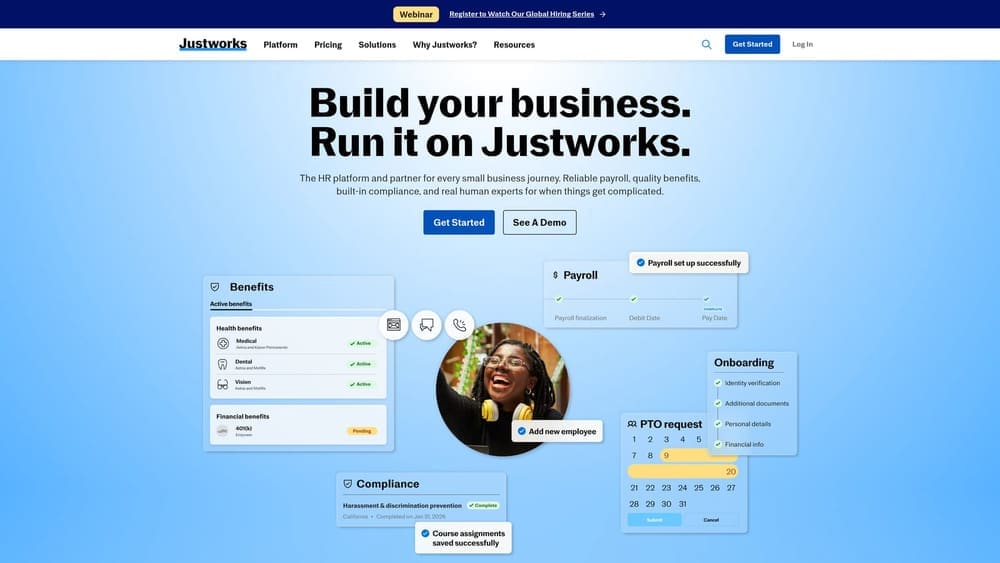
Its limitation is hospitality depth. It has fewer hospitality-specific scheduling and tip workflows than some alternatives, and you should verify industry eligibility for hotels and food and beverage operations before getting attached to a number.
- PEO co-employment, giving small teams access to shared employer structure.
- Payroll built into the same platform as HR records.
- Benefits offered through the PEO, rather than a separately sourced plan.
- Published pricing plans, so you can model cost per employee early.
Integrations need verification on the vendor site, particularly for scheduling and time tracking, since you may need a separate tool for shift management. Day-to-day administration is usually handled by an owner or office manager, which suits its small-employer focus. Pricing is on the Justworks website; check current plans and what changes the per-employee rate, such as plan tier and headcount.
Best for: Small and boutique properties modeling PEO cost.
6. Gusto
Gusto is payroll and HR software for small businesses. It is a payroll company, not a PEO, so there is no co-employment. You remain the sole employer of record, and you keep your own insurance carriers and broker.
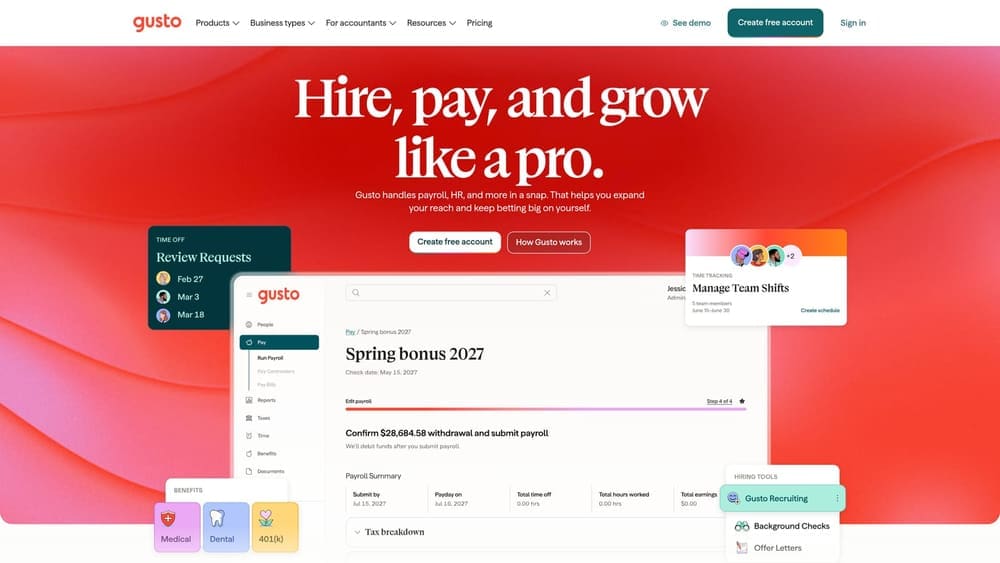
That is the whole tradeoff. You get flexibility and control over benefits and workers’ comp, but no pooled benefits and no shared employer liability. Compliance stays with the hotel, including tip reporting and state wage rules. Payroll software helps you file and calculate; it does not take over responsibility.
- Payroll processing that handles recurring runs for stable teams.
- Benefits administration, so you can offer plans from carriers you chose.
- Hourly and tipped worker support for the pay structures common in hospitality.
- Onboarding tools that cut paperwork when you add new hires.
Check the vendor site for integrations with scheduling and time tracking. Setup is lighter than a PEO migration, and an owner or office lead can usually run it. It is a weaker fit for operations with heavy seasonal hiring that want an outside HR team. Pricing is listed on the Gusto website; costs typically depend on plan tier and headcount.
Best for: Small properties with stable teams that want to keep their own carriers.
7. Toast Payroll and Team Management
Toast Payroll and Team Management ties payroll to the Toast restaurant point of sale. It is relevant to hotels because many properties run a restaurant, bar, or banquet operation that generates most of the tip complexity.
Its edge over everything else on this list is that tip and sales data flow from the POS into payroll, so there is less manual re-entry of tips at pay time. That can matter when you need accurate tip records for reporting, such as Form 8027 for large food or beverage establishments or the FICA tip credit under IRS Section 45B. Verify the applicable thresholds and rules on irs.gov rather than relying on a summary.
- POS-linked payroll that pulls hours and tips from the system your servers already use.
- Tip handling to cut the reconciliation work at the end of a pay period.
- Team management for staff records and communication.
- Scheduling alongside payroll for the front-of-house team.
The integration is Toast POS, and it is mainly for Toast users. It is not a full-property HR system or a PEO substitute, so it won’t cover housekeeping, front desk, or workers’ comp strategy on its own. The restaurant manager or controller typically runs it. Pricing is on the Toast site; check current terms, since cost relates to your Toast setup and headcount.
Best for: Restaurants and bars inside hotels already on Toast.
8. Homebase
Homebase starts from scheduling and time tracking rather than HR outsourcing. For small hourly teams where the daily headache is building shifts, covering call-outs, and capturing clock-ins, that focus is the point.
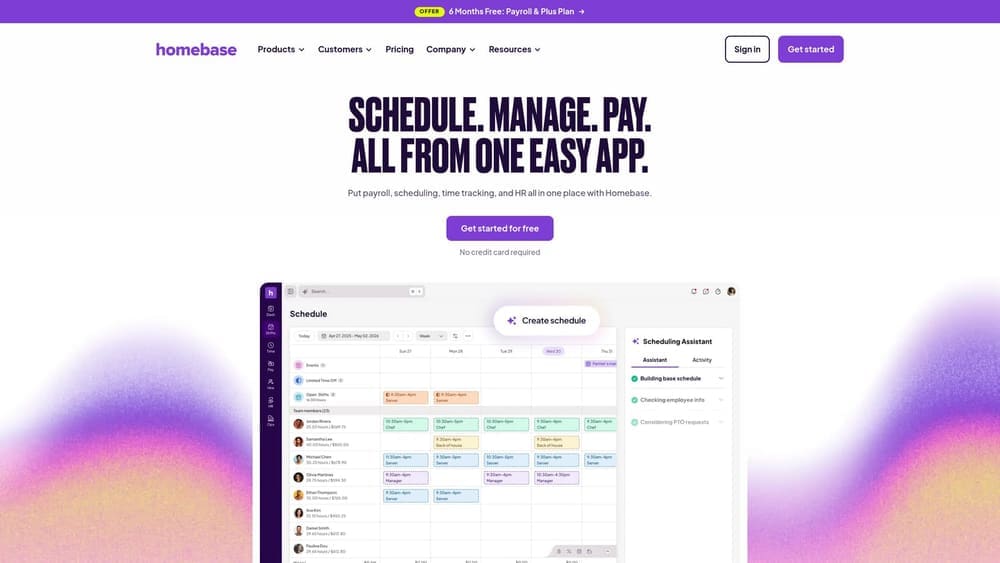
It is not a PEO, and it is lighter on benefits and risk management. If your main exposure is workers’ comp in housekeeping or you want pooled health plans, this tool does not address it.
- Shift scheduling that lets managers build and adjust rotas as demand shifts.
- A time clock that records hours at the source, reducing payroll disputes.
- Hourly payroll that uses those tracked hours directly.
- Team messaging so shift changes reach staff without separate group chats.
Check the vendor site for integrations with other payroll or HR systems, since some teams pair it with a different payroll provider. Setup is light and a department manager can run it day to day. It suits seasonal teams that need quick onboarding of temporary staff. Pricing is on the Homebase website; costs typically scale by plan tier and locations or headcount.
Best for: Small hourly teams needing shift scheduling more than HR outsourcing.
9. Paycor
Paycor is an HCM and payroll platform for mid-sized employers. It is not a PEO, so there is no co-employment. What it does distinctively well on this list is workforce analytics, which helps you track turnover and labor cost across departments and properties.
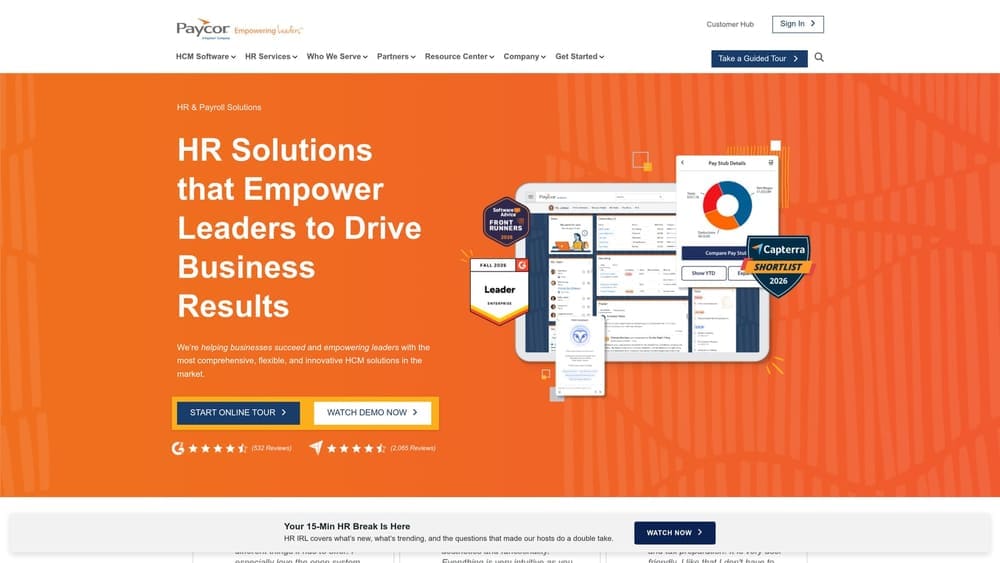
For hospitality, where turnover is a cost line and not a surprise, seeing it by department can show where hiring and retention money is going. The tradeoff is responsibility. There is no PEO workers’ comp program and no pooled benefits, and the employer keeps full compliance responsibility.
- Payroll for hourly, tipped, and salaried staff in one platform.
- Scheduling and time tools to connect hours worked with pay.
- Workforce analytics to monitor turnover and labor cost trends.
- ACA reporting support, relevant once you reach the applicable large employer threshold of 50 full-time equivalent employees (confirm on irs.gov).
Verify integrations on the vendor site. Implementation is a real project but lighter than a PEO migration, and an HR or finance lead usually owns it. Pricing is quote-based and tends to depend on headcount and the modules you choose.
Best for: Mid-sized hotel groups wanting analytics without co-employment.
Matching the Option to Your Property, and the Three Questions That Decide It
The same few terms keep coming up, so a quick reminder of what separates the models. A PEO shares employer responsibilities through co-employment, pooled benefits, and shared liability. A CPEO is IRS-certified. An ASO provides HR services without co-employment, so it is not the same as a PEO. Payroll-only companies process pay and filings while compliance stays with you. An EOR is the legal employer for workers, often used across borders.
By situation:
- Independent small property: Gusto if your team is stable and you want your own carriers, or Justworks if you want to model PEO cost from published pricing.
- Seasonal resort: Homebase for scheduling and fast onboarding, or Insperity if you want an HR team behind high-volume hiring and exits.
- Multi-state hotel group: ADP TotalSource for multi-state reach, or Paycor if you want analytics and prefer to keep compliance in-house.
- F&B outlet inside a hotel: Toast Payroll and Team Management if you already run Toast.
Whichever way you lean, the decision turns on benefits spend, workers’ comp exposure, and how much compliance work your team can realistically carry. A PEO is not automatically cheaper, and payroll software does not take compliance off your plate.
Don’t auto-renew. Make an informed, confident decision. Before you sign that PEO renewal, make sure you’re not leaving money on the table. Many businesses unknowingly overpay because of bundled fees, hidden administrative markups, and contracts designed to limit flexibility. We give you a clear, side-by-side breakdown of pricing, services, and contract terms, so you can see exactly what you’re paying for and choose the option that truly fits your business. PEO Metrics may receive vendor placement fees.
