
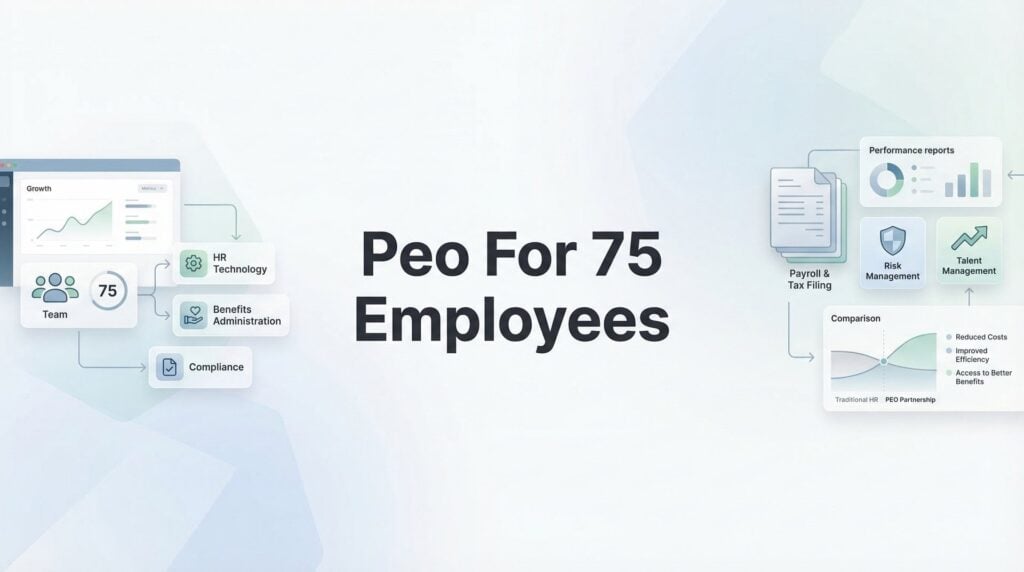
At 75 employees, you’re in a distinct position that most PEO content ignores. You’re past the scrappy startup phase where any HR help feels like a win. You’re not yet at the 100+ threshold where dedicated HR infrastructure becomes obviously necessary.
This middle ground creates unique leverage—and unique risks.
You have enough headcount to negotiate meaningful discounts, but you’re also attractive enough to PEOs that some will oversell services you don’t actually need. The decisions you make now about PEO partnerships will either set you up for smooth scaling or create painful transitions later.
This guide focuses specifically on the 75-employee inflection point: what changes at this size, which PEO features matter most, and how to avoid the common mistakes companies make when they’ve outgrown small-business solutions but aren’t quite ready for enterprise ones.
1. Audit Your Current HR Pain Points Before Shopping
The Challenge It Solves
Most companies start PEO conversations by asking what services are available. That’s backwards. You end up paying for bundled features you’ll never use while the actual problems consuming your HR team’s time remain unresolved.
At 75 employees, you likely have someone handling HR—whether that’s a dedicated person, a fractional resource, or an office manager wearing multiple hats. They know exactly where the bottlenecks are. The question is whether you’ve actually documented them.
The Strategy Explained
Spend two weeks tracking where HR time actually goes. Not where you think it goes—where it actually goes. Benefits enrollment? Compliance questions? Payroll corrections? State tax filings? Workers’ comp claims?
Create a simple spreadsheet. Log every HR task that takes more than 15 minutes. Note how often it happens and whether it’s something a PEO could realistically handle better than you’re handling it now.
This exercise reveals your true needs. Maybe you’re spending hours each month on benefits administration but payroll runs smoothly. Maybe compliance questions eat up time because you recently added employees in a second state. Maybe workers’ comp claims are fine but you’re drowning in FMLA paperwork.
Those specifics matter when you’re evaluating PEO proposals.
Implementation Steps
1. Create a time-tracking log for your HR person or team. Include task category, time spent, frequency, and frustration level on a 1-5 scale.
2. After two weeks, categorize tasks into: administrative (payroll processing, data entry), compliance (filings, certifications, audits), benefits (enrollment, carrier communication, claims support), and employee relations (onboarding, terminations, policy questions).
3. Rank the top five pain points by total time consumed and business risk if handled incorrectly. These become your evaluation criteria when comparing PEO proposals.
Pro Tips
Don’t rely on memory or assumptions. Actual tracking reveals surprising patterns. You might discover that what feels like a huge time drain is actually only two hours per month, while something you barely notice is consuming ten. Use this data to push back when PEOs emphasize features that don’t address your documented pain points.
2. Calculate Your True Per-Employee Cost Threshold
The Challenge It Solves
PEO pricing is deliberately opaque. You’ll see percentage-of-payroll models, flat fees per employee, hybrid structures, and administrative fees that somehow don’t count toward the quoted rate. Without a clear budget ceiling, you can’t negotiate effectively or compare proposals accurately.
At 75 employees, your total annual payroll might range from $3 million to $7.5 million depending on your industry and location. A seemingly small percentage difference translates to tens of thousands of dollars annually.
The Strategy Explained
Start with your current HR costs. Include salaries for anyone doing HR work, benefits administration platform fees, payroll processing costs, workers’ comp premiums, compliance software subscriptions, and any HR consulting you’re paying for.
Divide that total by 75. That’s your current per-employee HR cost.
Now add what you’re not currently doing but should be: better benefits access, multi-state compliance support, risk management consulting, or employee training programs. Estimate the value of those additions.
Your PEO budget threshold is somewhere between your current cost and your current cost plus the value of what you’re missing. If a PEO proposal exceeds that threshold, they need to clearly demonstrate where the additional value comes from.
Implementation Steps
1. Build a spreadsheet with three columns: Current HR Costs, PEO Quoted Costs, and Gap Analysis. Include line items for payroll processing, benefits administration, compliance support, workers’ comp, technology platforms, and HR staff time.
2. Request detailed pricing breakdowns from PEOs. Push past percentage-of-payroll quotes to understand flat fees, administrative charges, implementation costs, and year-over-year increase structures. Many PEOs offer flat-fee pricing at your headcount—don’t accept percentage models without exploring alternatives.
3. Calculate the three-year total cost of ownership for each proposal, including projected rate increases. PEOs often quote attractive first-year pricing that escalates significantly in years two and three. A thorough PEO ROI and cost-benefit analysis helps you see the full picture.
Pro Tips
Ask specifically about pricing at 100 employees. Some PEOs restructure fees at that threshold, which you’ll likely hit within 18-24 months if you’re growing. Knowing the 100-employee pricing now prevents expensive surprises later. Also, negotiate administrative fees separately from per-employee costs—those are often more flexible than the headline rate.
3. Evaluate Benefits Access as Your Primary Differentiator
The Challenge It Solves
At 75 employees, you’re stuck in benefits no-man’s-land. You’re too large for most small-group plans to offer competitive pricing, but too small to access the carrier attention and plan designs that larger employers get. This creates real retention risk if your benefits package feels second-tier compared to what employees could get elsewhere.
PEOs promise access to master health plans that aggregate thousands of employees across multiple client companies. That sounds great in theory. In practice, the quality and cost of those plans vary wildly.
The Strategy Explained
Benefits access is often the single biggest value proposition a PEO offers at your size. But you need to evaluate it critically, not just accept the claims in a sales presentation.
Request the actual plan documents, not just summary sheets. Look at deductibles, out-of-pocket maximums, network access, and prescription drug formularies. Compare them directly to what you’re currently offering or what you could access through a benefits broker independently.
Pay attention to carrier stability. Some PEOs change master health plan carriers frequently, which creates disruption for employees who’ve established care relationships with specific providers. Ask how long they’ve maintained their current carrier relationships and what their renewal process looks like.
Implementation Steps
1. Get your current benefits plan documents and create a comparison matrix: premium costs, deductibles, out-of-pocket maximums, network size, prescription coverage, and ancillary benefits like dental and vision. This becomes your baseline.
2. Request the same information from each PEO you’re evaluating. Don’t accept summary marketing materials—ask for the actual Summary Plan Descriptions (SPDs) and rate sheets. Compare employee contribution amounts at the same coverage levels you currently offer.
3. Interview the PEO’s benefits team directly, not just the sales rep. Ask about claims support, COBRA administration, ACA reporting, and how they handle benefits questions from your employees. The quality of ongoing support matters more than the plan design itself.
Pro Tips
Ask what happens if the PEO loses a master health plan carrier mid-year. Some contracts force you to accept whatever replacement plan they negotiate, which could mean significant disruption for your employees. Also, clarify whether you can opt out of the PEO’s health plan and maintain your own benefits while using them for payroll and compliance—some PEOs require full benefits participation, others don’t.
4. Stress-Test Multi-State Readiness Even If You’re Single-State Now
The Challenge It Solves
At 75 employees, the odds you’ll hire someone in a second state within the next two years are higher than you think. Remote work has made geographic expansion almost accidental—you find a great candidate, they happen to live in another state, and suddenly you’re dealing with new tax registrations, unemployment insurance accounts, and compliance requirements you’ve never navigated before.
Some PEOs handle multi-state expansion smoothly. Others treat it as an add-on service with extra fees, implementation delays, and limited support. Finding out which type you’ve chosen after you’ve already hired someone in Texas is too late.
The Strategy Explained
Even if you’re currently operating in a single state, evaluate every PEO as if you’ll expand to three states within 18 months. Ask specific questions about their multi-state infrastructure, not just whether they “support” other states.
How many states do they currently have active clients in? How quickly can they register you in a new state? Do they charge setup fees for each new state? Understanding multi-state payroll compliance requirements helps you ask the right questions about state-specific compliance requirements like paid sick leave, minimum wage variations, or unique payroll tax rules.
The answers reveal whether multi-state is a core competency or an afterthought.
Implementation Steps
1. Identify the three states where you’re most likely to hire in the next two years. Consider where your current employees live, where your customer base is concentrated, and where your industry talent tends to be located.
2. Ask each PEO how they’d handle adding employees in those specific states. Request a written breakdown of setup fees, ongoing administrative costs, and timeline from hire date to payroll readiness. Some PEOs can turn this around in days; others take weeks.
3. Clarify how state-specific compliance is managed. Do they automatically apply local wage and hour rules, or do you need to track those separately? How do they handle state-mandated benefits like paid family leave in states that require it?
Pro Tips
Ask whether their workers’ comp coverage extends seamlessly across state lines or requires separate policies in each state. This matters more than most companies realize until they’re dealing with a claim. Also, find out if they have physical offices or local payroll tax expertise in the states you’re targeting—some PEOs for multi-state companies are strong in certain regions but weak in others.
5. Negotiate Contract Terms That Anticipate Growth to 100+
The Challenge It Solves
PEO contracts are written to lock you in, not to accommodate your growth trajectory. At 75 employees, you’re likely 18-36 months away from hitting 100 if you’re growing steadily. That threshold triggers ACA large employer mandates, changes your benefits purchasing power, and often reshapes what you need from a PEO.
Standard PEO contracts don’t account for this. They’re structured for the company you are today, not the company you’ll be in two years. That creates expensive friction when you outgrow the service model or pricing structure you originally agreed to.
The Strategy Explained
Negotiate your contract with explicit provisions for growth. This includes pricing adjustments at specific headcount milestones, service level changes as you scale, and realistic exit terms if the relationship stops working.
Most PEOs will tell you their standard contract is non-negotiable. That’s rarely true at 75 employees. You represent meaningful revenue, and they want your business. Push back on auto-renewal clauses, minimum commitment periods that extend beyond 12 months, and penalty fees for early termination.
Ask specifically what happens at 100 employees. Does your per-employee rate decrease? Do you get access to a dedicated account manager? Can you renegotiate service terms without penalty?
Implementation Steps
1. Request a contract draft before you commit. Read the termination provisions carefully. Look for notice periods (90 days is common but negotiable), penalties for mid-year termination, and data portability requirements. You should be able to exit with reasonable notice and take your employee data with you.
2. Negotiate headcount-based pricing tiers into the contract. If you’re at 75 now, get written commitments for what your rate becomes at 85, 95, and 105 employees. This prevents surprise increases and gives you leverage if they try to restructure pricing mid-contract.
3. Add a performance review clause that allows you to renegotiate terms annually based on service quality. Our PEO contract negotiation guide covers additional tactics for building flexibility into your agreement.
Pro Tips
Pay attention to how benefits costs are structured in the contract. Some PEOs build in automatic increases that track their master plan renewals, which means you absorb whatever rate hikes they negotiate with carriers. Push for caps on year-over-year increases or the ability to opt out of benefits if costs become unreasonable. Also, clarify who owns the relationship with your workers’ comp carrier—if you leave the PEO, can you maintain that policy directly?
6. Assess Technology Integration Depth, Not Just Features
The Challenge It Solves
PEO demos are designed to impress. You’ll see slick interfaces, mobile apps, and feature lists that sound comprehensive. What you won’t see is how their system actually integrates with your existing tools—or whether it integrates at all.
At 75 employees, you likely have workflows built around specific software: accounting systems, time tracking tools, applicant tracking systems, or performance management platforms. A PEO that forces you to abandon those tools or manually duplicate data creates operational friction that compounds over time.
The Strategy Explained
Focus on integration capabilities, not feature checklists. Ask about API access, data export formats, and compatibility with the systems you’re already using. If a PEO doesn’t offer direct integrations, find out how data moves between platforms and who’s responsible for maintaining accuracy.
Request a technical integration call with their implementation team, not just the sales rep. Ask specific questions about your current tech stack. Can payroll data flow automatically into your accounting system? Can time tracking sync without manual uploads? Can you export employee data in formats your other tools can consume?
The answers reveal whether you’re looking at a true PEO HR technology platform or a walled garden that requires you to adapt to their way of doing things.
Implementation Steps
1. Document your current HR tech stack: accounting software, time and attendance systems, applicant tracking, performance management, and any other tools your team uses daily. Identify which integrations are critical versus nice-to-have.
2. Ask each PEO for a detailed integration matrix showing which systems they connect with, whether those integrations are native or third-party, and what data flows in each direction. Don’t accept vague claims about “most major platforms”—get specifics.
3. Request a live demonstration of data export functionality. Ask to see what an employee data export looks like, how payroll reports are formatted, and whether you can schedule automated data transfers. If you ever leave the PEO, this determines how painful the transition will be.
Pro Tips
Ask about API rate limits and data access restrictions. Some PEOs technically offer APIs but limit how frequently you can pull data or restrict access to certain fields. Also, clarify who owns the data in their system—you should have unrestricted access to your employee information, payroll records, and benefits data at any time, not just during offboarding.
7. Plan Your 18-Month Reassessment Trigger
The Challenge It Solves
PEO relationships that work well at 75 employees often become misaligned at 95 or 110. Your needs change as you scale, but the service model you signed up for remains static. By the time you realize the fit isn’t working anymore, you’re locked into a contract with months remaining and facing expensive switching costs.
Most companies only evaluate their PEO during the initial selection process and then again when something breaks badly enough to force a change. That reactive approach costs money and creates operational disruption.
The Strategy Explained
Build a formal reassessment process before you sign the contract. Set a calendar reminder for 18 months from your start date. At that point, you’ll have enough experience with the PEO to evaluate whether the relationship is delivering value, and you’ll still have time to explore alternatives before your contract renewal.
The reassessment isn’t about finding problems—it’s about confirming alignment. Are the pain points you originally identified actually resolved? Has your headcount or geographic footprint changed in ways that affect what you need? Are you paying for services you’re not using or lacking support in areas that have become critical?
This structured review gives you leverage during renewal negotiations and prevents the inertia that keeps companies stuck in mediocre PEO relationships.
Implementation Steps
1. Create a reassessment checklist at the time you sign your PEO contract. Include the original pain points you were solving for, the services you expected to use most, and specific success metrics like time saved on benefits administration or reduction in compliance questions.
2. Schedule a formal review meeting 18 months from your start date. Invite whoever manages the PEO relationship day-to-day plus any leaders who interact with HR regularly. Review the checklist and document what’s working, what’s not, and what’s changed about your needs since you started.
3. Use that review to decide whether to renew, renegotiate, or start exploring alternatives. If you’re staying, use the documented feedback to negotiate better terms. If you’re considering a change, our guide on leaving a PEO walks you through the exit process step by step.
Pro Tips
Don’t wait until renewal time to raise concerns with your PEO. Use the 18-month mark to have a candid conversation about what’s working and what needs to improve. Good PEOs will address issues proactively if you give them the opportunity. If they’re defensive or dismissive, that tells you everything you need to know about whether the relationship is worth continuing.
Putting It All Together
The 75-employee mark is genuinely different from 25 or 150. You have enough scale to demand real value from a PEO partnership—better rates, dedicated support, flexible terms—but you’re also at risk of being sold solutions designed for companies half your size or twice it.
The strategies above aren’t about finding the “best” PEO in some abstract sense. They’re about finding the right fit for where you are now and where you’re heading in the next two years. If you’re approaching the 100-employee mark, the evaluation criteria shift again.
Start with the pain point audit. Get honest about your budget constraints. And negotiate like you have options—because at 75 employees, you genuinely do. Our guide on how to choose a PEO provides a structured framework for the selection process.
Before you sign that PEO renewal, make sure you’re not leaving money on the table. Many businesses unknowingly overpay because of bundled fees, hidden administrative markups, and contracts designed to limit flexibility.
We give you a clear, side-by-side breakdown of pricing, services, and contract terms—so you can see exactly what you’re paying for and choose the option that truly fits your business.
