
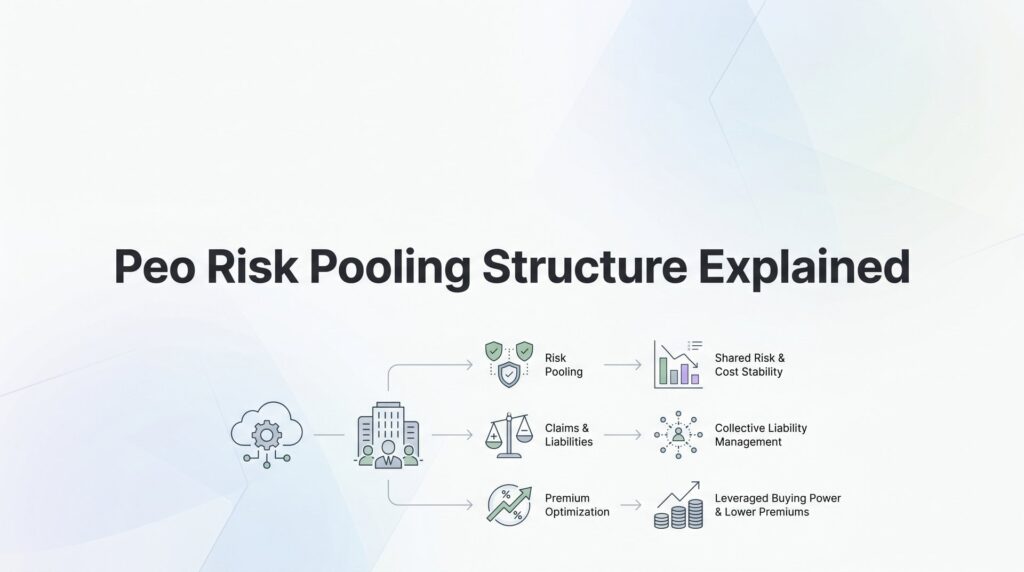
You’ve probably heard the pitch: join our PEO and get access to Fortune 500-level benefits through the power of risk pooling. It sounds compelling. And honestly, for some businesses, it’s completely true. But here’s what the sales rep usually skips: the actual mechanics of how the pool is constructed, who else is in it with you, and what happens when the pool has a bad year.
Risk pooling is the single biggest reason PEO insurance rates differ from what you’d get buying coverage on your own. It’s the structural foundation of the entire value proposition. Yet most business owners sign PEO contracts without understanding whether the pool is actually working in their favor or quietly costing them more than they’d pay on the open market.
This isn’t a knock on PEOs. Pooling genuinely helps a lot of companies. The problem is that you can’t evaluate whether it helps your company without understanding how the structure actually works. So let’s break it down in plain terms, including where it gets complicated and what questions you should be asking before you sign anything.
The Mechanics Behind the Master Policy
The foundation of PEO risk pooling is co-employment. When you engage a PEO, the PEO becomes the employer of record for your workforce on paper, at least for tax and insurance purposes. Your employees are technically employed by both you and the PEO simultaneously. That co-employment relationship is what allows the PEO to aggregate workers from dozens or hundreds of client companies into a single master insurance policy.
That master policy covers health insurance, workers’ compensation, and sometimes employment practices liability insurance (EPLI) across the entire client base. The carrier doesn’t underwrite your 40-person company in isolation. It underwrites the pool as a whole, which might represent tens of thousands of employees across multiple industries and states.
There’s an important distinction here that most business owners miss. Some PEOs are the actual employer of record on the policy, meaning they hold the master policy and your employees are covered under it directly. Others function more like benefits brokers, negotiating group coverage on your behalf but without the same legal structure underneath. The first model is true PEO co-employment. The second is closer to a benefits administration arrangement. The difference matters because it changes your exposure, your pricing leverage, and what happens if you leave.
Under a genuine co-employment structure, the carrier prices based on the pool’s aggregate risk profile. Your company’s individual claims history has limited direct influence on your rate, at least in a fully pooled model. That’s the core tradeoff. You gain access to pricing built on a much larger risk base, but you also absorb some of the risk exposure from every other company in that pool.
For smaller employers, this is often a net positive. A 15-person company can’t negotiate meaningful group health rates on its own. Joining a pool of 50,000 employees changes that math dramatically. But the benefit isn’t uniform. It depends entirely on who else is in the pool and how the PEO structures it.
Who Else Is Sharing Your Risk
This is where the conversation usually gets vague, and where you should push hardest for clarity.
PEOs approach pool composition in different ways. Some segment clients by industry risk class, grouping manufacturing companies together, office-based businesses separately, and so on. Others segment geographically. And some, particularly smaller PEOs, run a single blended pool that lumps everyone together regardless of industry or risk profile.
Each approach has different cost implications depending on what your business looks like. If you’re a clean, low-risk office operation and you’re pooled with a mix of construction and light manufacturing clients, you’re effectively subsidizing their higher claims exposure. The carrier prices the pool based on its overall loss experience, not your slice of it.
This is sometimes called the bad apple problem. One client with heavy workers’ comp claims, a pattern of health utilization that spikes the pool’s medical spend, or a string of EPLI claims can drag up costs for everyone in the pool. You have no visibility into who else is in it. You don’t know their industries, their claims histories, or their risk profiles. You’re trusting the PEO’s underwriting judgment and pool management practices, often without any contractual right to see the data. Understanding the workers’ comp underwriting risk review process can help you gauge how carefully a PEO vets incoming clients.
Some larger PEOs have addressed this by creating tiered risk pools or carving out high-risk industries into separate pools entirely. That’s a more sophisticated structure that better aligns pricing with actual risk exposure. But you won’t know which model your PEO uses unless you ask directly.
Here are the questions worth asking upfront:
How is the pool segmented? Is it by industry, geography, company size, or blended? Ask them to explain the logic.
What industries are represented in your pool? You don’t need a client list, but a general breakdown by risk class is reasonable to request.
Do high-risk industries get carved into separate pools? If the answer is no, understand that you’re sharing risk with the full spectrum of the PEO’s client base.
What’s the pool’s current size in terms of covered lives? Larger pools generally provide more stability, but only if they’re reasonably well-managed.
A PEO that can’t or won’t answer these questions clearly is telling you something important about how transparent the relationship will actually be.
When Pooling Saves You Money — and When It Doesn’t
Risk pooling delivers real value in specific situations. It’s worth being honest about both sides.
Pooling tends to work well for smaller companies that lack bargaining power in the standalone insurance market. If you have fewer than 50 employees, you’re generally not large enough to negotiate meaningful group health rates or influence your workers’ comp pricing in most states. Joining a large PEO pool effectively gives you access to pricing that reflects a much larger risk base. You can use a PEO insurance pooling savings estimator to get a rough sense of whether the math works for your situation.
It also helps companies in states where standalone workers’ comp markets are expensive or restricted. In some states, certain industries face limited carrier options and high assigned risk pool rates. A PEO with a strong master workers’ comp policy and a favorable experience modification rate can offer materially better pricing than you’d find on your own. For businesses stuck in the assigned risk market, there’s a specific assigned risk exit strategy worth exploring.
Companies with thin HR infrastructure also benefit, not just from the pricing but from the claims management support that comes with it. Effective claims handling directly affects loss ratios over time. If your team doesn’t have the bandwidth to manage workers’ comp claims aggressively, being inside a PEO pool with professional claims management can prevent the kind of cost escalation that happens when claims sit unmanaged.
Now for the flip side.
If your company has a clean loss history, a low-risk workforce, and enough employees to generate meaningful actuarial data, you may actually be subsidizing worse performers in the pool. The PEO has limited incentive to surface this. Their pricing model is built on the pool’s aggregate performance, and a well-performing client leaving the pool is a problem for them, not a win for you.
The breakeven logic works roughly like this: at some point, your own claims experience becomes strong enough that your standalone insurance costs would be lower than your share of the pool’s blended rate. That threshold varies by industry, state, and company size, but it’s a real calculation worth running. A good insurance broker with access to the standalone market can help you benchmark this. If your experience mod rate is significantly better than the PEO’s master mod rate, that’s a signal worth investigating.
Companies that have grown to 150 or 200 employees with consistently clean claims histories often find themselves at or past this breakeven point. They’re paying pool rates that reflect the claims behavior of companies much worse than them. That’s not a failure of the PEO model. It’s just a sign that you’ve outgrown the benefit.
How Pool Performance Flows Into Your Bill
Most business owners think of their PEO fee as a fixed cost. It’s not, at least not in the way you might assume.
Your per-employee admin fee or bundled rate is ultimately tied to the pool’s loss ratio, the ratio of claims paid out to premiums collected. When the pool performs well, carriers are more willing to hold rates steady or reduce them at renewal. When the pool has a bad year, that loss ratio deteriorates, and the pressure flows downstream to clients in the form of rate increases. Understanding your PEO cost structure modeling can help you anticipate how these dynamics affect your bottom line.
This can happen mid-contract in some PEO arrangements, particularly if the contract language allows for rate adjustments tied to pool performance. Read that language carefully. “Subject to adjustment based on market conditions” can mean a lot of things, and one of them is “we can raise your rate if the pool does badly.”
There’s also an important structural distinction between fully pooled pricing and experience-modified pooling. In a fully pooled model, your rate is the pool’s rate. Your individual claims history doesn’t factor in at all. In an experience-modified model, your own claims experience partially influences your rate within the pool. You’re still in the pool, but your pricing reflects some blend of pool performance and your own loss history.
Experience-modified pooling is generally better for companies with clean records. It creates an incentive for good claims management and means your good behavior actually shows up in your pricing over time. A strong loss prevention program structure can further improve your standing within the pool. Fully pooled pricing offers more stability but eliminates that feedback loop entirely.
The surplus and deficit question is also worth understanding. When the pool collects more in premiums than it pays out in claims, there’s a surplus. When it pays out more than it collected, there’s a deficit. How your PEO handles this varies significantly by contract. Some PEOs retain surplus as profit. Others credit it back to clients in some form. Some use it to build reserves against future bad years. The contract language around this is often vague enough to give the PEO wide discretion. Ask specifically how surplus and deficit are handled, and get a clear answer in writing before you sign.
Questions to Ask Before You Join Any Pool
By the time you’re reviewing a PEO proposal, you should have clear answers to the following. If you don’t, ask. If the PEO can’t answer clearly, treat that as meaningful information.
What is the pool’s loss ratio history over the past three to five years? A well-run pool should be able to share general performance trends. Refusal to provide any historical context is a red flag.
How is the pool segmented, and which segment would my company fall into? You want to understand who you’re sharing risk with at the segment level, not just the pool level.
How is surplus and deficit allocated within the pool? Get specifics, not generalities. “We manage it responsibly” is not an answer.
Is pricing fully pooled or experience-modified? This distinction matters at renewal, especially if your claims history is strong. Running a workers’ comp renewal risk analysis before your contract renews can reveal whether your pricing still makes sense.
What happens to my experience modifier and claims history if I leave? This is the portability question, and it’s critical. Some states have specific rules about how workers’ comp claims history transfers back to the client company after exiting a PEO arrangement. The mechanics vary by state and by how the PEO’s master policy was structured. In some cases, you exit the PEO with limited usable history, which can put you in a difficult position when pricing standalone coverage.
On the contract side, watch for these red flags:
Vague rate adjustment language. Any clause that allows rate changes tied to undefined “market conditions” or “pool performance” without clear thresholds gives the PEO too much pricing flexibility at your expense. Reviewing the full scope of PEO contract liability risks before signing is essential.
No disclosure of pool performance metrics. If the contract doesn’t include any obligation to share pool loss ratio data or renewal pricing methodology, you’re operating blind.
Inability to explain how your specific rate was derived. Your rate should be traceable back to the pool’s data and your segment within it. If the sales rep can’t walk you through the derivation, someone is either hiding something or doesn’t understand their own product.
The portability issue deserves extra emphasis. Some PEO structures make it genuinely difficult to leave because your claims history doesn’t transfer cleanly. You exit the pool and effectively start over as a new risk in the standalone market, which can mean higher rates for a period of time even if your actual loss history is excellent. Understanding this before you sign is far better than discovering it when you’re trying to negotiate your exit. If you’re already at that stage, a thorough PEO exit and cancellation guide can help you navigate the process.
The Bottom Line on Pool Structures
Risk pooling isn’t inherently good or bad. It’s a structure. And like most structures, it benefits some companies and quietly penalizes others. The difference between those two outcomes comes down to how the pool is built, who’s in it with you, and whether the pricing model actually reflects your company’s own performance over time.
If you’re a small company with a modest claims history and limited standalone market leverage, pooling is probably working in your favor. If you’ve grown, maintained a clean record, and operate in a low-risk industry, it’s worth running the math to see whether you’re subsidizing the rest of the pool.
The framework here isn’t meant to make you skeptical of PEOs. It’s meant to make you a better buyer. Ask the pool segmentation questions. Get clarity on surplus and deficit handling. Understand the portability mechanics before you’re trying to negotiate an exit. And compare providers on these dimensions, not just the headline rate.
Most PEO proposals don’t surface this level of detail on their own. That’s where side-by-side comparisons become genuinely useful. Don’t auto-renew. Make an informed, confident decision. PEO Metrics exists specifically to help businesses compare providers at this level of depth, including pool structure, pricing methodology, and contract terms, so you’re not making a multi-year commitment based on a sales deck.
