
Most business owners who’ve been through a PEO evaluation remember the moment it stopped making sense. The quote looked reasonable. The sales rep walked through the per-employee fee. Someone compared it to the other two quotes on the table. And then they signed.
Six months later, the actual cost looked nothing like what they expected. Not because the PEO lied, but because the comparison was never a real cost comparison. It was a price comparison. Those are very different things.
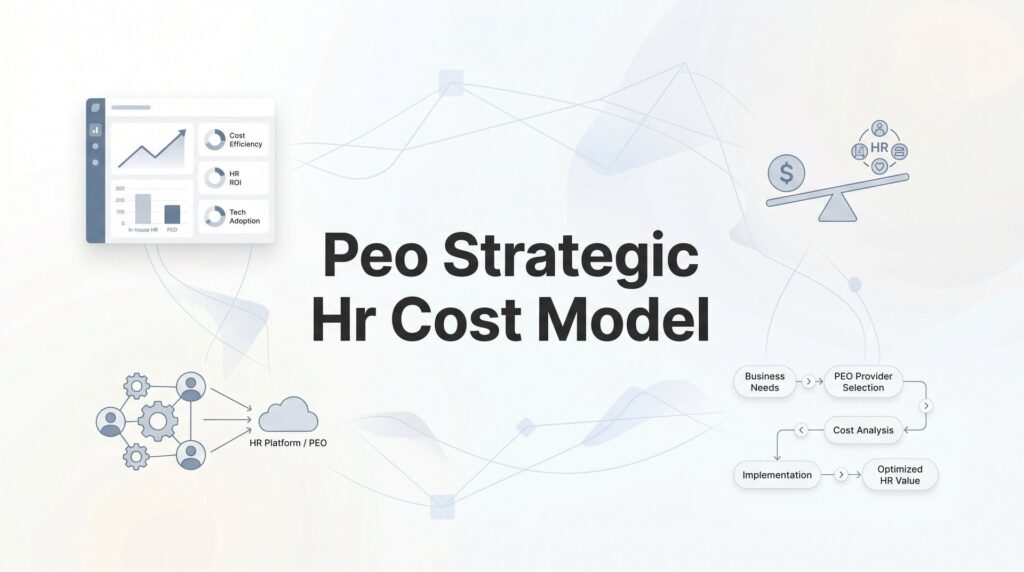
A PEO quote tells you what you’ll pay the vendor. A strategic HR cost model tells you what HR is actually costing you now, what it will cost under a PEO arrangement, and whether that delta is worth it given your specific headcount, risk profile, benefits situation, and growth trajectory. Building that model before you sign is the difference between a smart outsourcing decision and an expensive surprise.
This article is for operators who are past the basics. If you’re still getting up to speed on how PEOs work or how their pricing is structured, those foundational topics deserve their own read. Here, we’re focused on the strategic framework: what a real PEO cost model looks like, what inputs it requires, where it breaks down, and how to use it as a decision tool rather than a spreadsheet exercise.
Why Quote Comparisons Fall Short
Here’s what a typical PEO evaluation looks like in practice: you get two or three proposals, each with a per-employee-per-month fee or a percentage of gross payroll, and you pick the lowest one that seems credible. Maybe you negotiate a little. Then you sign.
The problem is that the quote only captures one layer of cost. It tells you the direct fee you’ll pay the PEO. It says nothing about the costs that stay with your business, the costs that shift, or the costs that disappear entirely. And it definitely doesn’t tell you whether the PEO’s pricing structure is actually better than what you’re doing now.
What business owners typically miss when comparing quotes:
Internal HR labor reallocation: If you have an HR manager spending 60% of their time on benefits administration and compliance tasks, some of that time may shift under a PEO. But how much? And what does it actually free them up to do? If the answer is “nothing useful,” the labor cost doesn’t disappear — it just gets redistributed.
Benefits procurement savings vs. markup: PEOs often offer access to large-group health benefits that can lower per-employee premiums. That’s real. But PEOs also apply administrative markups to those benefits. The net savings depends on your current benefits costs, your employee demographics, and how transparent the PEO is about what they’re marking up. A lower premium doesn’t mean lower total benefits cost.
Workers’ comp experience modification rate: Your current mod rate affects what you pay for workers’ comp coverage. Under a PEO’s master policy, your claims history may or may not follow you, depending on the structure. For businesses in high-risk industries or those with a poor claims history, this can be a significant cost lever in either direction.
Compliance cost avoidance: Legal consultations, HR policy updates, state-specific compliance audits — these costs are real, but they’re often invisible because they’re spread across multiple line items or absorbed by managers and executives who handle them informally. A PEO can reduce this exposure, but it doesn’t show up in the quote.
The strategic cost model exists to make all of this visible. It’s not a spreadsheet for its own sake. It’s a decision tool that forces you to confront what HR is actually costing you before you decide whether outsourcing any part of it makes financial sense.
Five Layers Every Cost Model Needs to Cover
A real PEO cost model isn’t a single number. It’s a stack of five distinct cost layers, and understanding how they interact is what separates a useful model from a back-of-napkin estimate.
Layer 1: Direct PEO fees. This is the only layer the quote covers. It’s either a flat per-employee-per-month charge or a percentage of gross payroll. Straightforward on the surface, but the structure matters: a percentage-of-payroll model scales with raises and promotions in ways a flat fee doesn’t. If you’re planning headcount growth or compensation increases, those dynamics need to be modeled explicitly.
Layer 2: Displaced internal HR costs. What are you currently spending on HR that the PEO would absorb? This includes dedicated HR staff time (fully loaded, not just salary), fractional time from managers and executives who handle HR tasks, benefits broker fees, payroll processing costs, and any third-party HR tools you’d no longer need. Most companies undercount this layer significantly, which we’ll come back to.
Layer 3: Benefits cost delta. This is the difference between what you’re currently paying for employee benefits and what you’d pay through the PEO’s group purchasing arrangement, net of any markups. To model this accurately, you need your current per-employee benefits cost broken down by coverage tier, your renewal history, and a clear picture of what the PEO is actually charging — not just the plan premium, but the full loaded cost including administrative fees.
Layer 4: Risk transfer and insurance value. Workers’ comp, employment practices liability, and compliance risk are real financial exposures. A PEO can shift some of that risk, but the value of that shift depends on your industry, your claims history, and your current insurance costs. Understanding how workers’ comp cost allocation actually works is essential for modeling this layer accurately.
Layer 5: Hidden operational costs. These are the costs of the transition itself and the ongoing friction of the co-employment relationship. Integration with your existing systems, changes to reporting structures, the time your team spends managing the PEO relationship, and any compliance adjustments required by the new arrangement. These costs are real in Year 1 especially, and they’re almost always left out of the initial model.
The key insight is how these layers interact. A PEO with a low admin fee might still be more expensive than a competitor if their benefits markup is higher. A PEO that saves you money in Year 1 might cost more in Year 3 if their renewal escalation outpaces your internal cost trajectory. The model has to account for all five layers, not just the ones that are easy to quantify.
Building the Model: What You Need Before You Start
Before you can build a useful cost model, you need to gather real inputs. Not estimates. Not industry benchmarks. Your actual numbers, organized in a way that makes the comparison honest.
The inputs that matter most:
Fully-loaded HR cost per employee: Start with your total HR spend, including HR staff salaries and benefits, payroll processing fees, HRIS and benefits administration software, benefits broker fees, and a reasonable estimate of manager time spent on HR-related tasks. Divide that by headcount. Most companies are surprised by this number when they add it up honestly. A thorough HR cost baseline analysis before evaluating providers makes this step far more reliable.
Benefits renewal history: What have your health insurance premiums done over the last three to five years? If you’re seeing consistent annual increases, that trajectory matters for modeling whether a PEO’s group purchasing power actually saves you money over time, or just delays the same increases.
Workers’ comp mod rate and claims history: Pull your current experience modification rate and your claims history for the last three years. This tells you how your current risk profile would interact with a PEO’s master policy. If your mod rate is above 1.0, a PEO arrangement might lower your effective workers’ comp cost. If you’re already below 1.0 with a clean history, you might actually pay more under a blended pool.
Turnover costs: HR-related turnover costs — recruiting, onboarding, lost productivity — are often partially addressable through better HR infrastructure. If a PEO would meaningfully improve your retention or hiring efficiency, that has real financial value. But be careful here: don’t model optimistic assumptions unless you have a specific reason to believe the PEO’s tools will change your turnover dynamics.
Compliance incident history: Have you had any HR-related legal expenses, EEOC complaints, wage and hour issues, or state compliance penalties in the last few years? These are real costs that a PEO might reduce through better compliance infrastructure. They’re also the kind of costs that don’t show up in any HR budget line until they happen.
The reason most companies undercount their internal HR costs is that HR functions are distributed. Your CFO handles some of it. Your office manager handles some of it. Your outside employment attorney handles some of it on a retainer nobody thinks of as “HR spend.” When you add it up honestly, the fully-loaded cost is almost always higher than people expect — which is important, because that baseline is what you’re actually comparing the PEO against.
The thinking structure that works: organize your inputs into what you’re spending today (fully loaded), what the PEO quote replaces directly, what stays with your business regardless, and what genuinely disappears. A solid PEO vs internal HR cost model adapts to any company size and keeps the comparison honest.
Where the Model Gets It Wrong
Even companies that try to build a cost model often make the same mistakes. Knowing where the model breaks down is as valuable as knowing how to build it.
Assuming all internal HR costs disappear. They don’t. Even under a full-service PEO arrangement, you’ll still need someone internally to manage the PEO relationship, handle employee questions the PEO can’t answer, and make judgment calls that require business context. For companies under 50 employees, that often means a part-time HR generalist or an operations manager with HR responsibilities. That cost doesn’t go away — it just changes shape.
Ignoring contract escalation clauses. PEO contracts often include annual fee increases tied to administrative rate adjustments, benefits renewal increases, or payroll growth. If you model Year 1 costs and assume they’re stable, you’re not modeling reality. A clear understanding of renewal clause negotiation strategy is essential before you sign anything with escalation terms.
Failing to model exit costs. What does it cost to leave the PEO if the relationship doesn’t work out? Early termination fees, the cost of re-establishing your own benefits and workers’ comp coverage, the operational disruption of transitioning back — these are real costs that belong in any multi-year model. Companies that don’t think about exit costs often stay in PEO relationships longer than they should because the switching cost feels too high.
Modeling only Year 1. A strategic cost model should project at least three years. Year 1 often looks favorable for the PEO because you’re comparing against your current (often underoptimized) HR setup. By Year 2 and Year 3, the picture changes as renewal escalations compound, your internal HR capabilities might have matured, and the PEO’s pricing leverage increases because you’re now dependent on their systems and relationships. A proper PEO cost forecasting approach accounts for these multi-year dynamics.
There’s also a scenario worth naming directly: sometimes the model shows that a PEO isn’t cost-effective for your situation. That’s not a failure of the exercise. That’s the exercise working correctly. A cost model that only confirms what the sales rep told you isn’t a cost model — it’s a justification. If the numbers say you’re better off building internal HR capacity or using a different outsourcing structure, that’s valuable information. The goal is clarity, not a predetermined answer.
Using the Model to Compare Providers on Substance
Once you’ve built a real cost model with your actual inputs, something shifts in how you evaluate PEO proposals. Instead of comparing quotes against each other, you’re comparing them against your own baseline. That’s a fundamentally different conversation.
A completed cost model tells you the number a PEO needs to beat — not just on direct fees, but across all five layers. When a PEO rep presents their proposal, you can ask specific questions: What’s the administrative markup on benefits? How does my workers’ comp mod rate interact with your master policy? What are the renewal escalation terms? Those questions land differently when you already know what your current fully-loaded HR cost is and exactly what the PEO needs to deliver to justify the switch.
The pricing structure matters here too. A per-employee flat fee and a percentage-of-payroll fee can look similar at your current headcount and compensation levels but diverge significantly as you grow. If you’re planning to add 20 employees over the next two years or give significant raises to a senior team, building a scalability financial model against that trajectory is critical. The cheaper option today might not be the cheaper option in Year 2.
One practical note: different PEO pricing structures also interact differently with your payroll distribution. A percentage-of-payroll fee is more expensive per-employee for high earners. If your workforce includes a mix of high-salary managers and lower-wage hourly workers, understanding the cost allocation methodology helps you see how the math looks different than a uniform headcount. Build your model around your actual payroll distribution, not an average.
The end goal of this comparison isn’t to find the cheapest PEO. It’s to find the PEO that delivers the best cost-adjusted value for your specific situation. Sometimes that’s the lowest-fee option. Sometimes it’s a higher-fee provider whose benefits pricing or risk management capabilities change the total cost picture meaningfully. The model tells you which is which.
What Changes When You Actually Do This Work
Companies that build real cost models before engaging PEO providers tend to have better outcomes. Not because the model is magic, but because it changes the dynamic of the entire conversation. You’re not a prospect being sold to — you’re a buyer with a clear picture of what you need the deal to deliver.
That clarity shows up in negotiations. When you know your benefits cost baseline and you know what the PEO is marking up, you can push back on specific line items instead of haggling over the headline fee. When you know your workers’ comp exposure, you can ask pointed questions about how the master policy would actually affect your cost — and walk away if the answer is vague.
Sometimes the model reveals something more significant: that the timing isn’t right. Maybe your internal HR costs are lower than you thought because you’ve recently invested in better tooling. Maybe your benefits renewal just locked in favorable rates for two years. Maybe your headcount is too small to access the PEO’s group purchasing leverage meaningfully. In those cases, the right answer might be to delay the PEO decision, shore up internal capacity first, or explore a hybrid HR cost model instead.
The model can also surface a different kind of problem: that your current HR setup has structural issues that a PEO won’t fix. If your turnover is high because of management problems, a PEO’s HR infrastructure won’t solve that. If your compliance exposure is concentrated in a specific area, make sure the PEO actually covers it rather than assuming it does.
Use this framework as a starting point, and validate your assumptions against real market data. Building a PEO savings projection model with your actual numbers is the best way to ensure the inputs you gather translate into actionable benchmarks.
The Bottom Line on Building Before You Buy
A PEO can be a genuinely smart financial move. For the right company at the right stage, the combination of benefits purchasing power, risk transfer, and administrative relief can deliver real value. But “the right company at the right stage” is doing a lot of work in that sentence.
The only way to know if you’re that company is to build the model with your real numbers before you take the first sales call. Not after. Not during. Before. Because once you’re in a sales process, every piece of information you get is filtered through someone else’s interest in closing the deal.
Start with your fully-loaded HR cost. Build the five layers. Project three years. Model your exit. Then, and only then, evaluate what providers are actually offering against what your model says you should be paying.
That’s not an anti-PEO stance. It’s a pro-clarity one. The goal is to make a decision you can defend with real numbers, not one you’re rationalizing after the fact.
Before you sign that PEO renewal, make sure you’re not leaving money on the table. Many businesses unknowingly overpay because of bundled fees, hidden administrative markups, and contracts designed to limit flexibility. Don’t auto-renew. Make an informed, confident decision.
