
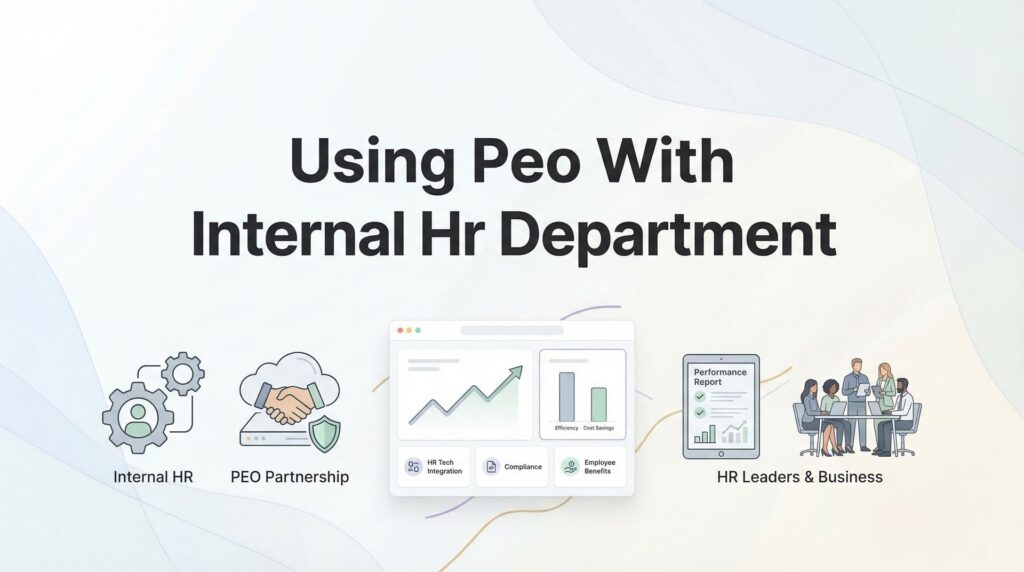
Most business owners assume it’s either/or—you either outsource HR to a PEO or you keep your internal HR team. But that’s not how it works in practice. Plenty of companies run a hybrid model where a PEO handles the compliance-heavy, transactional stuff (payroll, benefits administration, workers’ comp) while internal HR focuses on what actually moves the business forward—culture, talent development, employee relations, and strategic workforce planning.
The challenge isn’t whether this model can work. It’s figuring out who owns what, how handoffs happen, and where the boundaries sit so nothing falls through the cracks and nobody steps on each other’s toes.
This guide walks you through exactly how to structure a PEO-plus-internal-HR setup, from the initial division of responsibilities through ongoing coordination. We’re not covering whether you should use a PEO at all or how to choose a provider. This is specifically for companies that have decided to keep internal HR capacity while adding PEO services—and need a clear playbook for making that arrangement actually function.
Step 1: Map Your Current HR Functions and Identify the Split
Before you can divide responsibilities with a PEO, you need a complete picture of what your internal HR team actually does. Not the job description version—the real version.
Start by creating an inventory of every HR function your team currently handles. This includes payroll processing, benefits enrollment and administration, compliance filings, new hire onboarding, performance management, employee relations issues, training and development, recruiting, offboarding and terminations, workers’ comp claims, unemployment claims, and any state or federal reporting.
Once you have the full list, categorize each function into two buckets: transactional/administrative work versus strategic/relationship-based work. Transactional tasks are repeatable, rule-based processes that don’t require deep knowledge of your company culture or long-term business goals. Strategic tasks require judgment, relationship management, and alignment with where you’re trying to take the business. Now identify which functions are eating up disproportionate time relative to their strategic value. In most companies, this is payroll processing, benefits administration outsourcing , and compliance tracking. These tasks are critical, but they don’t differentiate your company or build competitive advantage. They’re also areas where mistakes carry real financial and legal risk.
Now identify which functions are eating up disproportionate time relative to their strategic value. In most companies, this is payroll processing, benefits administration outsourcing, and compliance tracking. These tasks are critical, but they don’t differentiate your company or build competitive advantage. They’re also areas where mistakes carry real financial and legal risk.
Flag the functions where your team lacks deep expertise or where compliance exposure is highest. If your HR person is Googling state wage and hour laws or struggling to keep up with changing benefits regulations, that’s a natural PEO candidate. Not because your team is incompetent, but because PEOs employ specialists who do nothing but track regulatory changes across all 50 states.
The success indicator here is simple: you should have a clear two-column list showing what stays internal versus what could transfer to a PEO. If you’re still saying “well, we kind of share that one,” you’re not done. Get specific. The ambiguity you leave now becomes the confusion you deal with later.
Step 2: Define Ownership and Handoff Points for Each Function
Having a list of who handles what isn’t enough. You need to map the actual workflow for every function you’re splitting or transferring.
For each task, document four things: who initiates the process, who executes the work, who approves or signs off, and who troubleshoots when something goes wrong. This sounds tedious, but it’s where most hybrid models break down. Employees get stuck in limbo because nobody’s sure whose job it is to fix the problem.
Let’s use new hire onboarding as an example. Internal HR handles the offer letter, initial culture orientation, and manager introductions. The PEO handles I-9 verification, benefits enrollment paperwork, tax withholding forms, and payroll system setup. But who makes sure the new employee actually completes all the PEO paperwork before their first day? Who follows up if they don’t? Who answers questions about the health insurance options? Get specific about these handoff moments.
Identify every “shared” function where both parties touch the process and map the exact handoff moment. For employee terminations, maybe internal HR handles the termination meeting and exit interview, but the PEO processes final paycheck calculations, COBRA notifications, and unemployment claim responses. Where does one end and the other begin?
Document escalation paths clearly. When does an issue move from the PEO back to internal HR? If an employee has a benefits question that touches on a company policy decision—like whether a domestic partner qualifies for coverage—that’s an internal HR call, not a PEO call. But if it’s about whether a specific medical procedure is covered under the plan, that goes to the PEO’s benefits team.
The common pitfall is assuming the PEO will “just handle it” without specifying what “it” includes. PEOs are good at what they do, but they can’t read your mind. If you want them to handle unemployment claims, say so explicitly. If you want to stay involved in workers’ comp case management, put that in writing. Understanding exactly what your PEO service agreement covers prevents gaps from forming.
Step 3: Establish Communication Protocols Between Your Team and the PEO
Even with clear ownership, things fall apart without structured communication. You need regular touchpoints and a single point of contact who owns the relationship.
Designate someone on your internal HR team as the primary PEO liaison. This person becomes the conduit for all coordination, questions, and problem-solving. They don’t have to handle everything themselves, but they own making sure nothing gets dropped. If you don’t do this, you’ll end up with multiple people on your team reaching out to different PEO reps about the same issue, creating confusion on both sides.
Set up recurring check-ins with your PEO account manager. During the first 90 days, weekly calls make sense. You’re still learning the system, catching process gaps, and adjusting workflows. After that, monthly check-ins are usually enough to review open items, upcoming needs, and any emerging issues.
Create a shared tracking system for employee requests that touch both parties. This could be as simple as a shared spreadsheet or as sophisticated as integrated ticketing software. The goal is to avoid employees getting bounced back and forth between internal HR and the PEO. When an employee submits a question, someone logs it, routes it to the right party, and tracks it to resolution. No black holes.
Define response time expectations upfront. What’s considered urgent versus routine? Who handles after-hours issues? If an employee calls the PEO on a Saturday with a payroll emergency, does the PEO handle it or route it back to your team on Monday? Know this before the emergency happens.
The success indicator: employees don’t notice the seams. They get answers without knowing or caring whether internal HR or the PEO is responding. From their perspective, it’s one seamless HR function.
Step 4: Clarify Data Access and System Integration
Data management is where hybrid models get messy fast. You need clarity on what employee data lives where and who can access what.
Determine your system of record for each type of data. Payroll data probably lives in the PEO’s system. Performance review history might live in your internal HRIS. Benefits enrollment is in the PEO system, but internal notes about accommodation requests stay with your team. Map this out explicitly so you’re not maintaining duplicate records that drift out of sync.
Establish who has read versus write access to which systems. Can your internal HR team view employee data in the PEO’s platform, or do they need to request reports? Can the PEO see performance data in your internal system? In most cases, your team should have read access to PEO systems for transparency, but write access should be limited to avoid conflicting updates. Understanding your PEO HR technology platform capabilities helps you plan these access levels.
Set up reporting workflows. What reports does internal HR need from the PEO, and how often? Headcount reports, turnover data, benefits utilization, workers’ comp claims—figure out what you need to run your business and make sure the PEO can deliver it in a usable format. Don’t wait until you need the data to discover the PEO can’t pull it the way you want it.
Address data ownership and portability upfront. What happens to your employee data if you leave the PEO? Can you export everything in a usable format, or are you locked into their system? This isn’t paranoia—it’s basic business continuity planning. Know your exit strategy before you need it.
The common pitfall is running parallel systems that slowly drift out of sync. Someone updates an address in the PEO system but forgets to update your internal HRIS. Six months later, you’re sending important documents to the wrong location. Pick a system of record for each data type and enforce it.
Step 5: Redefine Your Internal HR Team’s Role and Communicate the Change
Adding a PEO changes what your internal HR team does all day. If you don’t address this directly, you’ll create anxiety and resistance.
Be explicit with your HR team about how their role shifts. This isn’t about replacement—it’s about reallocation. They’re not losing responsibilities; they’re trading low-value administrative work for higher-impact strategic work. Frame it that way from the start.
Identify new priorities for internal HR now that transactional work is off their plate. This might include deeper focus on talent strategy, manager coaching, culture initiatives, workforce planning, employee engagement programs, or building out training and development. Give them clear direction on where to invest the time they’re getting back. Many companies find that PEO partnerships actually improve employee retention when internal HR can focus on these strategic initiatives.
Communicate to employees what goes where. Send a clear message: “For paycheck questions, contact the PEO at this number. For career development conversations, talk to internal HR.” Put this in your employee handbook, post it in your HRIS, and repeat it during onboarding. Clarity prevents frustration.
Update job descriptions and performance expectations for internal HR roles to reflect the new focus. If your HR manager’s success metrics used to include payroll accuracy and benefits enrollment completion, those need to change. Now you’re measuring things like employee engagement scores, manager satisfaction with HR support, and quality of talent development initiatives.
The success indicator: your internal HR team sees the PEO as a resource that frees them up to do more meaningful work, not as a threat to their job security. If they’re defensive or disengaged, you haven’t communicated the value clearly enough.
Step 6: Build a 90-Day Review Cadence to Catch Gaps Early
Even with perfect planning, you’ll discover gaps and friction points once you go live. The key is catching them early and adjusting quickly.
Schedule formal reviews at 30, 60, and 90 days post-implementation to assess what’s working and what’s not. Don’t skip these. The temptation after launch is to assume everything’s fine because you’re not hearing complaints. But employees often suffer in silence until frustration boils over. Following a structured PEO onboarding and implementation process helps you catch issues before they become problems.
Track specific metrics during this period. Monitor employee complaint volume about HR issues. Measure time-to-resolution for common HR requests. Track error rates in payroll and benefits administration. Compare these to your baseline before the PEO came on board. If complaints are up or resolution times are longer, something’s broken.
Gather feedback from three groups: your internal HR team, managers, and a sample of employees. Your HR team will tell you about process friction and coordination challenges. Managers will tell you whether they’re getting the support they need. Employees will tell you whether the experience feels seamless or confusing.
Identify any functions that landed in the wrong bucket and adjust ownership accordingly. Maybe you thought the PEO should handle all workers’ comp claims, but you’re discovering they don’t have enough context about your workplace to manage claims effectively. Move that back to internal HR. Or maybe you kept recruiting internal but realize the PEO’s applicant tracking system and candidate screening would save you significant time. Shift it over.
Document lessons learned and update your responsibility matrix. This isn’t a one-time exercise—it’s a living document that evolves as your business changes. When you add new HR functions or the PEO expands their service offerings, revisit the split and adjust as needed. Understanding the co-employment relationship helps you make these adjustments with clarity about legal responsibilities.
Putting It All Together
Running a PEO alongside internal HR isn’t complicated, but it does require intentional structure. The companies that make this work well treat it like any other cross-functional partnership: clear ownership, defined handoffs, regular communication, and willingness to adjust when something isn’t working.
Quick checklist before you go live: Function inventory complete with clear split. Ownership and handoff points documented for every shared process. Communication cadence established with designated contacts. Data access and system of record defined. Internal HR roles updated and communicated. 90-day review schedule locked in.
Get these pieces in place, and you’ll have a hybrid model that gives you the compliance coverage and administrative efficiency of a PEO while keeping the strategic HR capacity that actually shapes your company’s culture and talent outcomes. Your internal team focuses on building the organization you want. The PEO handles the regulatory complexity and transactional work that keeps you compliant. Everyone stays in their lane, and nothing falls through the cracks.
The coordination overhead is real, but it’s manageable if you’re deliberate about it. The alternative—trying to do everything internally or outsourcing so completely that you lose institutional knowledge and cultural continuity—creates different problems that are often more expensive to solve.
Before you sign that PEO renewal, make sure you’re not leaving money on the table. Many businesses unknowingly overpay because of bundled fees, hidden administrative markups, and contracts designed to limit flexibility. We give you a clear, side-by-side breakdown of pricing, services, and contract terms—so you can see exactly what you’re paying for and choose the option that truly fits your business. Don’t auto-renew. Make an informed, confident decision.
