
Technology companies face a benefits puzzle that most PEO providers aren’t built to solve. You’re competing for engineers and product managers against companies with deep pockets, equity packages, and premium health plans — but you may be running a 20-person team without the HR infrastructure to negotiate any of that on your own.
A PEO (Professional Employer Organization) co-employs your workforce, pooling your headcount with thousands of other businesses to unlock Fortune 500-caliber benefits that would otherwise be out of reach. The catch: not every PEO understands tech. Some were built around industries with heavy workers’ comp exposure. Others lack the integrations and flexibility that tech teams expect.
This list focuses on PEO providers and comparison tools that genuinely fit technology companies — from seed-stage startups to scaling SaaS firms to mid-market companies with distributed engineers across multiple states. We evaluated each option based on benefits quality, tech-industry fit, platform experience, and pricing transparency.
1. PEO Metrics
Best for: Tech companies that want unbiased, side-by-side PEO comparisons before committing to a provider
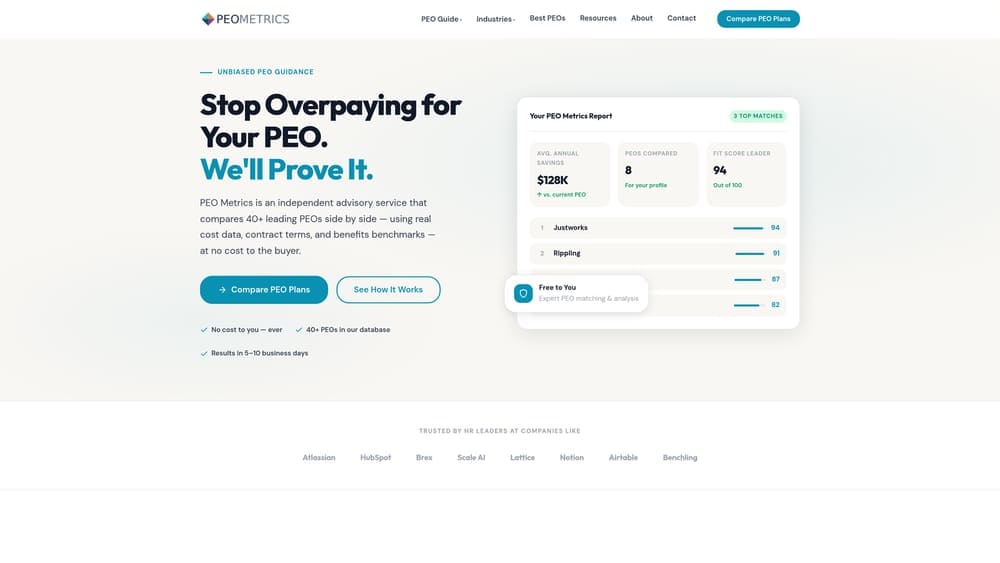
PEO Metrics is an independent PEO comparison platform that helps businesses evaluate multiple providers simultaneously — without the sales pressure of going directly to each vendor.
Where This Tool Shines
Most businesses approach PEO selection by talking to three or four vendors, sitting through demos, and comparing proposals that aren’t structured the same way. It’s nearly impossible to do an apples-to-apples comparison when every provider packages and prices things differently. PEO Metrics solves that by standardizing the comparison layer.
For tech companies specifically, this matters because the wrong PEO can cost you in two directions: overpaying on fees, or getting pooled with industries that inflate your benefits costs without any corresponding gain. Having an unbiased third party that understands those tradeoffs — and isn’t incentivized to push one provider over another — is genuinely useful before you sign a multi-year contract.
Key Features
Side-by-Side Provider Comparisons: Detailed benefits breakdowns across multiple PEOs so you can evaluate quality, not just price.
Pricing Transparency Analysis: Identifies hidden administrative markups and bundled fees that inflate total cost of ownership.
Industry-Specific Filtering: Helps tech companies find PEOs with real experience serving software, SaaS, and engineering-heavy workforces.
Unbiased Recommendations: Not affiliated with any single PEO provider, which means the guidance isn’t shaped by referral fees or preferred partnerships.
Best For
Tech companies that are evaluating a PEO for the first time, switching providers, or approaching a renewal and want to make sure they’re not overpaying. Particularly valuable for HR leaders who don’t have time to manage a full RFP process across multiple vendors.
Pricing
Contact for pricing. The service is structured around helping clients save money on PEO contracts, so the value proposition is tied to cost avoidance rather than an upfront fee.
2. Justworks
Best for: Startups and small tech companies that want transparent pricing and a modern platform experience
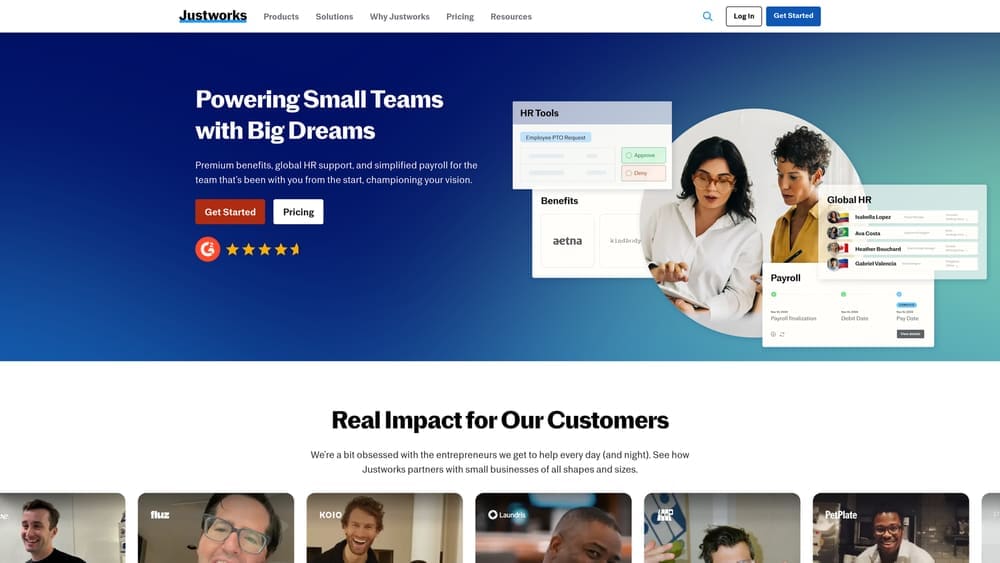
Justworks is a PEO built for small businesses and startups, with flat-rate pricing and a clean interface that tech founders actually enjoy using.
Where This Tool Shines
Justworks made its name by doing something unusual in the PEO world: publishing its pricing. Most PEOs require a sales call before you can even get a ballpark number. Justworks puts its per-employee rates on its website, which immediately builds trust with the kind of operator who wants to run their own numbers before talking to a salesperson.
The platform itself is polished in a way that resonates with tech teams. Employees can manage their own benefits, view pay stubs, and access documents without needing to call HR. That self-service layer reduces administrative friction significantly for lean teams.
Key Features
Flat Per-Employee Pricing: No hidden fees or percentage-of-payroll surprises — you know exactly what you’re paying each month.
Large-Group Health Insurance: Access to competitive medical, dental, vision, and 401(k) plans through Justworks’ pooled purchasing power.
Multi-State Compliance: Built-in tools for managing employees across different states, which is table stakes for distributed tech teams.
Developer-Friendly Platform: Modern UI with API access and integrations that fit into existing tech stacks without friction.
Commuter Benefits: Pre-tax commuter benefits included, which employees in urban markets tend to value.
Best For
Seed to Series B tech companies with 5-100 employees that want a clean, modern PEO experience without complex pricing structures. Strong fit for remote-first teams that need reliable multi-state compliance without dedicated HR staff.
Pricing
Starts at $59/employee/month (Basic plan) or $109/employee/month (Plus plan, which includes full benefits access). One of the most transparent pricing models in the PEO market.
3. Rippling PEO
Best for: Tech companies that want HR, IT, payroll, and device management unified in a single platform
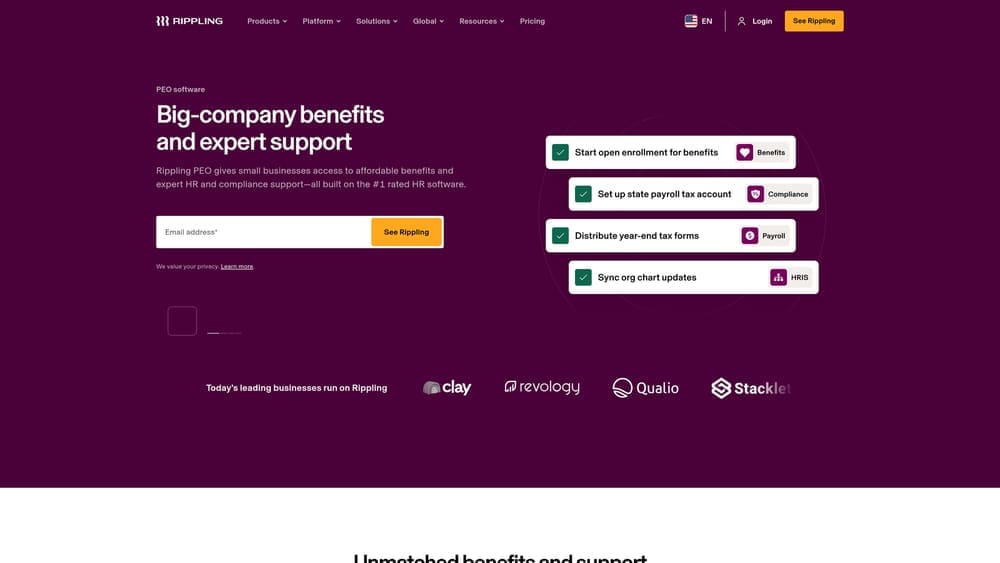
Rippling is the only major PEO that treats IT management as a core HR function, making it a natural fit for companies where device provisioning and software access are real operational concerns.
Where This Tool Shines
Most PEOs stop at payroll and benefits. Rippling goes further by connecting HR workflows to IT infrastructure. When you onboard a new engineer, Rippling can automatically provision their laptop, set up their software licenses, and enroll them in benefits — all from one place. When someone leaves, offboarding works the same way in reverse. For tech companies, that kind of automation has real operational value.
The integration ecosystem is also unusually deep. Rippling connects to hundreds of third-party tools, which matters when your team is already running on a specific HRIS, equity management platform, or project management stack and you don’t want to rip everything out to adopt a PEO.
Key Features
Unified IT + HR Platform: Manage devices, app access, payroll, and benefits from a single system of record.
Automated Onboarding/Offboarding: Workflows that trigger across HR and IT simultaneously, reducing manual steps and security gaps.
Deep Integration Ecosystem: Connects with hundreds of third-party applications including equity platforms, project management tools, and productivity suites.
PEO and EOR Options: Supports both domestic co-employment and international employer-of-record arrangements, useful for tech companies hiring globally.
Best For
Tech companies with 10-500 employees that already run on a complex software stack and want their HR infrastructure to match. Especially strong for companies with distributed teams, frequent hiring cycles, and IT management needs.
Pricing
Custom pricing; the base platform typically starts around $35/employee/month, with PEO pricing varying based on headcount and services. Expect a sales conversation before getting specific numbers.
4. TriNet
Best for: Tech companies that want industry-specific HR expertise and premium benefits designed for talent competition
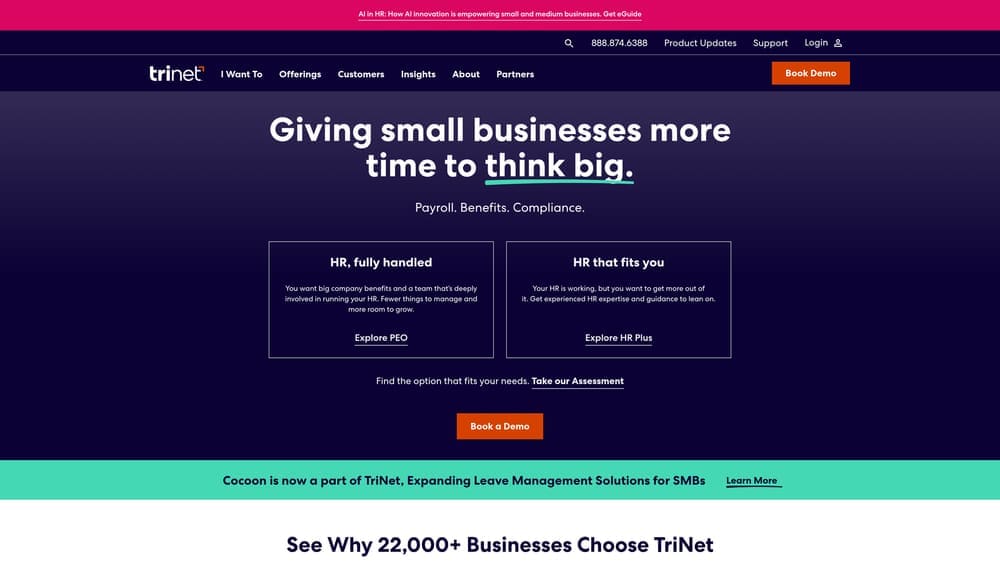
TriNet operates industry-specific service clusters, including a dedicated technology vertical with benefits packages and HR guidance tailored to what tech talent actually expects.
Where This Tool Shines
TriNet’s technology cluster is one of the more thoughtful differentiators in the PEO space. Rather than offering generic small-business benefits, they’ve built packages with tech recruiting in mind — which means access to premium medical carriers, mental health programs, and benefits that can compete with what larger tech companies offer. That matters when you’re trying to hire engineers who have options.
The strategic HR consulting component is also worth noting. TriNet assigns HR professionals with tech-industry backgrounds, not generalists who rotate across industries. If you’re navigating equity compensation questions, remote work policies, or multi-state compliance for a distributed engineering team, having an advisor who understands that context is genuinely useful.
Key Features
Technology Industry Cluster: Benefits and HR services designed specifically for tech companies competing for skilled talent.
Premium Medical Plans: Access to major carrier plans with competitive coverage levels that hold up against larger employer offerings.
Employment Practices Liability Coverage: Risk mitigation tools that matter as tech companies scale and take on more employment complexity.
Industry-Specific HR Consulting: Advisors with tech-sector experience rather than generalist HR backgrounds.
Best For
Growth-stage and mid-market tech companies with 20-300 employees that are actively competing for engineering talent and need benefits quality, not just administrative convenience. Strong fit for companies where talent retention is a measurable business priority.
Pricing
Custom quote based on headcount and services selected. TriNet typically uses a percentage-of-payroll pricing model, so costs scale with compensation levels — worth modeling carefully for companies with high average salaries.
5. Insperity
Best for: Tech companies moving past the startup phase that need structured HR advisory alongside benefits administration
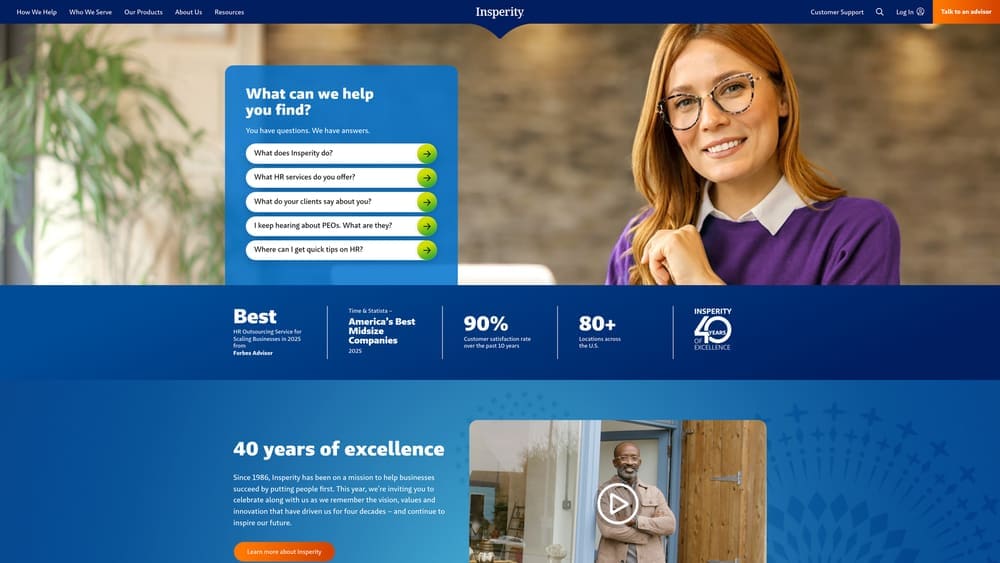
Insperity is a full-service PEO that pairs comprehensive benefits administration with strategic HR advisory — useful for tech companies that have outgrown founder-led HR but aren’t ready to build a full internal function.
Where This Tool Shines
Insperity’s differentiation is the HR Business Performance Advisor model. You get a dedicated HR professional assigned to your account who goes beyond processing payroll and answering compliance questions. They can help with workforce planning, performance management frameworks, and organizational structure decisions — the kind of strategic support that matters when you’re scaling from 30 to 100 employees and things start breaking.
The benefits package is comprehensive: health, dental, vision, life, disability, and 401(k) are all included, with access to plans that reflect Insperity’s substantial purchasing scale. For tech companies that want to offer a complete benefits suite without piecing it together from multiple vendors, Insperity handles that consolidation.
Key Features
Dedicated HR Business Performance Advisor: A named HR professional assigned to your account for strategic support, not just transactional service.
Comprehensive Benefits Suite: Health, dental, vision, life, disability, and 401(k) managed through a single provider relationship.
Performance Management Tools: Built-in support for employee reviews, goal tracking, and development planning.
Workforce Optimization Support: Organizational planning assistance for companies navigating rapid headcount growth.
Best For
Tech companies in the 30-300 employee range that are scaling quickly and need HR advisory support alongside benefits infrastructure. Less suited for very early-stage startups that don’t yet need the strategic layer.
Pricing
Custom pricing; Insperity generally works with companies between 5-5,000 employees. Expect pricing to reflect the higher-touch service model compared to self-serve PEO platforms.
6. ADP TotalSource
Best for: Mid-market tech companies that want Fortune 500-caliber benefits and deep compliance infrastructure
ADP TotalSource is ADP’s PEO offering, leveraging the company’s massive scale to deliver enterprise-grade benefits and compliance support to mid-market businesses.
Where This Tool Shines
ADP’s core advantage is purchasing scale. The company manages payroll for a significant portion of the U.S. workforce, and that scale translates directly into benefits buying power. Tech companies using TotalSource get access to health plans that are typically reserved for large enterprises — which can be a meaningful recruiting advantage when you’re competing against companies with 10x your headcount.
The compliance infrastructure is also unusually robust. For tech companies with employees in many states, ADP’s depth on multi-state tax filing, ACA compliance, and regulatory changes across jurisdictions is hard to match. This is particularly relevant for distributed engineering teams where someone is always moving or being hired in a new state.
Key Features
Fortune 500-Level Benefits Access: ADP’s purchasing scale unlocks health and benefits plans typically unavailable to smaller employers.
All-50-States Compliance Support: Deep regulatory infrastructure for companies with employees distributed across multiple jurisdictions.
ADP Workforce Now Integration: Unified platform for payroll, time tracking, and HR management that many mid-market companies already use.
Dedicated HR Business Partner: Named HR and benefits specialist support rather than a generic service queue.
Best For
Mid-market tech companies with 50-500 employees that need enterprise-grade compliance and benefits quality, and that may already be in the ADP ecosystem from earlier-stage payroll use.
Pricing
Custom quote required; ADP TotalSource typically uses percentage-of-payroll pricing for mid-market clients. Budget accordingly if your team carries high average salaries.
7. Paychex PEO
Best for: Tech companies that want to start with payroll and layer in full PEO services as they scale
Paychex PEO offers a modular approach that lets companies start where they are and add co-employment benefits structuring when the timing is right.
Where This Tool Shines
The modular service model is genuinely useful for early-stage tech companies that aren’t ready for full PEO co-employment but want to grow into it without switching vendors. You can start with payroll processing, add HR support, and eventually move into full benefits co-employment — all within the same platform relationship. That continuity reduces the friction of migrating employee records and payroll history.
Paychex also offers multiple carrier options for health benefits rather than a single-carrier arrangement, which gives employers more flexibility to match coverage to what their specific workforce values. For tech teams with varied demographics and benefit preferences, that optionality matters.
Key Features
Modular Service Model: Start with payroll and add PEO services incrementally as your company’s needs evolve.
Multiple Health Carrier Options: Choose from several carriers rather than being locked into a single plan design.
Dedicated Payroll and HR Specialist: Named support contact rather than rotating service representatives.
Compliance Coverage: Includes ACA, COBRA, and multi-state tax filing support as part of the service.
Best For
Early to mid-stage tech companies that are already using Paychex for payroll and want a low-friction path to full PEO services. Also a reasonable fit for companies that want more carrier flexibility than single-source PEOs typically offer.
Pricing
Custom pricing; the modular structure means costs scale with the services you actually use, which can be more economical at earlier stages than full-service PEO pricing.
8. CoAdvantage
Best for: Mid-market tech companies with specific or non-standard benefits requirements that need plan customization
CoAdvantage is a mid-market PEO with a reputation for greater willingness to customize benefits plan designs rather than forcing clients into rigid pre-built packages.
Where This Tool Shines
Most PEOs operate on a take-it-or-leave-it benefits model. Their purchasing power comes from standardization, so customization is limited. CoAdvantage takes a different approach, particularly for mid-market clients in the 50-500 employee range. If you want to incorporate fertility coverage, mental health programs, student loan assistance, or professional development stipends into your benefits package — the kind of benefits that matter in tech recruiting — CoAdvantage has more flexibility to build that in.
The dedicated account management model also reflects a more consultative relationship than you typically get from larger PEOs. For tech companies that have specific workforce demographics or unusual benefits preferences, having an account team willing to work through plan design rather than just process enrollment is a meaningful differentiator.
Key Features
Customizable Benefits Plan Design: Flexibility to structure benefits packages around your specific workforce needs rather than defaulting to standard offerings.
Mid-Market Focus: Optimized for companies in the 50-500 employee range, where larger PEOs often underserve and smaller ones lack scale.
Dedicated Account Management: Named account team with ongoing relationship rather than transactional service interactions.
Specialty Benefits Flexibility: Ability to incorporate fertility coverage, mental health programs, and non-traditional benefits that tech talent increasingly expects.
Best For
Mid-market tech companies with 50-500 employees that have specific benefits requirements not easily met by standardized PEO packages. Strong fit for companies where benefits differentiation is part of the recruiting strategy.
Pricing
Custom quote based on headcount and benefits plan design. Expect pricing to reflect the additional customization work compared to off-the-shelf PEO arrangements.
How to Choose a PEO for Your Technology Company
Choosing a PEO for a technology company is a different exercise than choosing one for a law firm or a restaurant. The factors that matter most — benefits competitiveness, platform integrations, multi-state compliance for distributed teams, and pricing transparency — are specific to how tech companies operate and hire.
Benefits Quality Is a Recruiting Tool, Not a Cost Center
Tech companies compete for talent against organizations that can offer rich benefits packages, equity upside, and career development. A PEO that gives you access to Fortune 500-level health plans, mental health programs, and 401(k) matching isn’t just checking an HR box — it’s a legitimate recruiting advantage. When evaluating providers, compare not just the monthly fee but the quality and breadth of the health carriers they offer. A cheaper PEO with a thin benefits network can cost you more in recruiting friction than a slightly pricier provider with premium plan options.
Integration With Your Tech Stack
Most tech companies already run on a specific combination of HRIS, equity management, project management, and identity provider tools. A PEO that doesn’t integrate with your existing stack creates manual reconciliation work that eats into the administrative savings it was supposed to deliver. Before signing, ask specifically which tools each provider integrates with natively — not just “we have an API” but actual named integrations. Rippling is the standout here, but TriNet and Justworks also offer meaningful integration libraries for tech-stack-heavy organizations.
Multi-State Compliance for Distributed Teams
Remote-first and hybrid engineering teams create compliance obligations across multiple state jurisdictions — income tax nexus, paid leave laws, state unemployment insurance, workers’ comp registration. A PEO that handles one or two states well but struggles at the margins can leave you with exposure you didn’t know you had. Specifically ask how each provider handles new-state registration when you hire your first employee in a state where you have no prior presence. The answer reveals more about operational depth than any sales deck.
Pricing Model Fit for High-Salary Workforces
Percentage-of-payroll pricing models can be expensive for technology companies because software engineers, product managers, and data scientists command salaries well above the cross-industry average. On a payroll-percentage model, a 40-person SaaS company with $150K average salaries will pay materially more than a 40-person retail company with $45K average salaries — even if the services are identical. For tech companies with competitive compensation, flat per-employee-per-month pricing (like Justworks offers) often produces significantly lower total annual cost. Model both options against your actual payroll before assuming one is cheaper.
Questions to Ask Every PEO You Evaluate
- How do you handle new-state employee registrations, and what’s the turnaround time?
- What health carriers and plan types do you offer in our primary locations?
- Which HRIS, equity, and payroll tools do you integrate with natively?
- Is your pricing per-employee-per-month or percentage-of-payroll, and can we model both?
- Do you have an industry-specific service team for technology clients?
- What are the contract length and early termination terms?
The providers that can answer these questions fluently — with specifics, not generalities — are the ones that have actually worked with technology companies before. The ones that pivot to marketing language are telling you something just as informative.
Choosing the Right Fit for Your Stage and Size
The right PEO for a 12-person seed-stage startup looks very different from the right PEO for a 200-person SaaS company with engineers in eight states. Stage, headcount, benefits complexity, and how much HR infrastructure you already have all shape the decision.
If you’re early-stage and want transparent pricing without a sales process, Justworks is the most accessible starting point. If platform integration and IT management matter as much as benefits, Rippling is worth serious consideration. For mid-market companies that need enterprise-grade benefits and compliance depth, ADP TotalSource and TriNet are the more natural fits — with TriNet offering more tech-specific HR expertise and ADP bringing broader regulatory infrastructure.
Companies with specific or non-standard benefits requirements — fertility coverage, mental health programs, professional development stipends — should look closely at CoAdvantage, which offers more plan design flexibility than most PEOs in its tier. And if you’re scaling past the startup phase and need strategic HR advisory alongside benefits administration, Insperity’s model is worth evaluating.
One thing worth emphasizing regardless of which provider you’re considering: the PEO industry is not always transparent about how benefits pooling works. Some PEOs pool tech companies with higher-risk industries, which can inflate your costs without any corresponding benefit. It’s a question worth asking directly before you sign.
Before you finalize any decision — whether it’s your first PEO contract or a renewal — make sure you’re comparing providers on equal footing. Most businesses end up overpaying because proposals aren’t structured the same way and bundled fees are hard to decode without a reference point.
Don’t auto-renew. Make an informed, confident decision. A clear, side-by-side breakdown of pricing, services, and contract terms lets you see exactly what you’re paying for — and whether there’s a better option for where your company is headed.
