
Tree service businesses carry a workers’ comp burden that most industries never have to think about. Aerial work classifications, NCCI code 0106 arborist designations, seasonal crew churn, and storm-response crews crossing state lines — it adds up to a genuinely complicated HR and payroll situation. The wrong setup doesn’t just cost you admin headaches; it can mean overpaying on workers’ comp premiums by a significant margin, missing multi-state tax obligations, or leaving your team without benefits that help you retain skilled climbers.
The core decision most tree service owners face is whether to go with a full PEO co-employment model or a standalone payroll platform. Both have real merit depending on your crew size, risk profile, and growth stage. Below are the solutions worth evaluating — built for the actual realities of tree care, not generic office-job HR software with a green logo.
1. PEO Metrics
Best for: Tree service owners who want to compare multiple PEO providers before committing to one.
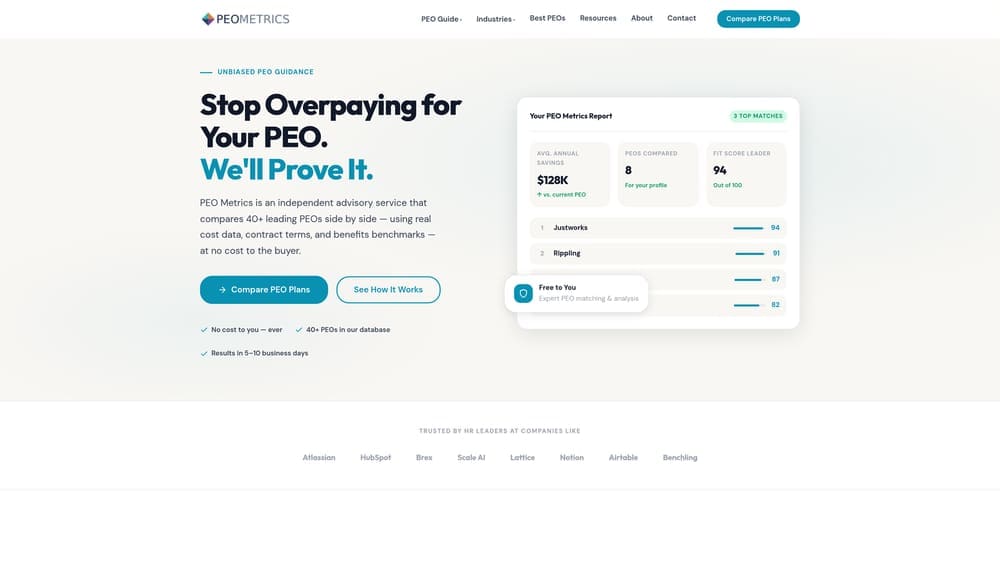
PEO Metrics is an independent PEO comparison platform that helps business owners evaluate multiple providers side-by-side before signing anything.
Where This Tool Shines
Most tree service owners evaluate PEOs the same way they’d buy a truck — they talk to one dealer, get one quote, and sign. The problem is that PEO pricing and coverage vary significantly across providers, especially for high-risk classifications like arborist work. PEO Metrics exists specifically to fix that information gap.
Rather than being tied to any single PEO, the platform gives you a structured, apples-to-apples view of what different providers are actually offering — including how they handle workers’ comp for high-risk codes, what their administrative fees look like, and what’s buried in the contract. For tree service companies where workers’ comp is often the single largest HR cost, this kind of upfront visibility matters a lot.
Key Features
Side-by-Side PEO Comparisons: Compare multiple providers across pricing, service scope, and contract terms in a single view rather than juggling separate sales conversations.
Pricing Transparency: See actual cost breakdowns across providers, including administrative fees and workers’ comp handling — not just top-line quotes.
High-Risk Industry Filters: Filter for PEOs that actually accept arborist and tree service classifications, which not all providers will.
No-Commitment Process: You’re not locked into any provider through the platform — it’s a comparison tool, not a referral funnel with a financial stake in your decision.
Best For
Tree service companies at any stage who are evaluating PEOs for the first time, switching providers, or approaching a contract renewal and want to know whether they’re getting a fair deal. Particularly useful if you’ve been with the same PEO for years and haven’t benchmarked pricing recently.
Pricing
Free comparison service. Contact PEO Metrics directly for details on how the process works for your specific situation.
2. Oasis (Paychex PEO)
Best for: Tree service companies that want bundled payroll, HR, and workers’ comp under one PEO with strong industry risk appetite.
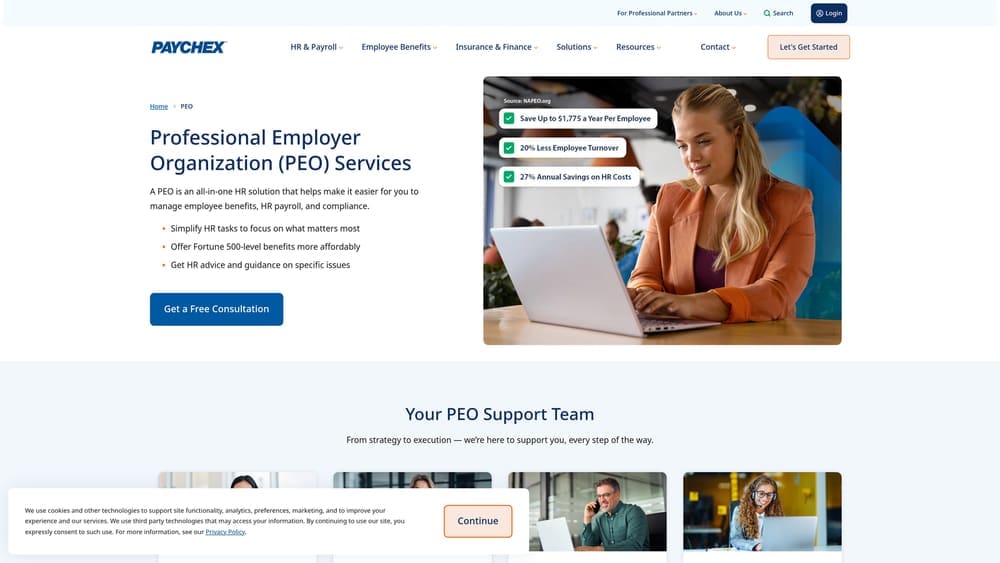
Oasis, a Paychex company, is a full-service PEO that combines the scale of one of the country’s largest payroll providers with a co-employment model designed for small and mid-size businesses.
Where This Tool Shines
Paychex’s scale gives Oasis real negotiating power on workers’ comp master policies. For a tree service company with high-risk NCCI classifications, being placed under a master policy rather than shopping the individual market can meaningfully affect your premium — though results vary by location and risk history. The pay-as-you-go workers’ comp billing is particularly useful for seasonal operations where payroll fluctuates significantly spring through fall.
The dedicated HR professional assigned to your account is a genuine differentiator for small tree service operators who don’t have in-house HR. You get someone who knows your account rather than a generic support queue.
Key Features
Master Workers’ Comp Policies: Access to group workers’ comp coverage that can offer better rates than what a small tree service company could secure independently.
Pay-As-You-Go Workers’ Comp Billing: Premiums calculated on actual payroll each period rather than estimated upfront — helpful for seasonal crew fluctuations.
Dedicated HR Professional: A named HR contact assigned to your account for compliance questions, employee relations, and policy guidance.
Integrated Payroll and Benefits: Payroll processing, tax filing, and benefits administration run through a single platform.
Best For
Tree service companies with 10 to 50 employees that want a single vendor handling payroll, workers’ comp, and HR compliance. Strong fit for owners who want expert support without building an internal HR function.
Pricing
Custom pricing based on headcount and risk profile, quoted per employee per month. Request a direct quote — pricing varies significantly by industry classification and state.
3. Insperity
Best for: Tree service companies prioritizing competitive employee benefits to attract and retain skilled climbers and crew leads.
Insperity is a premium full-service PEO known for providing small and mid-size businesses access to large-group health insurance and benefit plans that would otherwise be out of reach.
Where This Tool Shines
Retaining experienced arborists and crew leads is genuinely hard in this industry. Insperity’s strength is the benefits package it can put in front of your employees — large-group health insurance rates, 401(k) with matching options, and supplemental coverage that competes with what larger employers offer. If you’re losing skilled workers to bigger landscaping companies or municipal tree crews, benefits access is often the real gap.
The compliance support is also solid. Insperity provides HR guidance that covers everything from offer letters to termination documentation, which matters for tree service companies navigating seasonal hire and fire cycles where mishandled separations can create liability.
Key Features
Large-Group Health Insurance Access: Benefits typically only available to companies with hundreds of employees, extended to small tree service businesses through the PEO co-employment structure.
401(k) Retirement Plans: Employer matching options that help differentiate your compensation package in a competitive labor market.
HR Compliance Guidance: Ongoing support for employment law compliance, policy documentation, and employee relations.
Performance and Development Tools: Employee performance tracking and development resources for companies investing in crew retention.
Best For
Tree service companies focused on workforce retention and willing to invest in a premium HR infrastructure. Best fit for businesses with 15 or more employees where benefits competitiveness is a real recruiting challenge.
Pricing
Custom pricing — Insperity is generally positioned at the higher end of the PEO market. Factor that into your comparison against what you’d spend on benefits procurement separately.
4. TriNet
Best for: Tree service companies running crews across multiple states who need consistent compliance coverage everywhere they operate.
TriNet is a full-service PEO with strong multi-state compliance infrastructure and industry-vertical HR expertise built into its service model.
Where This Tool Shines
Storm damage response is a real operational reality for tree service companies. When a major weather event hits two states over, you may send crews there for weeks. That creates temporary multi-state payroll obligations, tax withholding requirements, and workers’ comp coverage questions that most payroll-only platforms aren’t equipped to handle cleanly. TriNet’s multi-state compliance infrastructure is designed for exactly this kind of operational footprint.
The real-time compliance alerts are useful for companies that don’t have someone monitoring state-level employment law changes. Tree service businesses operating across state lines can face different requirements for wage and hour rules, workers’ comp coverage, and paid leave — TriNet surfaces those changes rather than leaving you to discover them after the fact.
Key Features
Multi-State Payroll Tax Compliance: Automated filing and withholding across all states where your crews work, including temporary deployments.
Industry-Tailored HR Teams: Vertical-specific HR expertise rather than generic generalist support.
Real-Time Compliance Alerts: Notifications when relevant state regulations change, reducing the risk of unknowing violations.
Integrated Risk Management: Benefits, payroll, and risk tools in a unified platform.
Best For
Tree service companies with consistent multi-state operations or those that frequently respond to storm work across state lines. Also a strong fit for companies that have experienced compliance surprises in the past and want proactive monitoring.
Pricing
Custom pricing based on company size, industry, and state footprint. Request a quote directly — multi-state complexity typically affects pricing.
5. Gusto
Best for: Small tree service crews under 10 employees who need clean payroll processing without the cost or commitment of a full PEO.
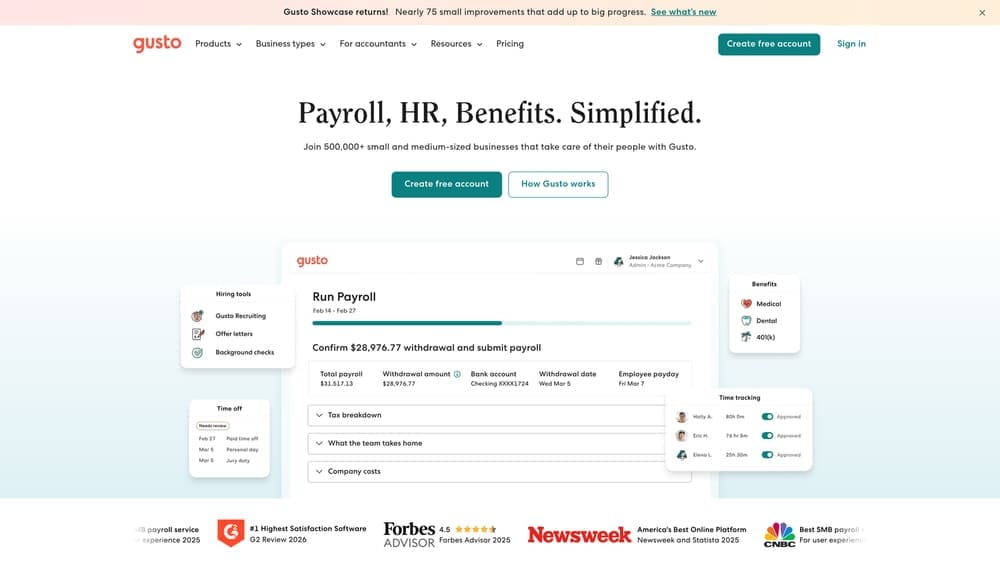
Gusto is a modern payroll platform built for small businesses, offering straightforward W-2 and 1099 payroll processing without co-employment.
Where This Tool Shines
Gusto is honest about what it is: a payroll platform, not a PEO. For a tree service company with a small, stable crew and a handle on its own workers’ comp and compliance, that’s often enough. The interface is genuinely easy to use, and the automated tax filing across all 50 states covers the basics for companies with limited multi-state exposure.
The 1099 contractor payment handling is worth noting specifically for tree service. Many operations use subcontractors for specialty work or peak season overflow. Gusto handles mixed W-2 and 1099 payroll in one place, which reduces administrative friction — though it doesn’t help with the misclassification risk that comes with heavy contractor use.
Key Features
W-2 and 1099 Payroll: Pay both employees and contractors through a single platform with automated tax handling.
Automated Tax Filing: Federal, state, and local tax filing handled automatically across all 50 states.
Basic Benefits Administration: Health, dental, and vision brokerage for companies that want to offer benefits without a PEO structure.
Employee Self-Service Portal: Onboarding, document storage, and pay stub access for employees without requiring HR staff involvement.
Best For
Tree service companies with fewer than 10 employees, straightforward payroll needs, and an existing workers’ comp policy. Not the right fit if you’re scaling quickly, operating across multiple states regularly, or need help managing OSHA compliance and benefits.
Pricing
Starts at $40/month base plus $6/month per person on the Simple plan. Higher tiers available with additional HR features.
6. ADP TotalSource
Best for: Larger tree service operations that need enterprise-grade HR infrastructure and serious workers’ comp negotiating power.
ADP TotalSource is ADP’s full-service PEO offering, combining deep HR infrastructure with the scale of one of the largest payroll and HR companies in the country.
Where This Tool Shines
ADP’s size translates directly into workers’ comp leverage. For tree service companies with larger crews in high-risk classifications, access to ADP’s master workers’ comp policies can be a meaningful cost factor. The safety consultants included in the TotalSource model are particularly relevant here — OSHA exposure in tree work is real, and having documented safety programs and professional guidance on compliance reduces both incident risk and potential penalty exposure.
The HRIS reporting and analytics capabilities are more sophisticated than what most smaller PEOs offer. For companies managing 25 or more employees across multiple crews and locations, labor cost visibility and workforce analytics start to matter operationally, not just administratively.
Key Features
Master Workers’ Comp Policies: Large-scale group coverage with competitive rates for high-risk classifications including arborist and tree service work.
Safety Consultants: Dedicated safety professionals who can help document OSHA-compliant programs and reduce incident exposure.
Full-Suite HRIS: Reporting, analytics, and workforce management tools with depth suited to larger operations.
Legal Compliance Support: OSHA, DOL, and employment law guidance integrated into the service model.
Best For
Tree service companies with 20 or more employees, complex multi-crew operations, or a history of workers’ comp challenges. The OSHA safety support alone makes TotalSource worth evaluating for any high-risk operation that’s had incidents or citations.
Pricing
Custom pricing — generally requires a minimum of 5 to 10 employees. Contact ADP directly for a quote based on your headcount and risk profile.
7. Paylocity
Best for: Tree service companies that need serious workforce scheduling and time tracking alongside payroll, without moving to a co-employment model.
Paylocity is a cloud-based payroll and workforce management platform with built-in scheduling, time tracking, and labor analytics designed for companies managing variable workforces.
Where This Tool Shines
Seasonal crew management is where Paylocity earns its place on this list. Tree service demand fluctuates significantly across the year, and managing crew schedules, tracking field hours accurately, and onboarding seasonal workers efficiently are operational challenges that a basic payroll platform doesn’t solve well. Paylocity’s scheduling and time tracking tools are genuinely integrated into the payroll workflow — not bolted on as an afterthought.
The mobile app for field crew time entry is practical for tree service operations where crews aren’t sitting at a desk. Workers can clock in and out from job sites, managers can approve time remotely, and that data flows directly into payroll without manual re-entry.
Key Features
Workforce Scheduling and Time Tracking: Built-in scheduling tools that integrate directly with payroll, reducing manual reconciliation for variable crew hours.
Multi-State Payroll Tax Support: Tax filing and withholding handled across states for companies with broader geographic reach.
Labor Cost Analytics: Reporting tools that give visibility into crew labor costs by job, crew, or time period.
Mobile Field Access: Employee-facing mobile app for time entry, scheduling, and self-service — functional for crews working remote job sites.
Best For
Mid-size tree service companies in the 20 to 75 employee range that need more operational workforce management than a basic payroll platform offers, but aren’t ready for or don’t need the co-employment structure of a full PEO. Also a good fit for companies that already have workers’ comp and benefits handled and just need stronger payroll and scheduling infrastructure.
Pricing
Custom pricing — generally competitive for mid-size companies. Contact Paylocity for a quote based on your headcount and module needs.
Making the Right Call for Your Crew
The honest answer is that the right choice depends on where your business actually sits right now — not where you plan to be in three years.
If you’re running a small crew under 10 people with stable payroll and an existing workers’ comp policy, a straightforward payroll platform like Gusto or Paylocity gets the job done without overcomplicating things. You’re paying for what you actually need.
Once you cross 15 to 20 employees, the math starts to shift. Seasonal onboarding and offboarding, multi-state crew deployments, OSHA documentation requirements, and benefits administration start consuming real time and creating real liability. That’s where a PEO co-employment model earns its cost. Oasis and ADP TotalSource both bring serious workers’ comp leverage for high-risk classifications — a genuine differentiator for tree service companies where arborist codes carry elevated premiums. Insperity is worth a look if retaining skilled climbers is your primary challenge and benefits competitiveness is the gap. TriNet stands out specifically for companies with consistent multi-state operations or storm-response work that regularly crosses state lines.
The catch with PEOs is that pricing and workers’ comp appetite vary significantly by provider. Not every PEO will even take on arborist classifications. And if you’ve been with the same PEO for years without benchmarking, there’s a reasonable chance you’re overpaying.
That’s exactly what PEO Metrics is built to address. Before you sign that PEO renewal, make sure you’re not leaving money on the table. Don’t auto-renew. Make an informed, confident decision.
