
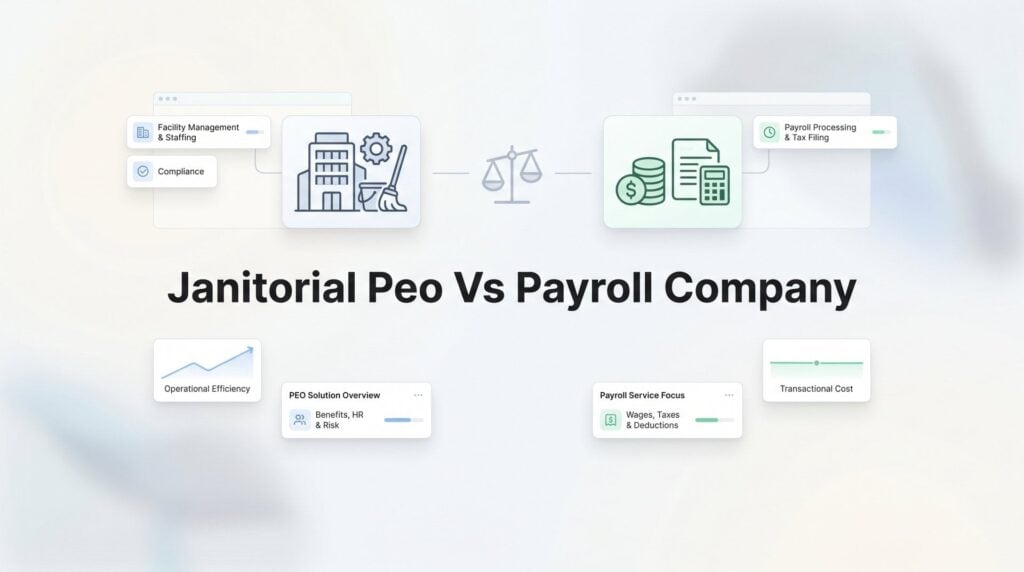
If you run a janitorial business, you’ve probably hit the point where managing payroll, workers’ comp, and HR compliance starts eating into the time you need to actually run crews and land contracts. The real question isn’t just which provider to pick. It’s whether you need a full PEO co-employment arrangement or a standalone payroll company.
The answer depends on your headcount, your workers’ comp exposure, how many job sites you manage, and whether you’re drowning in HR admin or just need someone to cut checks on time. Janitorial work sits in a high-risk workers’ comp classification, involves constant employee turnover, and often spans multiple locations and tax jurisdictions. Those factors matter a lot when you’re comparing provider types.
This list covers both PEOs and payroll providers that work well for cleaning businesses, with honest notes on where each one fits and where it doesn’t. Both models are represented so you can compare them side by side and figure out which path makes sense for your operation.
1. PEO Metrics
Best for: Janitorial business owners who want to compare PEO providers before committing to a contract
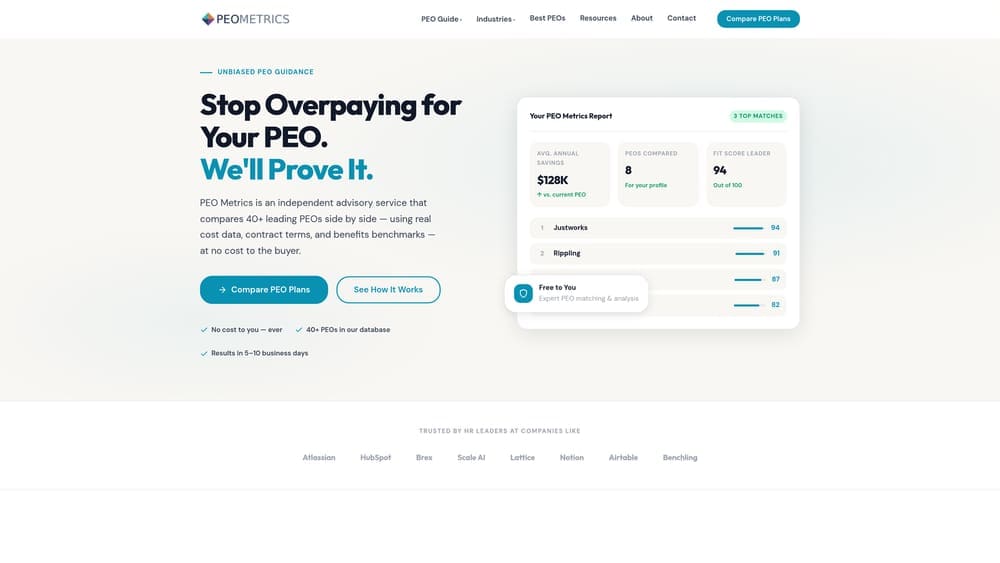
PEO Metrics is an unbiased PEO comparison service that helps business owners evaluate providers on pricing, workers’ comp programs, and service fit without having to talk to a dozen sales reps first.
Where This Tool Shines
Most janitorial business owners evaluating PEOs are going in blind. Each provider quotes differently, bundles services in different ways, and uses contract language that makes apples-to-apples comparison nearly impossible. PEO Metrics cuts through that by giving you structured, side-by-side data before you’re in a sales cycle.
For cleaning companies specifically, the workers’ comp analysis is where this tool earns its keep. Workers’ comp costs can vary significantly across PEOs depending on their pooled programs, experience modification factors, and carrier relationships. Knowing where those differences are before you sign saves real money.
Key Features
Side-by-Side Provider Comparisons: Real pricing data across multiple PEOs in a structured format, so you’re not piecing together quotes manually.
Workers’ Comp Program Analysis: Evaluates how different PEOs structure their workers’ comp pooling, which matters a lot in high-risk cleaning classifications.
Unbiased Guidance: Not affiliated with any single PEO provider, so the analysis isn’t shaped by referral commissions or preferred partnerships.
PEO vs. Payroll Fit Assessment: Helps you determine whether co-employment actually makes sense for your business size and risk profile before you invest time evaluating PEOs at all.
Best For
Janitorial companies with five or more employees that are actively evaluating PEOs, or businesses currently in a PEO contract that suspect they’re overpaying. Also useful for operators who aren’t sure yet whether a PEO or a standalone payroll company is the right model for their situation.
Pricing
Free comparison service for businesses evaluating PEO providers. No cost to use the comparison tools or get guidance.
2. Oasis (Paychex PEO)
Best for: Mid-size janitorial companies that want full PEO services backed by a large, established provider
Oasis is Paychex’s PEO offering, combining payroll, HR, benefits administration, and workers’ comp under one co-employment arrangement with the infrastructure of a major national provider behind it.
Where This Tool Shines
Oasis works well for cleaning companies that have grown past the point where a basic payroll tool handles everything, but aren’t large enough to negotiate their own insurance rates or hire dedicated HR staff. The bundled workers’ comp program is a real advantage for janitorial businesses in higher-risk classifications, since pooled rates through a PEO can undercut what you’d pay on the open market.
The Paychex infrastructure also means robust payroll processing across multiple states, which matters if your crews cross state lines or you’re managing contracts in different jurisdictions.
Key Features
Bundled Workers’ Comp: Pooled rates through Paychex’s carrier relationships, with pay-as-you-go options that smooth out cash flow.
Dedicated HR Support: Access to HR professionals who can help with compliance, employee relations, and documentation.
Large-Group Health Benefits: Access to health, dental, and vision plans at group rates your small cleaning company couldn’t access independently.
Multi-State Payroll and Tax Filing: Handles the complexity of operating crews across different tax jurisdictions.
Best For
Janitorial companies in the 20 to 150 employee range that want a full-service PEO with strong payroll infrastructure and don’t want to manage multiple vendor relationships for HR, benefits, and workers’ comp separately.
Pricing
Custom pricing based on headcount and services selected. Typically quoted on a per-employee-per-month basis. Expect a sales conversation before you get real numbers.
3. TriNet
Best for: Smaller janitorial companies that want access to enterprise-level benefits through industry-specific pooling
TriNet is a PEO that organizes clients into industry verticals for benefits pooling, which can give smaller cleaning businesses access to health and retirement plan options they’d never get on their own.
Where This Tool Shines
TriNet’s industry clustering model means your benefits pool is made up of companies with similar workforce profiles, which can result in more stable rates over time. For a janitorial company trying to offer competitive benefits to retain supervisors and long-term crew leads, this matters more than most operators realize.
The cloud-based HR platform is solid, and the dedicated account team model means you’re not starting from scratch every time you call in. That said, TriNet tends to be priced at the higher end of the PEO market, so the value equation depends on how much you’re actually using the benefits and HR services.
Key Features
Industry-Specific Benefits Clusters: Benefits pooling organized by industry type for more relevant rate groupings.
Workers’ Comp and Risk Management: PEO-level workers’ comp coverage with risk mitigation support.
Cloud-Based HR Platform: Compliance tools, document management, and employee self-service in one system.
Dedicated Account Team: Named contacts rather than a generic support queue.
Best For
Smaller janitorial companies, typically under 50 employees, where the primary driver is benefits access and HR compliance support rather than complex payroll needs. Less ideal if cost is the primary concern.
Pricing
Custom per-employee pricing. Generally sits in the mid-to-premium range among PEOs. Request a quote directly, and compare it carefully against other PEO options before committing.
4. Justworks
Best for: Smaller janitorial businesses that want PEO co-employment with transparent, predictable pricing
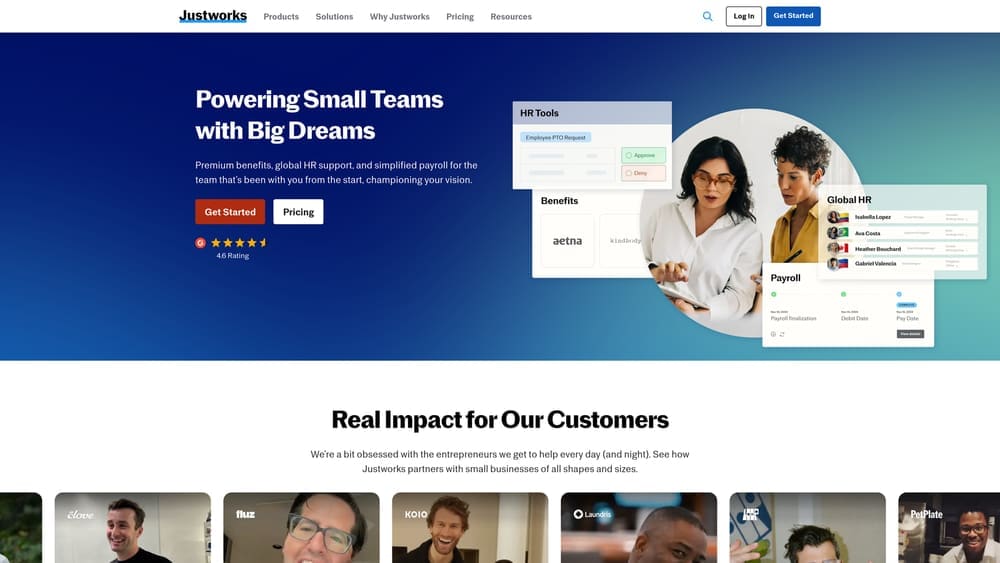
Justworks is a streamlined PEO with flat-rate, published pricing, which is unusual in a market where most PEOs require a sales call just to get a ballpark number.
Where This Tool Shines
Transparency is Justworks’ strongest differentiator. You can see pricing tiers on their website without filling out a lead form, which makes early-stage budgeting much easier. For a cleaning company owner who wants to understand what co-employment actually costs before investing time in demos, that’s genuinely useful.
The platform is clean and easy to navigate, which matters when you’re onboarding and offboarding employees frequently, as most janitorial companies are. The compliance tools handle state tax registration and basic HR documentation without requiring HR expertise on your end.
Key Features
Flat Per-Employee Pricing: Published rates with no hidden fees, making cost comparisons straightforward.
Large-Group Health Benefits: Access to health, dental, and vision coverage at group rates through the PEO co-employment model.
Built-In Compliance Tools: State tax registration, compliance alerts, and HR documentation support.
Simple Onboarding Interface: Designed for ease of use, which reduces administrative burden during high-turnover periods.
Best For
Janitorial companies with roughly 5 to 50 employees that want co-employment benefits without navigating complex contract structures. Works best when the workforce is primarily W-2 employees in one or two states.
Pricing
Starts at $59 per employee per month for the Basic plan. A PEO Plus tier is available at higher pricing. One of the few PEOs with publicly listed rates.
5. Gusto
Best for: Small janitorial businesses that need solid payroll automation without co-employment complexity
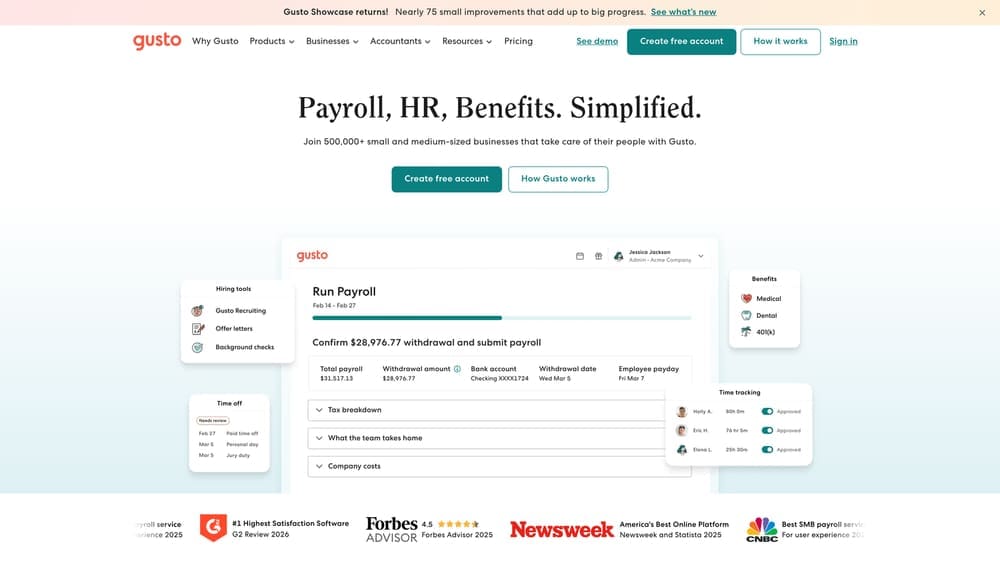
Gusto is a payroll-first platform with optional HR features, built for small businesses that want automated pay processing and tax filing without entering a co-employment arrangement.
Where This Tool Shines
Gusto handles the payroll basics well: automated runs, direct deposit, W-2s, and state and federal tax filing. For a small cleaning operation with a stable crew and clean safety records, that’s often all you actually need. The interface is intuitive enough that a non-HR person can manage it without much of a learning curve.
The time tracking integrations are worth noting for janitorial businesses specifically. Shift-based crews need reliable time capture, and Gusto connects with several third-party time tracking tools that work for mobile, dispersed workforces.
Key Features
Automated Payroll with Tax Filing: Handles federal, state, and local tax filings automatically each pay period.
Employee Self-Service Portal: Employees can access pay stubs, W-2s, and onboarding documents without calling you.
Time Tracking Integrations: Connects with tools that support shift-based and mobile workforces.
Optional Benefits Brokerage: Health benefits available, but not pooled PEO rates, so pricing reflects your company’s individual risk profile.
Best For
Small janitorial businesses with under 20 employees, straightforward workers’ comp situations, and no need for PEO-level benefits pooling or HR compliance support. Not the right fit if workers’ comp costs are a significant pain point.
Pricing
Starts at $40 per month base plus $6 per employee per month on the Simple tier. Higher tiers available with additional HR features.
6. ADP Run / ADP TotalSource
Best for: Janitorial companies that want flexibility to start with payroll and scale into a full PEO within one vendor ecosystem
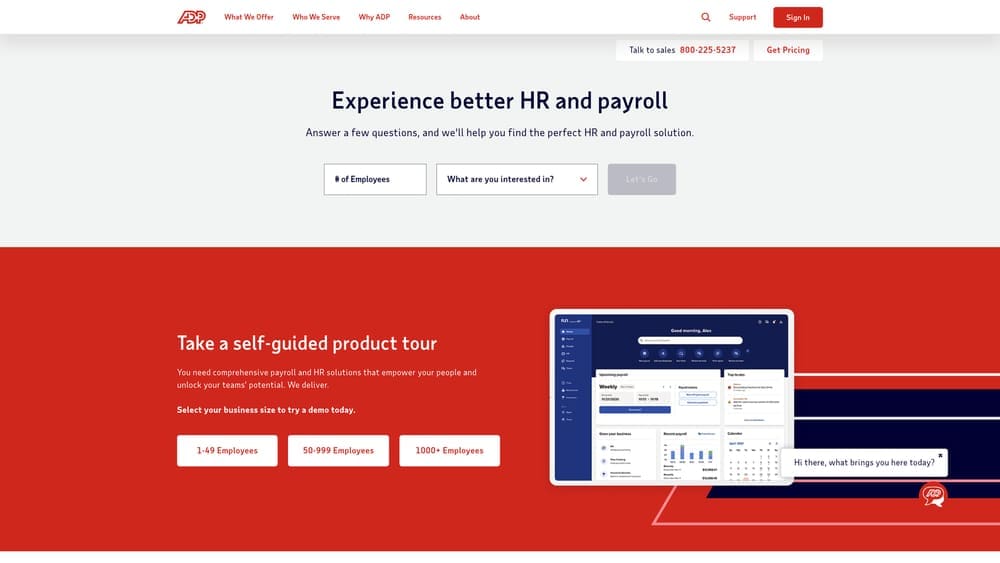
ADP offers both a standalone payroll product (ADP Run) and a full PEO (TotalSource), which gives cleaning businesses a path to upgrade their HR infrastructure without switching vendors as they grow.
Where This Tool Shines
The dual-product structure is genuinely useful for janitorial companies at an inflection point. If you’re currently running 10 employees with basic payroll needs but expect to grow to 40 or 50 employees over the next couple of years, starting with ADP Run and transitioning to TotalSource later keeps your data and processes intact. That’s a real operational advantage.
ADP’s scale also means broad workers’ comp carrier relationships, which matters when TotalSource is evaluating pooled rates. Larger PEOs generally have more leverage with carriers, and ADP is one of the largest PEOs in the country.
Key Features
Dual-Product Flexibility: ADP Run for payroll-only; TotalSource for full PEO co-employment, both within the same vendor ecosystem.
Multi-State Payroll and Tax Compliance: Handles complex multi-jurisdiction payroll well, relevant for janitorial companies with contracts across state lines.
Workers’ Comp Carrier Relationships: Broad carrier access through TotalSource’s PEO pooling program.
Scalable Infrastructure: Built to handle growth without requiring a platform migration.
Best For
Janitorial companies that are growing and want to avoid switching vendors as their HR needs evolve. Also a strong fit for multi-state operations where payroll complexity is already a challenge.
Pricing
ADP Run pricing is custom and generally mid-range for payroll-only services. TotalSource PEO pricing is also custom, quoted per employee per month. Expect a sales process before you get real numbers.
7. Paychex Flex
Best for: Janitorial companies running multi-site operations across different tax jurisdictions who need payroll, not co-employment
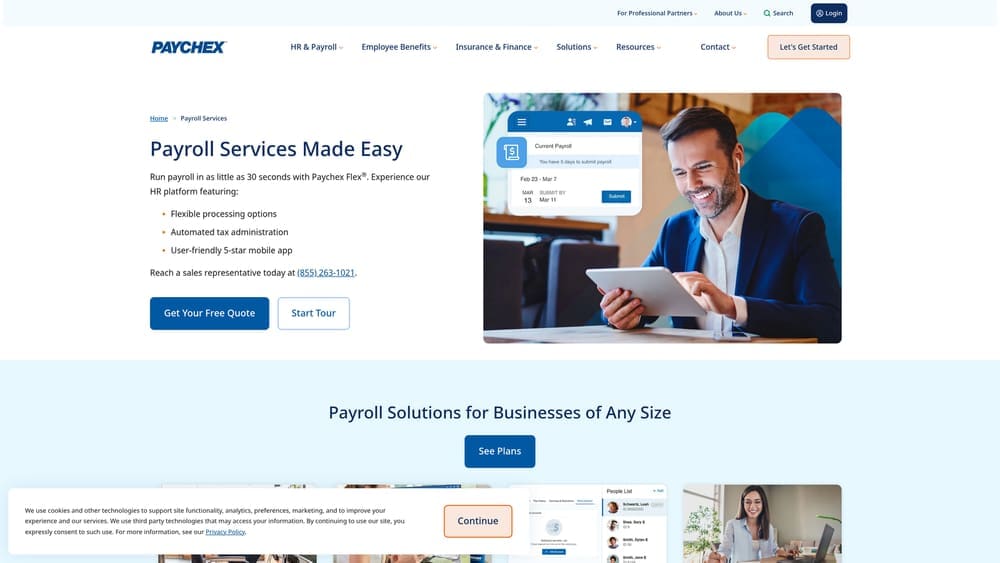
Paychex Flex is Paychex’s standalone payroll platform, separate from their Oasis PEO product, and it’s built to handle the kind of multi-location payroll complexity that janitorial companies often deal with.
Where This Tool Shines
Jurisdiction-specific tax handling is where Paychex Flex earns its place on this list. If you’re managing cleaning contracts in multiple cities or states, each with different local tax rules, having a payroll system that handles that automatically is worth a lot. Paychex has been doing multi-state payroll for a long time and the infrastructure reflects that experience.
The pay-as-you-go workers’ comp option is also worth flagging. It’s not PEO-pooled workers’ comp, so you won’t get group rates, but it does smooth out cash flow by tying premium payments to actual payroll rather than requiring large upfront deposits. For a janitorial company with seasonal fluctuations in crew size, that’s a practical benefit.
Key Features
Multi-Location Payroll: Handles jurisdiction-specific tax rules across multiple sites and states.
Time and Attendance Add-Ons: Optional modules for tracking shift-based crews across locations.
Pay-As-You-Go Workers’ Comp: Standalone option that ties premium payments to payroll cycles rather than requiring large deposits.
Mobile App: Allows payroll approvals and management from the field, useful for operators who aren’t desk-bound.
Best For
Mid-size janitorial companies running crews across multiple locations or states that need payroll only, not co-employment. Particularly useful when workers’ comp is manageable independently but payroll complexity is the primary pain point.
Pricing
Custom pricing. Typically starts around $39 per month plus per-employee fees, though actual quotes vary based on headcount and features selected.
8. SurePayroll
Best for: Very small janitorial businesses or solo operators who need basic payroll processing at a low cost
SurePayroll is a budget-friendly payroll service designed for small businesses that need straightforward pay processing and tax filing without the overhead of a full-service platform.
Where This Tool Shines
SurePayroll keeps things simple. If you’re running a small residential cleaning operation with a handful of W-2 employees and your primary need is getting people paid accurately and on time with taxes handled automatically, this does the job without overcomplicating it. The interface is minimal by design, which is either a feature or a limitation depending on what you need.
The nanny and household payroll option is a niche but relevant feature for residential cleaning operators who work in a household employer context. It’s designed for exactly that scenario and handles the specific tax requirements that come with it.
Key Features
Low-Cost Payroll Processing: Automatic tax filing included at a price point accessible for very small operations.
Two-Day and Next-Day Direct Deposit: Flexible deposit timing options for different payroll schedules.
Simple Interface: Minimal learning curve, designed for business owners who aren’t payroll specialists.
Household Payroll Option: Useful for residential cleaning operators working in a household employer context.
Best For
Solo operators or very small janitorial businesses with under 10 employees that need basic payroll and tax filing without HR features, benefits, or workers’ comp support. Not the right fit if you’re managing multiple sites, multiple states, or significant workers’ comp exposure.
Pricing
Starts at $19.99 per month plus $4 per employee per month. One of the most affordable payroll options on this list for very small teams.
Picking the Right Fit for Your Cleaning Business
The honest answer is that the PEO vs. payroll company decision for janitorial businesses usually comes down to two things: workers’ comp costs and how much HR complexity you’re actually managing.
If your workers’ comp premiums are a significant expense, your experience modification rate is elevated, or you’re in a high-risk classification code, a PEO’s pooled workers’ comp program is often the most compelling reason to go the co-employment route. That’s where Oasis, TriNet, Justworks, or ADP TotalSource deserve a serious look. The benefits access is a secondary win, especially if you’re trying to retain experienced crew leads and supervisors.
If you’re a smaller operation with a clean safety record and your main need is getting people paid accurately across multiple locations, a standalone payroll platform is simpler, cheaper, and doesn’t require you to enter a co-employment relationship. Gusto works well for straightforward small-team payroll. Paychex Flex handles multi-site complexity better. SurePayroll is the right call if budget is the primary driver and your operation is small.
One thing that trips up a lot of janitorial business owners: assuming the PEO they’re currently using is the best deal available. PEO contracts are not all priced the same, and bundled fees can obscure where the real costs are. Before you renew anything, it’s worth running a comparison.
Don’t auto-renew. Make an informed, confident decision. A side-by-side breakdown of pricing, services, and contract terms across multiple PEOs takes the guesswork out of the evaluation and makes sure you’re not leaving money on the table before you sign another year.
